
AI has exposed a fundamental rupture in how enterprises run cloud: it can no longer be treated as infrastructure or plumbing. The operating models built around PMO oversight, migration waves, and infrastructure-first governance are breaking under the weight of AI, regulatory pressure, and sustainability requirements. To build AI systems they can trust, CIOs must run cloud services as software that is versioned, automated, and continuously modernized. Enterprises that fail to make this shift will not scale AI, but instead run into technical debt.
AI transformation dominates the headlines, but it is continuous cloud modernization (see Exhibit 1) with a multi-cloud core, not episodic migration, that determines whether AI can scale responsibly. Enterprises are expanding hybrid infrastructure, data engineering, cybersecurity, and AI-infused operations because these capabilities form the technical foundation for AI readiness. This shift in investment reflects a deeper truth: AI requires an always-modern cloud core that keeps trust, data, and speed tightly connected. Without that, AI initiatives will stall under reliability gaps, data fragmentation, and governance failures.
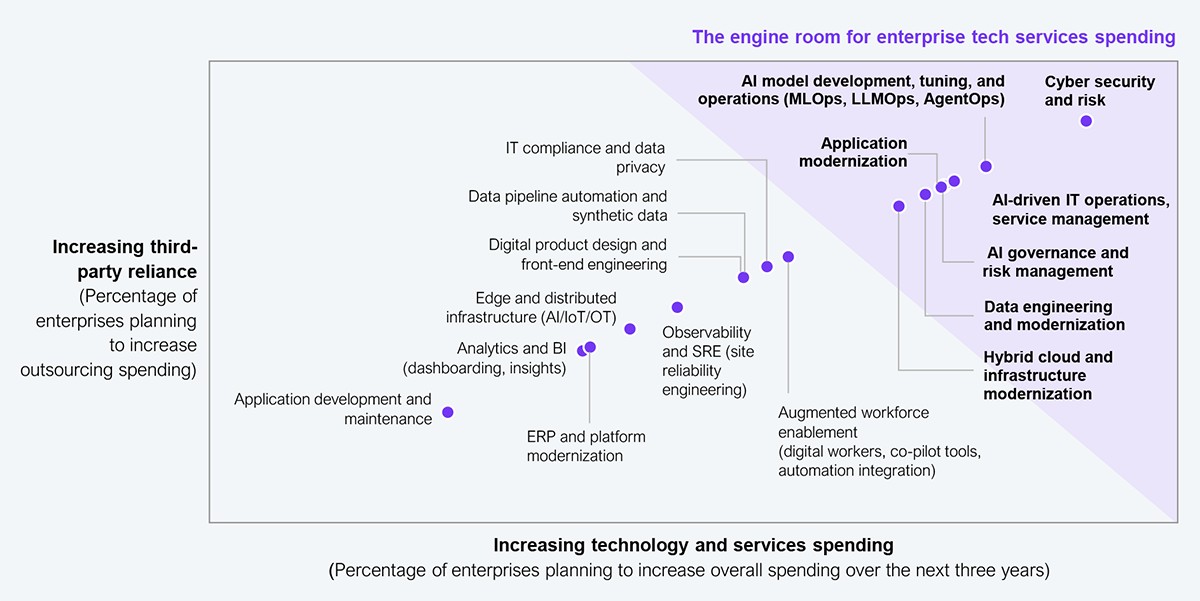
Based on inputs from 505 IT and business leaders with Global 2000 enterprises
Source: HFS Research, 2025
The first decade of cloud centered on cost and speed. The new decade demands confidence. Boards expect cloud investments to demonstrate tangible trust, resilience, sustainability, and AI performance outcomes. This shift is driving the rise of total cloud value orchestration, a management model that links cost, carbon, and confidence telemetry into a unified control plane. Supporting disciplines such as FinOps 2.0, GreenOps, and TrustOps are evolving to provide continuous measurement and optimization across financial, ESG, and engineering performance.
Without cloud confidence, AI confidence collapses. Outages become AI failures. Weak governance becomes model drift. Fragmented landing zones become compliance exposure. CIOs can no longer separate cloud strategy from AI strategy because they now share the same operating model.
Enterprises that pursue a confidence-based cloud maturity will measure their environment by the trustworthiness of data and AI governance, the resilience of primary plus multi-cloud architectures, carbon per workload, and the sovereignty of data, models, and policies.
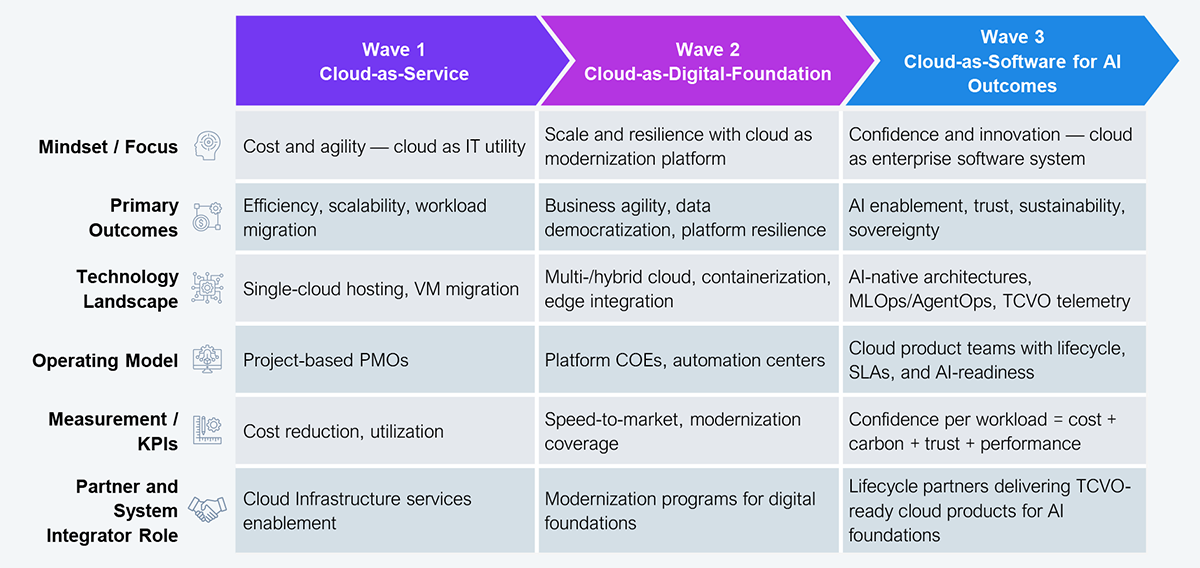
Traditional PMO structures and infrastructure-centric governance slow AI more than they support it. They are built for one-time delivery cycles and static control gates that do not match the speed or uncertainty of AI systems. Enterprises need to run cloud as software. This requires cross-functional cloud product teams that own, release, and continually upgrade internal cloud services.
In practice, a cloud services as software operating model includes the following capabilities:
In this model, architecture, data, and compliance become versioned business controls that evolve with every release. Cloud becomes the operating system for AI (see Exhibit 2).
Source: HFS Research, 2025
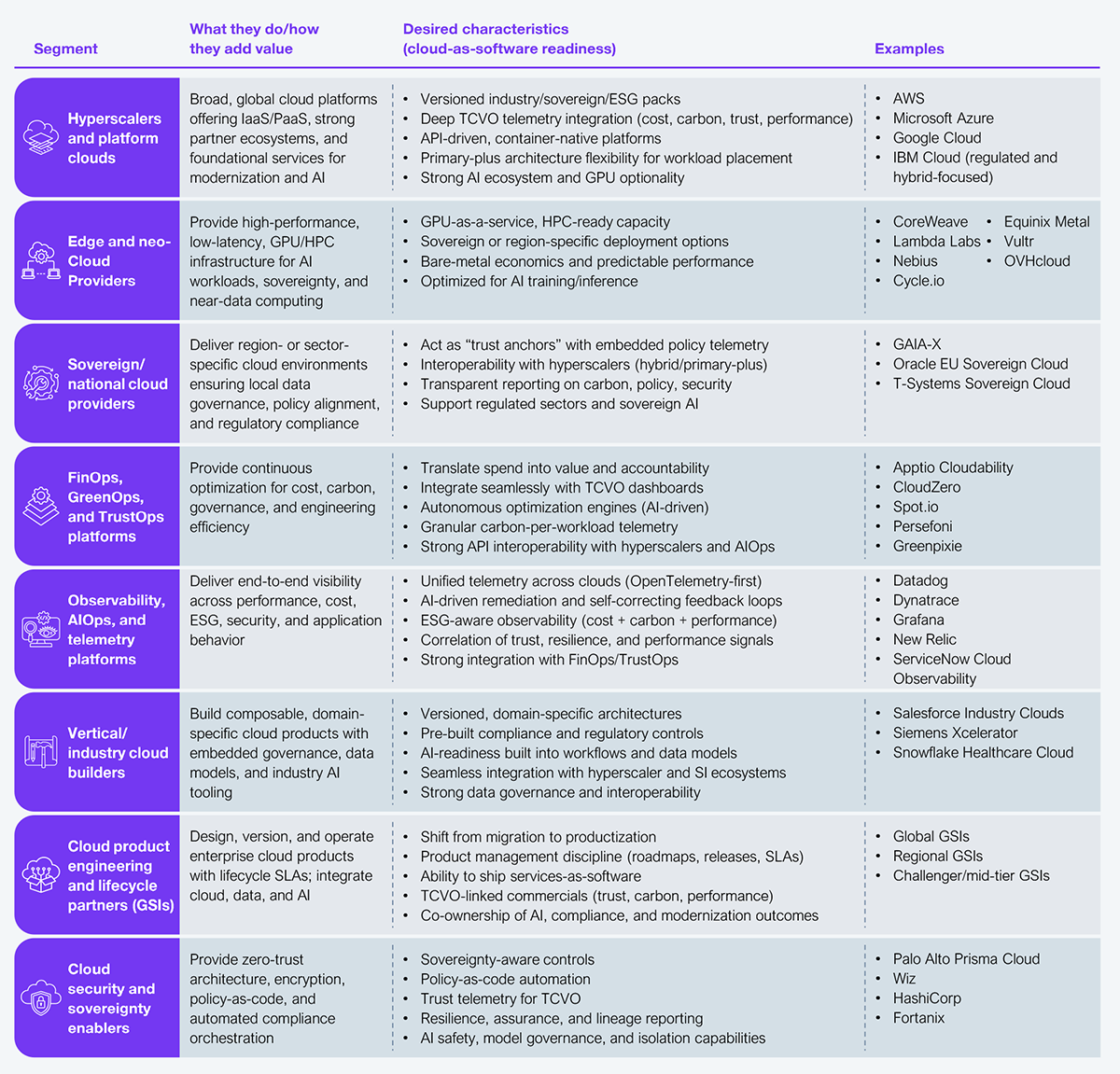
Enterprises can’t build cloud services as software alone. The operating model depends on a multi-layer ecosystem that behaves more like a coordinated software delivery system than a traditional supply chain. Hyperscalers, neo-cloud providers, sovereign cloud operators, FinOps and TrustOps platforms, AIOps and observability stacks, industry cloud builders, and lifecycle partners each play a role in transforming cloud from a utility into a versioned, governable, AI-ready software platform (Exhibit 3).
Source: HFS Research, 2025
The shift from cloud projects to cloud products isn’t a theory. It’s already visible across leading enterprises that treat cloud as a software system for innovation, compliance, and sustainability.
These examples demonstrate that cloud is no longer just an infrastructure consumption model, but a software-defined operating platform where governance, telemetry, and AI readiness determine enterprise advantage.
Scaling AI demands a reset: cloud must be run as software, not infrastructure. CIOs need to treat it as a continuously evolving product across core, edge, and AI environments—versioned, governed, observable, and always improving. Those who make this shift will start operating a living cloud system built for AI.
Register now for immediate access of HFS' research, data and forward looking trends.
Get StartedIf you don't have an account, Register here |
With the exception of our Horizons reports, most of our research is available for free on our website. Sign up for a free account and start realizing the power of insights now.
Our premium subscription gives enterprise clients access to our complete library of proprietary research, direct access to our industry analysts, and other benefits.
Contact us at [email protected] for more information on premium access.

