This HFS Challengers’ Code report is for CIOs and enterprise operations leaders evaluating AI-native service partners capable of embedding intelligence into end-to-end workflows and contracting for measurable outcomes rather than headcount.
Headcount-based service models lock enterprises into rising cost curves, and AI makes structural cost decline achievable. Most AI efforts optimize fragments of work instead of redesigning operations end to end. As AI resets delivery economics, CIOs are questioning whether traditional IT services can convert spend into measurable business performance. CIOs must codify operational knowledge using AI, embed it in workflows, and evaluate contracts and service providers to implement it as an accountable, outcome-based business transformation. This shift is creating demand for AI-native operational specialists built for declining effort and accountable outcomes. iOPEX targets business-critical domains such as service, revenue, product, and finance by running operations through an operations-as-software model.
Unlike incumbents anchored to large legacy labor bases, iOPEX is structurally aligned to reduce effort and cost every quarter, even when that compresses traditional services revenue. iOPEX is willing to trade near-term revenue protection for faster adoption of lower-cost, outcome-driven delivery. It designs engagements for AI economics from day one, targeting structural effort reduction rather than one-off automation wins.
HFS Research’s recent survey of 122 business IT leaders working with G2000 enterprises reveals that more than half are not satisfied with the outcomes delivered in core operations, given the generic and bolt-on nature of the prevailing tools.
iOPEX runs end-to-end operational domains as integrated systems, not stitched-together solutions. Instead of automating handoffs across disconnected tools, iOPEX designs an operating environment with pre-built AI agents to handle high-frequency, repeatable work, and humans govern exceptions, policy, and continuous improvement.
The model is platform-centric but platform-agnostic, optimized for environments like Salesforce and ServiceNow without forcing vendor lock-in. The iOPEX-Salesforce partnership aims to maximize CRM and agentic-AI performance for customers by transforming the platform into an AI-enabled engine for business growth. The iOPEX-ServiceNow alliance goes beyond implementation to operational ownership, automation-led cost takeout, and agentic execution across workflows in high-tech, BFSI, telecom, retail, and media domains, overcoming friction points across processes for faster resolution. iOPEX brings execution-led expertise across Snowflake, Databricks, and Reltio, transforming such data platforms into AI-driven, real-time engines for insights, automation, and measurable business outcomes. Deep expertise in these environments enables accelerated deployment, while migration accelerators and interoperability capabilities provide flexibility for enterprises seeking to avoid structural dependency on a single platform vendor.
This systems orientation reduces fragmentation, improves visibility across workflows, and creates operating environments that can adapt as business conditions evolve.
iOPEX’s operating model draws on deep domain experience, translating it into reusable frameworks, accelerators, and governance disciplines. Institutional knowledge is codified into structured playbooks and telemetry-driven management practices, using prebuilt agents specific to each operation, reducing reliance on individual expertise.
AI adoption pathways are defined pragmatically, helping enterprises transition from labor-bound models to agent-led, outcome-driven operations without destabilizing critical workflows. Governance, AI review processes, and performance monitoring are embedded to ensure explainability, control, and continuous refinement.
We don’t do tech for tech’s sake. We do it for the business, and we’re willing to guarantee the outcomes.
— Shiva Ramani, CEO of iOPEX
This perspective anchors iOPEX’s approach: technology matters only when it improves operational performance and measurable outcomes.
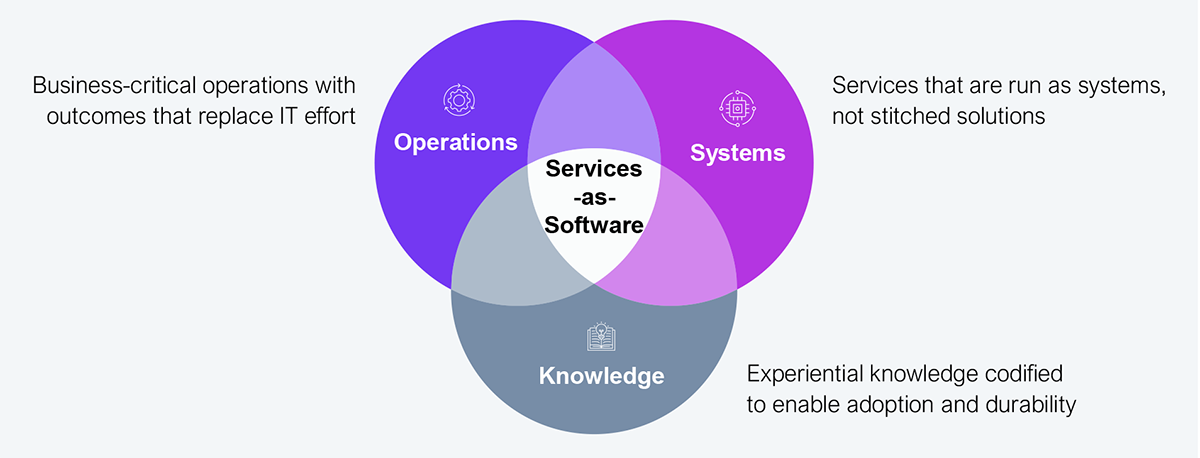
Its Services-as-Software™ (SaS) model in Exhibit 1, described as “always-on intelligence,” sits at the intersection of outcome ownership, integrated systems, and codified operational knowledge. Always-on intelligence embeds agentic AI directly within business workflows, allowing operations to run as autonomous, continuously improving systems.
ElevAIte, iOPEX’s GenAI and MLOps platform, accelerates the deployment of these capabilities across cloud and on-premises environments.
Source: iOPEX, HFS Research, 2026
Services-as-Software is emerging as a structural alternative to traditional digitization (see Exhibit 2). Instead of layering automation onto linear, labor-heavy time-and-material models, SaS converges technology, domain expertise, and AI into operating systems designed to reduce effort and cost over time while improving measurable business outcomes.
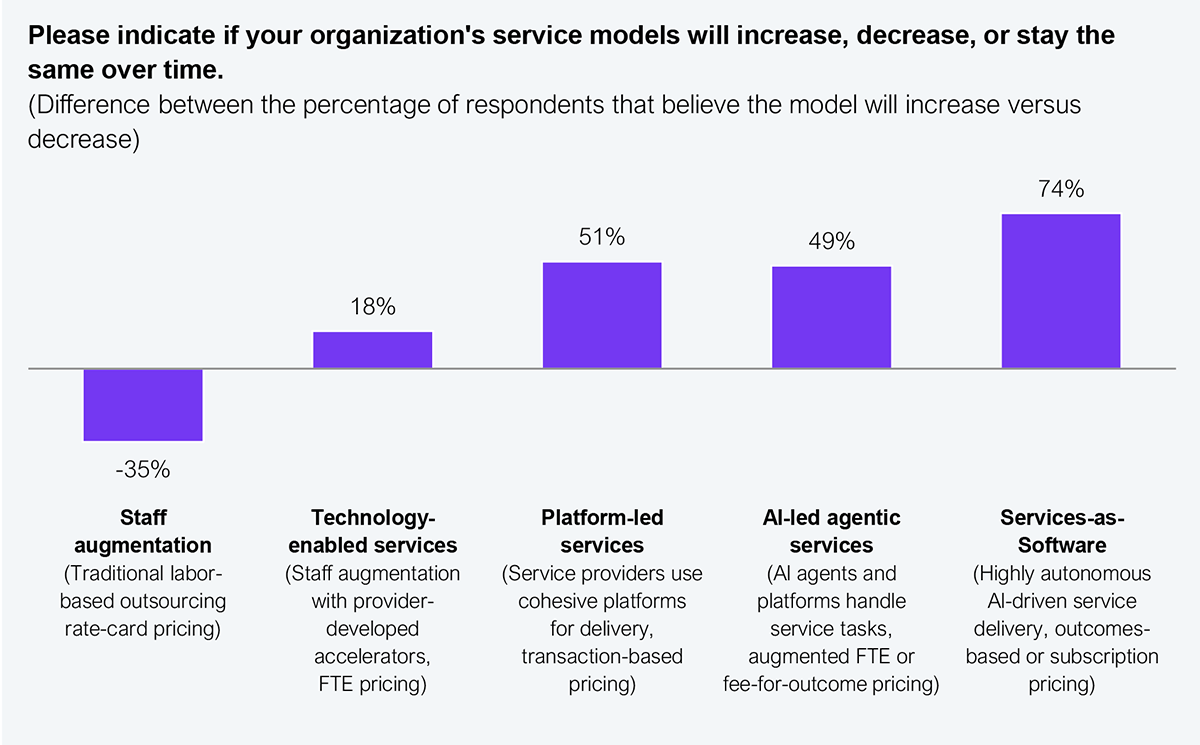
Sample: 608 IT and business leaders across Global 2000 enterprises; survey in partnership with Publicis Sapient, 2025
Source: HFS Research, 2026
The transition to SaS is not an incremental automation initiative. It represents a redesign of how operational domains are structured, governed, and priced.
Systemized delivery replaces stitched solutions. AI agents handle routine execution, and governance mechanisms ensure transparency and control. As intelligence compounds, operational effort declines relative to business growth.
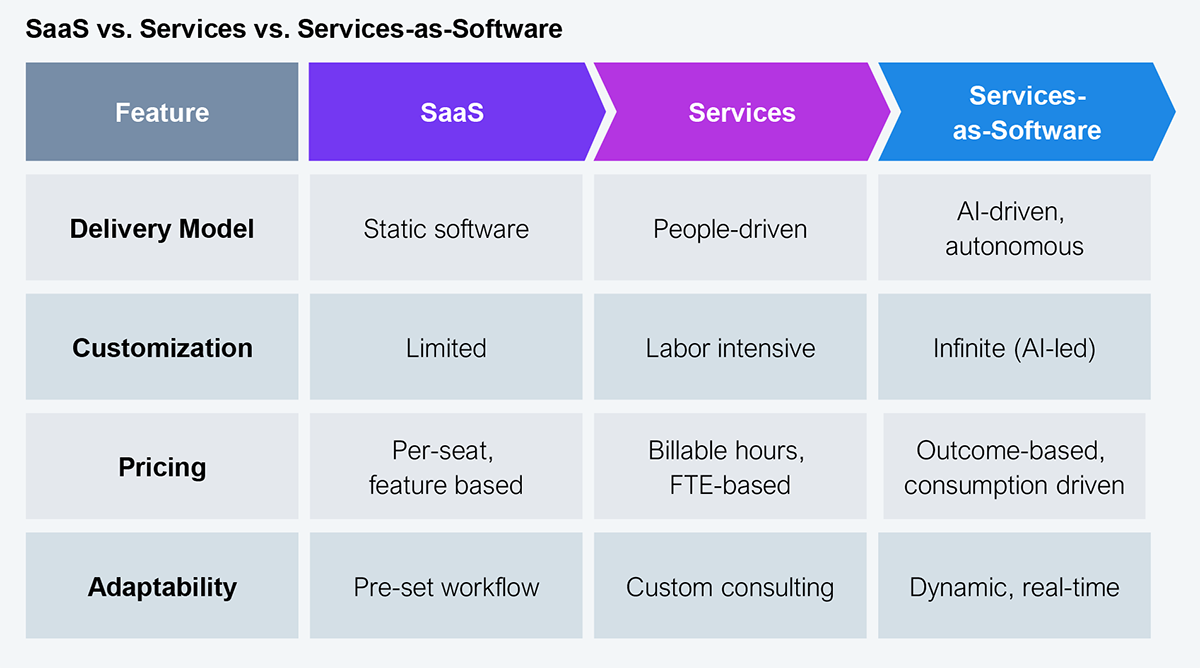
Exhibit 3 outlines the structural tenets of SaS. Business outcomes replace human effort as the unit of value. AI agents execute high-frequency, repeatable tasks with accuracy, while humans govern exceptions and drive continuous improvement. Commercial models align with measurable business outcomes, and delivery is engineered to reduce structural effort.
Source: HFS Research, 2026
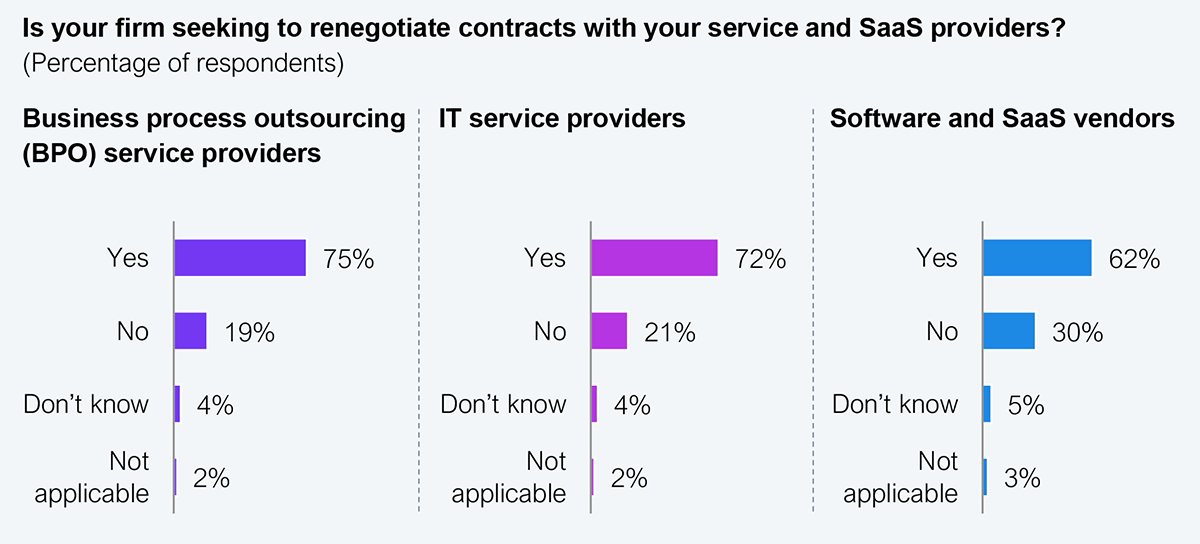
Enterprise dissatisfaction with traditional service constructs is increasingly visible in contract renegotiations and sourcing strategies. Organizations are signaling their intent to reduce dependence on human presence-based pricing models and shift toward software-led execution. Our research, shown in Exhibit 4, indicates that a significant majority of enterprises plan to replace portions of human-run services with AI-led alternatives over the next several years, 70%–75% intend to renegotiate existing service contracts, and 80% plan to replace elements of human-led services with AI-led models.
Sample: Global enterprise decision makers
Source: HFS Research, 2026
Despite clear intent, scaling AI across operational domains remains challenging. Data fragmentation, process inconsistency, cultural resistance, and commercial misalignment impede progress. Platform upgrades alone rarely resolve these structural constraints.
SaS reframes the problem. It converges platform modernization, domain redesign, AI integration, and commercial alignment into a cohesive operating model.
Two very different worlds, one based on humans and the other on technology, are blending with AI, accelerating the shift toward Services-as-Software.
— Saurabh Gupta, President of HFS Research
The competitive landscape is therefore shifting. Software vendors are embedding services. Service providers are embedding proprietary tools. A new category of domain-led operators is emerging.
Enterprises pursuing business operations transformation are seeking measurable improvements in cost efficiency, revenue performance, and resilience, or the capability to spring back from unforeseen disruption in their operations. The examples below from iOPEX customer stories illustrate how business operations-as-software translates into operational outcomes.
In a distributed field service environment, retail store device technicians navigated multiple systems to diagnose and resolve issues. iOPEX implemented an agentic orchestration layer that unified workflows and enabled natural-language access to operational data, achieving 92% accuracy in its responses. The result was a 28% reduction in weekly expert helpdesk calls and improved resolution consistency, as reported by Toshiba in a joint webinar with iOPEX.
An engineering support function previously priced on a headcount basis transitioned to a transaction-based construct supported by AI-enabled diagnostics. Per-ticket costs declined materially from approximately $440 to $175 in certain categories, while throughput improved. Savings were reinvested in further AI development.
In launching a digital advertising business, iOPEX supported operational build-out through telemetry-driven analytics and AI-enabled workflows. The operation scaled to significant revenue levels within three years while maintaining lean operating cost structures.
AI was embedded across denial prediction, payment posting validation, and collections prioritization. Reported outcomes included a 12% improvement in collection yield, a 30% reduction in denial rates, and reduced manual intervention.
Across these examples, the pattern is consistent: operational workflows are redesigned so that AI absorbs repeatable execution, humans govern exceptions, and effort declines structurally rather than incrementally.
iOPEX positions itself as a technology-enabled operating partner focused on transforming business functions, with accountability for delivering measurable outcomes. What differentiates iOPEX is not its coverage of specific departments, but its structural design. The firm enters engagements with the architectural assumption that effort and cost must decline each quarter. Commercial models, telemetry, and AI insertion points are engineered from day one to compress the cost-to-serve while protecting performance. This is not automation layered onto labor; it is labor re-engineered around software economics.
The company structures its offerings under five categories: ServiceOps, RevOps, ProductOps, FinanceOps, and MarketingOps, reflecting the business functions it seeks to transform rather than the platforms it implements.
Across these domains, engagements are structured around outcomes such as cost-to-serve, ticket economics, revenue realization, denial rates, or time-to-market new products, or cycle time. Commercial models increasingly align to transactions or performance metrics rather than headcount.
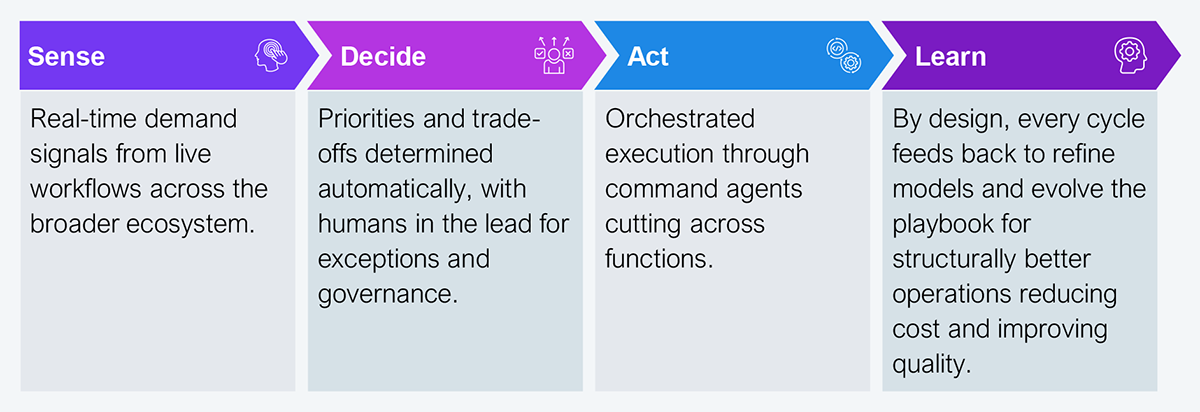
iOPEX operationalizes this model through a closed-loop operating framework built on its ElevAIte platform. The framework in Exhibit 5 combines three core components: Data Studio, Agentic Studio, and the runtime orchestration layer OrchestrAIte, to integrate telemetry, analysis, action, and learning.
Continuous telemetry captures signals across workflows, systems, and customer interactions. AI agents then prioritize and execute actions aligned to defined business metrics. Each action feeds performance data back into the system, enabling the model to continuously refine cost, quality, and cycle time.
Over time, this closed-loop design drives structural effort reduction rather than episodic automation gains.
Source: iOPEX, HFS Research, 2026
CIOs cannot evaluate and choose AI-led service providers using yesterday’s sourcing scorecards. Scale, brand, and hourly rates will not determine success in a Services-as-Software world. Structural alignment will.
AI will not reset your cost curve unless your provider’s incentives, governance, and commercial model are designed to reduce effort over time. As you reassess partnerships, apply these criteria:
Enterprises that apply these tests will distinguish between providers layering AI onto labor and those redesigning operations around software economics. That distinction will determine whether AI delivers incremental efficiency or structural advantage.
Enterprises that cling to effort-based service contracts risk digitizing inefficiency. AI will not reset the cost curve unless the commercial model, governance structure, and provider incentives evolve alongside it.
Redesign contracts around outcomes. Demand structural effort reduction. Prioritize partners capable of delivering Services-as-Software operating models, where AI execution, domain knowledge, and governance are engineered to improve performance over time. Firms such as iOPEX illustrate how this model can be operationalized in practice.
Services-as-Software is not simply a technology upgrade; it is an operating model shift. Enterprises that move decisively can translate AI investment into sustained operational advantage. Those that delay risk automating yesterday’s model.
Register now for immediate access of HFS' research, data and forward looking trends.
Get StartedIf you don't have an account, Register here |
With the exception of our Horizons reports, most of our research is available for free on our website. Sign up for a free account and start realizing the power of insights now.
Our premium subscription gives enterprise clients access to our complete library of proprietary research, direct access to our industry analysts, and other benefits.
Contact us at [email protected] for more information on premium access.