This HFS innovation case study on the Hiscox–Sutherland carrier playbook is for commercial carrier COOs and operations leaders building AI-enabled service models across broker and direct distribution channels in P&C insurance.
Hiscox, a global specialist insurer with a significant presence in London, built an early lead in US small and medium business (SMB) insurance by offering small business insurance online and over the phone in real time, in addition to its broker channel, something rare in a broker-dominated market and an edge for the carrier.
To deepen that moat, Hiscox is leveraging its 15-year partnership with Sutherland to run a two-front, AI-powered channel optimization strategy. First, it is repositioning the direct consumer channel as a real-time customer feedback engine to continuously improve the customer experience. Handling significant interaction volume, the channel is converting that activity into structured customer insight that feeds product innovation. Second, it is digitizing the broker’s end-to-end journey, redesigning the workflow into an agentic AI-enabled quote-to-bind flow built for speed, growth, and relevance.
For commercial carrier COOs building AI-enabled operations, this case is a blueprint for execution. As enterprise carrier differentiation shifts to experience, growth is fundamentally won by redesigning workflows and decision-making across distribution channels, with AI as an optimization tool.
In our conversation with Laura McCamile, Hiscox’s SVP of Operations Delivery and Strategy, she described anchoring both initiatives around one North Star: capturing the true voice of the customer to evolve Hiscox’s service model.
Too often, people start with the technology and then try to find the business need. Our strength is starting with the business need and the outcomes we want to deliver, then working through people, process, and technology, not technology first.
— Laura McCamile, SVP of Operations Delivery and Strategy, Hiscox
Historically, some carriers have leaned toward one-size-fits-all product structures, prioritizing generalization over adaptability, as shown in Exhibit 1. The result can limit differentiation and ultimately constrain carriers’ ability to keep pace with their customers’ needs.
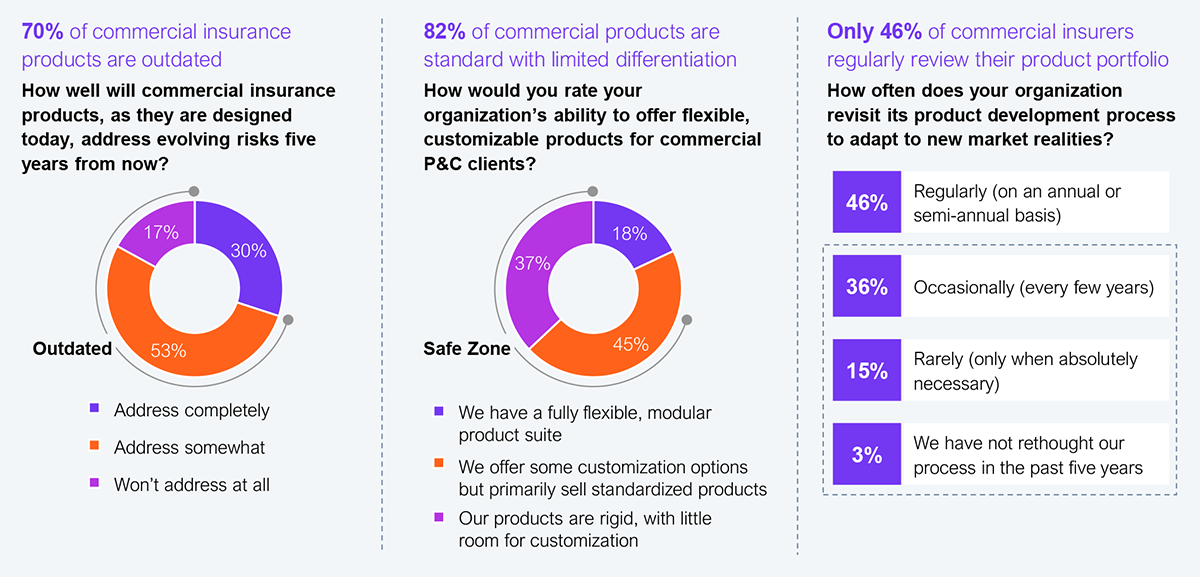
Sample: 350 commercial insurers from North America and Europe (including the UK). This represents industry-wide HFS research.
Source: HFS Research, 2026
Hiscox integrates customer feedback into product design and uses customer intelligence to guide business decisions. Achieving this required thoughtful design and optimization of the inputs and data at hand, drawing on a channel with over one million voice interactions annually. By strengthening intent-based segmentation and introducing more effective triage, Hiscox unlocked the ability to route calls with greater precision and gain clearer visibility into routing efficiency and cancellation drivers.
The priority for us at Hiscox was spotlighting the true voice of the customer: what our customers need, what they value, what they’re asking for from a product perspective, and what they’re telling us about service and pricing. If you ruthlessly focus on your customer, the results will come.
— Laura McCamile, SVP of Operations Delivery and Strategy, Hiscox
Working with Sutherland, Hiscox is implementing an AI-enabled service model in the direct consumer channel: combining intelligent routing, virtual voice and chat assistants, and human support into a coordinated, end-to-end experience where AI and humans work together to generate collective customer intelligence, drive growth, and optimize cost-to-serve.
A set of coordinated, sequenced moves across customer touchpoints followed:
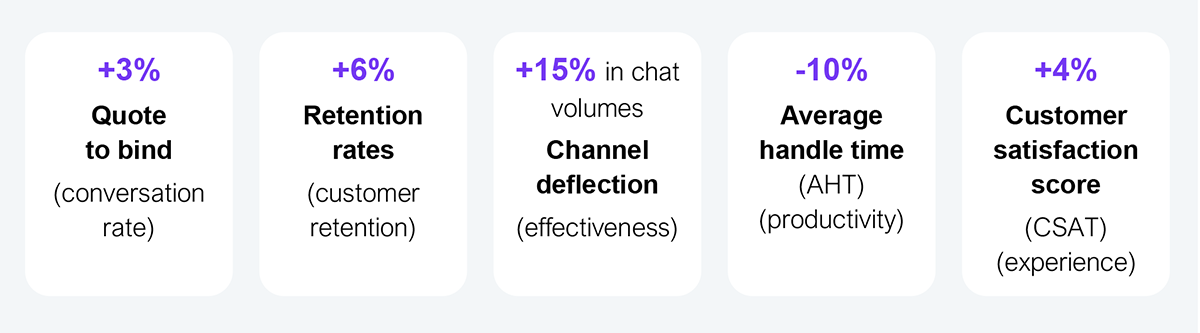
Early results from the direct consumer channel transformation are already registering across the metrics that matter (customer experience, growth, and cost-to-serve) while also driving product innovation and marketing insights. The numbers are shown in Exhibit 2.
Source: Sutherland and HFS Research, 2026
From cyber threats to economic shifts and supply chain disruption, the scale and complexity of risks continue to grow. Against this backdrop, the broker’s role as a trusted risk advisor has never been more critical. In an increasingly digital world, data has become indispensable to timely, precise risk assessment, yet its sheer volume and diversity are expanding exponentially. The real challenge is not access to information, but the ability to convert it into actionable insight. In an HFS research survey of 100 brokers across North America and Bermuda, 94% agreed that real-time data and automation are critical to sustaining their long-term competitive advantage. As shown in Exhibit 3, this shift in broker initiatives closely aligns with the steps Hiscox is taking to support and enable brokers in their expanding advisory role.
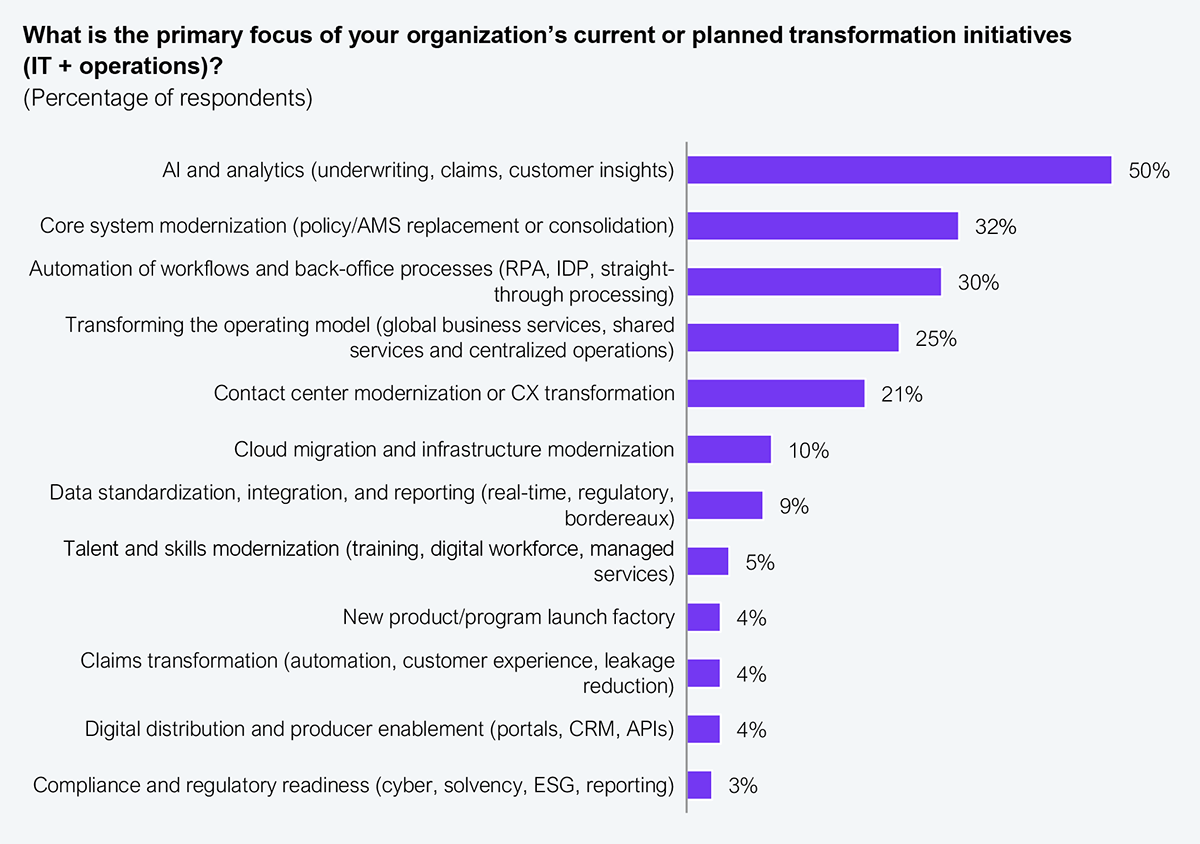
Sample: 100 brokers across North America and Bermuda. This represents industry-wide HFS research.
Source: HFS Research, 2026
With brokers sitting at the core of the Hiscox strategy, optimizing the end-to-end workflow was critical. As brokers increasingly strive to provide improved service to their customers, the case for a more structured, agentic AI-enabled approach grew, delivering evolved submission handling, underwriter data processing, spreadsheet-driven rating logic, and post-quote administration.
Brokers submit the same risk to multiple carriers, and underwriters must validate, price, and respond fast. To meet this demand, Hiscox, together with Sutherland, is optimizing the process and shifting the heavy lifting from manual preparation to faster decision-making and automated system updates back into policy administration, enabling underwriters to spend more time doing what they do best—underwriting.
The second lever is value, not just velocity. It includes a multi-quote capability that returns the requested quote (e.g., Professional Liability) and proactively proposes adjacent coverages (e.g., Cyber, General Liability) with bundled pricing, turning a transactional quote into a guided offer that reduces follow-up cycles and improves bind odds.
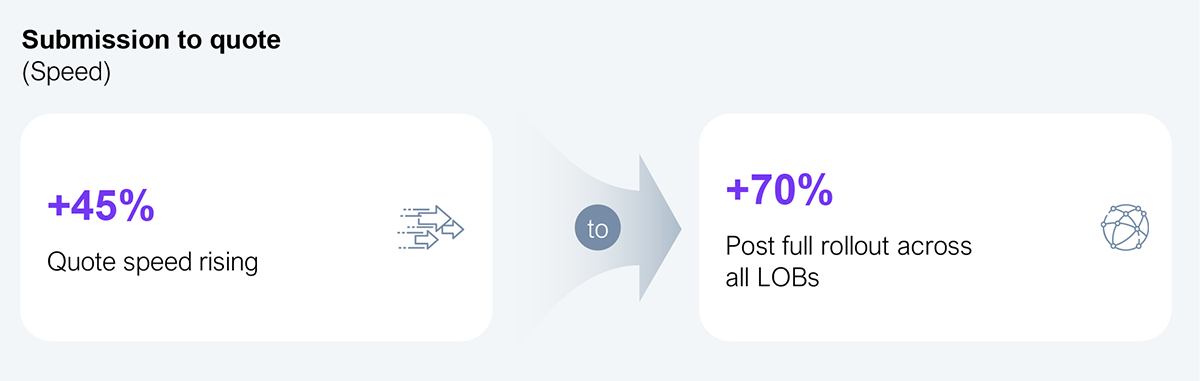
Early results show a 45% increase in submission-to-quote speed, with a projected 70% gain once rollout extends across all lines of business (see Exhibit 4).
Source: Sutherland and HFS Research, 2026
These are practical lessons for commercial carrier COOs looking to transform channel experience through AI enablement.
Lead transformation with realism
Hiscox is leading transformation with realism, ensuring ambition does not outpace operational capacity. Leadership is aligning change to what the organization could absorb, starting with customer and broker workshops that asked fundamental questions: Why would a customer engage? What does a broker need to accomplish? Only after clarifying real outcomes did they begin to optimize roles, simplify workflows, and layer in technology, deliberately following a people, process, technology sequence.
The takeaway: Disciplined sequencing starts with outcomes and capacity, not technology.
Senior leaders often hesitate because the tools still feel ‘taboo,’ they don’t fully grasp what’s practical now, and they don’t want to be the first movers (pioneers) who get it wrong. That hesitation creates an artificial gap between an approved idea and real execution.
— Laura McCamile, SVP of Operations Delivery and Strategy, Hiscox
Prioritize digital where you can and human where it matters
Digital is being applied where it creates efficiency, but human judgment remains central where empathy and nuance matter, especially in claims. In “human” moments, the right answer is sometimes less automation, not more.
The takeaway: Knowing where to automate and where to elevate human judgment is the mark of mature operations. Don’t replace empathy.
Scale through controlled experimentation and embedded governance
Hiscox is avoiding big-bang launches in favor of tightly scoped use cases. High-frequency, low-complexity transactions are tested through bounded minimum viable products (MVPs), paused, analyzed, refined, and scaled only then. Trust is earned through disciplined iteration, not headline moments. From day one, legal, compliance, business operations, data, and technology are co-architects, with AI integrity and ethics governance running in parallel.
The takeaway: Sustainable AI scale comes from controlled iteration with governance embedded from the start.
Anchored on a North Star, capturing the true voice of the customer, the difference was not the technology. It is how Hiscox pursues value realization within its own operational reality. It is identifying the behaviors behind outcomes, testing what changes them, and scaling only what works. The proof is in the early results: experience, growth, and a more efficient cost-to-serve in the direct consumer channel; speed, scale, and sustained carrier relevance in the broker channel.
For carrier COOs looking to move AI from the lab into the channels that drive growth, this is the blueprint not just for what to build, but for how to build it right.
If you ruthlessly chase and focus on your customer, the results will come.
— Laura McCamile, SVP of Operations Delivery and Strategy, Hiscox
Register now for immediate access of HFS' research, data and forward looking trends.
Get StartedIf you don't have an account, Register here |
With the exception of our Horizons reports, most of our research is available for free on our website. Sign up for a free account and start realizing the power of insights now.
Our premium subscription gives enterprise clients access to our complete library of proprietary research, direct access to our industry analysts, and other benefits.
Contact us at [email protected] for more information on premium access.