
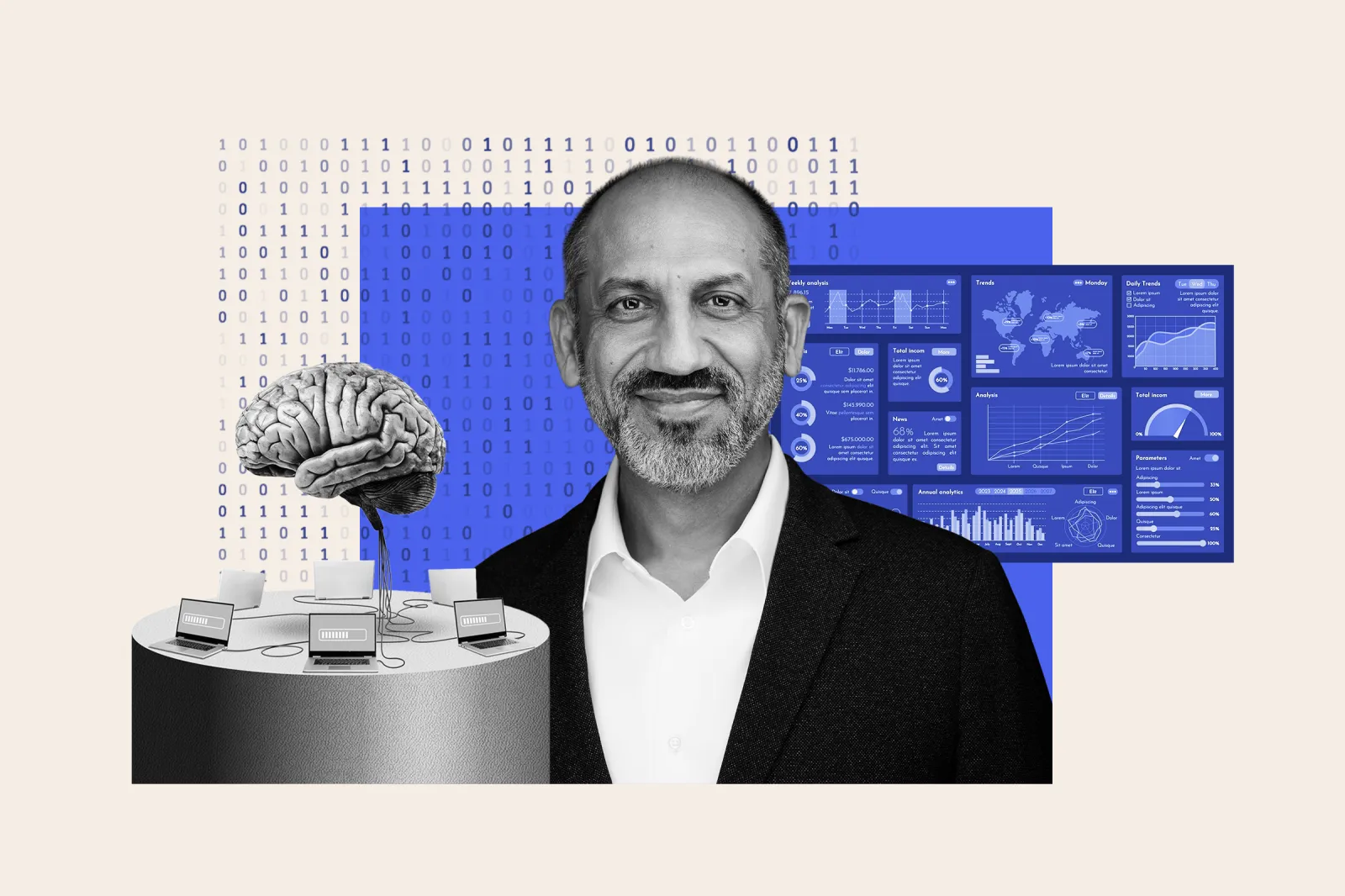
Balkrishan “BK” Kalra, president and CEO of Genpact, says the company’s advantage in AI comes from understanding the hidden operations that keep large enterprises running
Balkrishan “BK” Kalra does not describe Genpact as the company that belongs in the showroom.
The CEO, now in his third year leading the company, is more interested in the engine room: the finance, procurement, supply chain, insurance and risk operations that large companies depend on but customers rarely see. For nearly three decades, Genpact built its business in that hidden layer of corporate work, first inside General Electric and later as an independent business-process services company. Now Kalra is trying to turn that operational knowledge into the foundation for a new kind of AI services company.
“That distinctive domain is shining more,” Kalra told Newsweek. “We are now seizing that moment.”
His bet is not that enterprise AI needs bigger models alone. It is that models need process intelligence, or a deep understanding of how decisions, exceptions and handoffs move through a business.
Genpact calls its answer agentic operations: a model in which AI agents execute tasks and reimagine pieces of enterprise work, while human experts validate exceptions, train models and keep systems inside responsible AI guardrails. In its Q1 earnings call, the company said that approach is becoming central to its strategy, with agents being applied in areas such as accounts payable, record-to-report, source-to-pay and insurance operations.
That strategy gives Genpact a sharper message in a crowded market. The pitch is not that Genpact has better access to AI models. It’s that the company knows the operating context necessary to make those models useful inside real workflows. Kalra argues that decades spent running mission-critical operations can be converted into what he calls “context-rich process intelligence,” or knowledge of how enterprise work actually moves, where it breaks and how it gets fixed.

Kalra says Genpact’s advantage in a crowded agentic AI market comes from understanding the exceptions, edge cases and judgment calls inside enterprise operations.
The phrase “agentic AI” has become broad enough to cover everything from workflow automation to experimental software agents. That makes Genpact’s older process work more central to the company’s pitch, not less.
“You hear a lot of noise in the market,” Kalra told Newsweek. “Everybody is agentic.”
The last mile, he said, is where the difference shows up: the exceptions, edge cases and judgment calls that do not appear neatly inside public training data or standard software.
Kalra said foundation models have already changed expectations for what AI can do, but they do not know how work actually gets done inside a specific company.
“How do you bring the value for your clients by bringing that context at the last 20 percent?” he said. “That is what my case is about.”
Kalra sees Genpact’s history as especially useful. The company started inside GE in 1997, spun out as an independent company in 2005 and later listed on the New York Stock Exchange. Now, he’s trying to recast that foundation as something more current: an agentic and advanced technology business built on decades of core operations work.
Turning that history into an AI strategy is more complicated than a typical technology rollout. Genpact is trying to move from work that was largely human-processed and human-validated toward work that is increasingly machine-processed and human-validated. Its argument is that humans do not disappear from the model; their roles change.
Vijay Vijayasankar, Genpact’s global agentic AI officer, said the practical question is what has to surround a model before it can be trusted inside enterprise work.
“Those models are super important, but the model by itself very rarely helps in an enterprise context,” Vijayasankar told Newsweek.
Part of the issue is cost and speed. Large frontier models may be powerful, but Vijayasankar said many agentic business use cases do not require them for every task. Routing every step through the biggest model can make a system slower and more expensive than the work demands. Some steps can be handled by smaller models, deterministic rules-based software or a combination of both.
He used finance as an example of where agentic systems have to separate planning from execution. A model can help decide how work should move, but audit-sensitive steps, including Sarbanes-Oxley (SOX) compliance, still need to remain explainable, repeatable and reliable.
“You cannot tell an auditor that my SOX compliance is based on some probability—some guesswork,” Vijayasankar said. “That’s not a thing.”
Genpact’s pitch is therefore about architecture as much as automation. Vijayasankar described hallucination as inherent to probabilistic systems, which is why agents need scaffolding before they can be used in production workflows. “Hallucination is a feature,” he said. “It’s not a bug. It’s just the nature of how AI works.” Those systems, he added, need guardrails built around the unusual exceptions and edge cases that show up in real business processes.
Many companies are trying to scale AI across operations that are already strained. A new report from HFS Research, in partnership with Genpact, surveyed 2,002 enterprise executives across 16 industries and 14 functions and found that four forms of “enterprise debt” are limiting AI value: technology, data, process and talent.
The report states that 85 percent of leaders believe those debts limit AI value realization, while 51 percent have no remediation plan, an unapproved plan or an approved plan that has not started. Only 6 percent were classified as proven debt remediators, meaning they had established debt remediation initiatives, run them and measured the results.
The report also estimates that resolving those debts could unlock nearly $18 trillion in enterprise value across the world’s largest companies, through roughly 8 percent faster revenue growth and 16 percent cost reduction.
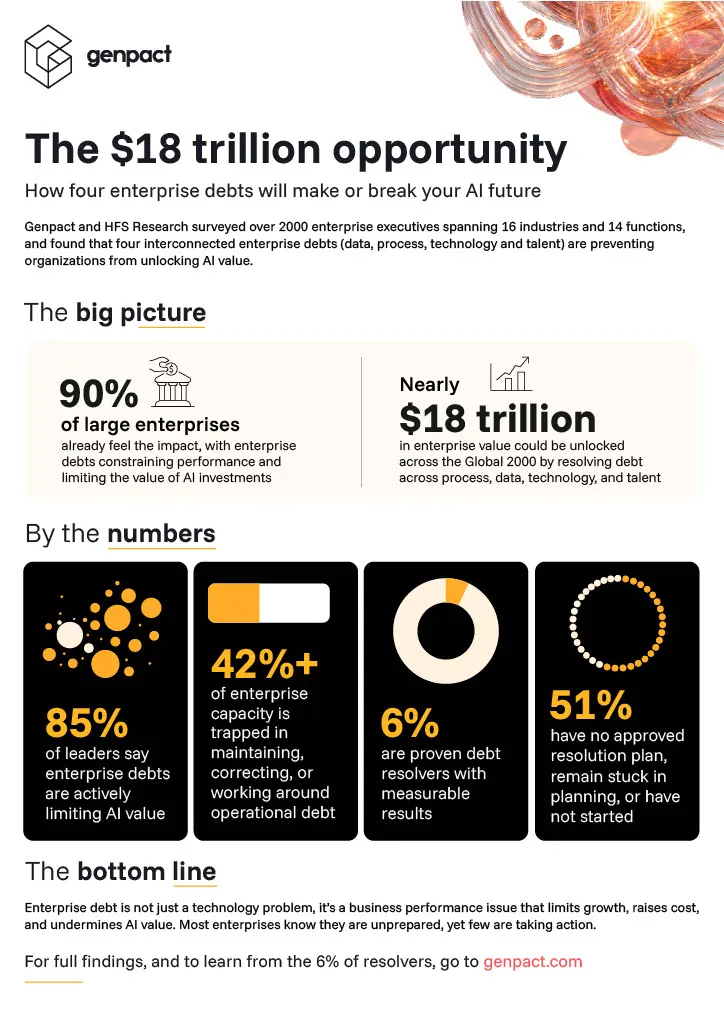
A Genpact and HFS Research report says data, process, technology and talent debts are preventing companies from turning AI spending into measurable value.
Saurabh Gupta, president of Research and Advisory Services at HFS Research, said the study’s central finding was less about the technology than the organizations trying to use it.
“AI technology is ready,” Gupta told Newsweek. “It’s there and it’s improving at almost a ridiculous speed right now. But we as enterprises are not.”
None of those debts are new. Large companies have lived for years with old systems, fragmented data, manual processes and employees stuck correcting the same problems again and again. AI is making those weaknesses more visible because boards and CEOs are now expecting the technology to deliver growth, productivity and competitive advantage.
Pressure is growing because the weaknesses that businesses once worked around are now blocking the AI programs that executives have promised. “At some point, you have to pay your credit card bills,” Gupta said. “And I think with AI, that deadline is approaching.”
HFS and Genpact found that nearly 13 percent of average functional spend is being allocated to AI, but Gupta said AI adoption at scale remains small. In his view, many companies are not failing because the technology is unavailable. They’re failing because they’re placing AI into operating environments that cannot support it.
“We are throwing AI at broken workflows, at old processes, and we’ve not fundamentally redesigned those processes,” Gupta said.
Data shows the problem clearly. The HFS and Genpact report found that only 33 percent of enterprise data is AI-ready, while 42 percent of analytics and AI initiatives are delayed, underperforming or failing because of data issues. It also found that 48 percent of processes still require manual or semi-manual intervention somewhere along the workflow, and about 40 percent of employee time in a typical week is affected by inefficient or manual processes.
Vijayasankar was blunt about what can happen when agents are deployed into that environment.
“Oh, it’ll be a massively terrible outcome,” he said.
Vijayasankar said older enterprise workflows were designed for a world where software could not reason. That makes it risky to assume those same workflows will hold up when agents begin taking action across systems.
“We have to re-engineer the process to make use of AI,” he argued. “Otherwise, at best, there will be minor improvements. But the more likely scenario is extreme chaos.”
Elena Christopher, vice president, Strategic Programs, Chief Growth Office, at Genpact, said the danger becomes clearer when agents move from pilot environments into live operations.
“They’re doing perhaps the wrong steps faster with nobody watching,” Christopher told Newsweek.
The answer is not to wait until every system, dataset and process is perfect before using AI. Gupta and Christopher said the companies making the most progress are operating at what the research calls “dual velocity.”
One track is long-term repair: workforce transformation, process redesign, better data foundations, modernization work and other investments that do not always produce a return in a few weeks. Another is near-term AI work that can show value, expose the next layer of enterprise debt and help justify the next investment.
Gupta said the proven debt resolvers are not choosing one debt category and ignoring the others. They are running a portfolio of initiatives across technology, data, process and talent. They’re also using AI to help repair the underlying issues, such as mapping enterprise context, speeding legacy modernization or analyzing workflows.
The dual-velocity idea also helps explain Genpact’s own pivot. The company is trying to show that its role is no longer limited to running operations efficiently. It wants to help clients redesign the work itself around agents, data and human expertise, not merely tighten existing processes.
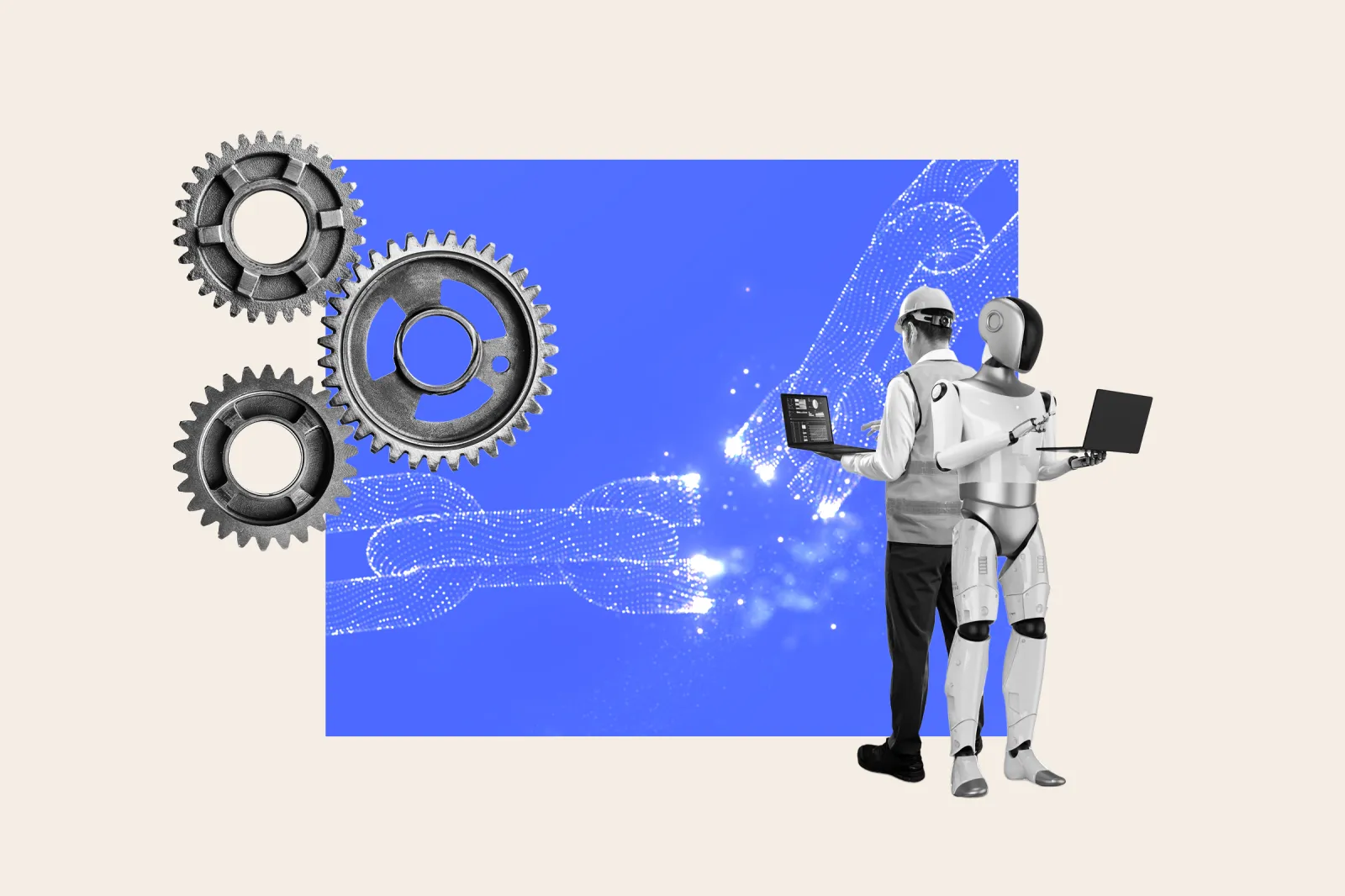
AI agents may be the visible technology, but Genpact is betting the harder work happens behind the scenes, where data, systems, workflows and human expertise have to move together.
Kalra said the message internally has been clear: Employees will need to become either AI builders or AI practitioners. Builders major in technology, data science or advanced technology, while also understanding a business domain such as finance, supply chain, claims or banking. Practitioners major in the domain, but need enough technical fluency to work with AI.
Workforce readiness is also part of the broader enterprise debt problem. Gupta said talent debt may be underestimated because it is harder to quantify than technology debt, even though it cuts across the other categories. And Christopher noted that companies risk creating future leadership gaps if they respond to AI by pulling back too sharply on entry-level hiring or delaying workforce investment.
“If we don’t hire new graduates, who the heck are going to become the leaders of the future?” Christopher said.
The more advanced companies, she said, are hiring for critical roles, upskilling earlier and trying to make AI part of how work gets done.
The question extends beyond Genpact. Agentic AI is forcing a more basic test for large enterprises: whether they can redesign work fast enough for the technology they are buying.
Gupta said the companies that make real progress will stop treating AI as a standalone project. Real progress has to start with the business outcome, whether that is a new product, a cleaner accounts payable process, a faster claims operation or a different customer experience.
“They would not call [that work] an AI project,” Gupta said. “AI is just sort of there. It’s the underpinning of everything, but it’s not an AI project.”
Christopher added that companies that struggle often begin with the technology label before defining the business problem.
“That is not a business strategy,” she said. “That is literally the hammer looking for the nail.”
The bet is that the next phase of enterprise AI will reward companies that know the work deeply enough to rebuild it. If agents become another layer on top of old systems, bad data, fragmented processes and unprepared teams, the engine room does not disappear. It just breaks faster.
Kalra’s argument comes down to a less glamorous test for enterprise AI: whether it can make the everyday machinery of business more dependable, from invoices and claims to procurement approvals and compliance checks.
“We are proud engine room people,” Kalra said. “We are not the showroom people. We enable the showroom.”
View the article
If you don't have an account, Register here |
With the exception of our Horizons reports, most of our research is available for free on our website. Sign up for a free account and start realizing the power of insights now.
Our premium subscription gives enterprise clients access to our complete library of proprietary research, direct access to our industry analysts, and other benefits.
Contact us at [email protected] for more information on premium access.

