This HFS Research Market Impact report is for COOs, CIOs, and engineering leaders in aerospace and defense building integrated, platform-centric execution models to convert backlog into revenue.
Aerospace and defense (A&D) industry leaders are sitting on a record backlog of 17,000 aircraft (10–12 years of capacity). They are seeing increasing demand for commercial and defense air transportation, yet they cannot deliver. Delays in engine delivery, for example, are holding back Airbus’s ability to reach 75 A320 deliveries per month in 2026, with hopes of reaching the target in 2027. This slippage in revenue recognition, along with quality and supply chain issues such as delayed seat deliveries, has led to margin erosion for Airbus. Its capacity to deliver is locked up by suppliers, and market share is lost to competitors who can deliver first. The answer to such puzzles is not more supply chain management, engineering, or digitization, but their integration into one unified operating model. Execution is failing structurally due to fragmented operating models, a constrained and disoriented supplier base that spreads geographically, and regulatory and security overhead.
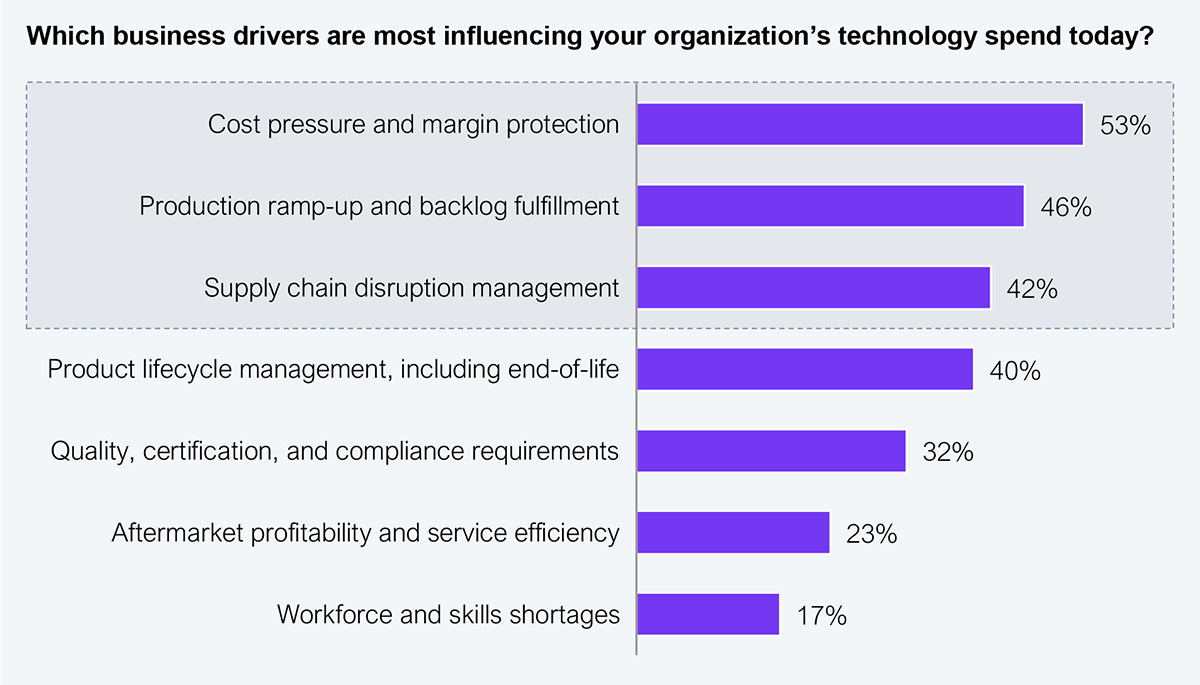
HFS Research, in partnership with Cognizant-Belcan, surveyed 202 senior A&D leaders across engineering, operations, and digital functions to understand how organizations are approaching program execution challenges, the technology investments required, and partner strategies. The findings point to a clear conclusion: the next phase of A&D growth will be won by execution, not innovation alone (see Exhibit 1). Efficient execution will be vital for early revenue recognition, ensuring minimal working capital and healthy margins.
Sample: HFS survey of 202 senior executives in the A&D industry
Source: HFS Research, 2026
Supply chain bottlenecks, production ramp-up delays, and cost pressures are emerging as the primary barriers to converting backlog into revenue (see Exhibit 1). Airbus’s recent A320 experience illustrates how even localized disruptions can cascade into systemic delivery challenges.
Investments today focus on enabling real-time supplier performance visibility, end-to-end traceability, faster issue detection and escalation, production scheduling, and predictive risk and maintenance insights. However, execution is no longer dependent solely on internal capability; it increasingly hinges on how effectively enterprises can digitally orchestrate extended supplier ecosystems and align them with production and delivery timelines.
A&D enterprises are operating in a period of sustained demand visibility, so the pressure isn’t easing. According to the International Air Transport Association (IATA), global air travel is projected to more than double by 2050, growing at a steady 3.1% CAGR in revenue passenger kilometers. Meanwhile, defense spending is on the rise due to geopolitical conflicts, with increasing demand for autonomous systems, drone operations, and unmanned traffic management solutions. The think tank SIPRI (Stockholm International Peace Research Institute) reported that global military expenditure increased to $2.9 trillion in 2025, the 11th consecutive year of growth, bringing military spending as a share of GDP to 2.5%, the highest level since 2009.
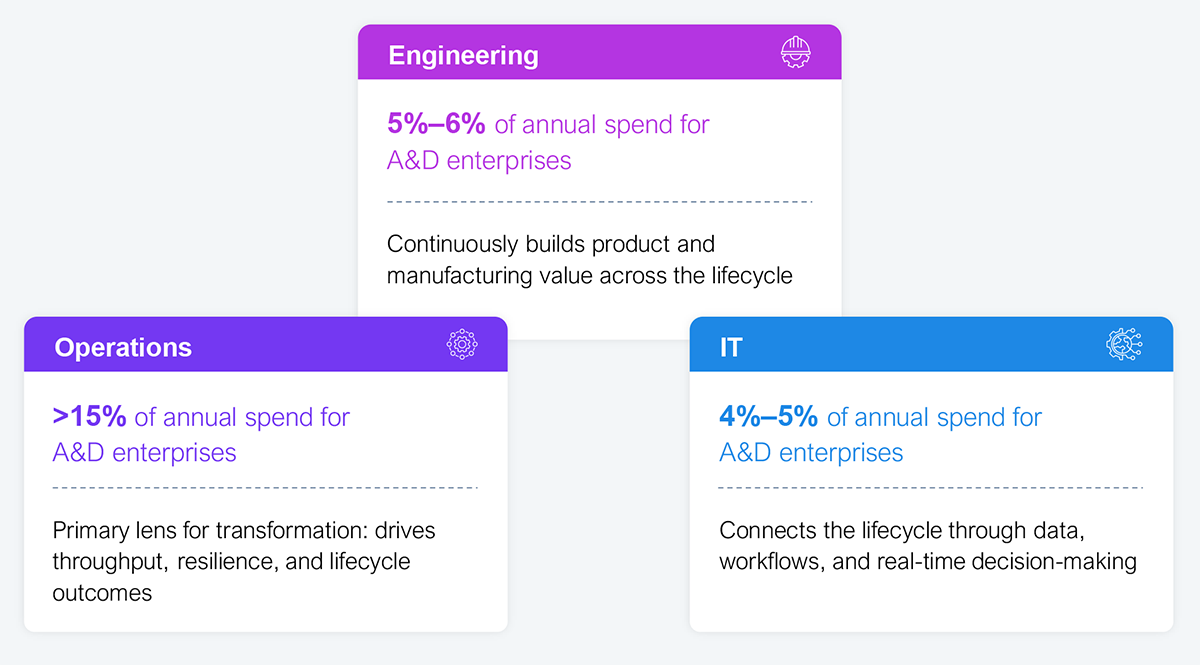
Developing a robust execution muscle requires COOs in A&D to make a concrete shift toward integrated engineering, digital, and operational models that enable lifecycle delivery at scale, not just functional milestones. Operations, spanning manufacturing, supply chains, logistics, delivery, and aftermarket services, now account for the largest share of enterprise investment, significantly outpacing engineering and IT/digital (see Exhibit 2). This reflects where outcomes are won or lost in the A&D business: in throughput, coordination, and lifecycle delivery.
Source: HFS Research, 2026
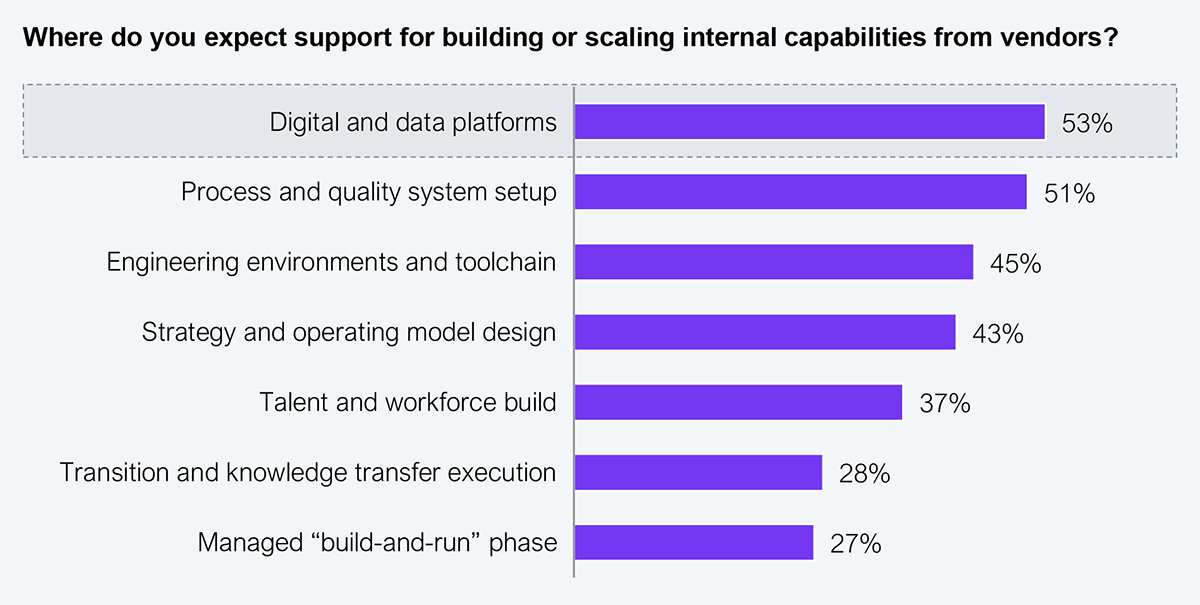
This shift toward functional integration is now pushing A&D enterprises to rethink not just operating models, but the underlying technology architecture that supports them. Increasingly, A&D enterprises need to move toward platform-based architectures that bring together engineering, operations, and data into a common control layer across the lifecycle. Performance depends on how effectively enterprises can coordinate across Tier 1, Tier 2, and Tier 3 supplier ecosystems, where most production and delivery dependencies reside (see Exhibit 3).
Platform-centric models enable this coordination by bringing together fragmented systems such as product lifecycle management (PLM), manufacturing execution systems (MES), enterprise resource planning (ERP), and supply chain tools into a connected environment where data flows seamlessly across teams and stakeholders. These platforms have evolved from isolated point solutions into integrated execution systems that can drive significant improvements in A&D operations. Technologies such as model-based systems engineering, 3D product simulation, AI, and digital twins have existed for years, but their impact has been limited by poor data quality, weak system integration, and high computing costs. Today, improvements in data maturity, connectivity, and computing power have pushed these technologies to a level where they can deliver tangible outcomes such as first-time-right engineering, optimized designs, and lower cost and cycle times.
Sample: HFS survey of 202 senior executives in the A&D industry
Source: HFS Research, 2026
Digital thread and digital twin architectures are becoming critical enablers in this model, with the majority of enterprises expecting to increase their reliance on these capabilities to track products from design through end-of-life. Platforms act as the integration layer, while enterprise systems provide the underlying data. This alignment is essential to enable interoperability, scalability, and real-time decision-making across the ecosystem.
Leading OEMs are already moving in this direction.
These examples highlight the critical lesson that integration cannot be layered on after fragmentation has taken root. It must be designed into the operating model from the outset across engineering, digital, and operations. If the platform is the foundation, AI is the layer that converts the inherent intelligence within it into timely, actionable insights for businesses to act on autonomously.
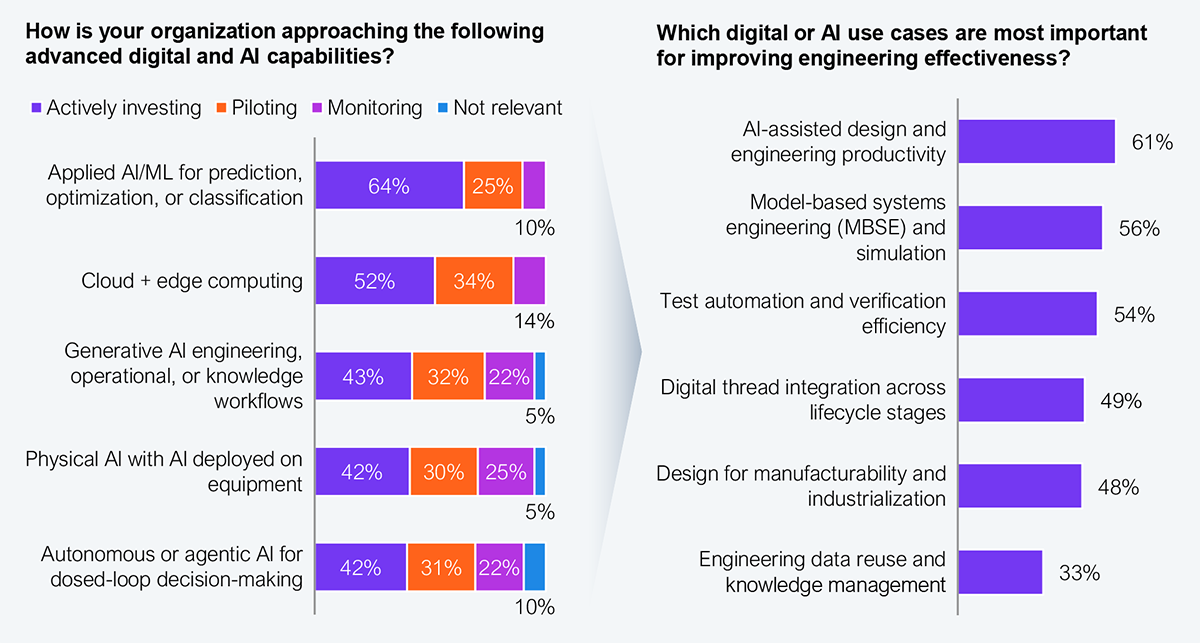
As A&D enterprises shift toward integrated, operations-led execution models, AI is emerging as a pragmatic lever to not only improve productivity but also reduce execution friction across the lifecycle. Rather than acting as a standalone innovation layer, AI is increasingly embedded into engineering, manufacturing, and supply chain workflows to address constraints around speed, quality, and predictability. This is reflected in enterprise priorities, with a majority actively investing or piloting AI across lifecycle functions (see Exhibit 4).
Sample: HFS survey of 202 senior executives in the A&D industry
Source: HFS Research, 2026
The impact is most visible in execution environments. In engineering, AI copilots and model-driven approaches are accelerating design, requirements analysis, and testing, with over half of enterprises expecting significant cycle-time compression. On the shop floor, computer vision enables automated inspection and quality monitoring, while in operations and supply chains, AI supports production scheduling, supplier risk detection, and predictive maintenance, shifting decisions from reactive to anticipatory.
These use cases signal a broader shift: engineering is becoming AI-augmented and model-first, operations are moving toward autonomous environments, and supply chains are evolving into digitally orchestrated networks. AI’s value lies not in isolated deployments, but in how effectively it is embedded into integrated engineering, digital, and operational systems that drive execution at scale. In such an interconnected, autonomous enterprise that’s also exposed to the outside world, cybersecurity plays a vital role in continuously identifying weak links in the value chain, assessing them, and strengthening them before malicious actors exploit them.
As A&D enterprises move toward integrated, platform-led execution models, security and regulatory compliance are no longer downstream considerations; they define who can participate in programs. The connected nature of modern A&D ecosystems, spanning OEMs, suppliers, and service providers, increases exposure to cyber threats while amplifying regulatory scrutiny.
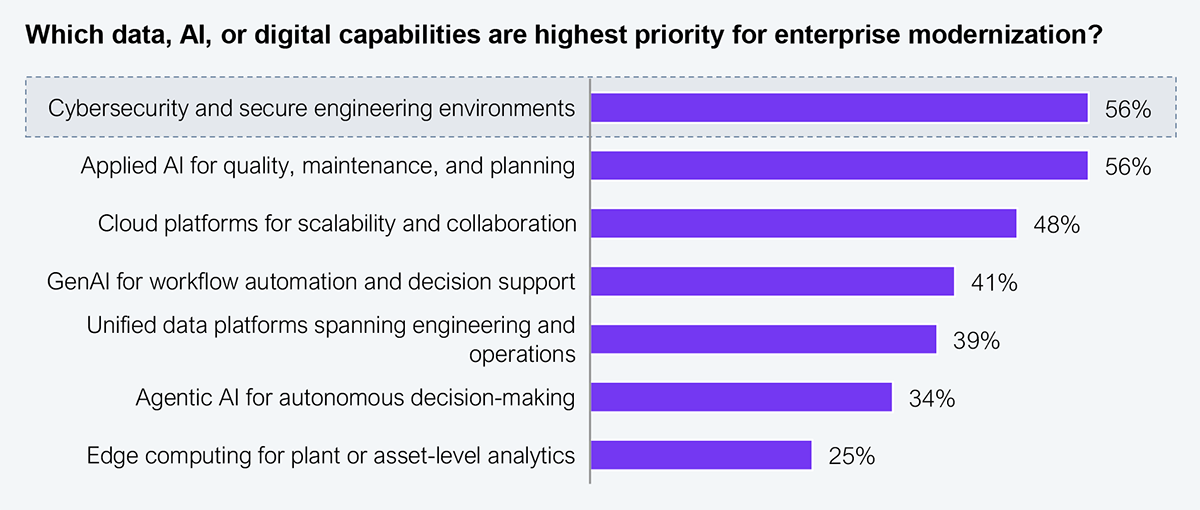
As a result, frameworks such as CMMC 2.0, export controls, and secure engineering environments are becoming structural requirements across the value chain. This shift is reflected in enterprise priorities, with 56% of A&D leaders identifying cybersecurity and secure engineering environments as the top focus area for modernization (see Exhibit 5). Cloud platforms are increasingly becoming the backbone for centralized computing, collaboration, and data storage across A&D programs. As this shift accelerates, compliance frameworks such as FedRAMP for secure cloud environments, ITAR for controlling defense-related data and technology transfers, and CMMC for organizational cybersecurity readiness are becoming mandatory requirements rather than optional standards. However, a significant portion of the broader A&D supplier ecosystem still lacks the maturity and certifications needed to meet these evolving regulatory and security expectations.
Sample: HFS survey of 202 senior executives in the A&D industry
Source: HFS Research, 2026
These requirements are fundamentally reshaping A&D delivery models. CMMC 2.0 introduces standardized cybersecurity controls across defense supply chains, forcing thousands of suppliers to strengthen their security capabilities while making prime contractors responsible for ensuring compliance across the broader ecosystem. At the same time, the specialized A&D supplier base has contracted significantly. For example, the US Department of Defense reported that the number of prime contractors supporting its weapon systems declined from 51 in the 1990s to just five in recent years, driven by rising program complexity, policy shifts, and economic pressures. Innovation in A&D has also become increasingly capital-intensive and high-risk, making it difficult for suppliers to invest in new capabilities while simultaneously aligning with multiple OEM-led digital transformation initiatives.
As A&D enterprises adopt platform-centric, operations-led execution models, their partner strategies are evolving in parallel. Fragmented vendor ecosystems are increasingly seen as a constraint to execution, driving a shift toward fewer partners that can bring integrated capabilities across engineering, digital, and operations. The services model in A&D is breaking down, and capacity providers are being replaced by execution partners who are integral to operations. Credible partners will be those who provide three elements:
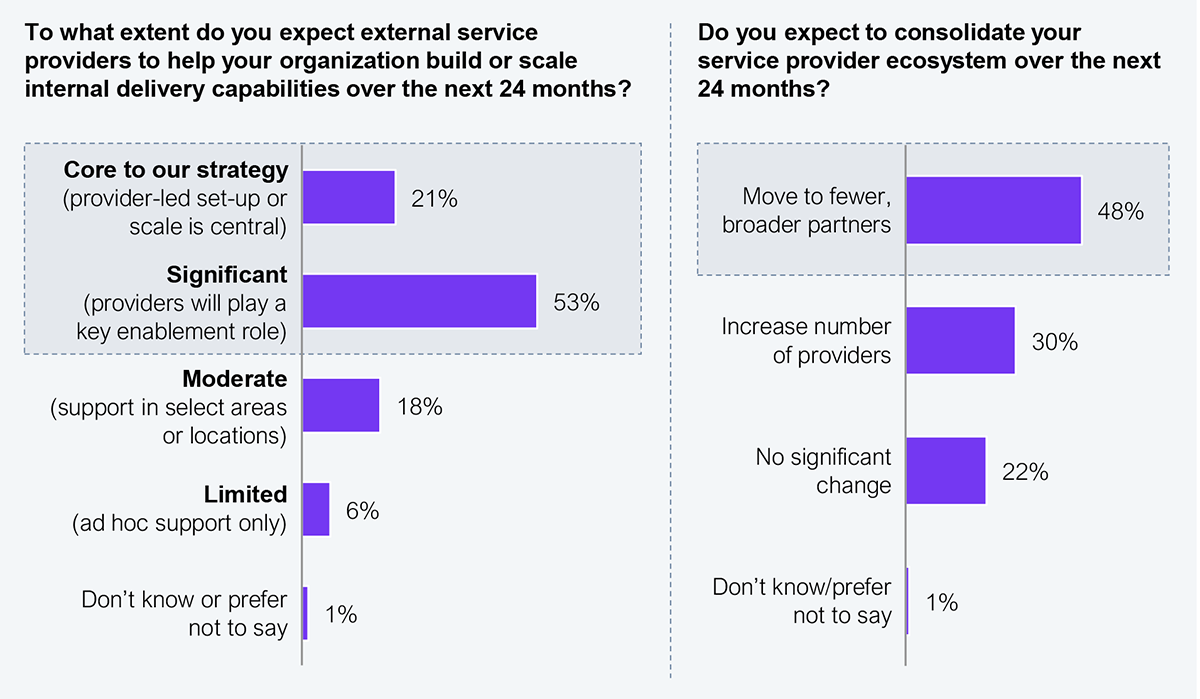
Nearly half of enterprises are planning vendor consolidation, and a majority are increasing reliance on service providers to build and scale execution capabilities (see Exhibit 6).
Sample: HFS survey of 202 senior executives in the A&D industry
Source: HFS Research, 2026
This shift is also redefining the nature of service delivery. Enterprises are moving toward outcome-oriented models, where providers are expected to take accountability for lifecycle metrics such as delivery timelines, cost adherence, and quality outcomes. In parallel, elements of a Services-as-Software™ (SaS) model are emerging, where core functions such as design iteration, production planning, and change management are increasingly software-driven, with human intervention focused on exceptions and critical decisions. This further reinforces the need for partners that can combine domain expertise with platform, data, and execution capabilities.
Two recent interventions illustrate what this execution-partner model, shifting to combined digital and engineering expertise, looks like in practice. Belcan supported its A&D clients through outcome-focused execution:
Service providers are no longer evaluated on their ability to augment capacity. They are expected to deliver embedded, outcome-driven interventions that directly improve execution across the lifecycle. COOs must not wait for issues to arise before reviewing their outsourcing spectrum. Instead, they should be proactive in taking stock of effort-based and outcome-based work and take steps to move toward the latter.
The traditional approach to outsourcing work is functional, effort-based projects in engineering, IT, or business process outsourcing, with very little interaction between them. This is a sub-optimal approach.
HFS Research studies indicate the decline in traditional FTE-based contracts, from 42% to a projected 28%, while outcome-based models are growing from 20% to a projected 39% over the next three years. Our most recent Horizons report for ER&D (engineering, research, and development) service providers shows that key players are delivering IP-driven, co-innovation-led, full-spectrum lifecycle services. Integrated outsourcing is therefore achievable and is being adopted by leading enterprises willing to reengineer their operating models. These models also help reduce dependence on traditional headcount-led scaling, enabling enterprises to address persistent talent shortages across the A&D industry. The Aerospace Industries Association has highlighted how workforce challenges continue to create headwinds for digital innovation, with attrition in the US aerospace and defense sector reaching 15% in 2024—more than double the industry average.
COOs in the A&D sector should take stock of their overall outsourcing landscape to assess how many contracts are siloed, their performance, and renewal dates, and publish a feasible roadmap for a time-bound shift to an integrated, outcome-based outsourcing, with buy-in from key stakeholders. At the same time, they should lay out the enterprise IT application landscape, interactions with external partners such as upstream suppliers and downstream dealers, and evaluate a platform-based approach to act as a wrapper around the applications.
A three-step playbook for COOs will consist of the following steps:
COOs who continue to view IT, engineering, and operations as siloed functions will lose the ability to achieve timely, profitable order fulfillment and revenue recognition. Instead, they must integrate the enterprise IT landscape into a platform-centric architecture orchestrated by AI. Vendor choice and consolidation should be among the outcomes of operating model redesign, selecting those who commit to outcome accountability across the lifecycle of products.
Register now for immediate access of HFS' research, data and forward looking trends.
Get StartedIf you don't have an account, Register here |
With the exception of our Horizons reports, most of our research is available for free on our website. Sign up for a free account and start realizing the power of insights now.
Our premium subscription gives enterprise clients access to our complete library of proprietary research, direct access to our industry analysts, and other benefits.
Contact us at [email protected] for more information on premium access.