Competitive Intelligence

DXC: Services Capabilities for HCP, 2026

The DXC: Services Capabilities for HCP, 2026 profile is for hospital and government health system CIOs, EHR managed services leaders, and IT operations executives evaluating interoperability and managed services partners.
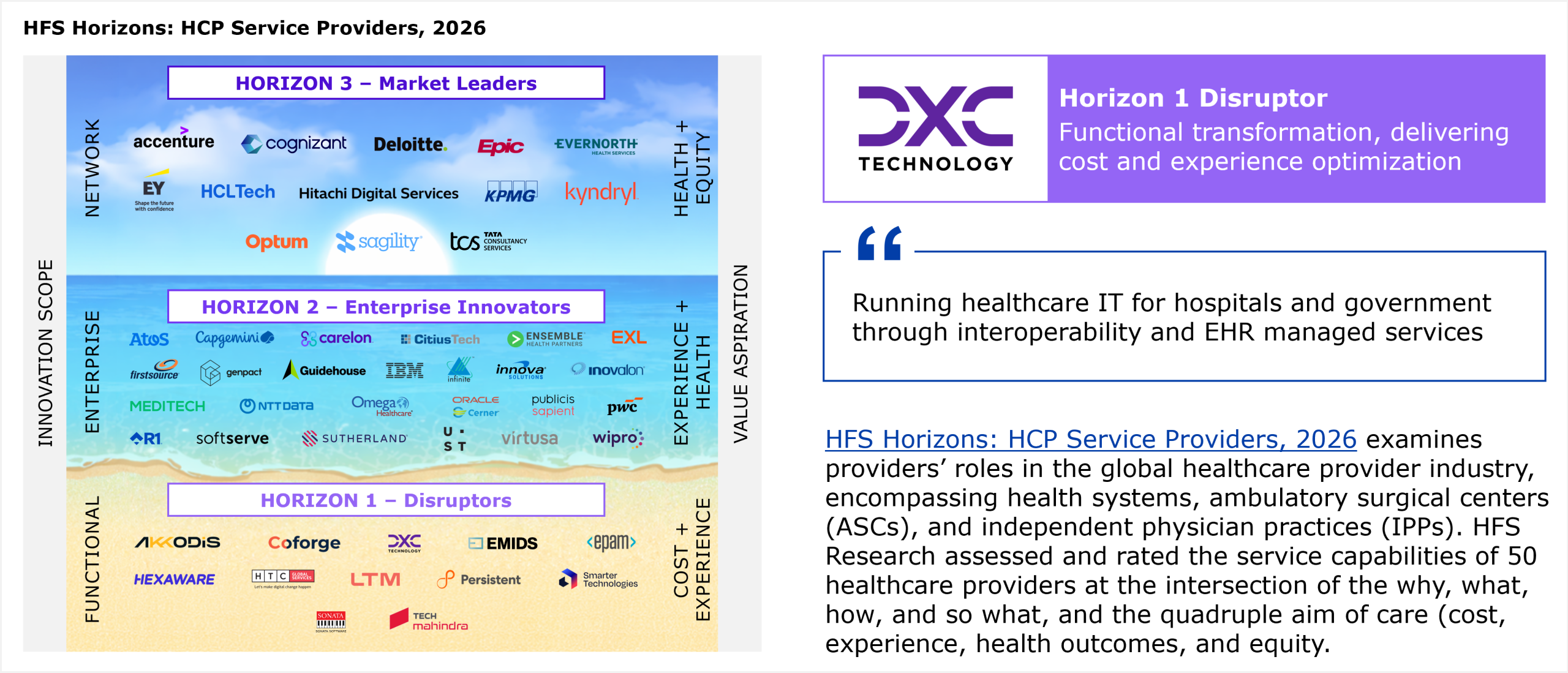
HFS Horizons placement grid plotting service providers across three horizons against two axes. The left vertical axis, innovation scope, runs from Functional at the bottom, through Enterprise in the middle, to Network at the top. The right vertical axis, value aspiration, runs from Cost plus Experience at the bottom, through Experience plus Health in the middle, to Health plus Equity at the top. The three horizon bands are stacked top to bottom. Horizon 3 Market Leaders sits at the top and represents providers delivering on the full quadruple aim of cost, experience, health outcomes, and equity. Horizon 2 Enterprise Innovators sits in the middle and represents enterprise transformation that delivers cost, experience, and health outcomes. Horizon 1 Disruptors sits at the bottom and represents providers addressing cost and experience. All providers within a horizon are listed alphabetically. Horizon 3 Market Leaders includes Accenture, Cognizant, Deloitte, Epic, Evernorth Health Services, EY, HCLTech, Hitachi Digital Services, KPMG, Kyndryl, Optum, Sagility, and Tata Consultancy Services. Horizon 2 Enterprise Innovators includes Atos, Capgemini, Carelon, CitiusTech, Ensemble Health Partners, EXL, Firstsource, Genpact, Guidehouse, IBM, Innova Solutions, Inovalon, MEDITECH, NTT DATA, Omega Healthcare, Oracle Cerner, Publicis Sapient, PwC, R1, SoftServe, Sutherland, UST, Virtusa, and Wipro. Horizon 1 Disruptors includes AKKODiS, Coforge, DXC Technology, Emids, EPAM, Hexaware, HTC Global Services, LTM, Persistent, Smarter Technologies, Sonata, and Tech Mahindra. DXC, shown as DXC Technology, is placed in Horizon 1 Disruptor. The accompanying callout summarizes DXC as running healthcare IT for hospitals and government through interoperability and EHR managed services. The study assessed and rated the service capabilities of 50 healthcare providers at the intersection of the why, what, how, and so what, and the quadruple aim of care. Source: HFS Research, 2026.

Note: All service providers within a Horizon are listed alphabetically
Source: HFS Research, 2026
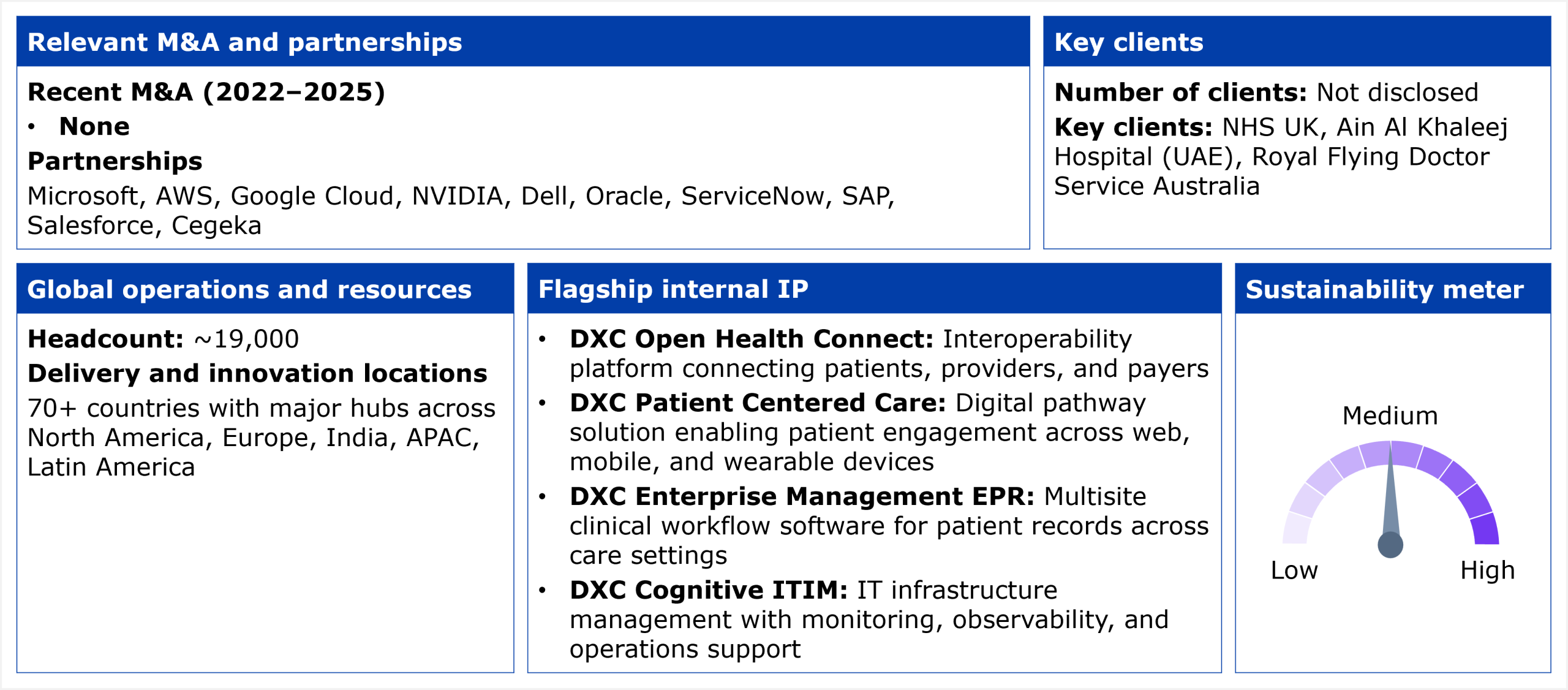
Key facts about DXC’s HCP services capabilities

Information panel divided into five blocks summarizing DXC's HCP services profile. The first block, relevant M&A and partnerships, states no recent M&A from 2022 to 2025. Its partnerships are Microsoft, AWS, Google Cloud, NVIDIA, Dell, Oracle, ServiceNow, SAP, Salesforce, and Cegeka. The second block, key clients, states that the client count is not disclosed, with key clients NHS UK, Ain Al Khaleej Hospital (UAE), and Royal Flying Doctor Service Australia. The third block, global operations and resources, states a headcount of approximately 19,000, with operations in 70 or more countries and major hubs across North America, Europe, India, APAC, and Latin America. The fourth block, flagship internal IP, lists four entries: DXC Open Health Connect, an interoperability platform connecting patients, providers, and payers; DXC Patient Centered Care, a digital pathway solution enabling patient engagement across web, mobile, and wearable devices; DXC Enterprise Management EPR, multisite clinical workflow software for patient records across care settings; and DXC Cognitive ITIM, IT infrastructure management with monitoring, observability, and operations support. The fifth block, sustainability meter, is a gauge dial reading from Low through Medium to High, with the needle pointing to Medium. Source: HFS Research, 2026.

Source: HFS Research, 2026

DXC’s performance in the study and HFS’ views of its strengths and development opportunities for HCP services capabilities

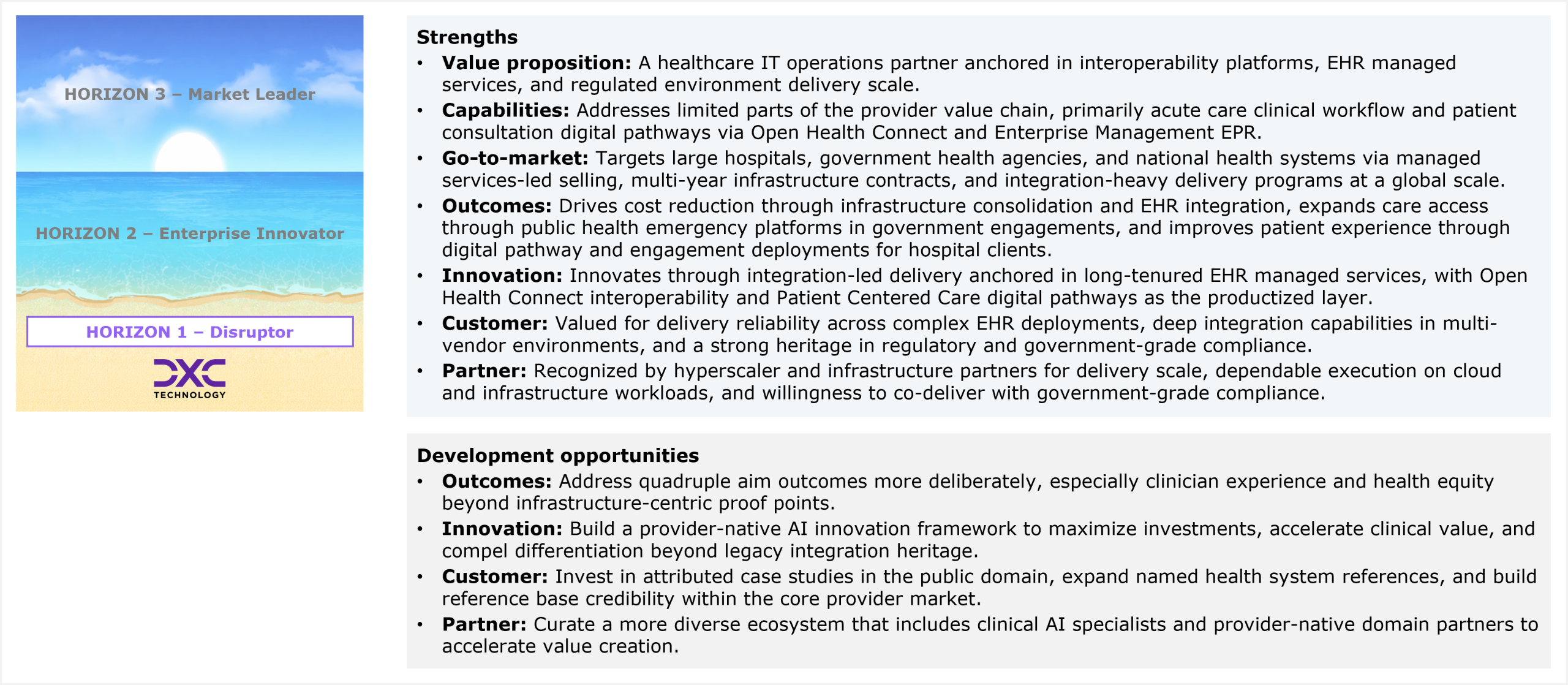
Two-part assessment slide accompanied by a horizon ribbon on the left that marks DXC's placement in Horizon 1 Disruptor, below Horizon 2 Enterprise Innovator and Horizon 3 Market Leader. The first part lists strengths across seven dimensions. Value proposition: a healthcare IT operations partner anchored in interoperability platforms, EHR managed services, and regulated environment delivery scale. Capabilities: addresses limited parts of the provider value chain, primarily acute care clinical workflow and patient consultation digital pathways via Open Health Connect and Enterprise Management EPR. Go-to-market: targets large hospitals, government health agencies, and national health systems via managed services-led selling, multi-year infrastructure contracts, and integration-heavy delivery programs at a global scale. Outcomes: drives cost reduction through infrastructure consolidation and EHR integration, expands care access through public health emergency platforms in government engagements, and improves patient experience through digital pathway and engagement deployments for hospital clients. Innovation: innovates through integration-led delivery anchored in long-tenured EHR managed services, with Open Health Connect interoperability and Patient Centered Care digital pathways as the productized layer. Customer: valued for delivery reliability across complex EHR deployments, deep integration capabilities in multi-vendor environments, and a strong heritage in regulatory and government-grade compliance. Partner: recognized by hyperscaler and infrastructure partners for delivery scale, dependable execution on cloud and infrastructure workloads, and willingness to co-deliver with government-grade compliance. The second part lists development opportunities across four dimensions. Outcomes: address quadruple aim outcomes more deliberately, especially clinician experience and health equity beyond infrastructure-centric proof points. Innovation: build a provider-native AI innovation framework to maximize investments, accelerate clinical value, and compel differentiation beyond legacy integration heritage. Customer: invest in attributed case studies in the public domain, expand named health system references, and build reference base credibility within the core provider market. Partner: curate a more diverse ecosystem that includes clinical AI specialists and provider-native domain partners to accelerate value creation. Source: HFS Research, 2026.

Source: HFS Research, 2026

To read the complete report, click the download button below.

Sign in to view or download this research.

Login

Register

Insight. Inspiration. Impact.

Register now for immediate access of HFS' research, data and forward looking trends.

Get Started

Download Research

    Sign In

    Sign up for a free
    research account

    With the exception of our Horizons reports, most of our research is available for free on our website. Sign up for a free account and start realizing the power of insights now.

    Digests/Newsletters: Overviews of the latest news, insight, and research by HFS.

    HFS Events: Exclusive invitations to HFS webinars, roundtables, and summits, bringing together key industry stakeholders focused on major innovations impacting business operations.

    By registering you agree to our privacy policy.

    I hereby consent that HFS Research can process my personal data.

    Premium Access

    Our premium subscription gives enterprise clients access to our complete library of proprietary research, direct access to our industry analysts, and other benefits.

    Contact us at [email protected] for more information on premium access.

    Help

    If you are looking for help getting in touch with someone from HFS, please click the chat button to the bottom right of your screen to start a conversation with a member of our team.

    [email protected]

      Contact Ask HFS AI Support