Competitive Intelligence

Epic: Services Capabilities for HCP, 2026

This Epic Competitive Intelligence Profile is for health system CIOs, CMIOs, and sourcing leaders evaluating EHR platforms that power the provider value chain across the quadruple aim of care.
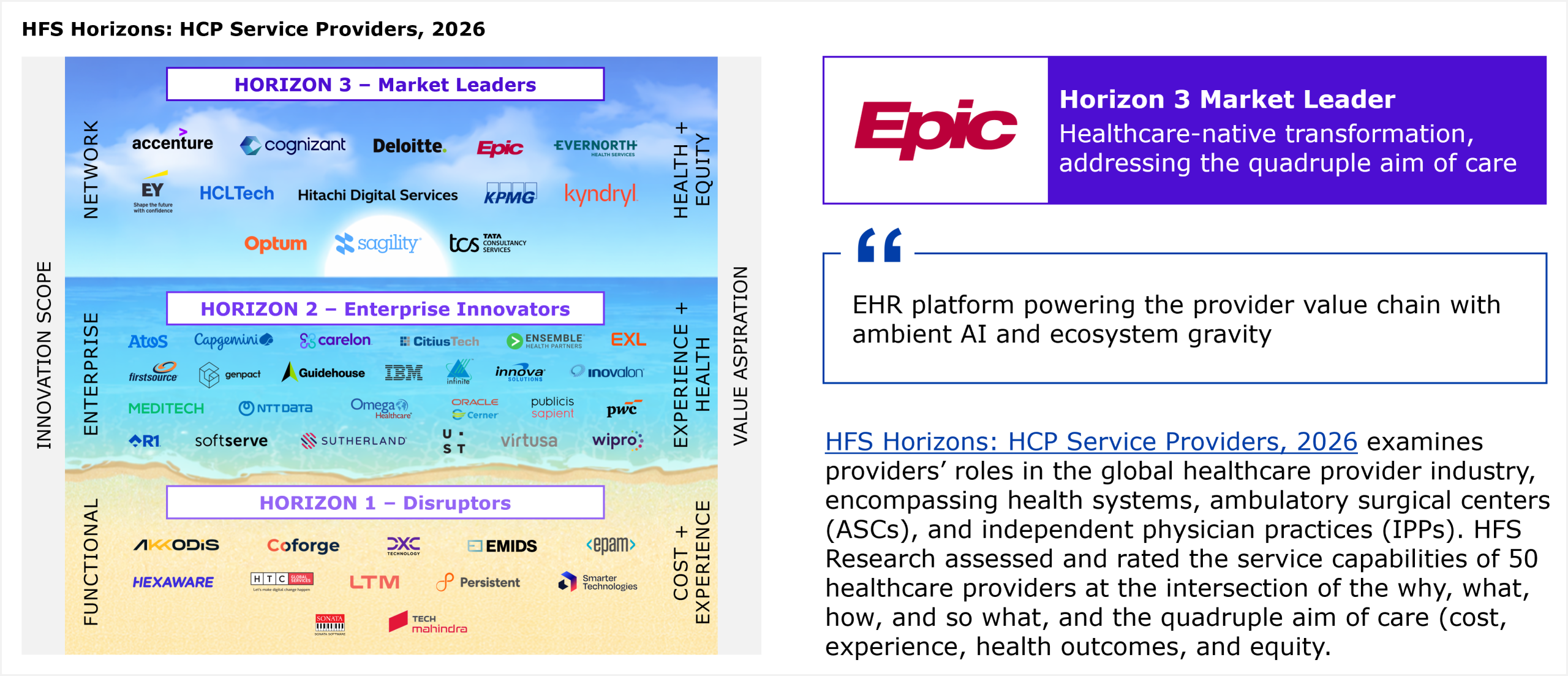
Positioning chart titled HFS Horizons: HCP Service Providers, 2026, organized as three stacked horizontal bands. The left vertical axis, Innovation Scope, rises from Functional at the bottom, to Enterprise in the middle, to Network at the top. The right vertical axis, Value Aspiration, rises from Cost plus Experience at the bottom, to Experience plus Health in the middle, to Health plus Equity at the top. The bottom band is Horizon 1, Disruptors, aligned to the Functional and Cost plus Experience level. The middle band is Horizon 2, Enterprise Innovators, aligned to the Enterprise and Experience plus Health level. The top band is Horizon 3, Market Leaders, aligned to the Network and Health plus Equity level. Epic is placed in the top band as a Horizon 3 Market Leader. The Horizon 3 Market Leaders cohort also includes Accenture, Cognizant, Deloitte, Evernorth, EY, HCLTech, Hitachi Digital Services, KPMG, Kyndryl, Optum, Sagility, and Tata Consultancy Services. The Horizon 2 Enterprise Innovators include Atos, Capgemini, Carelon, CitiusTech, Ensemble Health Partners, EXL, Firstsource, Genpact, Guidehouse, IBM, Innova Solutions, Inovalon, MEDITECH, NTT DATA, Omega Healthcare, Oracle Cerner, Publicis Sapient, PwC, R1, SoftServe, Sutherland, UST, Virtusa, and Wipro. The Horizon 1 Disruptors include AKKODiS, Coforge, DXC Technology, Emids, EPAM, Hexaware, HTC Global Services, LTM, Persistent, Smarter Technologies, Sonata, and Tech Mahindra. All providers within a Horizon are listed alphabetically and are not ranked against each other. The study assessed 50 healthcare providers in total. Source: HFS Research, 2026.

Note: All service providers within a Horizon are listed alphabetically
Source: HFS Research, 2026
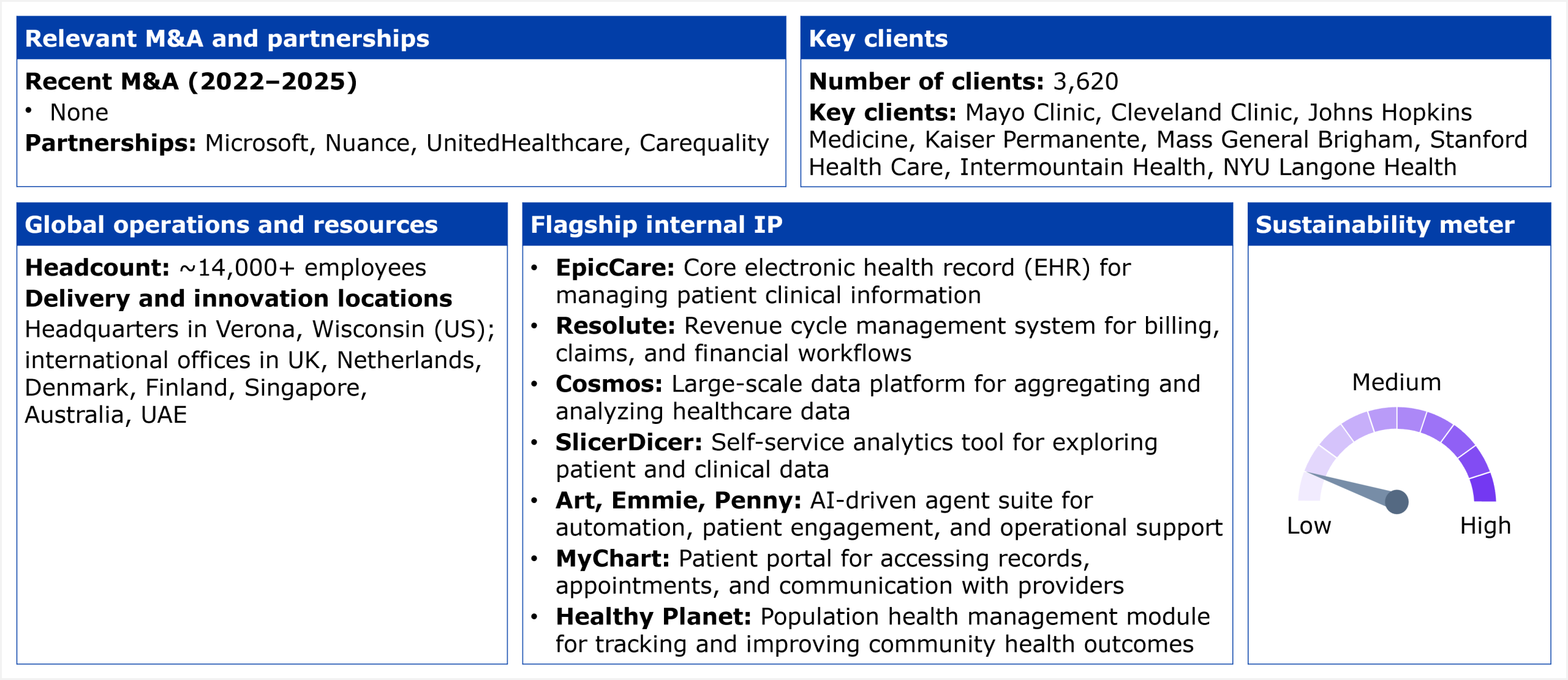
Key facts about Epic’s HCP services capabilities

Panel layout titled Key facts about Epic's HCP services capabilities, divided into five boxes plus a gauge. Relevant M&A and partnerships box: no recent acquisitions are listed for 2022 to 2025, and the listed partnerships are Microsoft, Nuance, UnitedHealthcare, and Carequality. Key clients box: number of clients 3,620, with named key clients Mayo Clinic, Cleveland Clinic, Johns Hopkins Medicine, Kaiser Permanente, Mass General Brigham, Stanford Health Care, Intermountain Health, and NYU Langone Health. Global operations and resources box: headcount of about 14,000 plus employees, headquarters in Verona, Wisconsin in the US, and international offices in the UK, the Netherlands, Denmark, Finland, Singapore, Australia, and the UAE. Flagship internal IP box lists EpicCare, the core electronic health record for managing patient clinical information; Resolute, a revenue cycle management system for billing, claims, and financial workflows; Cosmos, a large-scale data platform for aggregating and analyzing healthcare data; SlicerDicer, a self-service analytics tool for exploring patient and clinical data; Art, Emmie, and Penny, an AI-driven agent suite for automation, patient engagement, and operational support; MyChart, a patient portal for accessing records, appointments, and communication with providers; and Healthy Planet, a population health management module for tracking and improving community health outcomes. A sustainability meter is shown as a semicircular gauge marked Low, Medium, and High, with the needle pointing into the lower range toward the Low end. Source: HFS Research, 2026.

Source: HFS Research, 2026

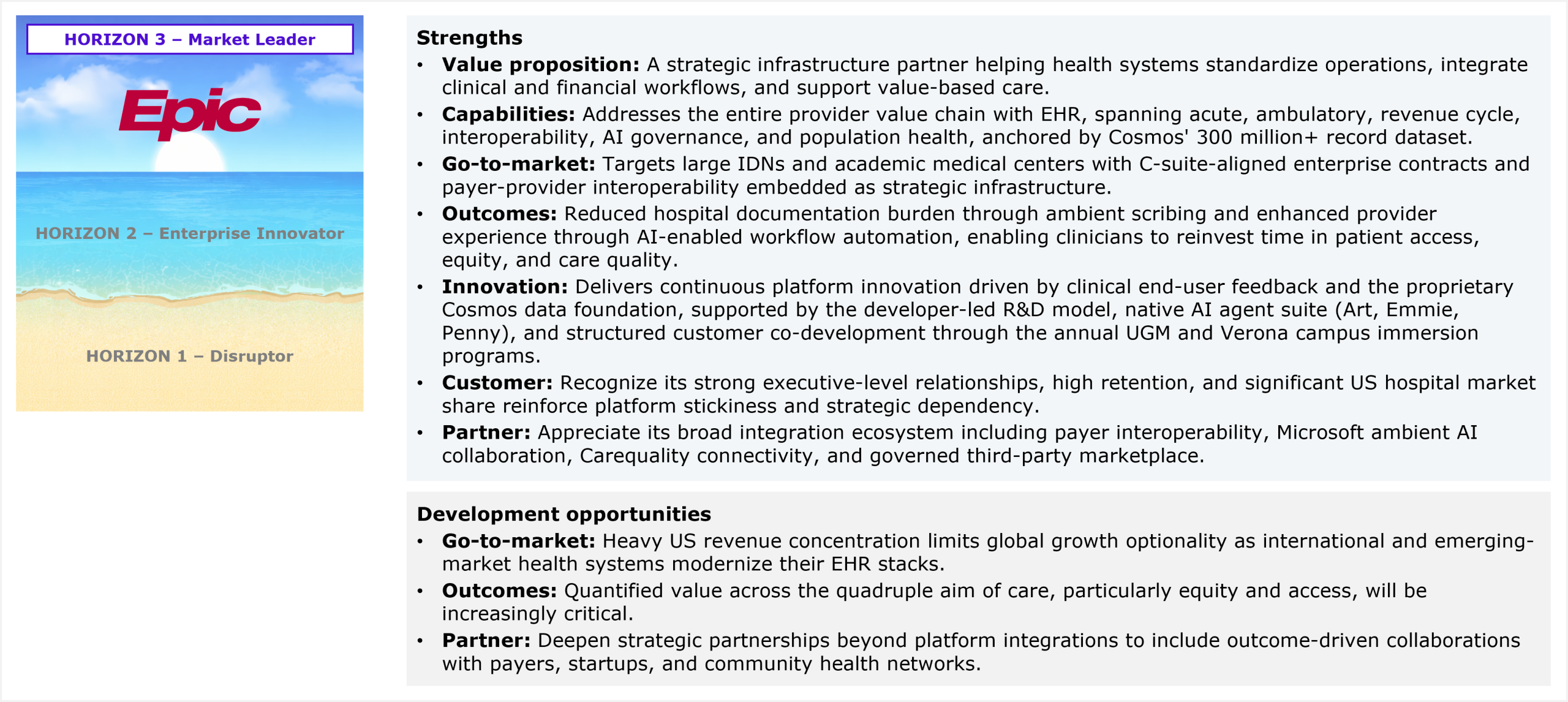
Epic’s performance in the study and HFS’ views of its strengths and development opportunities for HCP services capabilities

Slide titled Epic's performance in the study and HFS' views of its strengths and development opportunities for HCP services capabilities. On the left, a three-step Horizon ladder graphic highlights Horizon 3 Market Leader at the top, where Epic sits, above Horizon 2 Enterprise Innovator and Horizon 1 Disruptor. On the right, two lists. The Strengths list covers seven areas: value proposition, positioned as a strategic infrastructure partner helping health systems standardize operations, integrate clinical and financial workflows, and support value-based care; capabilities across the entire provider value chain with the EHR, spanning acute, ambulatory, revenue cycle, interoperability, AI governance, and population health, anchored by the Cosmos dataset of 300 million plus records; go-to-market that targets large integrated delivery networks and academic medical centers with C-suite-aligned enterprise contracts and payer-provider interoperability embedded as strategic infrastructure; outcomes including reduced hospital documentation burden through ambient scribing and enhanced provider experience through AI-enabled workflow automation, freeing clinicians to reinvest time in patient access, equity, and care quality; innovation through continuous platform development driven by clinical end-user feedback and the proprietary Cosmos data foundation, a developer-led R&D model, the native AI agent suite Art, Emmie, and Penny, and structured customer co-development through the annual UGM and Verona campus immersion programs; customer perception, recognized for strong executive-level relationships, high retention, and significant US hospital market share that reinforce platform stickiness and strategic dependency; and partner perception, appreciated for a broad integration ecosystem including payer interoperability, the Microsoft ambient AI collaboration, Carequality connectivity, and a governed third-party marketplace. The Development opportunities list covers three areas: go-to-market, where heavy US revenue concentration limits global growth optionality as international and emerging-market health systems modernize their EHR stacks; outcomes, where quantified value across the quadruple aim, particularly equity and access, will be increasingly critical; and partner, where deepening strategic partnerships beyond platform integrations to include outcome-driven collaborations with payers, startups, and community health networks is the opportunity. Source: HFS Research, 2026.

Source: HFS Research, 2026

To read the complete report, click the download button below.

Sign in to view or download this research.

Login

Register

Insight. Inspiration. Impact.

Register now for immediate access of HFS' research, data and forward looking trends.

Get Started

Download Research

    Sign In

    Sign up for a free
    research account

    With the exception of our Horizons reports, most of our research is available for free on our website. Sign up for a free account and start realizing the power of insights now.

    Digests/Newsletters: Overviews of the latest news, insight, and research by HFS.

    HFS Events: Exclusive invitations to HFS webinars, roundtables, and summits, bringing together key industry stakeholders focused on major innovations impacting business operations.

    By registering you agree to our privacy policy.

    I hereby consent that HFS Research can process my personal data.

    Premium Access

    Our premium subscription gives enterprise clients access to our complete library of proprietary research, direct access to our industry analysts, and other benefits.

    Contact us at [email protected] for more information on premium access.

    Help

    If you are looking for help getting in touch with someone from HFS, please click the chat button to the bottom right of your screen to start a conversation with a member of our team.

    [email protected]

      Contact Ask HFS AI Support