As products become software-defined, AI enabled, and continuously connected to the manufacturer, the traditional boundaries between engineering, IT, and lifecycle support are breaking down. CTOs can no longer rely on delivery models built around isolated engineering tasks, disconnected digital programs, or vendor sprawl across the product lifecycle. Instead, they increasingly need partners that can connect product engineering, software platforms, data, verification and validation (V&V), and aftermarket operational accountability in one continuous loop.
This shift is being driven by increasing product complexity. Modern products, from vehicles to industrial equipment to medical devices, are deeply embedded systems where hardware, software, AI models, connectivity, and regulatory requirements evolve simultaneously. Hardware and software development lifecycles operate at different speeds, often creating synchronization and integration challenges. Engineering decisions increasingly affect digital performance, compliance exposure, operational uptime, and warranty risk, long after a product leaves the design stage.
For CTOs, the challenge is no longer securing engineering capacity. It is orchestrating the lifecycle of software-defined systems without creating fragmentation across providers, tools, and domains. When lifecycle ownership is fragmented, enterprises experience slower release cycles, validation delays, compliance gaps, and unclear accountability when failures occur in the field.
Enterprises are therefore consolidating toward partners that can span engineering, digital platforms, and lifecycle execution.
Engineering delivery models are undergoing a structural shift. Historically, enterprises relied on fragmented providers. One handled mechanical engineering, another embedded software, others testing, IT platforms, or customer support operations. While workable in slower innovation cycles, this model increasingly creates delays, rework, and accountability gaps in software-defined systems.
Today’s product environments demand tighter integration across engineering and digital layers. Software updates affect mechanical performance. AI models depend on data pipelines and cloud infrastructure. Regulatory validation now spans engineering artifacts and operational telemetry. In a recent worldwide study across the heavy industries sector, HFS Research found that more than half of the 202 participants opined that external service providers will play a significant role in building or scaling their internal capabilities. However, 48% of them plan to consolidate their vendors over the next two years into fewer, broader partners.
When disconnected vendors deliver these elements, enterprises face practical consequences:
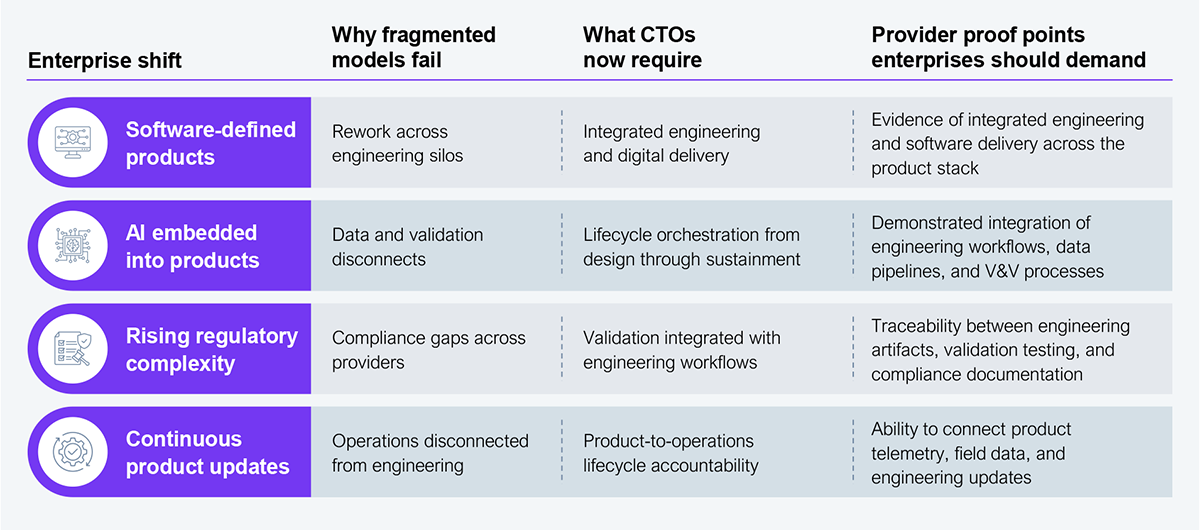
Lifecycle accountability is, therefore, becoming the new battleground for engineering services. Exhibit 1 illustrates why CTOs are shifting from fragmented engineering ecosystems toward partners that can orchestrate the entire product lifecycle.
Source: HFS Research, 2026
As enterprises move toward lifecycle-accountable engineering models, CTOs should look for clear delivery signals from potential partners.
These signals include
Providers that cannot demonstrate these capabilities risk reinforcing the fragmentation enterprises are trying to eliminate
Akkodis’ strategy reflects this lifecycle convergence. The company combines engineering expertise well entrenched “in the customer’s process,” particularly in complex and regulated industries such as automotive and aerospace, with expanding digital and AI capabilities that connect engineering decisions to operational outcomes. AI-Core is Akkodis’ recently launched platform engineered to accelerate data processing, AI, automation, validation, and testing across industries and domains.
One instance of this shift from isolated tasks to integrated product lifecycle accountability can be seen in Akkodis’ work with a major German automotive OEM, where the firm supports software and systems engineering across connected vehicle platforms. By combining embedded engineering expertise with digital capabilities, the company coordinates development, testing, and validation across multiple engineering domains, allowing the client to accelerate release cycles while maintaining regulatory and safety standards.
This example demonstrates how integrated engineering and validation delivery can help enterprises maintain compliance while accelerating development cycles.
A similar model is emerging in North America (NA). Akkodis supports engineering programs for major aerospace and defense manufacturers that require coordinating systems engineering, embedded software development, and certification testing across complex regulatory environments. These programs require partners that can integrate engineering workflows, digital toolchains, and validation processes into a unified lifecycle delivery model.
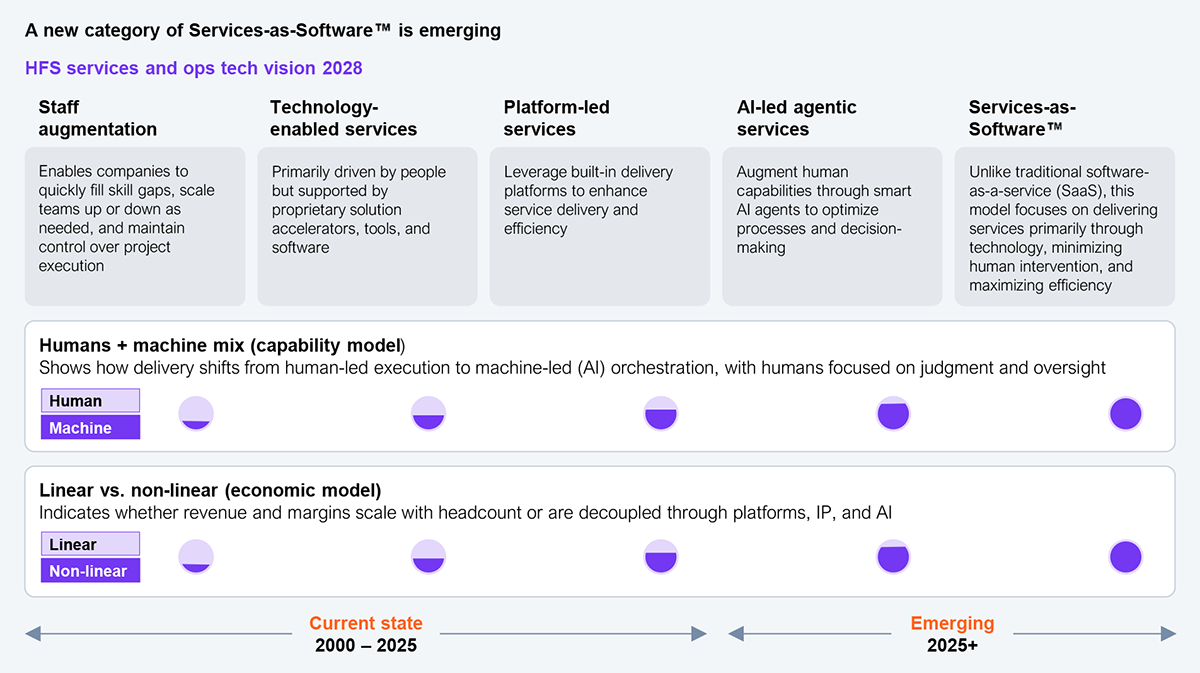
This shift also aligns with the HFS vision of Services-as-Software™ (SaS), where services evolve from staff-heavy delivery models toward non-linear, technology-enabled, platform-driven, and increasingly AI-orchestrated execution (Exhibit 2).
Source: HFS Research, 2026
As the market shifts away from traditional IT staffing toward SaS-based models and AI continues to reshape IT delivery, Akkodis NA has successfully transformed to such an approach for scaling its managed services, engineering programs, and solution-led delivery.
The company’s leadership is also pushing an AI-first delivery mindset that applies AI across engineering workflows, solution development, and service delivery. The objective is not only productivity improvement but reshaping how engineering services are delivered by compressing development cycles, accelerating validation, and enabling more outcome-oriented engagements.
For Akkodis, the opportunity is to translate its engineering depth into a repeatable lifecycle delivery model that combines domain expertise, digital integration, and AI-enabled execution. For an energy customer, the team designed and implemented an AI-led platform solution leveraging the team’s deep knowledge of SCADA, IT-OT integration, supply chain management, and product engineering.
For CTOs navigating software-defined products and AI-enabled systems, the choice of engineering partners is shifting from capacity to accountability. Enterprises that continue to manage fragmented engineering vendors risk slower product releases, higher validation costs, compliance exposure, and unclear ownership when failures occur in the field.
Enterprise leaders should take three actions. First, consolidate engineering and digital providers where lifecycle integration is critical. Second, require partners to demonstrate how engineering, validation, data, and operations connect across the full product lifecycle. Third, measure partners on release velocity, validation cycle time, operational reliability, and compliance outcomes rather than engineering hours delivered.
CTOs should judge any contender in this market on whether it can deliver integrated lifecycle execution with measurable outcomes such as faster release cycles, faster validation, stronger reliability, and clearer compliance traceability.
Register now for immediate access of HFS' research, data and forward looking trends.
Get StartedIf you don't have an account, Register here |
Register now for immediate access of HFS' research, data and forward looking trends.
Get Started