Boardroom conversations have shifted from how enterprises can deploy AI to how they can drive meaningful outcomes, but the reality is that enterprises have a people problem they must address first. This was the exact topic of conversation at HFS’ recent Executive Roundtable, in partnership with Cognizant, titled Accelerating enterprise outcomes in the AI era: Activating the Services-as-Software™ flywheel.
The conversation quickly revealed that enterprises don’t have the right people, with the right skills, in the right roles, to drive scalable outcomes in the AI era. If you hold any senior leadership position within your organization, whether you’re the CEO, CHRO, or COO, you hold some responsibility for your firm’s workforce strategy. It’s your responsibility to fix the people problem to ensure your firm drives outcomes that impact your top and bottom line (not just your marketing collateral) with AI.
Source: HFS Research, 2026
Enterprise leaders acknowledge that while they have invested heavily in AI tools, platforms, and capabilities, they remain a long way from generating significant outcomes at scale. HFS’ own research reinforces this, as Exhibit 2 shows that only around a quarter of enterprises are scaling or pioneering AI today.
The roundtable discussion made it clear that the gap isn’t primarily a technology problem; it’s a people one. Enterprises can invest in tools like Copilot, but investments mean very little if their employees don’t have the skills needed to actually leverage them. One roundtable attendee gave us a perfect real-world example, explaining that while savvy employees were already saving thousands of hours with their AI tools, 20% of the workforce had yet even to open them.
This highlights that enterprises’ AI investment will have a low ceiling unless they reassess their workforce for the AI era. Enterprises must ensure employees understand that AI is here to augment them, not replace them, although the pace of adoption varies by industry. The key to this is nurturing digital native graduates at the bottom of the career pyramid.
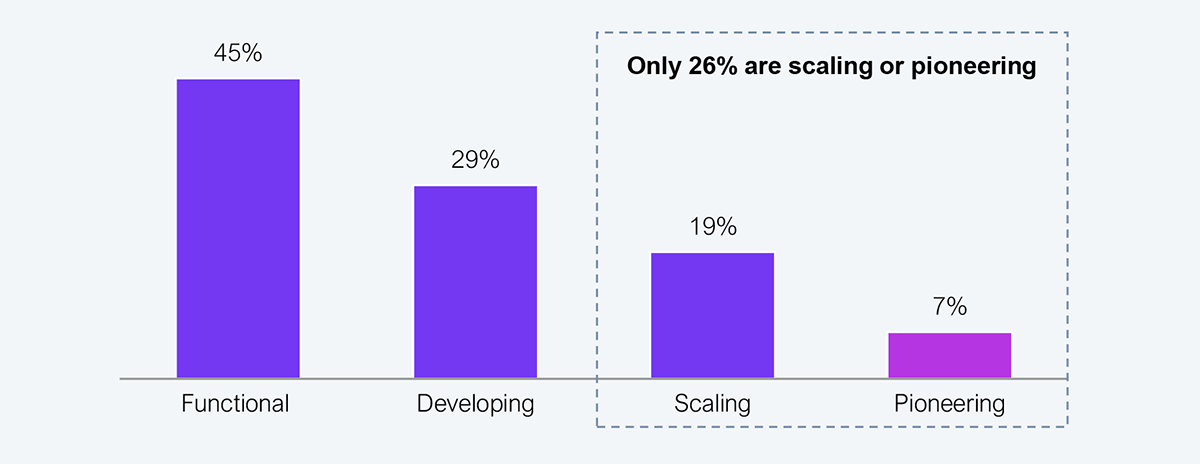
Sample: 545 major enterprise decision makers
Source: HFS Research, 2026
Enterprises’ people problem isn’t just about reskilling existing employees. It’s about reshaping how they view emerging talent. Economists report a significant reduction in graduate hiring as a result of emerging technologies continuing to automate entry-level manual work. If technology can do the same work as a graduate at half the cost, why not? One roundtable attendee explained that while it seems a logical approach (and it might be in the short term), it has long-term consequences.
Organizations that reduce graduate hiring are cutting the most digital-savvy generation in the workforce today. Enterprise leaders agreed that graduate employees are the most proactive AI adopters in their organizations. Not only that, but they risk turning away the very talent they expect to lead their organization in the future, along with those who typically build their culture and identity.
This is why enterprises must continue hiring graduates, but they need to do it differently. Instead of viewing them as cheap labor to complete manual tasks, enterprises should reframe roles and outcomes around technology-enabled services. They must give employees the environment and tools to continually upskill themselves. One leader explained how this shifts to an “hourglass workforce,” hollowing out mid-career roles and relying on graduates and highly skilled employees. It requires a complete overhaul in how graduates are assessed, onboarded, and managed through the early years of their careers, and it needs the right leadership in place to make it a reality.
Hiring AI-native employees is only half the battle. If your organization isn’t ready to support how graduates and digital-savvy employees use these tools, you risk growing your AI Velocity Gap. These employees will grow increasingly frustrated that they can’t leverage the tools available to them and ultimately look for an employer that allows them to. You can avoid this by implementing clear internal AI policies and fostering a culture of experimentation. That only happens with the right leadership.
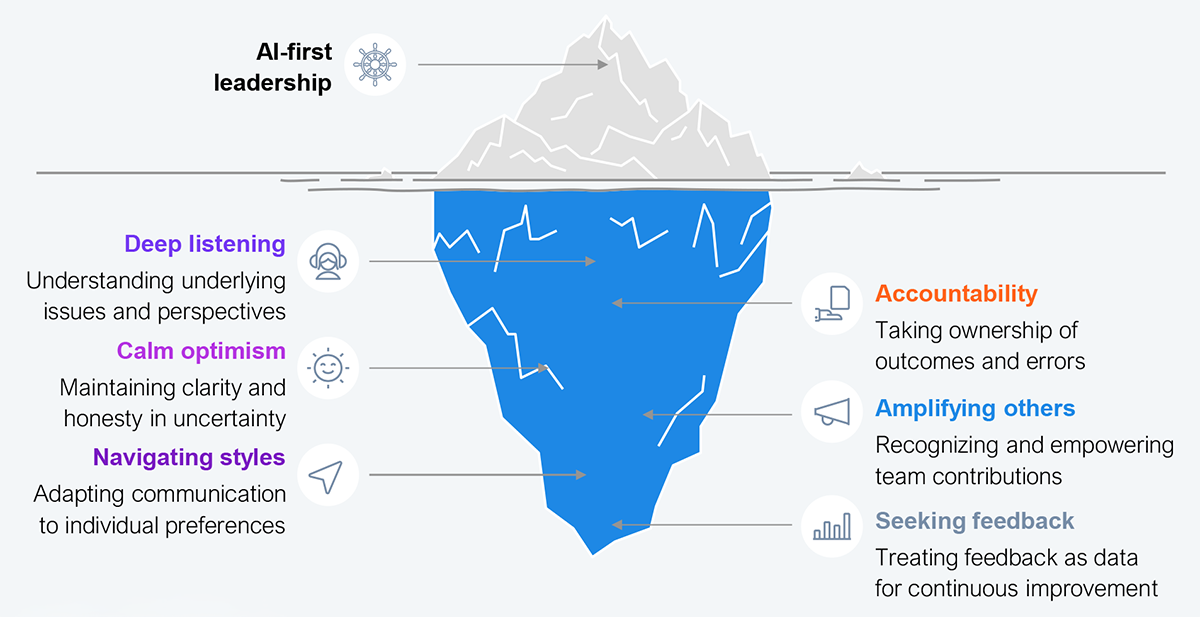
Traditional leadership models were built around oversight, risk aversion, and hierarchical org structures, but that approach is no longer applicable. Exhibit 3 sets out the critical behaviors that define AI-first leadership. These traits are key to removing the barriers to AI adoption. When leaders empower employees, lead by example, and take accountability for outcomes, AI adoption accelerates. Meanwhile, leaders stuck with the archaic mindset will find limited enthusiasm and AI projects that never deliver real outcomes. Putting it simply, leaders must foster a culture that embeds AI at the core, rather than having it owned by a single business center.
These leadership behaviors are the first step to activating the Services-as-Software flywheel in your firm; budget and headcount are irrelevant without them.
Source: HFS Research, 2026
The enterprises that succeed in the AI era won’t be those with vast innovation budgets and headcounts. It will be the firms that invest in making sure they have the right people, with the right skills, in the right roles, but that starts with leadership. Every leader should step back and ask themselves how they can reset their leadership behaviors to remain relevant in the future, then ensure they are fostering a culture of creative digital-native employees who are willing to drive change with AI.
Register now for immediate access of HFS' research, data and forward looking trends.
Get StartedIf you don't have an account, Register here |
Register now for immediate access of HFS' research, data and forward looking trends.
Get Started