This Market Impact Report is for CIOs, CTOs, heads of AI, and senior operations leaders in retail, CPG, healthcare, insurance, and industrials evaluating how to move AI from pilot purgatory to enterprise scale and adopt Services-as-Software™ as a standard operating model.
This report outlines how enterprise leaders in retail, CPG, healthcare, insurance, and industrials are deploying AI to compress decision time, improve customer experience (CX), and industrialize operations, and why most efforts stall at scale. We test what ‘good’ looks like for governance, measurement, and sourcing in the emerging Services-as-Software (SaS) era. The findings translate directly into buyer actions, KPIs, governance gates, and contract levers.
Insights were drawn from several interviews with CIOs, CTOs, heads of AI, and senior business leaders in healthcare, retail, CPG, insurance, and industrials across North America and Asia (anonymized where requested).


Three years ago, it took half an hour. Now the same person can do it in five seconds. That’s not a fad. That’s transformation.
— Head of AI at a US-based healthcare company

AI can be a buzzword. It’s not a magic wand. Sometimes it kills one issue and creates another.
— CIO of an Asia-based insurance company


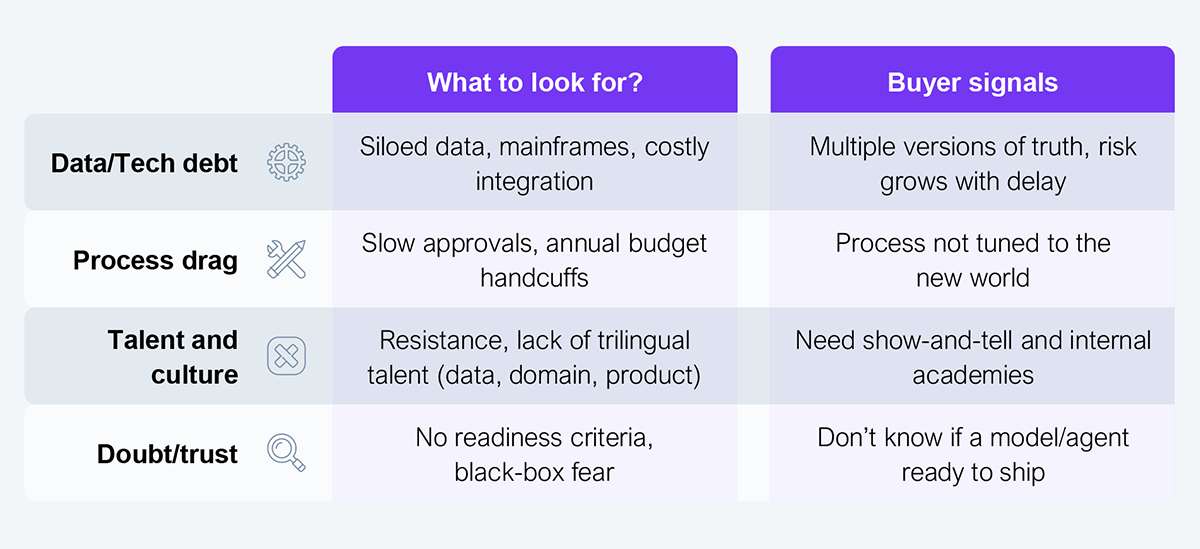
For all the enthusiasm around AI, a sobering fact remains: most enterprise AI initiatives do not fully scale or deliver sustained impact. Multiple responses indicate that only 10–15% of AI proof-of-concepts make it to production. Our interviews confirmed this ‘scaling wall’ of debt, drag, deficit, and doubt.
Every executive had stories of promising pilots that fizzled out or stalled, pointing to a similar pattern: no shortage of AI POCs but a lack of fully deployed AI solutions enterprise-wide.
So why is scaling AI hard? The leaders we spoke with cited four interlocking challenges: technological, organizational, cultural, and trust (see Exhibit 1), which must be overcome to break out of pilot purgatory.
Legacy tools weren’t built with AI in mind. Data is ‘spaghetti’ with no consolidation.
— Retail and insurance leaders
Source: Interviews with several enterprise leaders across the US and Asia
Breaking through this scaling wall requires an all-fronts assault. Companies must modernize their data and IT environment (cloud migration, data lakes, APIs, modular architectures) so AI pilots aren’t stuck in integration hell. They should revamp processes to be more agile—adopting DevOps/MLOps for model deployment, implementing agile project methods, and changing approval workflows to empower faster experimentation. Culturally, they must invest in upskilling and change management. This involves positioning AI as a tool to augment employees, not replace them, and training staff to confidently use AI-driven insights in their day-to-day decisions. A retail executive said they host ‘AI demo days’ where teams showcase what they built and learned. Such sessions demystify AI and drum up cross-company support while building grassroots support to scale successful projects to other units.
Crucially, the tone from the top matters. Several executives noted that without C-level support, AI initiatives languish in innovation labs. One described how their CEO and business unit heads actively ask “How are we using AI on this?”—a clear signal that scaling AI is a priority.
A retail product executive said their CIO always insists on an ‘AI plan’ for any new budget request. This kind of mandate forces teams to bake scalability into project design (they know it’s headed for real deployment, not just a sandbox). It also helps combat the ‘random acts of AI’ syndrome by aligning AI efforts with business strategy and ensuring resource commitment beyond the prototype phase.
Enterprise leaders no longer ask “why AI?” but “where and how can AI deliver the most agility?” Across our interviews, executives described a range of AI initiatives aimed squarely at making their businesses more responsive and impressive. These initiatives span decision support, customer-facing innovations, and operational efficiencies.
Here are some of the prominent bets enterprises are placing:
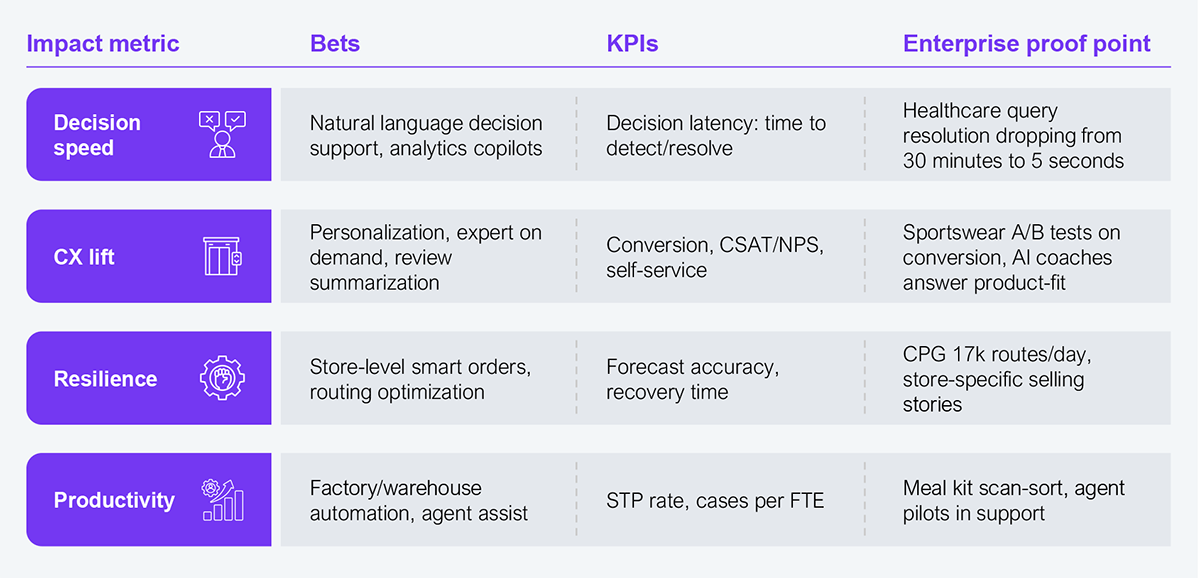
Decision support in healthcare: A healthcare AI head described complex, cross‑modal queries dropping from 30 minutes to five seconds, enabled by governed pipelines and a blend of proprietary/open models and Gemini for Google Cloud—an example of measurable decision‑latency collapse.
These tools are really great. I love the human support I get with them.
— Head of Applied AI at a healthcare company
Retail personalization at scale: A global sportswear brand operationalized expert‑on‑demand and AI coaches to provide 24×7 product‑fit guidance by drawing on shopping history, validating the results through A/B testing on add‑to‑cart, conversion, and checkout rates.
We plan each season because we must respond to trends and consumer insights on Nike.com and our app.
— Digital business director of a sportswear brand
Supply chain and frontline optimization in beverages: A global beverages leader uses store‑specific selling stories that factor demographics and weather while running 17,000 daily routes with AI‑assisted routing (Ortec). Data governance is managed using a system integrator, while vendors provide planning, manufacturing, and CRM stacks.
We like to use the word “smarter” as in “how do we make every process smarter?”—suggestions our people can act on.
— Supply chain transformation lead, CPG
Meal kit operations: Machine learning and synthetic data help improve forecast accuracy. Barcoding and scan‑sort automation reduce manual touches. Pilot agentic AI augments customer support.
Insurance operations: Straight‑through underwriting and KYC checks combine machine learning, computer vision, and HITL for compliance. Conversational bots support customers.
Technology programs (especially automation and outsourcing) have traditionally been justified with cost savings and efficiency gains. The classic KPI might be an ‘X% reduction in processing time’ or a ‘Y headcount reduction leading to $Z saved.’ While cost and efficiency remain important, our research found a notable shift: leading organizations are redefining success in terms of agility, resilience, and CX rather than cost alone. KPIs are expanding beyond savings to include decision latency, forecast accuracy, time to detect/resolve, conversion, CSAT/NPS, and error rates.
Source: Interviews with several enterprise leaders across the US and Asia
One might wonder if there are trade-offs between cost and these new metrics. In some cases, yes—improving resilience or CX means investing more in redundancy or service, which can increase cost. However, the interviewed leaders mostly believe that AI lets them transcend the old trade-off. For example, it can simultaneously improve CX and reduce cost by automating routine tasks (customers get faster service; company saves money on manual labor) or it can improve resilience and efficiency by optimizing inventory (less stockouts and inventory holding cost). These win-win outcomes are the ideal, and AI makes them more achievable than traditional methods. Therefore, focusing on the broader agility metrics often yields cost benefits, even if indirectly.
Moreover, as enterprises recalibrate their success metrics, they’re also reassessing their expectations for providers and partners. This mindset is driving the Services-as-Software evolution that we will discuss in the next section.
Don’t come to me selling 30% cost savings through outsourcing. Tell me how you’ll improve my NPS by 10 points or reduce my turnaround by 50%—that’s how you’ll get my attention now.
— CIO of a US-based specialty retailer
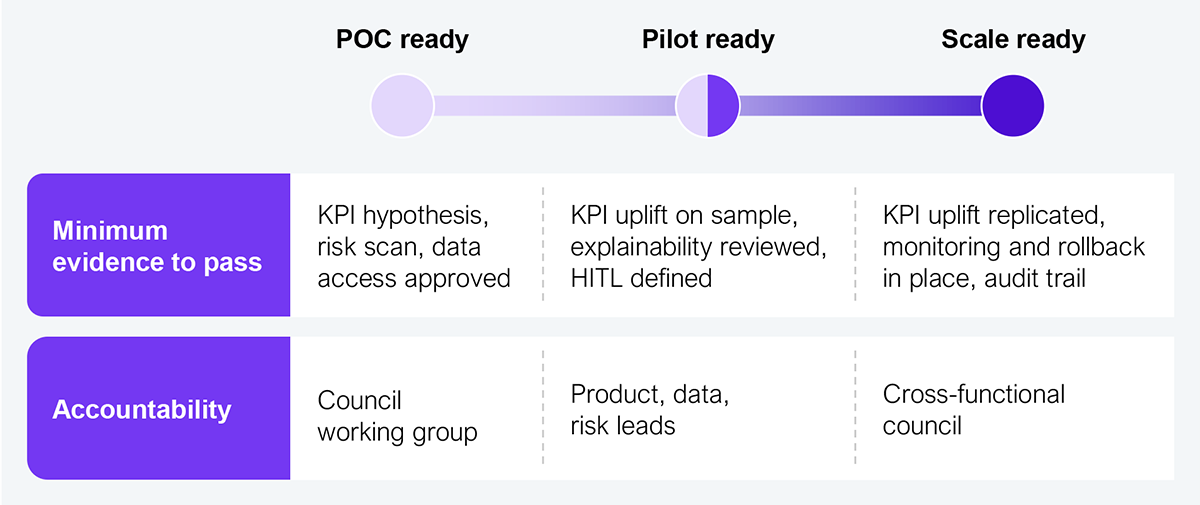
The one theme that nearly every executive hammered home was this: without proper governance, your AI ambitions will run amok or aground. Leaders want guardrails that accelerate scale. Readiness criteria (accuracy thresholds, robustness, explainability), versioning, always-on monitoring, and a rollback plan are emerging as standard gates.
How do you know when a tool, technique, or agent is ready for production? How do you manage and version it?
— Head of Applied AI at a healthcare company
To identify which AI projects are the most promising and ready to scale to the next level, enterprises are designing stage-gates, with dedicated teams responsible for moving them to the next stage.
Source: Interviews with several enterprise leaders across the US and Asia
Here’s a breakdown of how enterprises are implementing governance and why it’s so critical to infuse agility.
In summary, governance is the keystone because it holds together all other pieces. It ensures that the AI bets align with business strategy, attacks the scaling barriers by creating consistency and trust, and bakes in the redefined success metrics and ethical considerations.
Amid the tactical work of scaling AI and retooling metrics and governance, our conversations also touched on a more strategic, disruptive trend on the horizon: the blurring line between technology services and software products. We call this the Services-as-Software (SaS) paradigm, where services traditionally delivered by humans (often via outsourcing or consulting engagements) are increasingly being codified into software platforms, frequently powered by AI. In parallel, software vendors are infusing more services-like capabilities into their products, effectively encroaching on a territory once dominated by service providers. This two-way convergence, sometimes dubbed ‘reverse SaaS’ or ‘everything-as-a-service,’ is poised to redefine how enterprises procure and consume solutions and how providers deliver value.
Why is SaS the need of the hour? Because SaS promises agility on a fundamentally different scale. Instead of lengthy service engagements or labor-intensive contracts, enterprises could tap into on-demand, intelligent platforms that deliver outcomes via automation and minimal human oversight. It’s the difference between hiring a team of analysts to continuously monitor the supply chain versus subscribing to a supply chain control-tower software that automatically flags anomalies to managers. The latter is faster, more scalable, and outcome-focused.
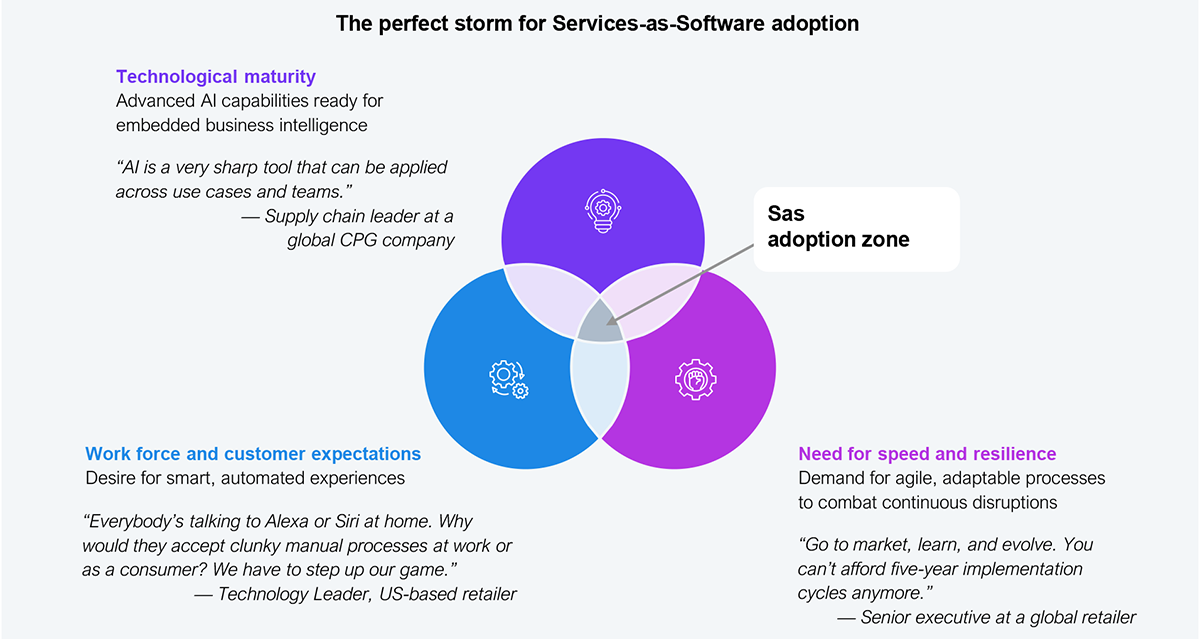
Three core factors, i.e., technology maturity, need for speed and resilience, and workforce and customer expectations, are fueling the SaS agenda.
Source: Interviews with several enterprise leaders across the US and Asia
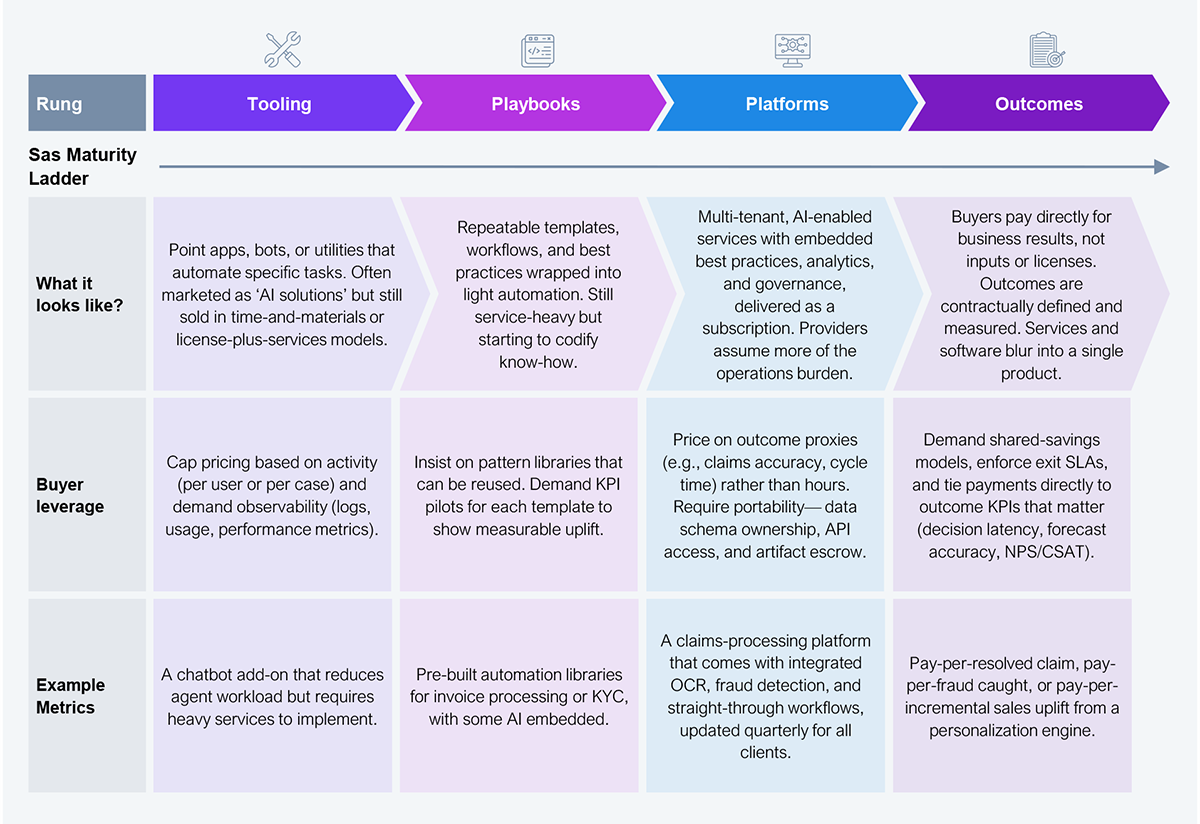
However, SaS is a continuum and HFS (in collaboration with the leaders) contemplated a SaS maturity ladder. This buyer-side framework shows how ‘services become software’ in four rungs—each rung changes what you buy, how value is proven, and how you contract. It helps you locate every vendor engagement today and plot the next step toward paying for outcomes with portability and guardrails.
Source: Interviews with several enterprise leaders across the US and Asia
The role of providers is shifting from labor arbitrage to AI-first partners. They are required to codify IP, embed AI across delivery, and measure metrics by outcomes, not hours. Increasingly fatigued by AI‑washing, enterprises are prioritizing partners for their embedded intelligence and willingness to co‑own outcomes. Buyer expectations include:
Vendors that didn’t embed AI risk being abandoned by enterprises.
— Supply chain leader at a CPG firm
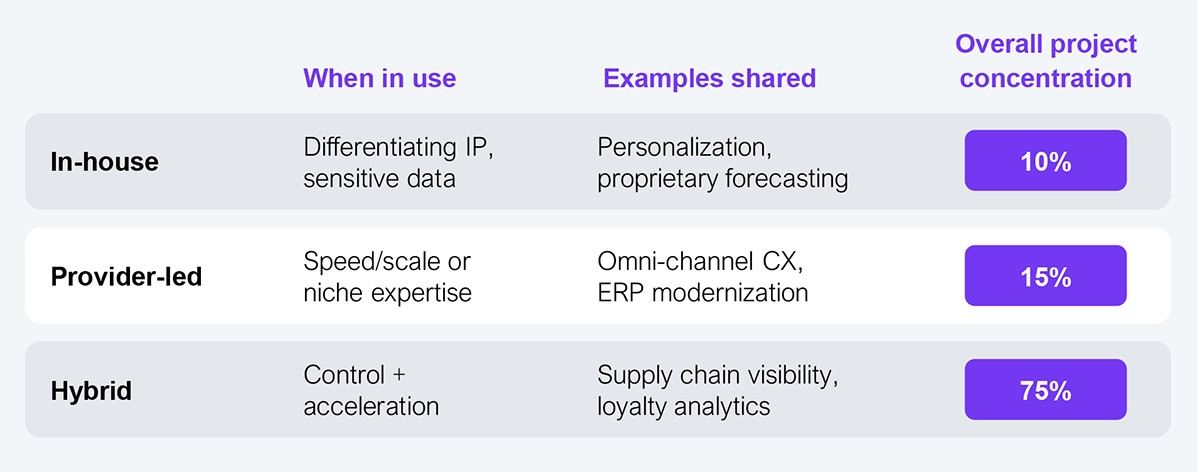
Enterprises, on the other hand, are opting for a hybrid build approach while pivoting toward an AI-centric future. They’re keeping their strategy, IP, and sensitive data in-house and expecting providers to accelerate the development and scaling of managed services.
Source: Interviews with several enterprise leaders across the US and Asia
HITL remains a prudent approach, consistently endorsed by leaders as the durable near-term model. Here’s a prescribed 18-month roadmap based on our ongoing enterprise work and brainstorming with the leaders interviewed for this report:
100 days
12 months
18 months
Provider pressure test
The journey toward an AI-empowered, agile enterprise is challenging but underway in organizations across sectors. Their experiences form a playbook that others can follow, adapting to their context but guided by common principles.
While still nascent, the shift to outcome-based, AI-infused service models is on the horizon. Prepare by rethinking vendor strategies and exploring pilots with progressive partners. Enterprises that internalize this change early will shape it, negotiating better terms and forging the ecosystems that suit their needs. As buyers, cultivate flexibility in contracts. As providers, invest in IP and platforms.
Register now for immediate access of HFS' research, data and forward looking trends.
Get StartedIf you don't have an account, Register here |
With the exception of our Horizons reports, most of our research is available for free on our website. Sign up for a free account and start realizing the power of insights now.
Our premium subscription gives enterprise clients access to our complete library of proprietary research, direct access to our industry analysts, and other benefits.
Contact us at [email protected] for more information on premium access.