For decades, India supplied the people behind global enterprise operations, but now a different layer is forming as startups convert that operational expertise into Services-as-Software™ (SaS) platforms aimed directly at enterprise budgets in the same spend categories CIOs already fund. This is not a sourcing directive but a visibility shift for CIOs, because when services convert into software, the ecosystems that produce credible platforms start to matter as much as the firms that deliver the work. This perspective is based on our recent conversations, capital flows, and the growing number of platforms emerging in the same domains where Services-as-Software is taking hold.
By the time these platforms enter formal vendor evaluations, early adopters will already have secured cost, speed, and data advantages, which is why the real risk is not choosing the wrong vendor, but recognizing the shift too late.
SaS restructures how enterprise capability is built and monetized. Work historically delivered through managed services, integration programs, and large delivery teams is being codified into repeatable software workflows that can be executed. Security monitoring becomes analytics-driven platforms. Cloud governance becomes embedded in policy engines. Operational redesign becomes configurable AI-native systems.
This is not incremental automation layered onto legacy delivery but a shift in economic model. When expertise is embedded into product architecture, revenue detaches from headcount and attaches to workflow ownership. What once scaled linearly with labor now scales with adoption. Margin pools migrate toward the platform layer that owns the logic, the automation, and the data exhaust.
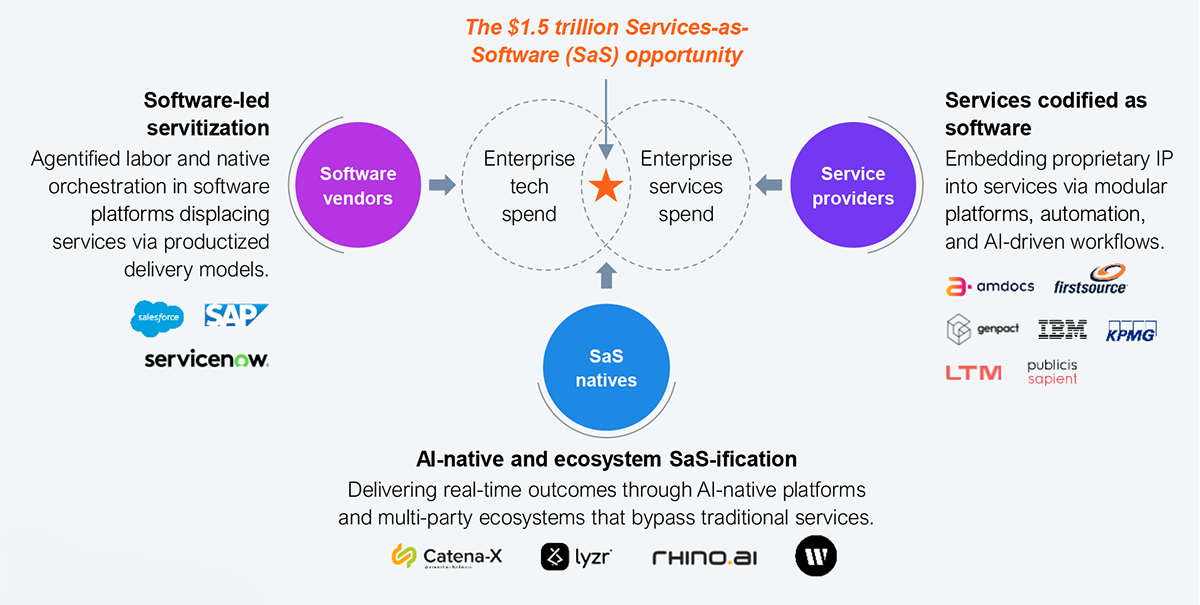
That migration changes negotiating power, renewal leverage, and long-term cost structures. Platforms that encode services into software accumulate workflow gravity and institutional data, increasing switching friction over time. As automation deepens and intelligence becomes native to platforms, the boundary between services and software continues to blur (see Exhibit 1).
Source: HFS Research, 2026
Ecosystems capable of converting delivery expertise into scalable platforms begin competing upstream for budgets traditionally allocated to service providers.
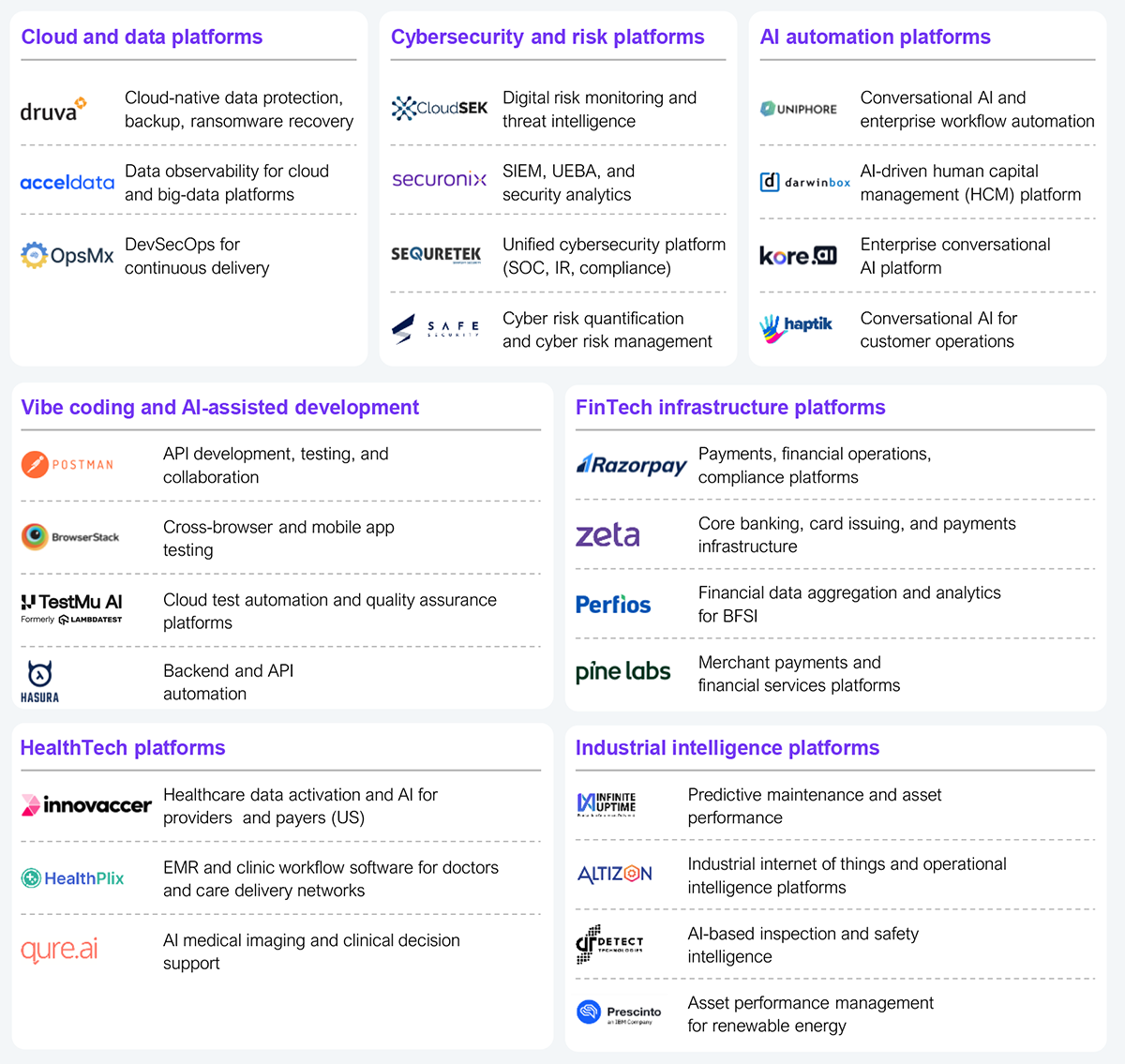
India’s startup ecosystem has crossed the point where it can be treated as background noise in enterprise technology. More than 159,000 DPIIT-recognized startups are active today. The volume matters because it creates density and repeatable patterns, not because it guarantees quality. What matters for enterprise technology leaders is where serious activity is clustering, which is increasingly visible in the same spend categories SaS is already reshaping, including cloud operations, cybersecurity, AI automation, fintech infrastructure, health platforms, and industrial intelligence.
This is not “innovation in India.” These are services being turned into products.
Across these segments, work historically delivered through managed services and integration efforts is being embedded into software workflows designed to execute, with security monitoring and response codified into analytics engines, cloud optimization and governance productized into platforms, and operational workflows structured into AI-native systems that absorb what used to require delivery capacity and institutional know-how.
Several emerging players are beginning to look less like regional startups and more like early platform contenders building enterprise-grade platforms in these domains, particularly when they combine repeatable enterprise workflows, measurable outcomes, and governance maturity that can survive real procurement scrutiny (see Exhibit 2).
Source: HFS Research, 2026
India’s startup ecosystem is not only large but also shaped by factors that determine how quickly platforms become enterprise-ready and how deeply they can be embedded into operational workflows.
Taken together, these factors do not make India unique. They align it structurally with the SaS transition, where enterprise credibility, workflow depth, and economic durability matter more than narrative scale.
As Services-as-Software reshapes enterprise operating models, India’s startup ecosystem is becoming more visible as a contributor to AI-native and platform-led capabilities.
This is not a procurement directive. It is a visibility shift.
HFS will continue tracking how this ecosystem develops and how its platforms perform in global enterprise contexts. Enterprises should monitor this evolution as part of their broader SaS landscape.
Register now for immediate access of HFS' research, data and forward looking trends.
Get StartedIf you don't have an account, Register here |
With the exception of our Horizons reports, most of our research is available for free on our website. Sign up for a free account and start realizing the power of insights now.
Our premium subscription gives enterprise clients access to our complete library of proprietary research, direct access to our industry analysts, and other benefits.
Contact us at [email protected] for more information on premium access.