This HFS Take 5 report is for CIOs, CEOs, CFOs, and AI transformation leaders rebuilding the operating model to scale production AI for growth.
Enterprise AI is moving faster than the operating model can support. Most enterprises can deploy AI, but few can price it on outcomes, orchestrate it across the ecosystem, or make it deliver growth. The result is more complexity and less impact. The data, governance, and integration foundations required to scale production AI have not kept pace. The technology is no longer the challenge, but the operating model around AI is.
HFS Research, in partnership with Movate, surveyed senior enterprise leaders to understand how organizations are scaling production AI in 2026, and where the operating model must change to keep pace.


The Bottom Line: Enterprises are scaling AI faster than they are building the foundation, the commercial discipline, and the ecosystem orchestration required to make AI deliver growth. To turn AI’s efficiency dividend into growth impact, the operating model must come first.
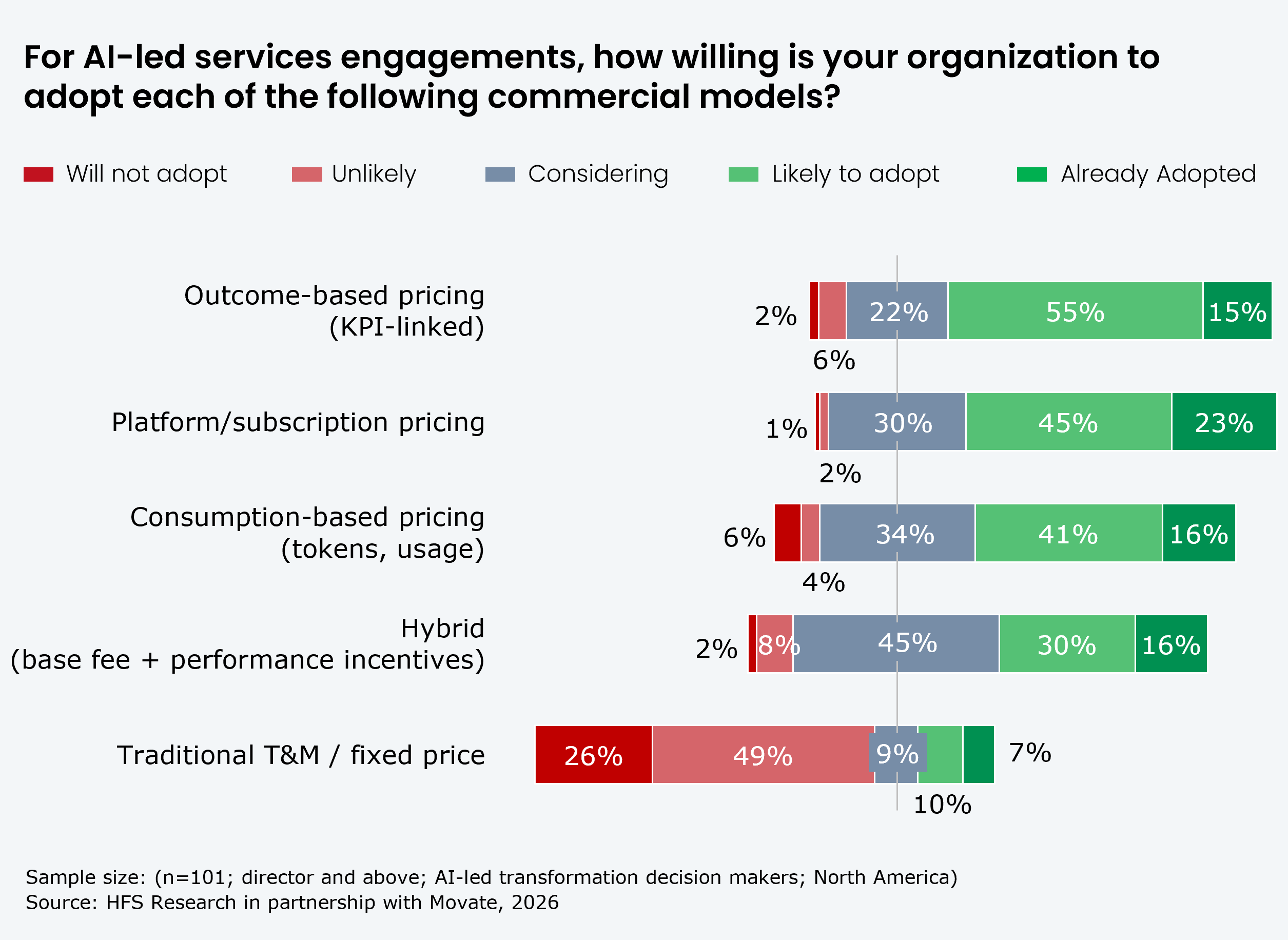
The commercial model market has tipped
Seventy percent of enterprise buyers are committed to or already adopting outcome-based pricing for AI-led services. Only 17% are willing to adopt traditional T&M, while 75% are unlikely or will not. T&M is the most rejected item across the entire survey.
Pricing has shifted from effort to outcomes
Enterprises are no longer willing to pay providers for effort. The contract is shifting toward outcomes that can be measured against business KPIs.
Build the framework with discipline
Demanding outcome-based pricing is the easy part. Executing it requires defined KPIs tied to AI specifically, attribution methods that hold up under scrutiny, and contracts that survive under stress.
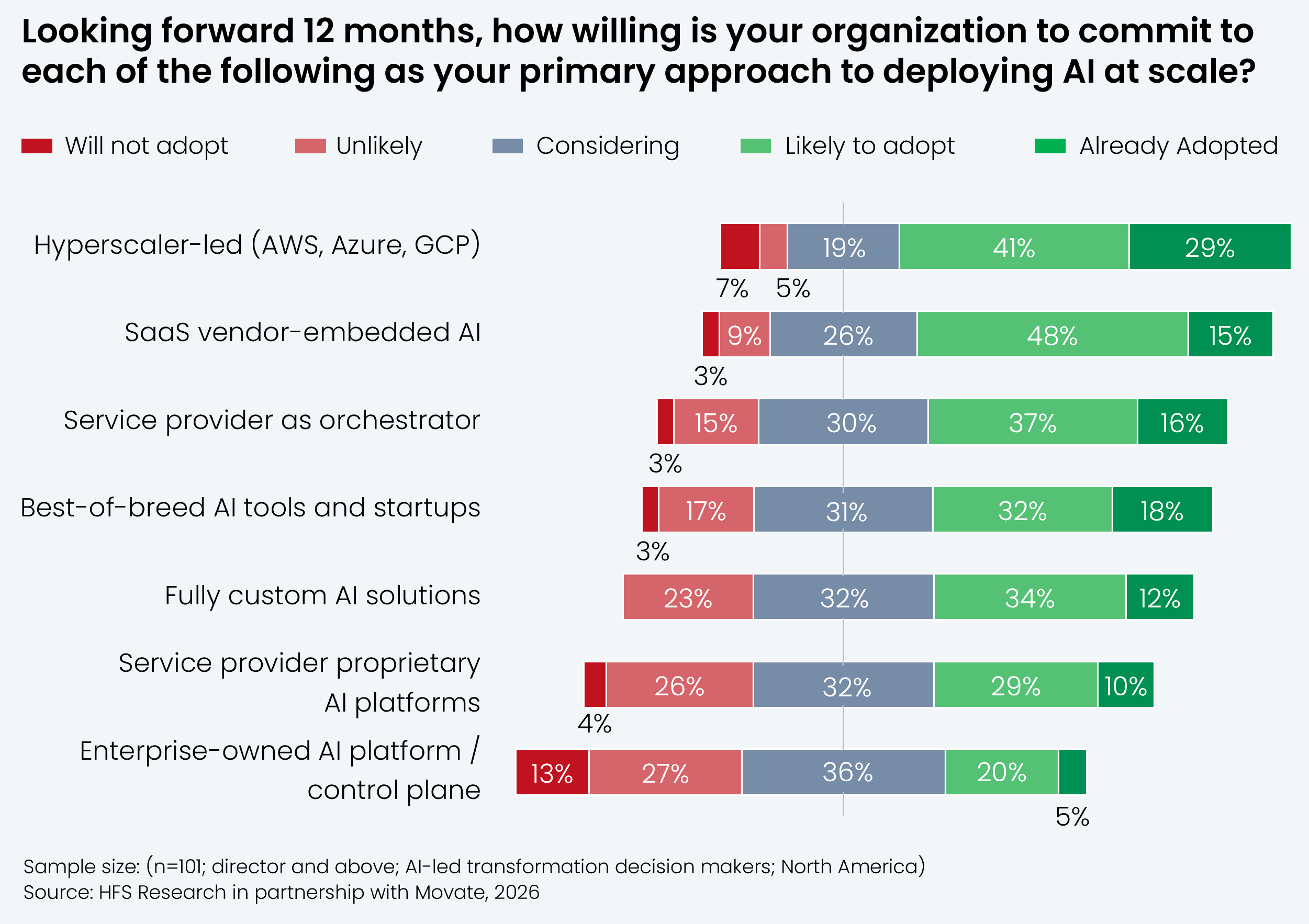
The ecosystem model has won
Hyperscaler-led platforms (70%) and SaaS vendor-embedded AI (63%) lead the 12-month commitment race. Service provider orchestration (53%) outperforms proprietary platforms (39%). Enterprise-owned AI platforms score lowest at 25%.
Buyers reject lock-in and DIY
Enterprises are choosing ecosystems over single-stack ownership. They are committing to platforms they already trust rather than building themselves or locking in. Service providers earn their seat by orchestrating across the ecosystem.
Architect for orchestration
Build the orchestration layer first, then evaluate each vendor to see how they fit into it. Treat proprietary IP and platforms as accelerators inside orchestration, not as the foundation.
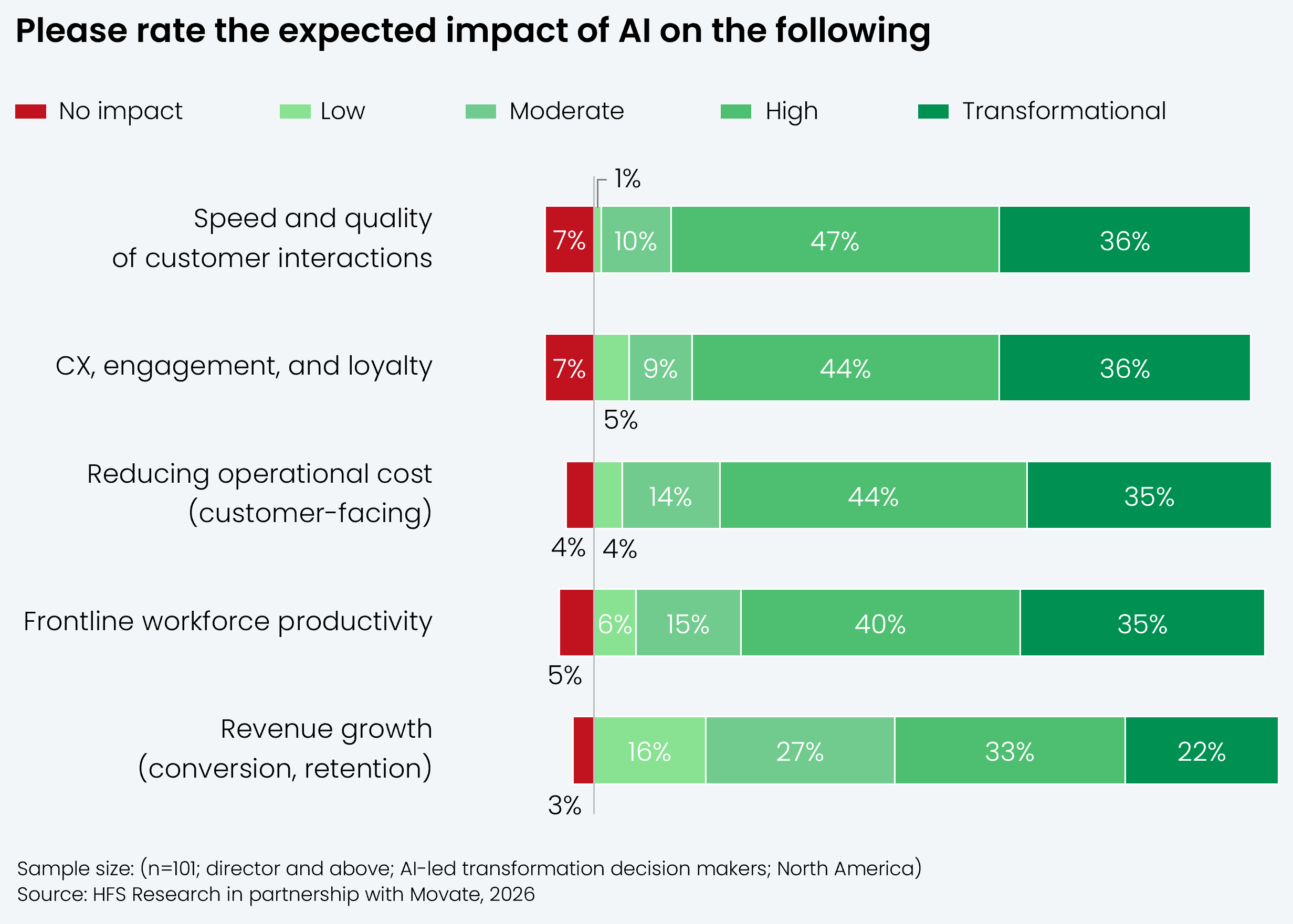
Efficiency is the impact
Speed (83%), CX engagement (80%), cost (79%), and productivity (75%) all score transformational or high impact. Revenue growth lags at 55%, with only 22% expecting a transformational impact.
Revenue is the gap
Enterprises see AI as a tool for cutting cost and lifting CSAT. They have not yet seen it move the top line. The next AI investment must change that.
Underwrite AI for growth
Move AI investment from cost-reducing use cases to revenue-generating ones such as dynamic pricing, sales acceleration, and customer expansion. The next AI dollar must aim at growth.
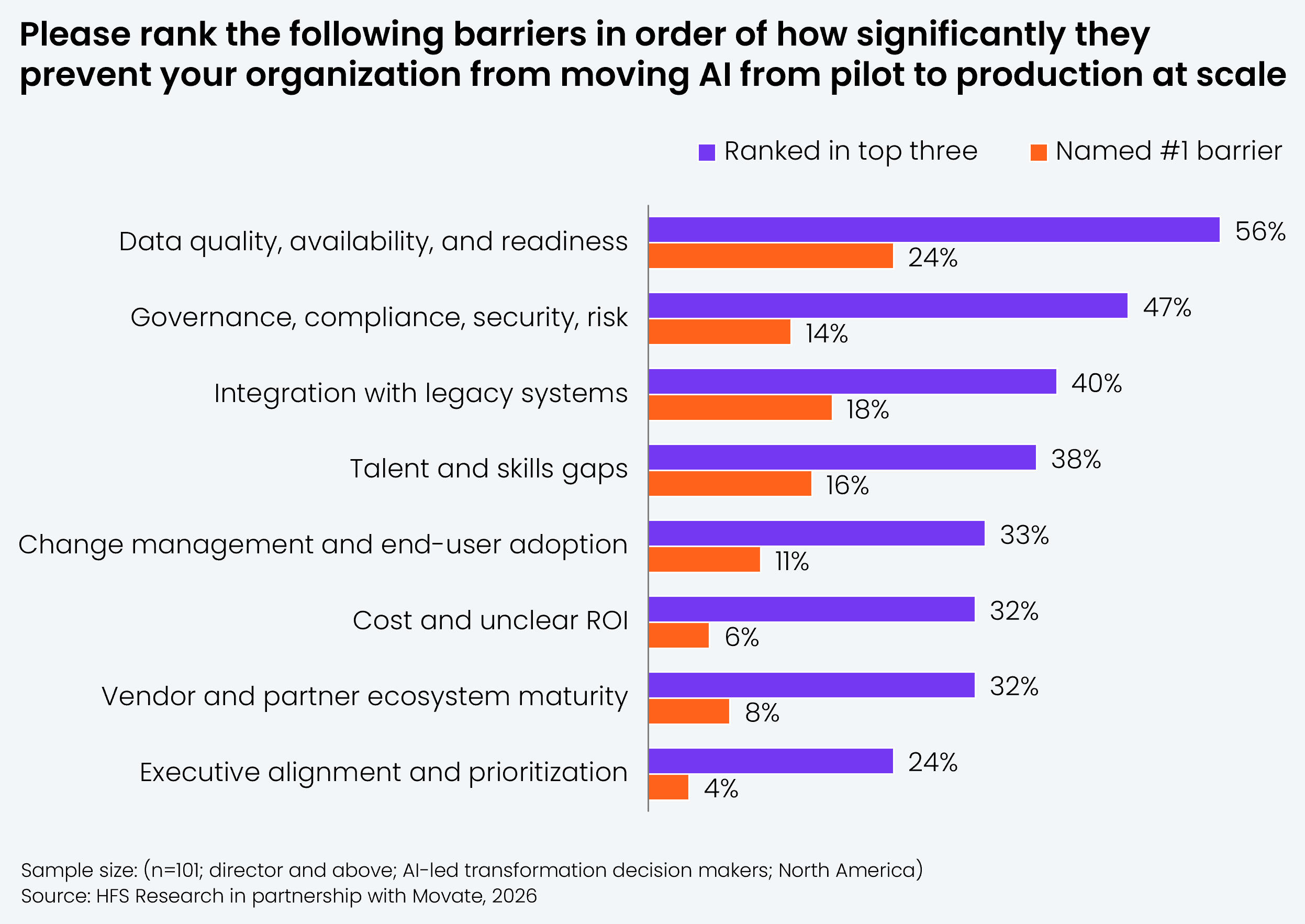
Data, governance, and integration top the list
Twenty-four percent of enterprises cite data quality, availability, and readiness as the top barriers, with 56% ranking them in the top three. Forty-seven percent place governance, compliance, security, and risk in the top three. Legacy integration follows next at 40%.
The wall is execution, not ambition
The top three barriers are all capability gaps in the foundation underneath their AI. Executive alignment ranking dead last means leadership commitment is not the constraint. The challenge is not whether to do AI, but whether the foundation is ready to deliver it.
Fix the foundation before scaling the ambition
Audit data quality, governance, and integration readiness as a precondition to AI scale. Fund the foundational work with executive sponsorship. Adding AI pilots on top of an unfit foundation means you are only scaling complexity.
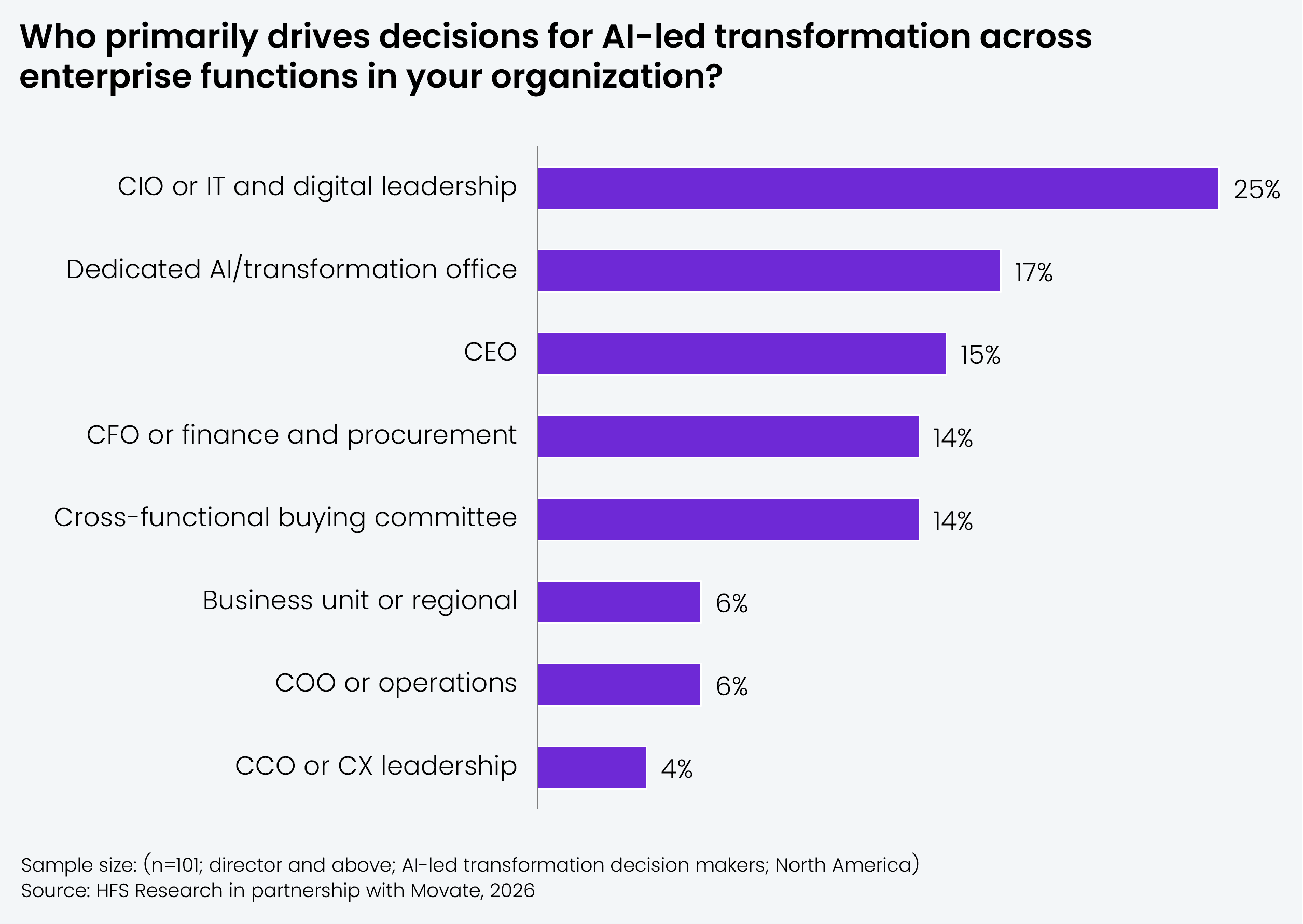
The buying decisions are scattered
The CIO holds the largest single share at 25%, but that is still only a quarter of decisions. The dedicated AI or transformation office (17%), CEO (15%), CFO (14%), and cross-functional buying committees (14%) account for another 60%.
Every seat owns a piece
AI decisions now span CIO, CEO, CFO, and the dedicated AI office. Single-stakeholder approaches miss 75% of the decision landscape. Each seat has a stake in the outcome, but they rarely make the decision together.
Unify the AI buying conversation
Treat AI buying as one C-suite conversation, not a series of disconnected approvals. Bring CIO, CEO, CFO, and the AI office to the same table from the start. The decisions that hold up under execution are owned by everyone responsible for the outcome.
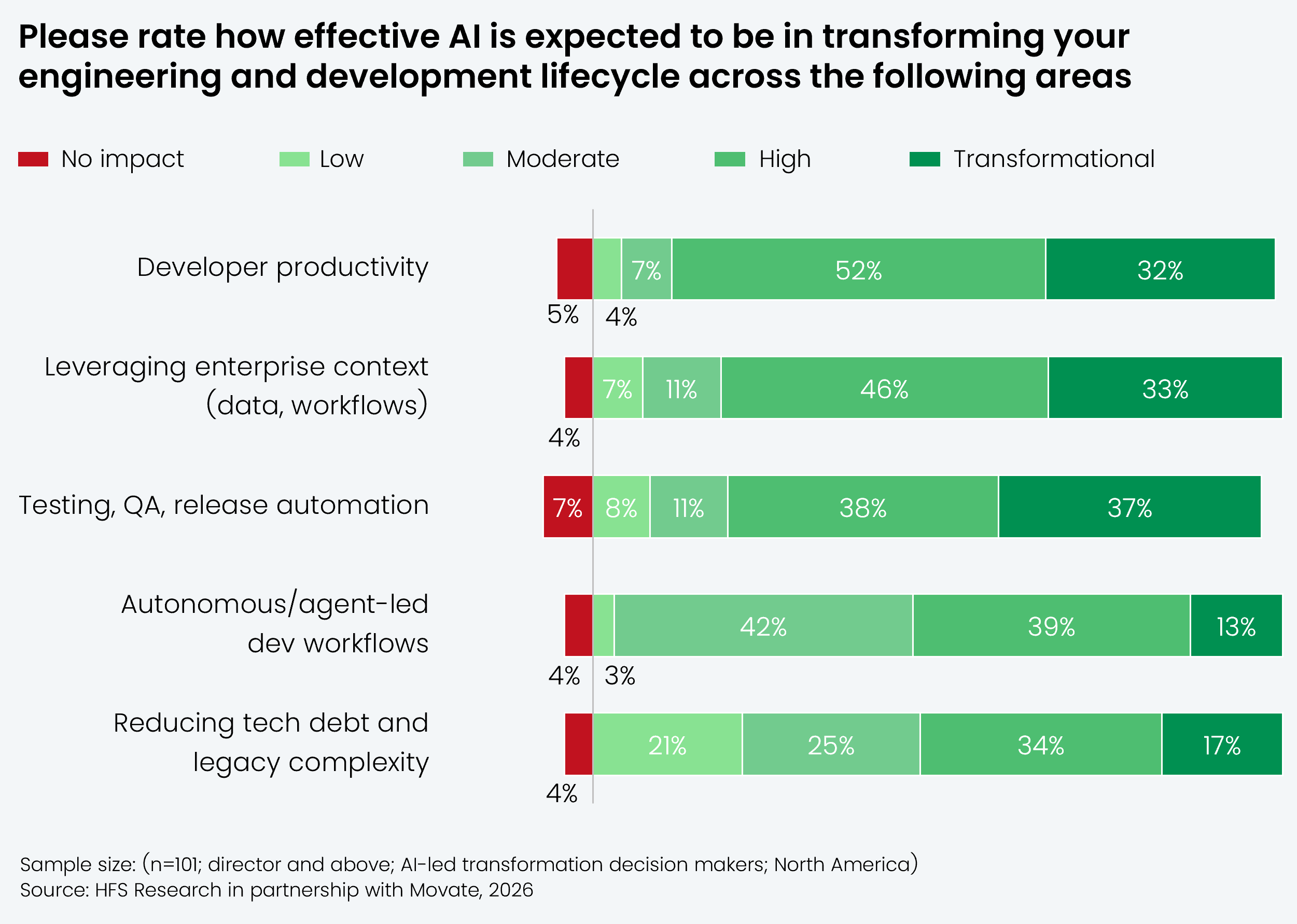
Productivity is the proven case
Developer productivity leads at 84% transformational or high impact. Enterprise context (79%) and testing/QA automation (75%) follow. Autonomous workflows (52%) and tech debt reduction (51%) lag the field.
Autonomy is the gap
AI is making existing engineers faster, but it has not yet rewritten how engineering itself works. The transformational case for autonomous workflows and tech debt remediation remains a forward bet.
Lead with productivity, bet on autonomy
Lead engineering AI investments with productivity outcomes that prove themselves quickly. Win the autonomy bet with focused workflows, strong observability, and rapid evidence loops.
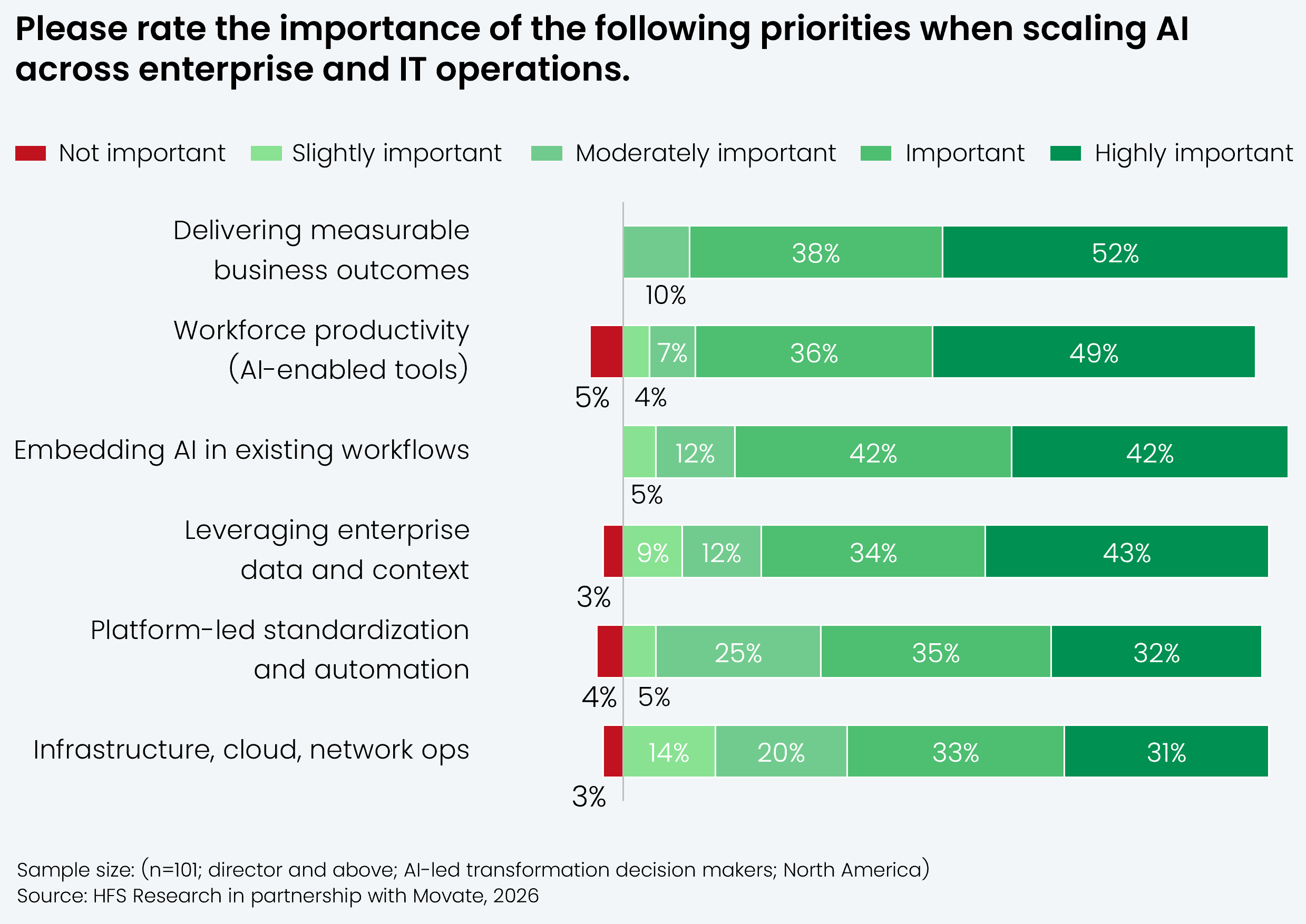
Outcomes are the universal priority
Ninety percent of senior leaders rate measurable business outcomes as important or highly important when scaling AI. Workforce productivity (85%), embedded workflows (84%), and enterprise data leverage (77%) follow. Infrastructure and cloud ops sit at the bottom.
Outcomes connect every priority
Every priority on the list earns its place, including infrastructure and standardization. Outcomes are the only ones that everyone agrees on. Every other priority has at least some level of dissent.
Anchor every AI conversation in outcomes
Outcomes are the test for every other priority. Workforce productivity, embedded workflows, data leverage, and infrastructure are all drivers of outcomes. Set the outcome first, then choose the priorities that deliver it.
AI has delivered efficiency through cost, productivity, customer experience, and speed, but revenue growth remains the outstanding promise, blocked by an operating model that has not kept pace.
Enterprises are stuck because decision rights are disorganized, commercial terms still favor effort over outcomes, and the data, governance, and integration foundations lag AI investment. What is needed is a rebuilt operating model that ties AI spend to results, funds the foundation before the next pilot, and directs the next AI dollar at revenue rather than more efficiency.
Enterprises must move now to rebuild the operating model around AI. Efficiency has been delivered and revenue is the next frontier. The next round of AI must look different from the last.

Rebuild the AI buying model
By aligning decisions across the full c-suite and moving pricing to outcomes.

Fund the foundation
By treating data, governance, and integration as prerequisites before the next pilot.

Aim the next AI dollar at growth
By moving from cost-reducing to revenue-generating use cases.
Register now for immediate access of HFS' research, data and forward looking trends.
Get StartedIf you don't have an account, Register here |
With the exception of our Horizons reports, most of our research is available for free on our website. Sign up for a free account and start realizing the power of insights now.
Our premium subscription gives enterprise clients access to our complete library of proprietary research, direct access to our industry analysts, and other benefits.
Contact us at [email protected] for more information on premium access.