This HFS Innovation Case Study is for CIOs, CTOs, and claims leaders in insurance looking to move AI from isolated pilots into governed production at scale.
CIOs, CTOs, and claims leaders in insurance have recognized a major challenge: moving AI from pilots to governed production at scale. Traditional automation rules and straight-through processing could no longer manage the increasing volume and variability of incoming claims correspondence.
Two workflows absorbed the skilled capacity on work that should never have required human judgment to initiate. The first is inbound claims emails with missing identifiers and buried intent. The second is outbound garage follow-ups, driven by manual phone calls across a distributed partner network.
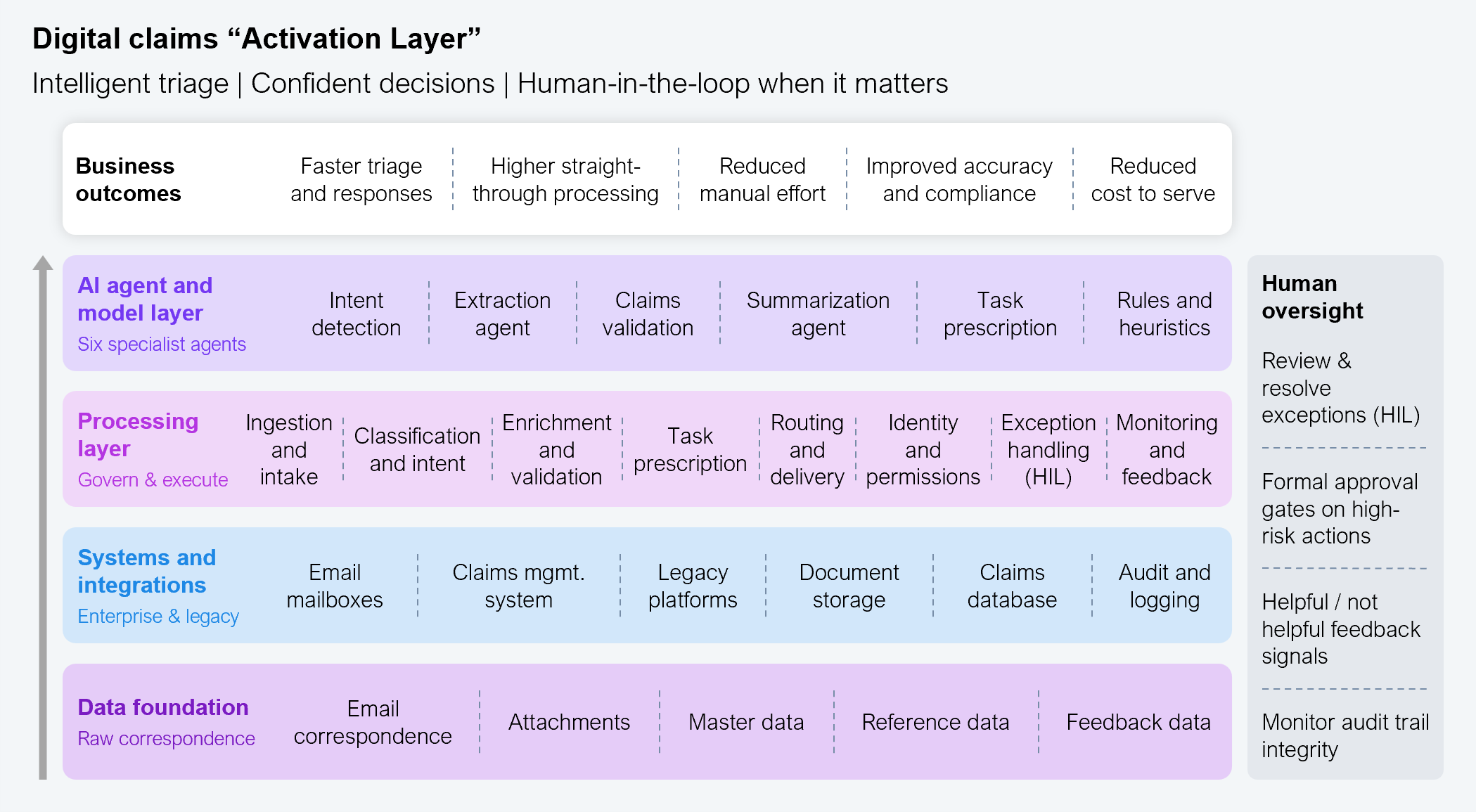
This case study shows how The AA, in partnership with EXL, solved that by building an AI-powered activation layer that turns unstructured claims emails into governed workflow execution. Spanning data ingestion, system integration, processing, and AI-led intent detection and validation, the activation layer delivers measurable business outcomes such as faster triage, lower cost to serve, and safer scaling through embedded human oversight (see Exhibit 1). This case focuses on workflow administration, communication management, and operational orchestration. It does not automate liability assessment, settlement decisions, or other regulated claims decisions.
The AA is the UK’s longest-standing motoring services organization. The firm handles motor insurance claims at a significant scale across repairs, payments, liability, accident assist, and a large garage partner network, making it one of the most operationally intensive back-office environments in insurance.
Source: HFS research in partnership with EXL, 2026
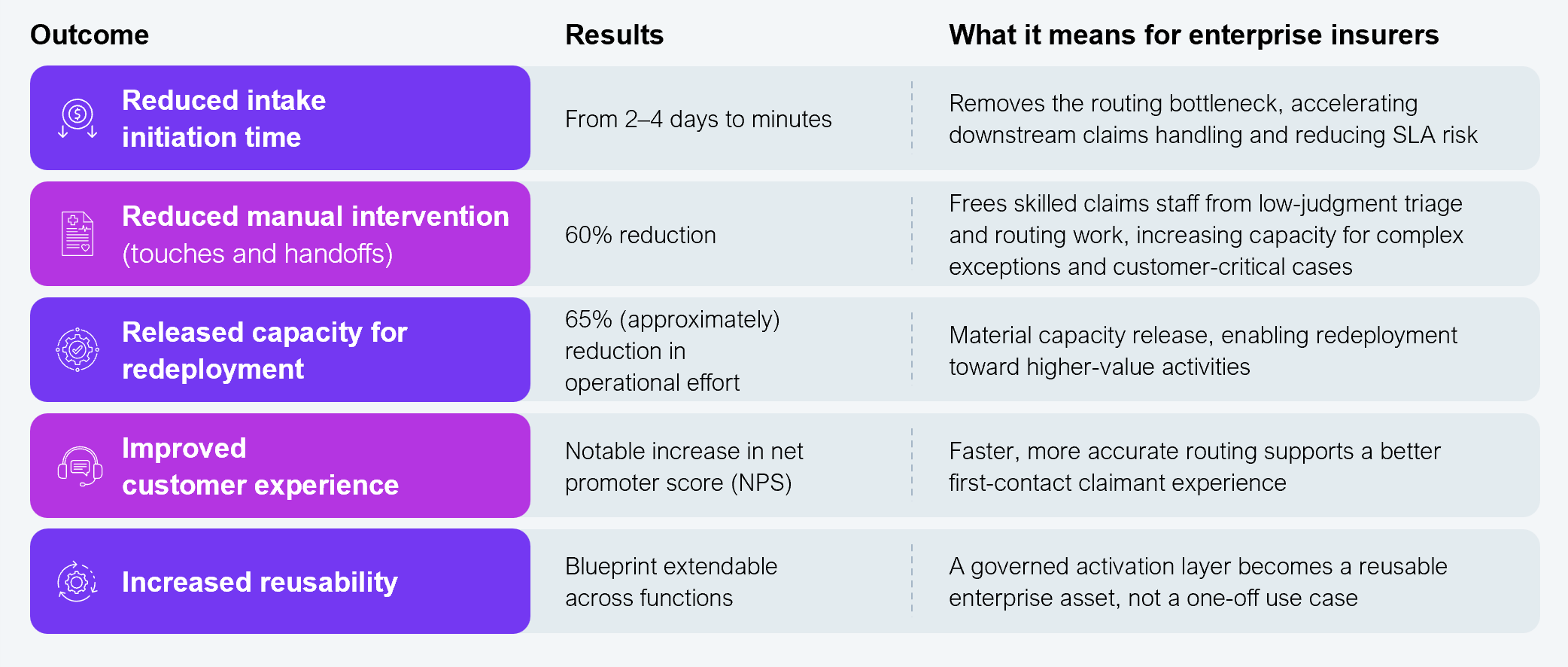
Without the AI-powered activation layer, claim emails were manually read and routed, the garage status depended on more than 30,000 annual chase calls, and cases could take days just to initiate. With the AI-powered activation layer in place, AI automates intake, routing, and garage follow-up; initiation time fell from days to minutes; and the same governed platform extends to additional workflows. At every stage, the solution is scoped to workflow initiation, routing, and communication administration, while claims decisions remain subject to established claims handling controls and human oversight where required.
For CIOs and CTOs, this story matters because The AA’s operating reality is not unique. High-volume inbound communications, fragmented partner networks, legacy platform constraints, and skilled capacity absorbed by low-judgment work are common conditions across insurer back offices. What’s less common is what the organization did to solve all of it at scale, with governance built in from day one.
HFS Research spoke with Raghava Krishna, Technology Director, Digital & AI at The AA. The practitioner perspective was reinforced by Natalie Spurrier, Claims Director at The AA, who underscored what made these use cases different from the earlier wave of AI experimentation in the industry.
The difference between what we’ve done and the experimentation phase the industry went through is governance and scale. We didn’t want another proof-of-concept that worked in isolation. We wanted something that could handle more than 100,000 inbound communications a year. That meant building the activation layer first, so AI became part of the workflow rather than something sitting alongside it.
— Natalie Spurrier, Claims Director, The AA
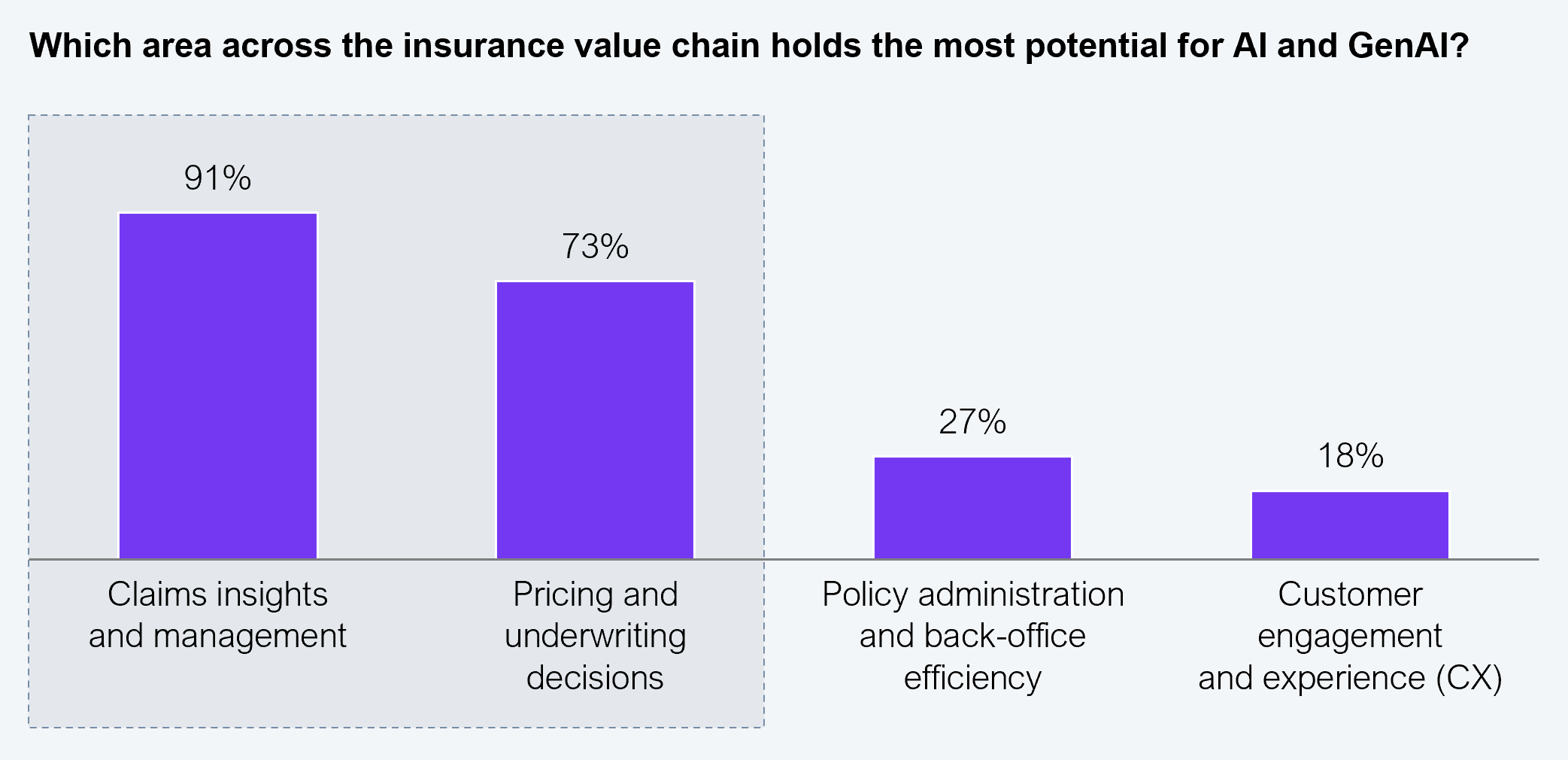
A roundtable conducted by HFS Research in late 2025 with 17 senior insurance leaders, including CIOs, chief operating officers (COOs), and claims heads, confirmed claims as the top focus area. Ninety-one percent (91%) of participants cited claims insights and management as the function with the greatest AI potential (see Exhibit 2) compared to every other part of the insurance value chain. Those leaders were clear that it is no longer about whether to apply AI to claims, but how to get it into live workflows at scale without scattered proof-of-concept experiments that have historically delivered little compounding return. That requires an activation layer, a governed infrastructure that lets AI run safely in production workflows. The AA is a useful test case because it solved that activation-layer gap while targeting messy, high-volume claims workflows.
Sample: 17 insurance delegates at a HFS roundtable
Source: HFS Research, 2026
The AA’s claims back office was processing more than 100,000 inbound communications annually with extreme variability across multiple mailboxes, sender formats, and workgroups. Claim identifiers were frequently missing, buried in free text, or embedded in attachments. Reply chains obscured intent. A human agent had to read each email, interpret its intent, match it to a claim, and route it to the right team before any substantive work began.
The existing core claims platform at The AA had integration constraints, which ruled out any solution that required writing back into the system. The AI layer to be designed had to work around it, not through it.
The AA, in partnership with EXL, built a multi-agent orchestration layer that reads incoming emails, extracts intent, summarizes content, and infers or validates missing claim numbers via read-only API lookup. It then automatically routes each case to the correct team. Human-in-the-loop checkpoints were retained for edge cases and low-confidence decisions. The solution ran on The AA’s newly built enterprise AI platform, with large language model (LLM) guardrails, input and output validation, logging and auditability, and an AI Technology Review Board approving the use case before go-live.
A key principle for us was maintaining ownership of our strategic AI capabilities and operating model, rather than becoming dependent on the underlying platform for innovation.
— Raghava Krishna, Technology Director, Digital & AI, The AA
The outcomes are significant (see Exhibit 3). Across speed, efficiency, and customer experience, the results demonstrate what becomes possible when AI is engineered for production with the right activation layer.
Source: The AA and EXL (program results), validated through HFS Research executive interviews, 2026
The AA’s garage communication channel was running almost entirely on phone calls. With more than 30,000 chase calls a year across a distributed network, skilled staff were spending time on low-value outbound follow-up tasks, such as checking repair status, recording responses, and updating teams with information that could already be stale. There was no case-level milestone visibility, service-level agreement (SLA) tracking, or a systematic way to prioritize which garages to contact and when. The constraint mirrored the claims channel: a legacy core platform without transactional write APIs.
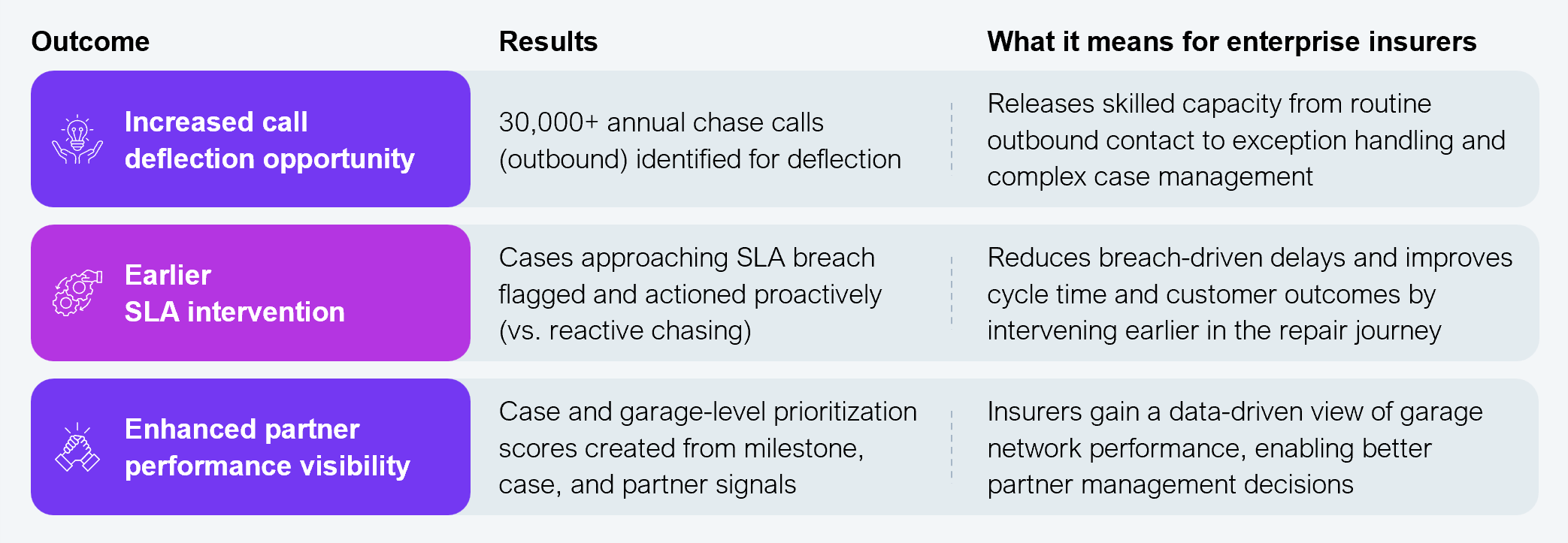
The AA, in partnership with EXL, built an intelligent outbound orchestration layer to replace the manual chasing model. The orchestration agent ingests daily case data, identifies which vehicles are approaching or have breached SLA thresholds, prioritizes cases using a governed scoring model (customer profile, repair milestone, and garage performance history), and automatically generates and sends the right number of follow-up communications to the right garages at the right time without human initiation. Responses are captured, summarized, and pushed into downstream workflow systems via available integrations (with audit logging). The same enterprise AI platform, guardrails, and governance framework that underpin the claims email agent apply here, ensuring consistency, auditability, and compliance across both channels.
The outcomes reflect the changes that occur when reactive manual chasing is replaced by proactive, governed AI orchestration across a partner network at scale (see Exhibit 4).
Source: HFS Research, 2026
Our engagement with The AA provides a powerful example for how insurers can turn the potential of AI into real, measurable results.
By designing a powerful intelligent layer that could be easily scaled across workflows and ensuring the constant improvement of every outcome we measure, we have helped The AA deliver outstanding outcomes for their customers.
— Mohit Manchanda, Head of Insurance and Diversified Industries, UK and EMEA, EXL
Orchestrated workflows when implemented carefully can scale AI effectively. CIOs, CTOs, and claims leaders can apply the following lessons to make their AI initiatives more successful:
The idea was to centralize the technology knowledge, governance, and reusable capabilities, while enabling federated delivery across the business based on varying maturity and operational needs.
— Raghava Krishna, Technology Director, Digital & AI, The AA
We created a centralized platform with approved models, guardrails, logging, auditing, and monitoring. Every single API endpoint exposed from the platform is fully governed. At the end of the month, there is a report generated: these are the use cases, these are the models, this is the token usage, and these are the negative scenarios we have seen.
— Raghava Krishna, Technology Director, Digital & AI, The AA
Back-office operations across the industry face the same opportunity: high-volume, high-friction workflows absorbing skilled capacity on work that AI can reliably initiate and route. The differentiator isn’t the use-case idea; it’s whether insurers can build the governed, production-ready activation layer that lets those use cases run safely at scale. The question is no longer whether to act; the operational and competitive case is already made. For CIOs and CTOs, the priority is to make the activation layer the first build, as The AA and EXL did, and then scale the workflows around it.
The outcomes have helped build strong executive confidence and support for scaling additional use cases.
— Raghava Krishna, Technology Director, Digital & AI, The AA
Register now for immediate access of HFS' research, data and forward looking trends.
Get StartedIf you don't have an account, Register here |
With the exception of our Horizons reports, most of our research is available for free on our website. Sign up for a free account and start realizing the power of insights now.
Our premium subscription gives enterprise clients access to our complete library of proprietary research, direct access to our industry analysts, and other benefits.
Contact us at [email protected] for more information on premium access.