This HFS Take 5 report, written in partnership with Hitachi Digital Services, is for business and technology leaders in mobility, industrial equipment, and energy and utilities evaluating physical AI adoption to unlock value in critical operations.
Executive summary
HFS Research defines physical AI as software-led services embodied in physical systems that perceive, decide, and act in the real world, operate autonomously, and are delivered and monetized as productized services.
Enterprises are turning to physical AI to unlock latent value in their most critical operations, the areas where prevailing digital technologies have so far fallen short, not because those technologies were immature, but because they lacked the functionality and cost profile to act in the physical world, where operations are physical and touch many interconnected systems. The IoT and 5G boom a decade ago sensed operating conditions in real time but could not act on them. Physical AI closes that loop, adding autonomous action and prediction.
A study conducted in partnership with Hitachi Digital Services surveyed 105 business leaders operating in the US across mobility, industrial equipment, and energy and utilities to map how they are adopting physical AI, including the drivers, expected outcomes, critical use cases, challenges, and spend patterns. More than half of them expect their enterprises to operate at conditional autonomy or higher within two years, up from roughly a quarter today. This is a clear signal that adoption is moving from experiment to operational reality.
The survey uncovered five key takeaways:
-
Physical AI is deployed where legacy tech was lacking, with 43% of enterprises running connected fleets in mobility.
-
Businesses fund what pays back fast. Cost reduction tops the list at 28%, followed by productivity and talent.
-
Enterprises are taking a pragmatic adoption roadmap, as augmented autonomy becomes the norm at 39% within 24 months.
-
A strong business case, not technology maturity, gates adoption. Twenty-two percent of enterprises cite high upfront cost as the top challenge.
-
Business leaders are optimistic about doubling physical AI spend, using a hybrid approach involving multiple vendors.
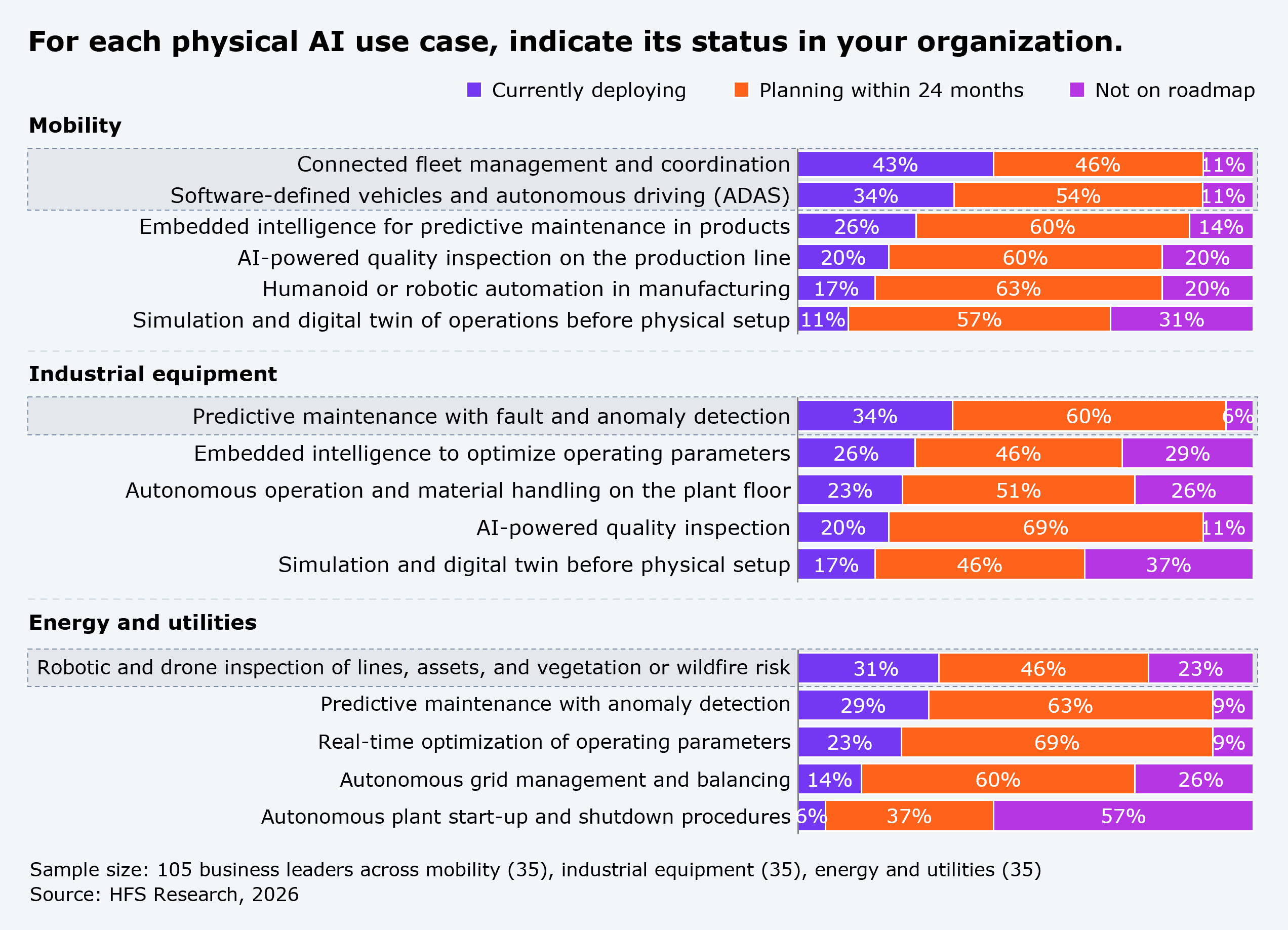
Legacy systems could sense and flag operations, but not reason and act. Recent advances in physical AI, including foundation models, edge inference, and reinforcement learning, address these barriers for large-scale, critical applications of use cases that had been underserved by technologies.
- Mobility: Fleet management (43%) and software-defined vehicles (34%) act upon what legacy telematics could only track. Hitachi Digital Services’ Guided Repair, for example, holds repair sessions for around 11,500 Penske technicians in more than 990 locations to identify and execute repairs.
- Industrial equipment: Predictive maintenance (34%) leads, with traditional monitoring only flagging abnormalities, while physical AI triages where the fault sits and times overhauls, turning detection into action.
- Energy and utilities: Robotic and drone inspection (31%) leads in inspection, a high-risk, labor-intensive, and hard-to-scale application. Physical AI makes it feasible and safe in critical situations, such as the Fukushima Daiichi nuclear disaster site.
- The path forward: Enterprises should identify core operations set aside earlier because of a lack of technical feasibility or affordability, and re-examine them with physical AI, where latent value sits and ROI comes fastest.
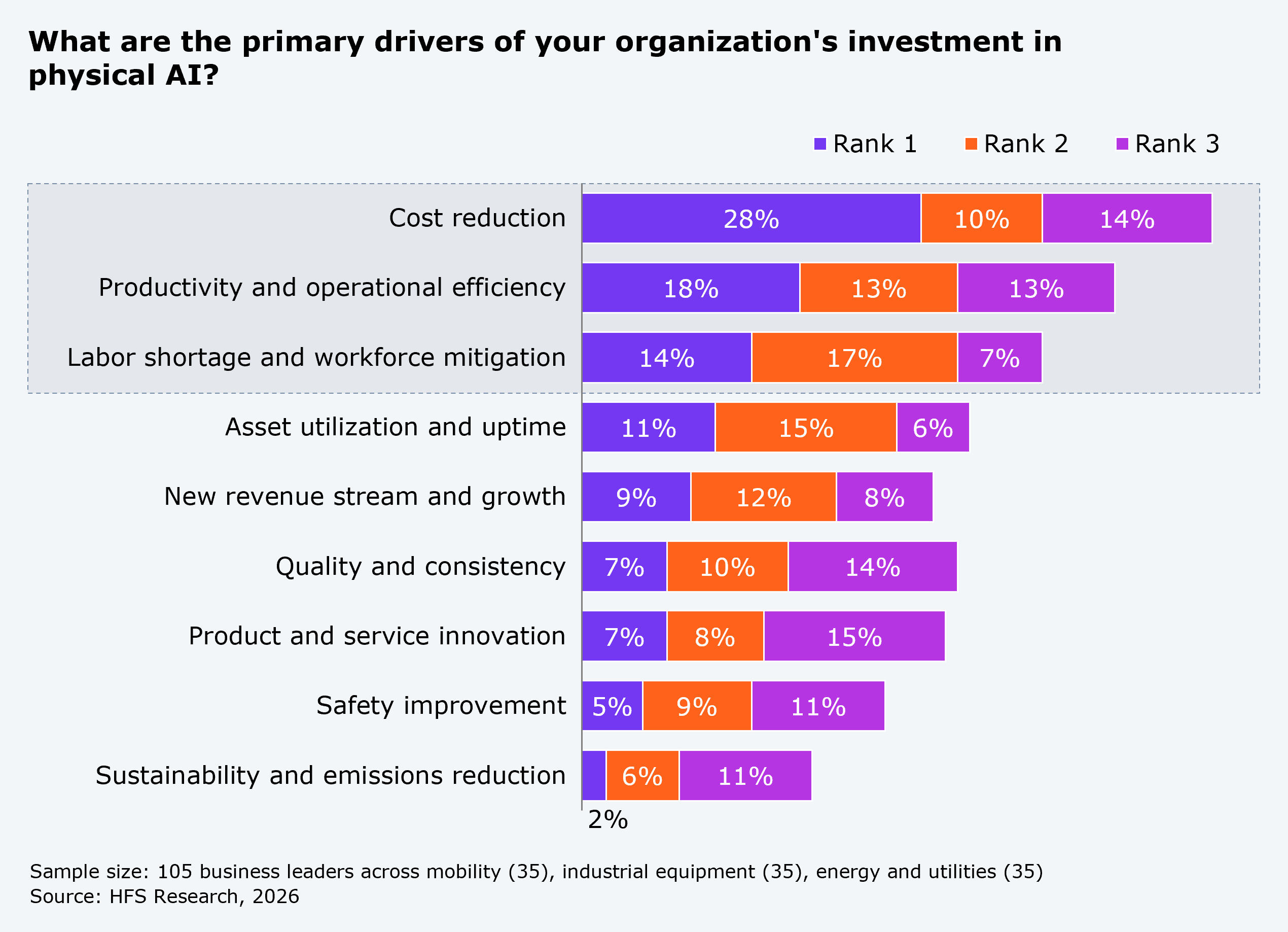
Asset-heavy industries under pressure to improve their thin margins deploy physical AI where it helps the most: for cost reduction (28%), productivity and efficiency (18%), and to address talent shortages (14%).
- Applying lessons learned from earlier deployments of enterprise IT systems, physical AI is applied in areas with tangible business impact.
- Under mobility, with rising logistics costs, a 174,000-driver shortage in the US, and productivity capped at 60%, physical AI offers autonomous trucks for hub-to-hub material movement.
- Revenue-generating streams are also on the radar, though not in the short term. Some tractor manufacturers already sell autonomy as a subscription, and robotics suppliers offer humanoids as-a-service to car makers, turning upfront capex into recurring revenue.
- Choosing use cases that deliver ROI first then gradually move toward revenue generation is an effective approach for physical AI adoption.
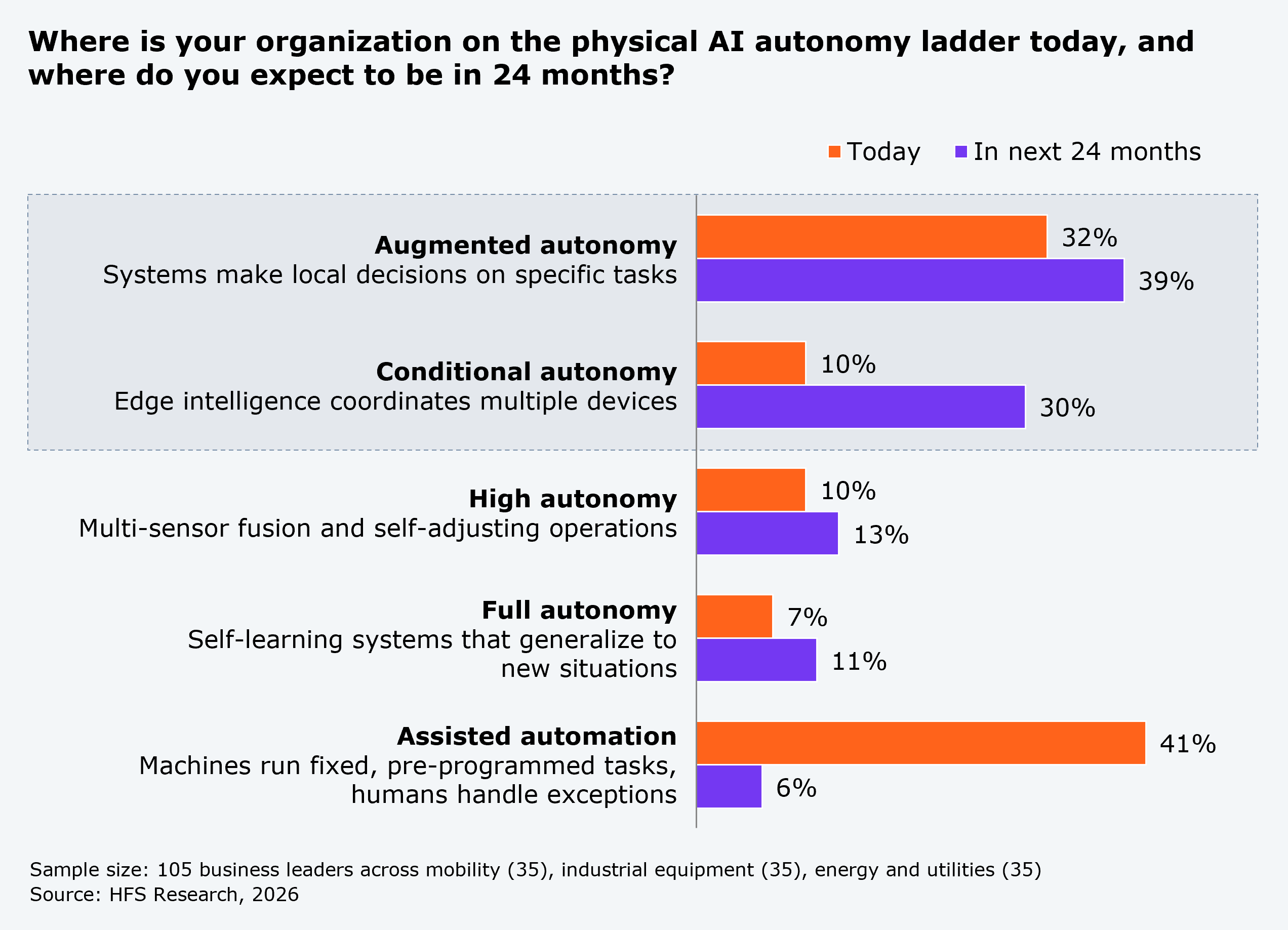
The falling cost of physical AI and rising maturity of related technologies incentivize enterprises to progress toward advanced levels of autonomy on their physical AI adoption roadmap.
- Augmented autonomy with edge-based decisions for specific tasks will see the most investment among 39% of enterprises over the next 24 months.
- Conditional autonomy with multimodal edge intelligence, coordinating multiple diverse devices will be the highest level of autonomy in the next two years that will see large-scale adoption for applications such as fleet and swarm management.
- High and full autonomy use cases, such as Level 4 and 5 driverless automobiles, will take more than two years to mature and achieve large-scale adoption, first for industrial applications. Factories will see lights-out implementations in specific areas, if not the entire factory.
- Enterprises must assess where they are in the adoption roadmap today and plan their future.
-
A strong business case, not technology maturity, gates adoption, with high upfront cost the top challenge for 22% of enterprises
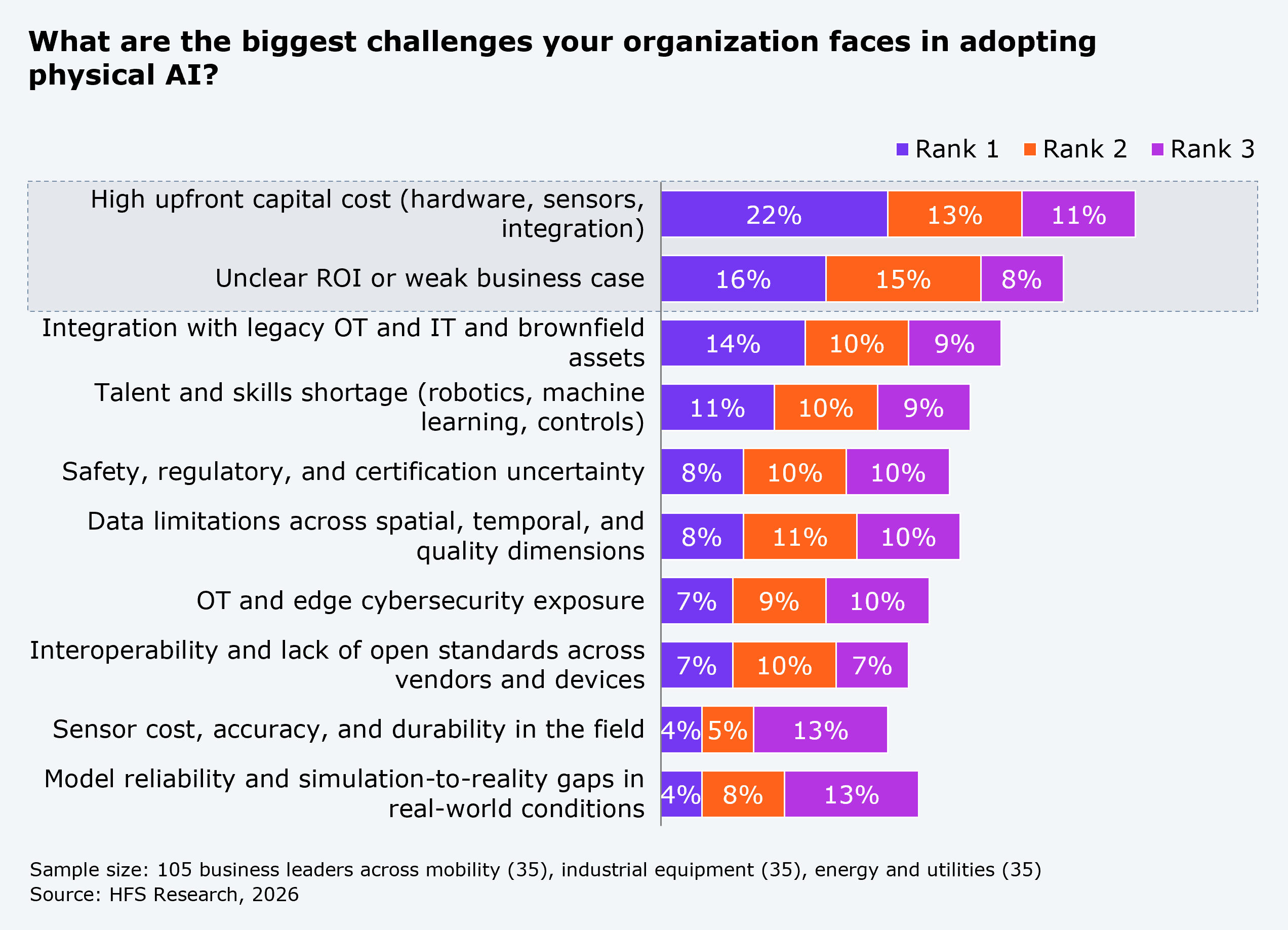
- The top barriers are commercial first: high upfront costs (22%) and weak ROI (16%) lead the list. Enterprises are reading this correctly. Physical AI is capital-intensive, so the discipline is to prove a clear business case before scaling, not chase use cases and hope value follows.
- This reflects a lesson from the broader AI wave. Having seen pilots expand without clear payback, enterprises are being more selective. They are funding physical AI where the operational case is unambiguous and where value can be measured early.
- The real work is data and integration. Physical AI has to fuse physical and digital systems and learn from a new class of data, the temporal and spatial signals that describe how equipment behaves in the real world, which is costly to capture, engineer, and maintain. Solving that foundation, not the algorithms, is what turns a pilot into production.
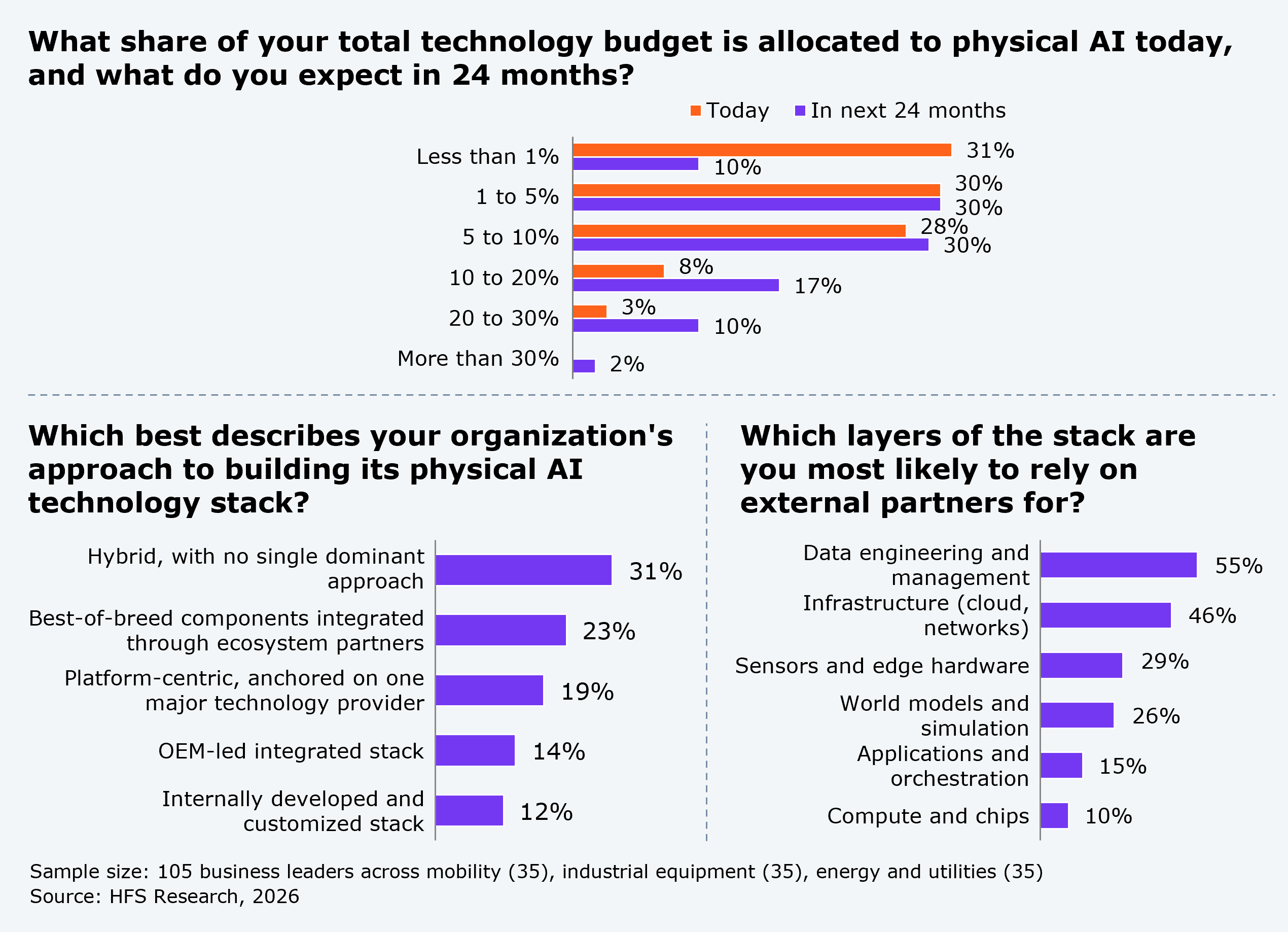
- Physical AI is set to roughly double its share of the technology budget over the next two years, moving from experimentation to a funded priority.
- But enterprises are not betting the budget on one provider. A hybrid and best-of-breed approach is emerging because no single vendor can span the full physical AI stack, from compute and platforms to devices and hardware, data engineering, infrastructure, and applications. Buyers are keeping compute and applications closer, while relying more on partners for data engineering and infrastructure.
- The provider opportunity is not to own the whole stack. It is to win the layers where buyers need the most help, integrate cleanly around the compute and platform providers they have already chosen, and lower the entry barrier through consumption or outcome-based commercial models that reduce upfront capex pressure.
The Bottom Line: Enterprises must identify and adopt physical AI to unlock latent value in critical operations and use cases that could not be addressed before due to technologies that were not ready functionally or economically.
Enterprises should start their physical AI journey with critical operations where earlier digital technologies could not fully unlock value, and where physical AI can prove measurable ROI in the near term through cost, productivity, uptime, safety, or labor impact.
Scaling will require more than robots, sensors, and edge models. It needs data engineering, spatial and temporal data, foundational models, IT/OT integration, infrastructure, and governance across physical and digital systems. Keep humans in the loop through the early stages; autonomy should scale as the foundations mature.
-
Business leaders must identify critical use cases that could not be implemented earlier using traditional technologies for physical AI applications
-
Enterprises must assess their readiness for physical AI, identify weak spots across the tech stack, and identify trusted partners for those layers
-
Scaling physical AI will need data engineering, spatial and temporal data, IT/OT integration, and governance at the intersection of physical and digital systems