Data Viewpoint

Almost half of India’s GCCs did not add people last year, and the oldest and largest centers added fewest

The HFS Data Viewpoint “Almost half of India’s GCCs did not add people last year, and the oldest and largest centers added fewest” is for enterprise CIOs, GCC heads, and global operations leaders reassessing how they measure the performance of their India capability centers.
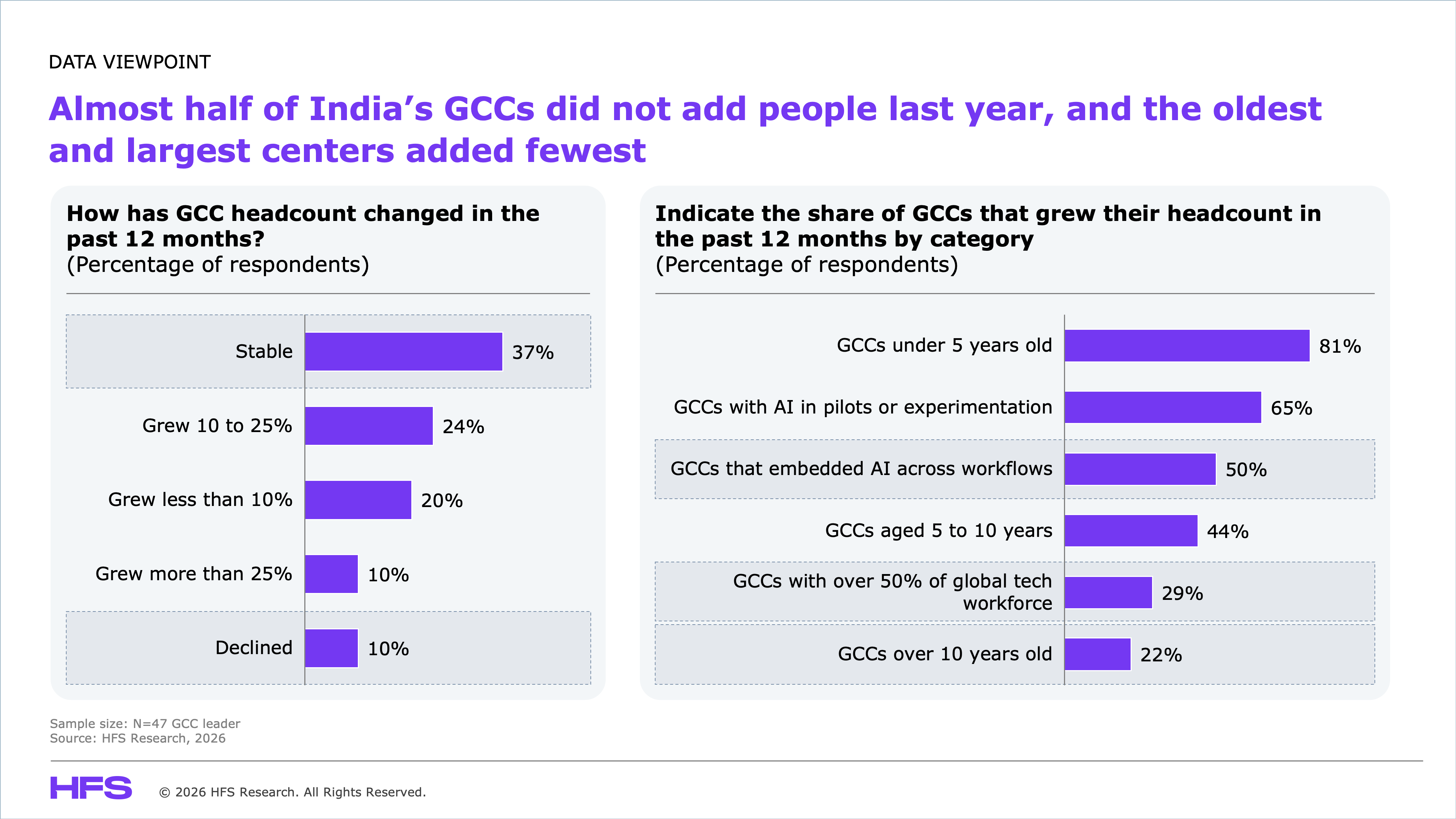
Two horizontal bar charts shown side by side. The left chart answers the survey question "How has GCC headcount changed in the past 12 months?" with the vertical axis listing five headcount outcomes and the horizontal axis showing the share of GCC leaders reporting each one: stable, 37%; grew 10 to 25%, 24%; grew less than 10%, 20%; grew more than 25%, 10%; declined, 10%. The right chart answers the survey question "Indicate the share of GCCs that grew headcount in the past 12 months by segment" with the vertical axis listing six GCC segments and the horizontal axis showing the share within each segment that grew headcount: GCCs under five years old, 81%; AI in pilots or experimentation, 65%; AI embedded across workflows, 50%; GCCs aged five to 10 years, 44%; GCCs with over 50% of global tech workforce, 29%; GCCs over 10 years old, 22%. Dashed highlight boxes mark the stable and declined bars on the left chart and the AI embedded across workflows, GCCs with over 50% of global tech workforce, and GCCs over 10 years old bars on the right chart. Sample: 47 GCC leaders across India, HFS Generative GCC Index 2026. Source: ANSR and HFS Research, 2026.

HFS Research, in collaboration with ANSR, surveyed 47 GCC leaders across India for the inaugural HFS Generative GCC Index 2026. The finding that should concern enterprise leaders is that nearly half of these centers added no people at all in the past year, and the ones that made the most progress in scale, tenure, and AI adoption are adding the fewest.

This matters because the enterprise conversation about GCCs still focuses on headcount, budget approvals, board slides, and the per-FTE pricing that surrounds that model. But new data shows that the centers themselves are moving beyond this. The gap between these two perspectives shows how enterprises are misinterpreting their own operations.

All 47 respondents lead GCCs for multinational enterprises headquartered worldwide. Their centers are, by their own account, becoming more important to the enterprise. At the same time, 64% percent say an outage tomorrow would cause significant or enterprise-wide disruption.

Here are the top five takeaways from this study:

  • Almost half of India’s GCCs did not grow last year. Forty-seven percent of leaders report that headcount was flat or declining over the past 12 months, and only 34% grew more than 10%. In a market adding nearly 100 new centers a year, the growth comes from new entrants rather than from expansion within established ones.
  • Growth is concentrated almost entirely in young centers. Eighty-one percent of GCCs under five years old grew headcount, compared to 44% of those aged five to ten and 22% of those over ten. Mature centers have largely stopped growing.
  • The largest centers have stopped scaling. Among the GCCs with more than half of their enterprises’ global technology workforce, only 29% grew. The centers carrying the most enterprise work are the least likely to be adding to it.
  • AI maturity coincides with slower hiring. Fifty percent of GCCs with AI embedded across delivery workflows grew headcount, compared to 65% of those still running pilots or experiments. The centers that are further along in AI are taking on more work without hiring proportionately, which is the goal of an AI-led operating model.
  • The share of GCCs that grew fast is equal to those that shrank. Ten percent of centers grew headcount by more than 25% in the past year, while 10% saw a decline. The India GCC story of rapid expansion, therefore, reveals a nuanced trend: about 1 in 10 established centers are shrinking, the first indication that the GCC model is starting to shift.
The Bottom Line: Headcount has become the wrong metric to watch, and enterprises that still use it will keep misreading their most capable centers. The measures that would tell them something useful, such as what the center owns and what it decides without asking, must be prioritized.

Sign in to view or download this research.

Login

Register

Insight. Inspiration. Impact.

Register now for immediate access of HFS' research, data and forward looking trends.

Get Started

Download Research

    </label

    Sign In

    Sign up for a free
    research account

    With the exception of our Horizons reports, most of our research is available for free on our website. Sign up for a free account and start realizing the power of insights now.

    By registering you agree to our privacy policy.

    I hereby consent that HFS Research can process my personal data.

    Digests/Newsletters: Overviews of the latest news, insight, and research by HFS.

    HFS Events: Exclusive invitations to HFS webinars, roundtables, and summits, bringing together key industry stakeholders focused on major innovations impacting business operations.

    Premium Access

    Our premium subscription gives enterprise clients access to our complete library of proprietary research, direct access to our industry analysts, and other benefits.

    Contact us at [email protected] for more information on premium access.

      Contact Ask HFS AI Support