Events NY Spring Summit 2026 Day 1 — May 13, 2026
Day 1 of 2 · NY Spring Summit 2026 · How to AI

Day 1 — Wednesday, May 13, 2026

New York, NY

Filter
9:00 AM Welcome

Welcome and opening remarks
Welcome and opening remarks video thumbnail YouTube · Click to watch
Host
Joel Martin
Chief Research Officer, HFS Research

Joel Martin is Chief Research Officer at HFS Research, where he leads the firm's global research agenda at the intersection of IT services, enterprise technology, and artificial intelligence. He guides a growing, multi-disciplinary research organization worldwide.


Dana Daher
Executive Research Leader, HFS Research

Dana Daher is an Executive Research Leader at HFS Research, spearheading research initiatives in emerging technologies and employee experience. With a unique blend of expertise in anthropology and IT, Dana leads cutting-edge research that shapes industry landscapes across various domains.

Summary

Joel Martin and Dana Daher open the HFS NY Spring Summit 2026 with the day's theme, How to AI, and put two unfiltered audience polls in front of the room. The first asks where attendees rate their organization's AI strategy maturity; the second asks who in the enterprise is actually best at using AI today. Middle managers lead on usage, ahead of frontline teams, senior executives, and consultants. Joel and Dana also unveil two HFS programs running across the two days: the Data Intelligence Suite, with live analyst demos, and the AI-First Deal Lab interactive workshop on Day 2 designed to translate Services-as-Software™ and outcome-based commercial models into real procurement decisions.

Key takeaways
  • The HFS NY Spring Summit 2026 theme is How to AI.
  • Audience poll 1 (AI strategy): Most of the room reports being either developing or having a clear AI strategy in place. The same question reappears in Phil Fersht's keynote, so attendees can compare the room with the broader Global 2000 sample.
  • Audience poll 2 (Who is best at using AI?): Middle managers lead, ahead of frontline teams, senior executives, and consultants. Senior executives finished last.
  • HFS unveils the Data Intelligence Suite, a self-serve research and survey-data product, with live analyst demos available both days.
  • The AI-First Deal Lab returns as an interactive workshop on Day 2 at lunch, led by Nigel Edwards and Saurabh Gupta, designed to translate Services-as-Software and outcome-based models into real contracts and KPIs.
9:10 to 10:00 AM Keynote

Services-as-Software™ is here. Your operating model is not.

YouTube · Click to watch
Speaker
Phil Fersht
CEO and Chief Analyst, HFS Research

Phil Fersht is widely recognized as the world's leading analyst focused on reinventing business operations to exploit AI innovations and the globalization of talent. He recently coined the term "Services-as-Software" to describe the future of professional services, where people-based work is blurring with technology.

Summary

Phil Fersht explores how AI is fundamentally reshaping enterprise operating models and accelerating the transition toward Services-as-Software™. He discusses the growing AI velocity gap between enterprises and consumers, the future of workforce transformation, and why organizations must rethink traditional services, governance, and procurement models to remain competitive in an AI-first economy.

Key takeaways
  • AI is transforming how enterprises operate, deliver services, and scale business functions.
  • Services-as-Software™ represents the shift from labor-based services to AI-enabled digital outcomes.
  • Enterprises must adapt their operating models to keep pace with AI-driven transformation.
  • AI maturity, governance, and workforce readiness remain major challenges for organizations globally.
  • Future-ready organizations will focus on AI-enabled growth, productivity, and outcome-based business models.
11:00 to 11:25 AM Fireside chat

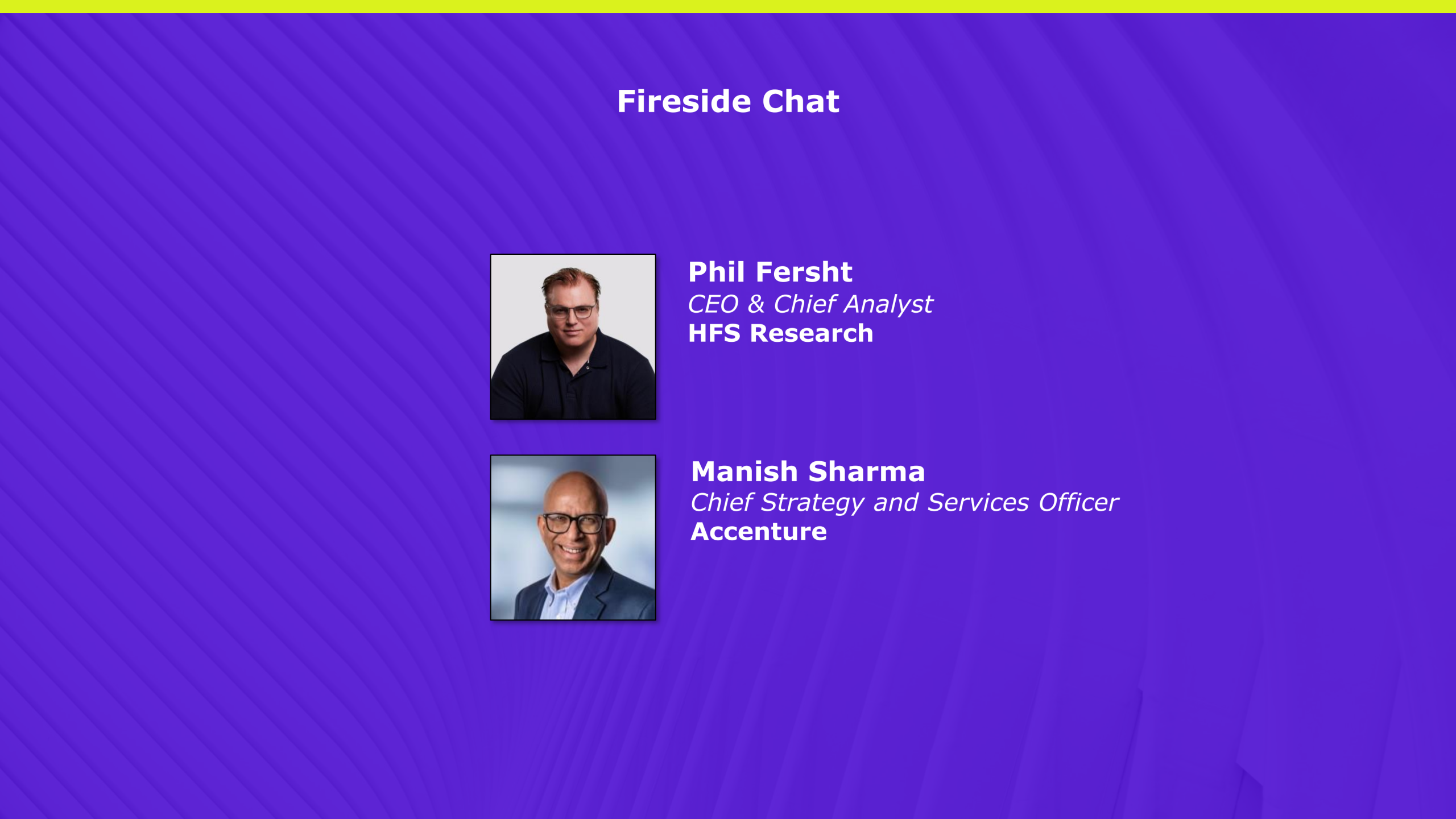
Fireside chat: Phil Fersht and Manish Sharma, Accenture

YouTube · Click to watch
Speaker
Phil Fersht
CEO and Chief Analyst, HFS Research

Phil Fersht is widely recognized as the world's leading analyst focused on reinventing business operations to exploit AI innovations and the globalization of talent. He recently coined the term "Services-as-Software" to describe the future of professional services, where people-based work is blurring with technology.


Manish Sharma
Chief Strategy and Services Officer, Accenture

Manish Sharma is known for his expertise in and passion for reinvention, rigor, and responsible business practices. He leads innovation and strategy for Accenture, as well as Reinvention Services—the integrated business unit that brings together Accenture's Strategy, Consulting, Song, Technology and Operations services worldwide.

Summary

Phil Fersht sits down with Manish Sharma, Chief Strategy and Services Officer at Accenture, for an unfiltered conversation on why most enterprise AI programs are still stuck in pilot mode and what the breakthrough 15 to 17% are doing differently. Manish lays out the five things that separate scaled AI from token-usage theatre: process, digital core, data, operating model, and talent, and argues that revenue growth, not productivity, is the real story for the C-suite. He frames the next decade as an AI industrialization wave that is the biggest tailwind the services industry has ever seen, points to Accenture's 5 billion dollar acquisition outlay (faculty.ai, DLB Associates, Ookla), and introduces the Reinvention Deployed Engineer, a new role at the intersection of industry, process, data, and AI. The session closes with audience questions on AI in K to 12 education, leadership and imagination debt, and recognition for the unsung process experts who make transformations actually work.

Key takeaways
  • Only 15 to 17% of clients move AI pilots to scale, and the gap is not the technology. It is fixing process, digital core, data, operating model, and talent before adding more pilots.
  • Reinvention is permanent, not a few-months-and-done project. Token usage equals activity. Real value shows up only when AI lands on a specific P&L line item with a baseline, an impact, and a date.
  • Revenue growth, not cost cutting, is the breakthrough story. Manish cites a consumer goods client lifting sales 6.4% with AI, and a contact center program that delivered 1 billion dollars in revenue uplift against 500 million in cost reduction.
  • AI industrialization is a 10-year tailwind for the services industry. Accenture is hiring 10,000 data and AI people over the next three quarters and has committed 5 billion dollars in acquisitions, including faculty.ai, DLB Associates, and Ookla, to build differentiated outcome-based IP.
  • The Reinvention Deployed Engineer (RDE) is Accenture's answer to commoditized models: one person who fuses function, process, industry, and technology skills to deliver client business outcomes.
  • AI is a CEO agenda, and where the C-suite leads visibly, results follow. Manish cites Ecolab CEO Christophe Beck personally directing the transformation, and UPS CHRO Darrell Ford running a 300,000-person surge hire in 12 weeks with AI. Neither is a side-of-desk project.
9:45 to 10:30 AM Panel

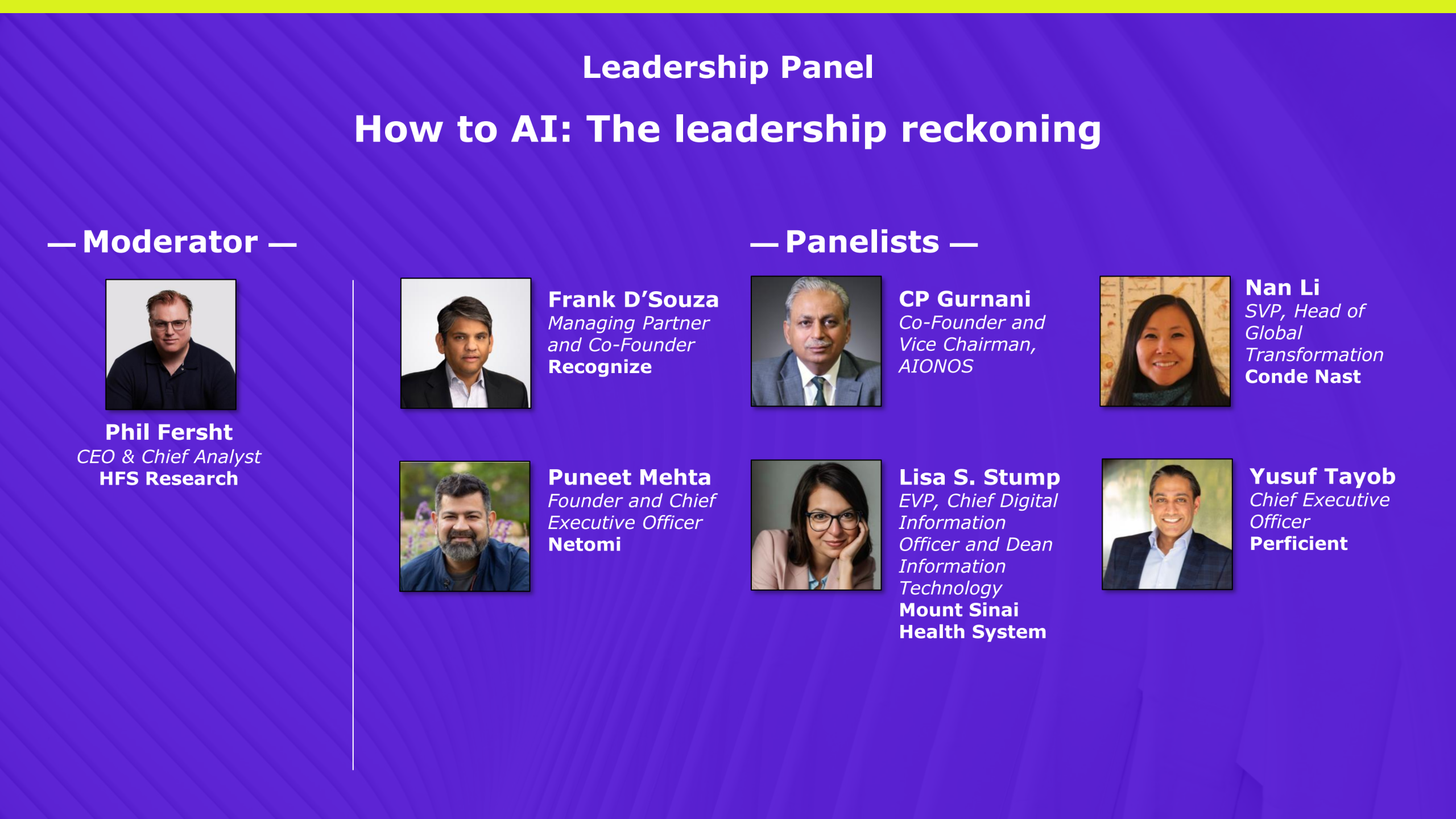
How to AI: The leadership reckoning

YouTube · Click to watch
Speaker
Phil Fersht
CEO and Chief Analyst, HFS Research

Phil Fersht is widely recognized as the world's leading analyst focused on reinventing business operations to exploit AI innovations and the globalization of talent. He recently coined the term "Services-as-Software" to describe the future of professional services, where people-based work is blurring with technology.


Francisco D'Souza
Managing Partner and Co-Founder, Recognize

Francisco (Frank) D'Souza is an entrepreneur, global business leader, technologist, and investor with a deep belief in the power of technology to enhance lives and businesses. As the co-founder and managing partner of Recognize— a technology investment platform —Frank guides his firm and its portfolio companies toward purposeful growth and seamless operations.


CP Gurnani
Co-Founder and Vice Chairman, AIONOS

CP Gurnani is Co-Founder and Vice Chairman of AIONOS.


Nan Li
SVP, Head of Global Transformation, Conde Nast

Nan Li is Senior Vice President and Head of Global Transformation at Conde Nast.


Puneet Mehta
Founder and CEO, Netomi

Puneet Mehta is the Founder and CEO of Netomi, and one of the few people in enterprise AI who has actually deployed it through multiple technology generations, in environments where reliability and compliance are non-negotiable.


Lisa Stump
EVP, Chief Digital Information Officer and Dean Information Technology, Mount Sinai Health System

As the Executive Vice President and Chief Digital Information Officer at Mount Sinai Health System, her focus is on spearheading digital health initiatives and optimizing business and clinical systems, leveraging artificial intelligence and data to deliver excellence in health outcomes.


Yusuf Tayob
Chief Executive Officer, Perficient

Yusuf Tayob is a consulting industry veteran with more than 25 years of experience. As Perficient's Chief Executive Officer, Yusuf is focused on scaling Perficient's AI native portfolio of digital consulting services, including expanding global delivery and talent hubs and deepening strategic alliances across the cloud, data and emerging tech ecosystem.

Summary

Phil Fersht moderates a six-leader panel that confronts the hard question of the morning: What have you actually done and what have you been willing to break to make AI real? The panel digs into personal accountability, the operating model leaders dismantled (Yusuf Tayob killed the COO role at Perficient and rebuilt the company in two quarters), the leadership debt and decision debt that Mount Sinai's Lisa Stump is unwinding role by role, and the shift from token economy to outcome economy that Puneet Mehta is exploiting at Netomi. Frank D'Souza tells services CEOs the part most won't say out loud: there is a J-curve coming, the ones who drop revenue before they grow revenue keep the trust of clients and investors, the rest don't. CP Gurnani anchors the conversation in values, trust, and applied intelligence; Nan Li explains how Conde Nast turned a contentious relationship with the major LLMs into a licensed revenue stream and where the ethical line on human-led content sits. The conversation closes on people: the leaders who win five years out will be the ones who let their people do the work differently.

Key takeaways
  • The build, buy, partner question is not either–or. Frank D'Souza argues services firms without proprietary IP do not survive the J-curve; CP Gurnani builds differentiators in revenue management and data exchange while renting foundation layers; Lisa Stump builds where Mount Sinai has the data science capability to marry subject matter expertise with architected clinical data, and buys or partners where Mount Sinai already owns the systems and solutions, or where a vendor brings a platform that would otherwise take an inordinate amount of time and money to build.
  • Yusuf Tayob killed the COO role at Perficient on purpose. With no COO to report to, the operational functions had to be rebuilt from scratch, and Perficient's own AI-first website rebuild compressed from a 12-month estimate (10 months with AI assistance) to 10 weeks actual, optimized for AEO and crawled by agents more than humans.
  • Lisa Stump's leadership debt thesis: layering AI on top of a legacy people-and-process structure accelerates and accentuates the existing problem and misses the real opportunity. Mount Sinai is working role by role through which tasks are highly exposed to AI, which to automate, which to leave with humans, and then redesigning the org around the work that's left.
  • Puneet Mehta's three waves at Netomi convert the token economy into an outcome economy, compress 18-month deployment cycles into weeks (Paramount went live in three weeks handling 80% of front-office traffic), and give enterprise AI publicly quantified wins because every stakeholder around the room needs one.
  • Nan Li on Conde Nast and the LLM providers: a contentious crawling relationship became a licensed-content revenue stream with OpenAI, Anthropic, and Perplexity. The ethical line Conde Nast will not cross is AI-generated content; human voice leads the loop on every published piece.
  • CP Gurnani's applied intelligence thesis for the AI era: durability comes from values, ethics, and trust with clients, not from the technology. The leadership mandate, drawn from his Tech Mahindra years: don't run AI as a discrete checklist project, and bring all stakeholders together early on workforce impact rather than secretly ripping out quality assurance and surprising people with layoffs.
  • Frank D'Souza's J-curve message to services CEOs: have the courage to drop revenue before you grow revenue. The productivity benefit from generative AI is no longer a debate, time-and-materials pricing is exposed, and management teams without a J-curve plan look tone deaf to investors.
11:25 to 11:55 AM Interactive session

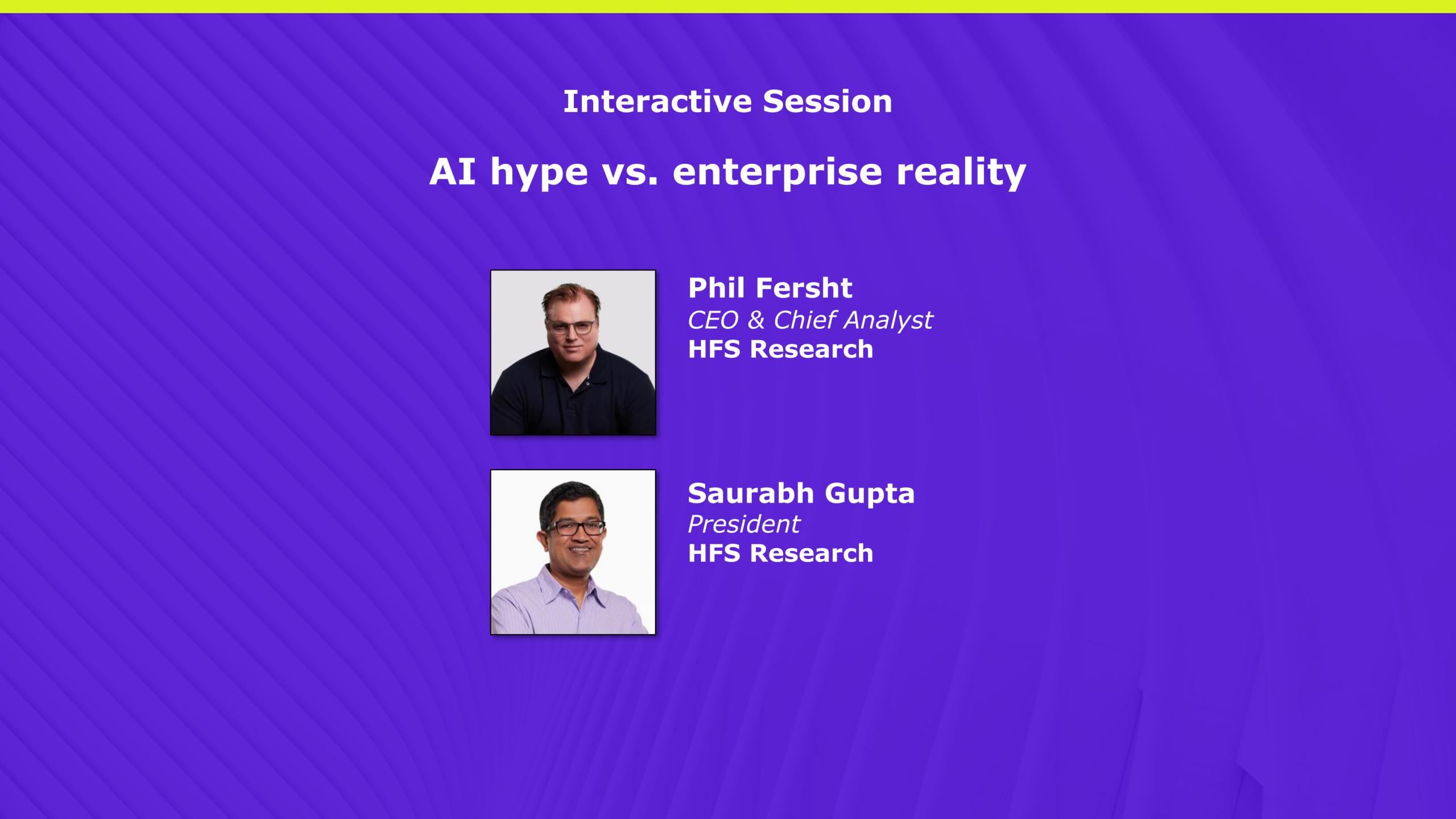
AI hype vs enterprise reality

YouTube · Click to watch
Speaker
Phil Fersht
CEO and Chief Analyst, HFS Research

Phil Fersht is widely recognized as the world's leading analyst focused on reinventing business operations to exploit AI innovations and the globalization of talent. He recently coined the term "Services-as-Software" to describe the future of professional services, where people-based work is blurring with technology.


Saurabh Gupta
President, HFS Research

Saurabh Gupta is President, Research and Advisory Services at HFS. He sets the strategic research focus and agenda for HFS Research, understanding and predicting the needs of the industry and ensuring that HFS maintains its position as the strongest impact thought leader for business operations and services research.

Summary

Phil Fersht and Saurabh Gupta run an unfiltered live polling and audience Q&A session on where enterprise AI hype is diverging from enterprise AI reality. The first poll asks the room which agentic AI claim is the biggest load of hype, with agentic washing drawing the most pointed audience commentary even though the poll split fairly evenly across all four hype options. The second poll asks what is really holding enterprises back, surfacing the HFS four debts framing of technical debt, data debt, process debt, and talent debt, plus a fast-rising fifth, leadership and accountability debt. Saurabh shares unpublished HFS data from 2,000 enterprise leaders showing 9 in 10 enterprises are stuck on all four debts and only 6 to 10 percent, almost all at the C-level, have begun to solve them. An audience contributor reframes agentic AI as the virtualization of work, the next shift after cloud virtualized infrastructure. Saurabh closes the session by extending the framing to a third category, virtual intelligence, alongside artificial and augmented intelligence. The constraints of the physical organization, who owns what, who can see what, who reports to whom, are what AI is actually attacking.

Key takeaways
  • Agentic washing drew the loudest audience pushback even though the poll itself split fairly evenly. Saurabh notes every RPA vendor, every workflow vendor, and many services firms have rebranded as agentic or AI-first.
  • 92 percent of enterprises HFS surveyed believe in agentic AI, but only 7 percent have working agents in production. Saurabh frames it as we are not even solving for a snack, let alone world hunger.
  • HFS quantifies four enterprise debts: technical debt, data debt, process debt, and talent debt. Audience and panel push to add a fifth, leadership and accountability debt, including who owns the outcome when an agent gets it wrong.
  • New HFS research with 2,000 enterprise leaders: 9 in 10 say all four debts are a significant issue, only 6 to 10 percent say they have solved for them, and that 10 percent is overwhelmingly C-level, treating AI as a CEO-mandated operating model change, not an IT modernization project.
  • Manufacturing and healthcare providers carry the heaviest debt loads in the HFS data set, both driven by deeply process-bound operating models. Services firms and banks rank lower than expected on a relative basis.
  • Incentive models are still designed to reward scoring the goal, not passing the ball. Until enterprises rewire performance metrics around AI-enabled outcomes rather than headcount and projects controlled, agentic AI will keep stalling.
  • Phil and an audience contributor reframe agentic AI as the virtualization of work, the next shift after cloud virtualized infrastructure. The constraints of the physical organization, who owns what, who can see what, who reports to whom, are what AI is actually attacking.
  • America is pouring trillions into AI infrastructure and compute, but underinvesting in education and workforce reskilling. Phil argues the binding constraint on enterprise AI value is people change, not model capability.
11:55 AM to 12:30 PM Panel

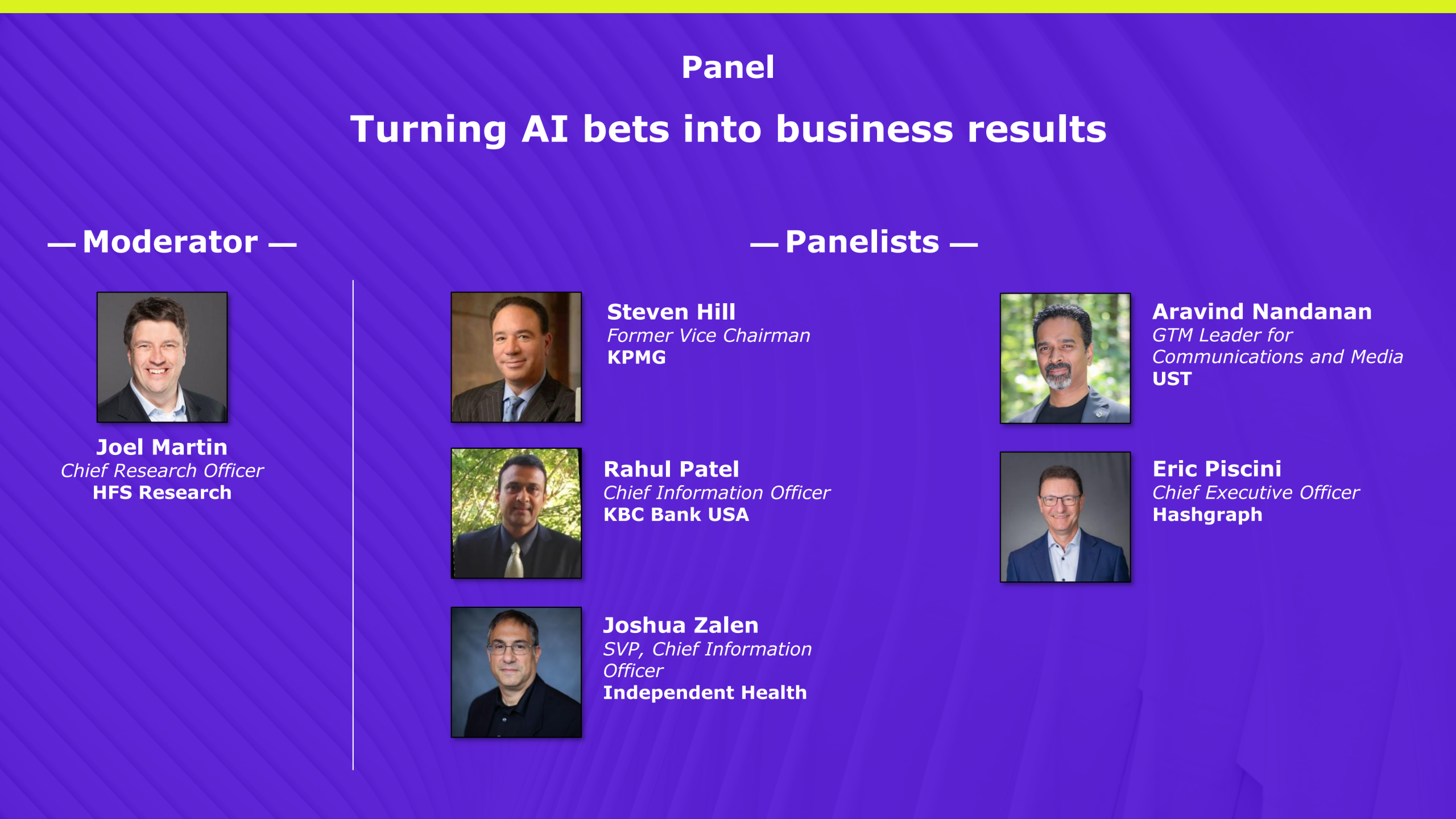
Turning AI bets into business results

YouTube · Click to watch
Speaker
Joel Martin
Chief Research Officer, HFS Research

Joel Martin is Chief Research Officer at HFS Research, where he leads the firm's global research agenda at the intersection of IT services, enterprise technology, and artificial intelligence. He guides a growing, multi-disciplinary research organization worldwide.


Steve Hill
Former Vice Chairman, KPMG

Proven visionary and catalyst for transformation with three decades of experience in spearheading sustainable and profitable growth. Renowned for an understanding of contemporary market dynamics and disruptive opportunities, offering guidance to corporate boards and enterprises in their journey to develop and expand their digital capabilities.


Aravind Nandanan
GTM Leader for Communications and Media, UST

Aravind Nandanan, the GTM Leader for Communications and Media at UST, is a veteran leader with a rich 24-year experience in the digital technology industry. As the steward of UST's Communications and Media business, Aravind sets the overall strategy and direction.


Rahul Patel
Chief Information Officer, KBC Bank USA

Experienced Chief Information Officer with a demonstrated history of working in the financial services industry. Skilled in Business Process, Requirements Analysis, Banking, Cyber Security, IT controls, Project Management, Business Continuity Planning, Enterprise Software, and Enterprise Architecture.


Eric Piscini
Chief Executive Officer, Hashgraph

Eric Piscini is the CEO of Hashgraph. With 25+ years of experience in building companies, developing strategies, and launching new products, he has previously served in executive and management roles at IBM Watson Health, Emerging Business Networks, Deloitte, and Citizens Reserve.


Joshua Zalen
SVP and Chief Information Officer, Independent Health

Joshua Zalen is an IT executive with over 20 years of leadership experience. Josh has developed IT strategies at large and mid-size companies and seen them to fruition with a focus on movement to as-a-service, cloud, and AI solutions.

Summary

Joel Martin moderates a 35-minute panel on what separates AI experimentation from execution. Rahul Patel of KBC Bank USA, Joshua Zalen of Independent Health, Aravind Nandanan of UST, Eric Piscini of Hashgraph, and former KPMG Vice Chairman Steve Hill share where they are scaling AI next, how KPIs are shifting from token counts to business outcomes, lessons from prior S-curves like cloud and blockchain, and why governance is the underplayed clock-speed lever for the board. The panel surfaces concrete moves: predicting radio access network failures to drive telco churn reduction, AI-enabled nurse care management at a regional health payer, vendor lock-in and contract renewal traps from early conversational AI deployments, and a secure-by-design cube spanning cognitive architecture, agency, and scope of impact. The throughline: stop buying AI, buy outcomes, and rewire governance for a compressed S-curve.

Key takeaways
  • KPIs are shifting away from token consumption to business outcomes. UST initially measured AI tokens across its 30,000-person workforce and saw bills climb without value; the team pivoted to revenue impact for clients, including a telco use case that linked radio access network failure prediction to customer churn and targeted promotions.
  • Regulated industries scale AI use cases where measurement is clean and stakeholders are easy to convince. KBC Bank USA is prioritizing software development acceleration and AI-driven cybersecurity, including continuous penetration testing and threat hunting, while managing EU AI Act constraints.
  • Vendor lock-in is the new technical debt. Independent Health deployed a conversational AI named Rose for open enrollment and hit the ROI, then got hit at renewal with non-agnostic LLM upgrade costs and a phone vendor pushing inferior native AI through 10x line-item increases.
  • Eric Piscini argues no one buys blockchain and no one buys AI; clients buy outcomes. Hashgraph delivered its CLPR product nearly a year early by embedding AI across engineering, product, and cybersecurity, while HR adoption lagged because it is a people business.
  • Steve Hill calls governance the underplayed attribute of this S-curve. AI breaks two prior assumptions: agents do not respect boundaries the way prior tech did, and employees arrive already using AI rather than waiting to be provisioned. Boards must drive governance clock speed to keep pace.
  • Secure by design is a multi-axis problem. Steve Hill describes Oak Trust Group's AIQ cube framework (Hill is a private equity investor in the firm), spanning cognitive architecture (deterministic vs probabilistic, constrained vs unconstrained generative AI), agency (human in the loop vs fully agentic vs orchestrator of agents), and scope of impact (decision, enterprise, market level), wrapped in a halo of security covering data, models, output, and access.
  • Process re-engineering is the missing ingredient. Aravind Nandanan argues the industry is not giving enough weight to redesigning processes around AI, and that AI speeds up knowledge and operational work but slows down where it has to own consequential decisions.
2:20 to 2:55 PM Panel

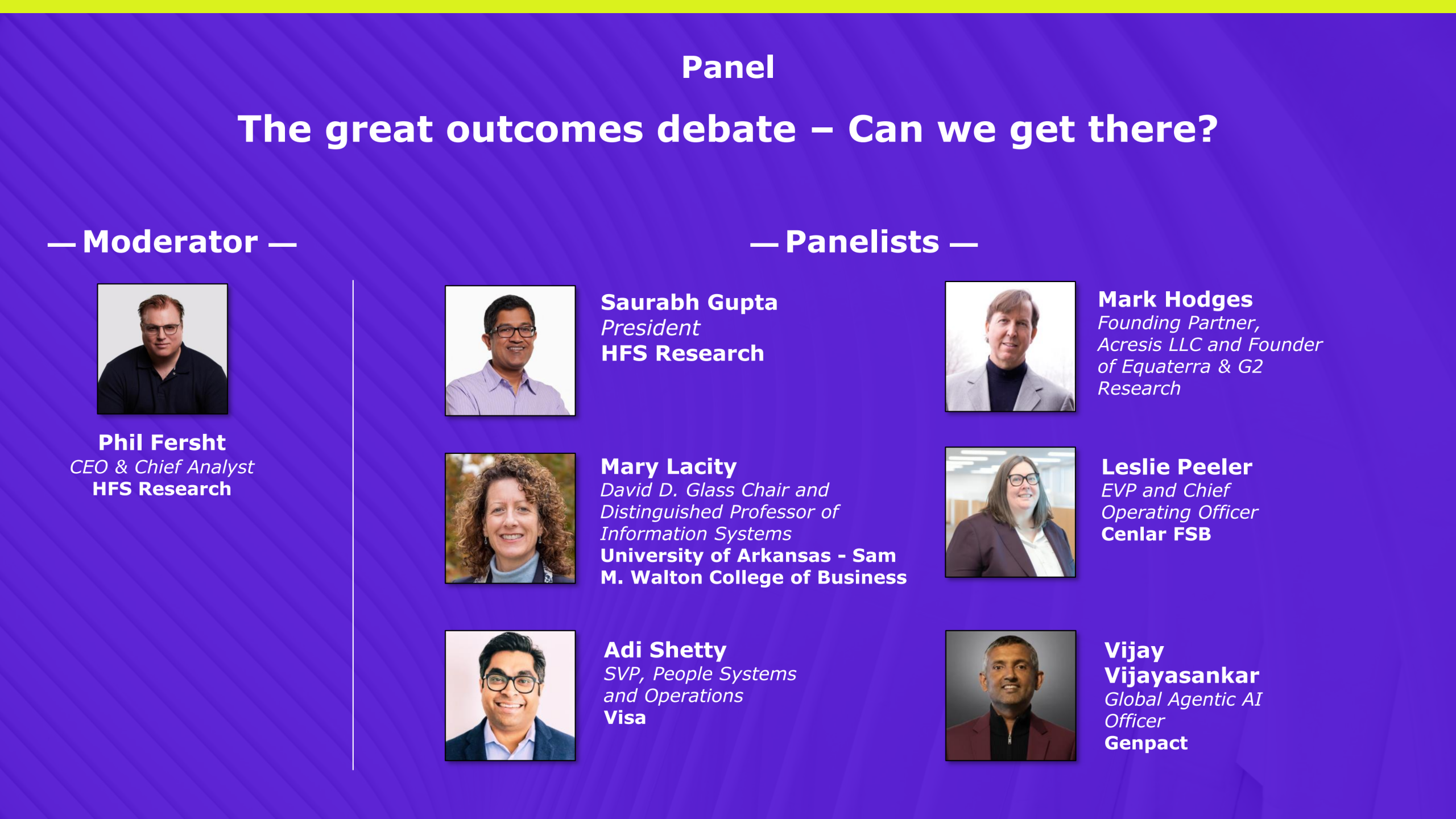
The great outcomes debate, can we get there?

YouTube · Click to watch
Speaker
Phil Fersht
CEO and Chief Analyst, HFS Research

Phil Fersht is widely recognized as the world's leading analyst focused on reinventing business operations to exploit AI innovations and the globalization of talent. He recently coined the term "Services-as-Software" to describe the future of professional services, where people-based work is blurring with technology.


Saurabh Gupta
President, HFS Research

Saurabh Gupta is President, Research and Advisory Services at HFS. He sets the strategic research focus and agenda for HFS Research, understanding and predicting the needs of the industry and ensuring that HFS maintains its position as the strongest impact thought leader for business operations and services research.


Mark Hodges
Founding Partner, Acresis LLC and Founder of Equaterra & G2 Research

Mark Hodges is Founding Partner, Acresis LLC and Founder of Equaterra & G2 Research.


Mary Lacity
David D. Glass Chair and Distinguished Professor of Information Systems, University of Arkansas ¬- Sam M. Walton College of Business

Dr. Lacity is a Distinguished Professor and David D. Glass Chair of Information Systems. She served as the Blockchain Center of Excellence at the University of Arkansas from 2018 to 2023. She was previously Curators' Distinguished Professor of IS at the University of Missouri-St. Louis.


Leslie Peeler
EVP and Chief Operating Officer, Cenlar FSB

Leslie Peeler is the EVP & Chief Operating Officer at Cenlar FSB, where she is leading a transformation in one of the most complex and heavily regulated sectors: mortgage operations. Her work is centered on turning complexity into clarity for their clients and their homeowners.


Aditya Shetty
SVP, People Systems and Operations, Visa

Adi Shetty is SVP, People Systems and Operations, Visa. He oversees Visa's People Systems & Solutions, Global Payroll, and Workforce Planning & Analytics teams. Adi brings more than 20 years of global experience driving digital transformation and AI innovation in human resources for large enterprises.


Vijay Vijayasankar
Global Agentic AI Officer, Genpact

Vijay is the Global Agentic AI Officer at Genpact. He leads the development and integration of Genpact's agentic AI capabilities, uniting advanced technology and deep domain expertise to redefine how enterprises operate.

Summary

Phil Fersht moderates a six-person panel on whether outcome-based deals are finally real or still a promise the services industry keeps making and missing. Leslie Peeler (Cenlar FSB) describes a live renegotiation with her largest spend supplier away from labor-based pricing toward a gain-share model, Aditya Shetty (Visa) presses for portability clauses and explicit exit architecture in every AI contract, and Saurabh Gupta argues every AI initiative needs a balanced scorecard rather than a single productivity number, with academic Mary Lacity reasserting the four conditions outcome-based contracts must still meet: mutual benefit, trust and transparency, measurable outcomes with strong baselines, and supplier control of the value chain. Vijay Vijayasankar (Genpact) and Mark Hodges (Acresis) take on procurement culture and tokenomics, and Saurabh Gupta argues the IT services contracting playbook is stuck in the 1990s. The session lands on practical actions: AI labs that do not punish failed pilots, an outcome owner for every initiative, and four screening questions (what, who, how, under what circumstances do you kill it) for every new AI proposal.

Key takeaways
  • Lowering cost is a valid outcome, but compounding outcomes over time is the better frame. Vijay Vijayasankar argues AI uniquely enables compounding because models improve over time, so the reframe to CFOs is what you do with the reduced cost over time, not how much headcount comes out.
  • Stop selling shrinkage, start selling capacity. Aditya Shetty (Visa) says HR and other functions have spent 18 months telling CFOs they can cut budgets by 30 percent, which CFOs now hear as auto-defunding. The new pitch is capacity for important work that never gets done.
  • Every business case needs more than one source of value. Mary Lacity asks for three (enterprise, customer, employee), Leslie Peeler asks for two, Saurabh Gupta proposes the HFS Four Ps (productivity, performance, personalization, prediction). The shared point: pilots stuck at productivity are stuck because productivity is the only number on the scorecard.
  • Mary Lacity reasserts the four classic conditions for outcome-based contracts in the AI era: mutual benefit for client and provider, high trust and transparency, measurable outcomes with strong baselines, and provider control of the value chain. If 90 percent of value generation depends on the client, outcome contracts will not work.
  • Deal structures are archaic. Saurabh Gupta calls today's RFPs Netflix-counting-DVDs: six to eight month selection cycles for an AI world that re-renders every six months. Mark Hodges expects the next contracting innovation to come either from a legacy outsourcing provider or an AI-native challenger, and procurement and legal will stampede the standard once a market leader sets it.
  • Tokenomics needs to be reframed as a variable cost of revenue, not an overhead line. Vijay Vijayasankar pushes back on Jensen Huang's call to spend $250,000 per engineer on tokens and warns against measuring teams on token consumption. Saurabh Gupta cites the Uber example of burning through a token budget in four months with no revenue lift.
  • Adi Shetty's four-question governance habit for every AI proposal: what is the business outcome you are buying, who is accountable when it is not met, how do you know it has arrived (90 day check), and under what circumstances do you pull the plug. If any one is unclear, do not fund it.
  • Prenups for AI deals. Adi Shetty argues every AI contract needs portability clauses, data migration rights, and explicit exit architecture, especially with the vendors who push back hardest on those terms.
2:55 to 3:20 PM Fireside chat

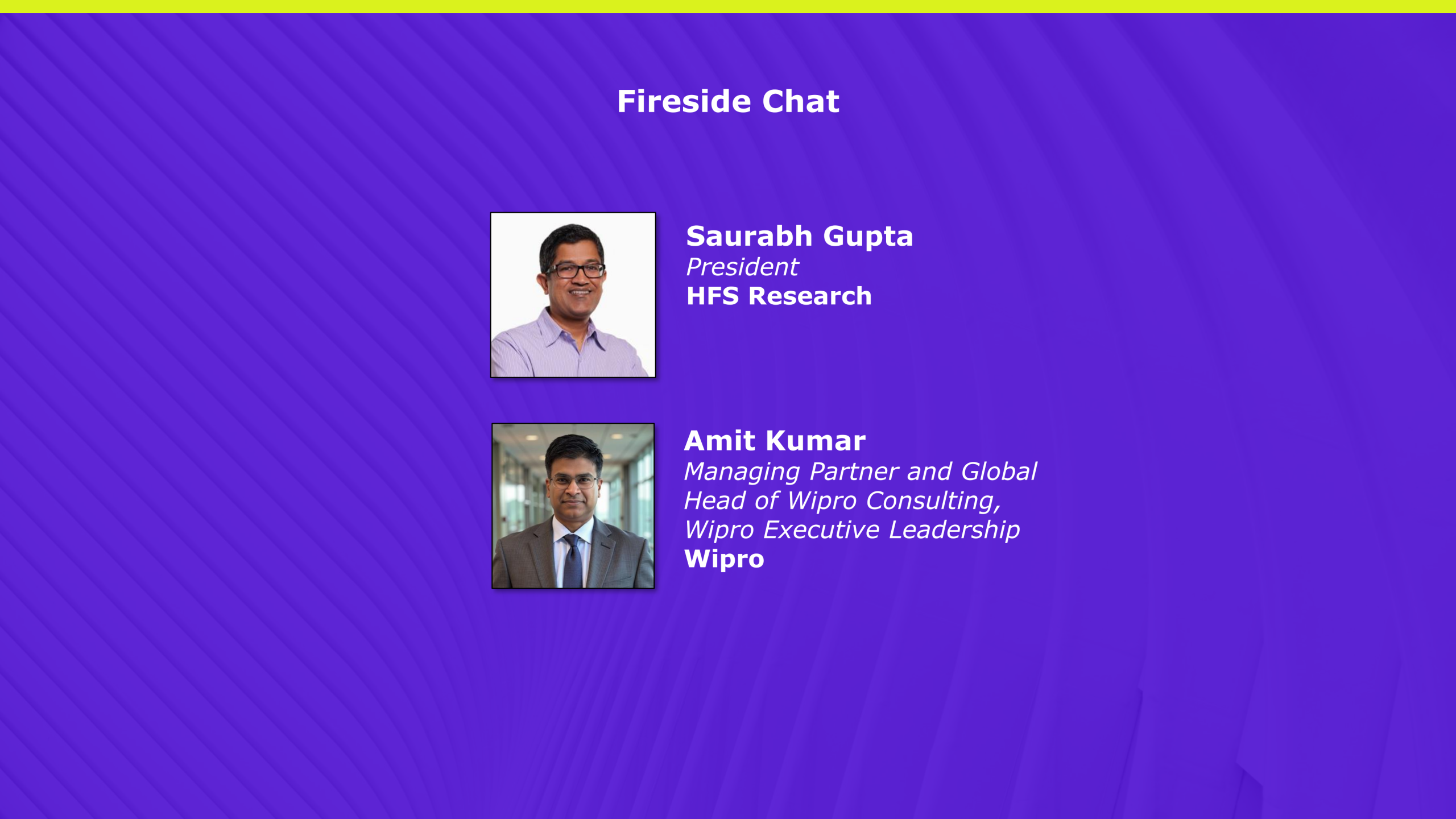
Fireside chat: Saurabh Gupta and Amit Kumar, Wipro

YouTube · Click to watch
Speaker
Saurabh Gupta
President, HFS Research

Saurabh Gupta is President, Research and Advisory Services at HFS. He sets the strategic research focus and agenda for HFS Research, understanding and predicting the needs of the industry and ensuring that HFS maintains its position as the strongest impact thought leader for business operations and services research.


Amit Kumar
Managing Partner and Global Head of Wipro Consulting, Wipro Executive Leadership, Wipro

Amit Kumar is the Managing Partner and Global Head of Wipro Consulting and a member of Wipro's Executive Leadership Team. He leads Wipro Consulting's global growth agenda, helping clients drive large-scale business transformation by aligning strategy, operations, and technology.

Summary

Saurabh Gupta sits down with Amit Kumar, Managing Partner and Global Head of Consulting and AI Advisory at Wipro, for an unfiltered fireside on whether consulting and IT services are still fit for purpose in the AI era. Amit argues that AI is an accelerator, not the thing itself: models will commoditize, value will accrue to firms that bring deep process, industry, and adoption expertise to bear on client outcomes. He walks the room through Wipro's decision to integrate BPO with consulting under a single client-facing organization, explains why outcome-based pricing is still a journey rather than a destination, and shares two personal leadership shifts, having learning coaches at both his direct-report level and at the bottom of the pyramid, and treating AI as an operating-model change rather than a search engine. The conversation closes on what an ex-Wiproite in the audience calls the 26-year-old myth of one unified services face, and how Wipro is now executing against it rather than just talking about it.

Key takeaways
  • AI is an accelerator, not the thing. Models will commoditize across Anthropic, OpenAI, Gemini, and others. The durable value in consulting and IT services sits in process knowledge, industry judgment, and driving human adoption at scale.
  • Wipro has integrated its BPO and consulting organizations to give clients one face and one end-to-end accountability across strategy, systems implementation, process operations, change management, and data. Amit says Wipro started this in November, announced it in January, and is now extending it to engineering, technology, and go-to-market.
  • Outcome-based pricing is still a myth in practice, but AI is accelerating the maturity curve. Amit expects the next two to three years to push the industry toward shared baselines, common data, trust, and contracts that price human-plus-agent delivery together.
  • Wipro's consulting buyer set has pivoted beyond the CIO to four non-CIO CXOs: CFO, CHRO, Chief Supply Chain Officer, and CMO. The firm is seeding ideas rather than waiting for RFPs.
  • Amit's two learning coaches model: one direct report, one at the bottom of the pyramid. The gap between how senior leadership and frontline talent read AI disruption is wide, and closing it is leadership work, not a technology task.
  • Consulting as a career is still one of the best options for the next generation, according to Amit, precisely because the once-in-20-years paradigm shift is happening live across industries, functions, and geographies.
3:40 to 4:25 PM Interactive session

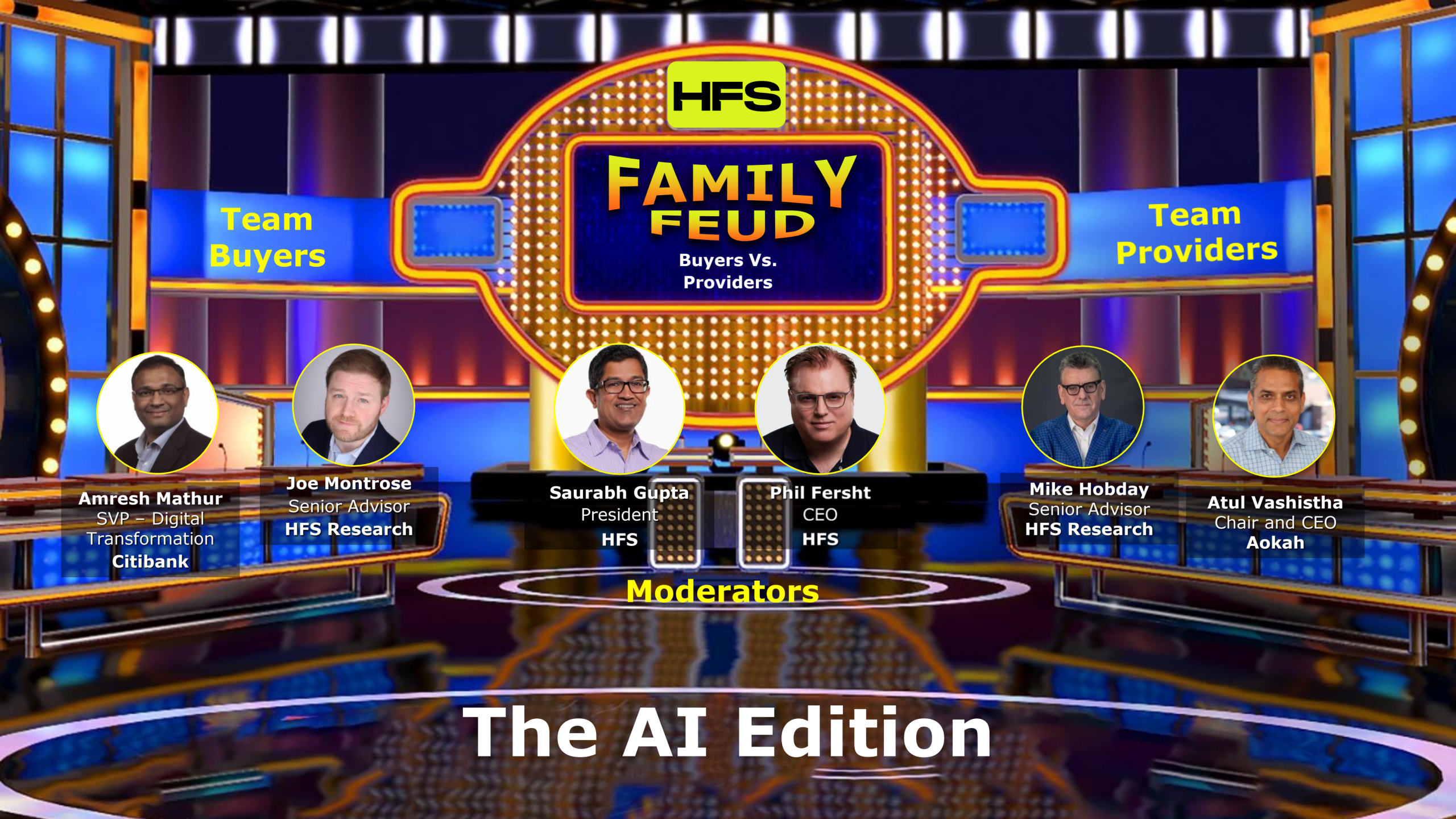
Family Feud: Providers vs Buyers, the AI edition

YouTube · Click to watch
Speaker
Phil Fersht
CEO and Chief Analyst, HFS Research

Phil Fersht is widely recognized as the world's leading analyst focused on reinventing business operations to exploit AI innovations and the globalization of talent. He recently coined the term "Services-as-Software" to describe the future of professional services, where people-based work is blurring with technology.


Saurabh Gupta
President, HFS Research

Saurabh Gupta is President, Research and Advisory Services at HFS. He sets the strategic research focus and agenda for HFS Research, understanding and predicting the needs of the industry and ensuring that HFS maintains its position as the strongest impact thought leader for business operations and services research.


Mike Hobday
Senior Advisor, HFS Research

Mike Hobday is a Senior Advisor at HFS Research, where he delivers research projects and consulting engagements and contributes to our Services-as-Software initiatives. He is known for his pragmatic approach to innovation and enterprise change.


Amresh Mathur
Senior Vice President, Digital Sales and Transformation, Citi

Amresh Mathur is a Senior Vice President of Digital Sales and Transformation at Citi with deep experience at the intersection of strategy, technology, and customer experience. Prior to Citi, he worked with large enterprises such as Samsung, Citizens Bank, and Infosys.


Atul Vashistha
Chair and CEO, Aokah

Atul is the Founder of Aokah, Supply Wisdom & Neo Group, and the visionary behind the GBSBoard and RiskBoard. Presently, Atul is a board member of Aokah and also serves as its Chair and CEO. Aokah is an AI platform helping companies orchestrate global capabilities.


Joe Montrosse
Senior Advisor, HFS Research

Joe Montrosse is an experienced advisor with over 30 years' experience helping advanced technology executives transform operations to deliver new capabilities to the customers they serve, improve the customer experience, reduce fixed and variable costs, and optimize operating models aligned to near term and long-term business strategy.

Summary

Phil Fersht and Saurabh Gupta referee the Family Feud, a live audience-voted debate between a buyer team (Amresh Mathur, Citi; Joe Montrosse, HFS Senior Advisor) and a provider team (Mike Hobday, HFS Senior Advisor; Atul Vashistha, Aokah) on what is really wrong with the AI provider buyer relationship. Across three rounds, the room voted on who kills pilots, who is most guilty of AI theater, who owns the data and process debt, who broke the trust, what is killing partnerships today, and where the leverage shifts in the AI first world. The audience answers map a clear pattern: leadership kills pilots by demanding pioneer outcomes on exploratory budgets, providers are the worst offenders on AI theater by rebranding existing work as agentic, and both sides have to share the blame for a broken trust model built on transactional contracts. Buyers are emerging as the long-term leverage holders because whoever owns the data owns the AI first operating model.

Key takeaways
  • Audience vote, who kills pilots: leadership wins, the room rejected blaming buyers, providers, both, or procurement and pinned it on senior leaders who want pioneer outcomes on exploratory budgets.
  • Audience vote, who is most guilty of AI theater: providers, for rebranding existing services as agentic. The buyer and provider teams both went with both, missed it, and neither earned a point.
  • Audience vote, who owns the process, data, talent, and tech debt: buyers, for owning the mess up front. The buyer team scored on humility, saying it before the room did.
  • Audience vote, who broke the trust: both. The room agreed both sides built and ran transactional relationships, even when the work needed a partnership.
  • Audience vote, the single biggest thing killing partnership today: neither side willing to share risk or real reward. Commercial models priced for labor came in close.
  • Audience vote, who needs to change more in the AI world: both. The contract is the problem, and nobody wants to be the one to rewrite it.
  • Audience vote, who holds the leverage in the AI-first world: large providers, because the world is flattening. Saurabh's read on stage: large providers will lose leverage.
  • Audience vote, who holds the leverage in renegotiating contracts: buyers, because AI-first contracts make switching cheap and exit costs are low.
  • Audience vote, who owns the AI first operating model of the future: buyers, because whoever owns the data owns the game. Atul Vashistha announced Aokah will release its GCC decision data set to HFS buy-side customers free starting July 1.
  • Final score, called by Saurabh: buyer team wins. Citi sponsors the drinks.
4:25 to 4:50 PM Fireside chat

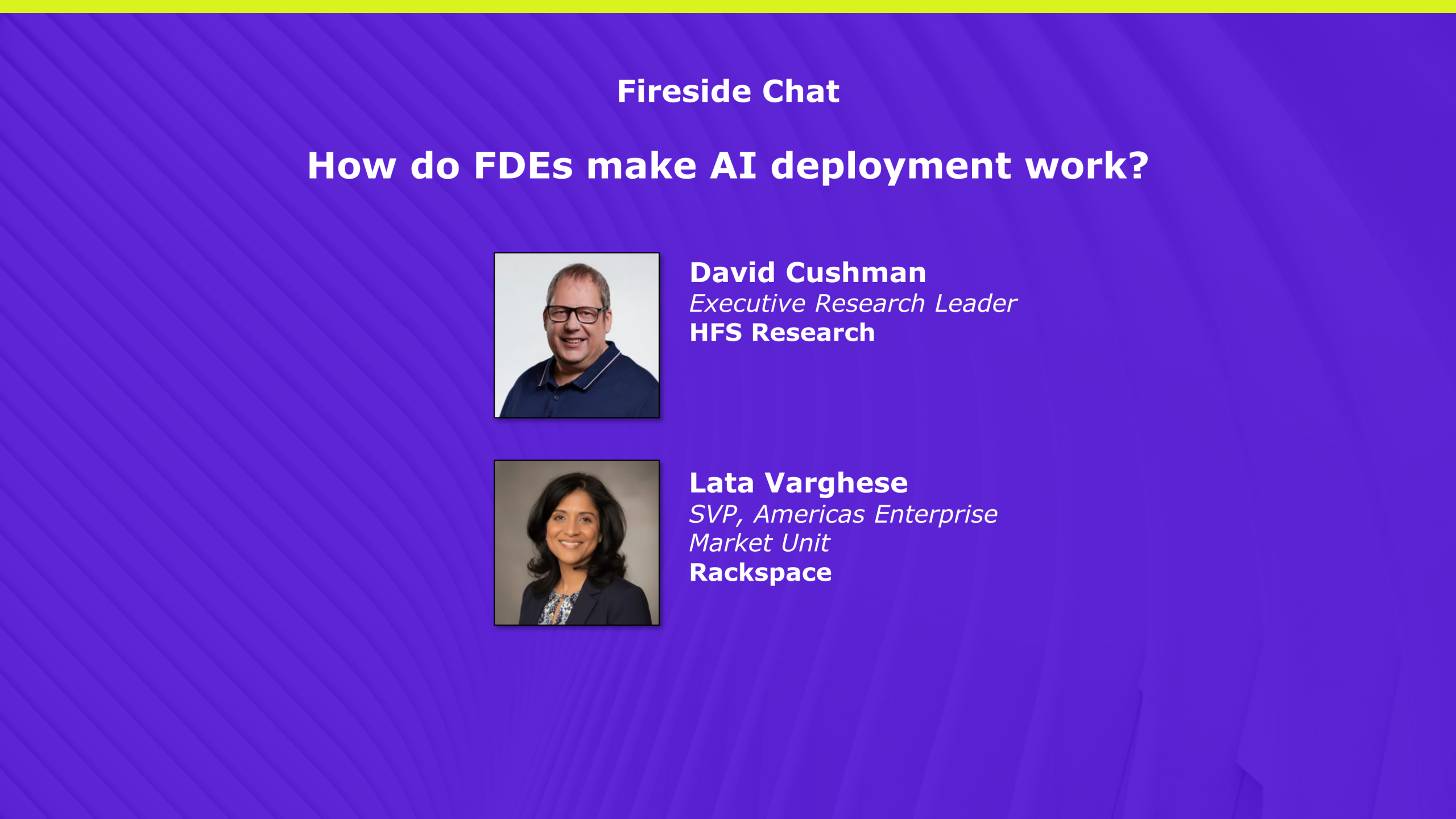
Fireside Chat: How do FDEs make AI deployment work?

YouTube · Click to watch
Speaker
David Cushman
Executive Research Leader, HFS Research

David is an Executive Research Leader at HFS, focusing on emerging technology, tracking OneOffice and OneEcosystem enablers from automation, AI, GenAI, data and design thinking, Web3 and metaverse, process orchestration, workflow, and intelligence to quantum computing.


Lata Varghese
SVP, Americas Enterprise Market Unit, Rackspace

Lata Varghese is Market Unit Leader for Regulated Industries at Rackspace, where she drives the company's GTM for regulated enterprises across the full stack, from infrastructure to agents, in governed, production environments.

Summary

David Cushman sits down with Lata Varghese of Rackspace to unpack the Forward Deployed Engineer model that Palantir has popularized and ask what it actually takes to make AI work in regulated industries. Lata reframes FDEs away from the unicorn-engineer mythology and toward a pod combining engineering, domain, and process that sits close to the workflow, builds with the users, and stays accountable on day two operations. The conversation moves through governed infrastructure, inference economics, ontology and context, IP and sovereignty concerns, agentic AI sprawl in banking, and ambient AI data volumes in healthcare. The throughline: stop hand-waving the hard parts, build software a different way, and earn the right to scale by solving a big enough problem on infrastructure you can actually govern, audit, and explain.

Key takeaways
  • Forward Deployed Engineer is less about the title and more about a pod that brings engineering, domain, and process together close to the workflow, so production constraints surface early instead of being parked for later.
  • FDEs do not disappear at go-live. Rackspace's model keeps the same people accountable on day two, running and operating the solution next to the CISO, CCO, and clinical or banking workflow owners.
  • Scaling AI in regulated industries comes down to boring old infrastructure. Healthcare and banking already run HIPAA, HL7, FHIR, fraud, and KYC controls, and AI does not get a get-out-of-jail-free card on governance, auditability, or explainability.
  • Inference economics start to matter once you scale. Smaller language models trained on enterprise data, plus an ontology and a governed intelligence layer, beat bolting on yet another point solution and creating AI sprawl.
  • IP and sovereignty are now real buying criteria. Enterprise CIOs do not want frontier model providers reading their API pipelines and learning their secrets, which is pushing workloads back onto governed infrastructure they control.
  • Palantir is not for every client, but the Palantir model of building close to the problem is. Rackspace is eating its own dog food by deploying Palantir on its back office, and pairs it with ecosystem partners including Uniphore for the right tooling on the right problem.
4:50 to 5:25 PM Panel

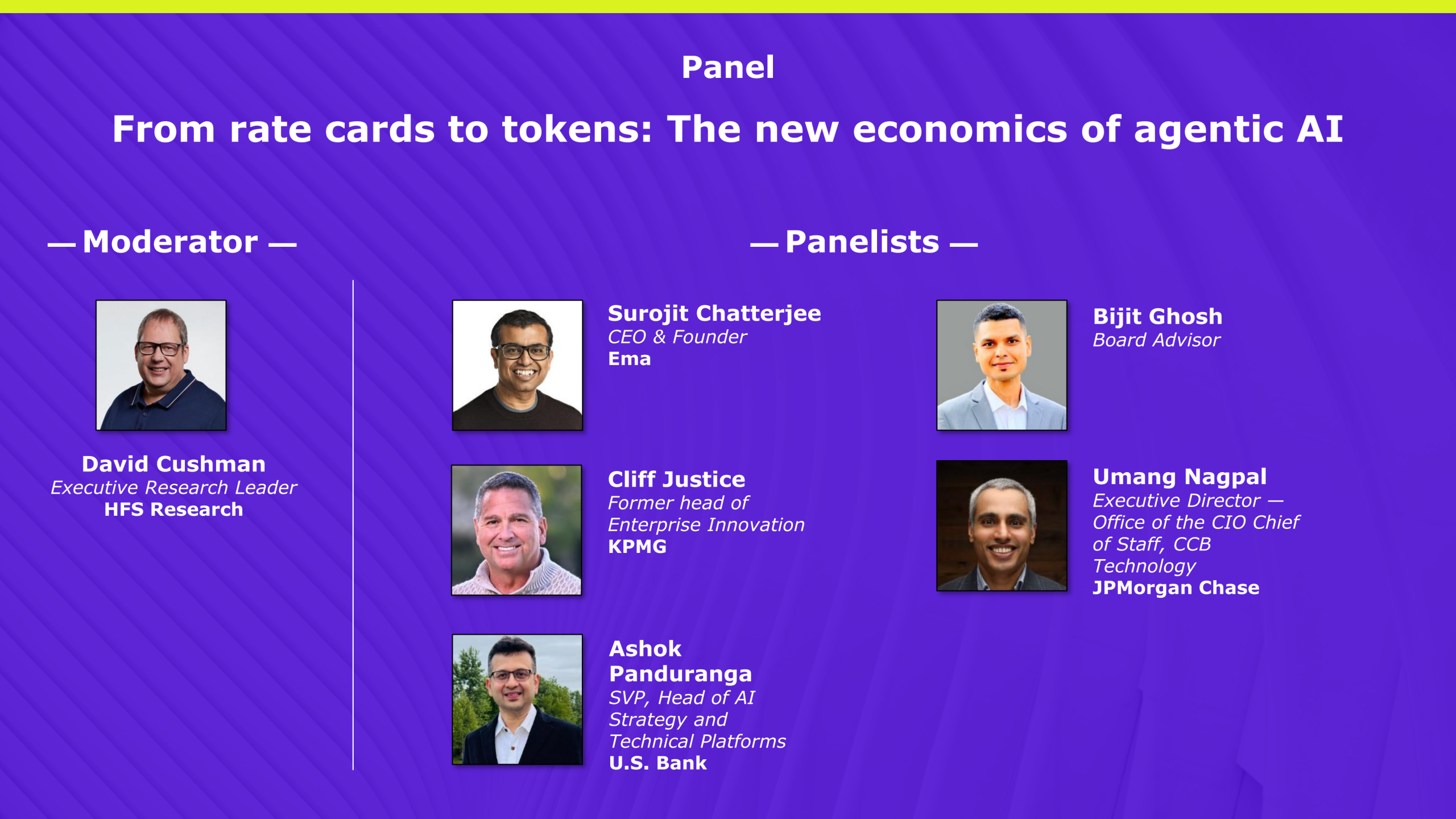
From rate cards to tokens: The new economics of agentic AI

YouTube · Click to watch
Speaker
David Cushman
Executive Research Leader, HFS Research

David is an Executive Research Leader at HFS, focusing on emerging technology, tracking OneOffice and OneEcosystem enablers from automation, AI, GenAI, data and design thinking, Web3 and metaverse, process orchestration, workflow, and intelligence to quantum computing.


Surojit Chatterjee
CEO and Co-founder, Ema.ai

Surojit Chatterjee is the CEO and Co-founder of Ema, an agentic AI platform building AI employees for the enterprise. Before founding Ema, Surojit served as Chief Product Officer at Coinbase through its 2021 IPO and as VP and GM of Google Mobile Ads.


Bijit Ghosh
Board Advisor

Bijit Ghosh is the Chief Technology and AI Officer, leading business and technology transformation at the intersection of AI/ML, Data Platforms, Cloud, and high-performance AI infrastructure (GPU/XPU computing).


Cliff Justice
Former head of Enterprise Innovation, KPMG

After retiring from KPMG in 2026, where he led Enterprise Innovation, he now serves as an independent advisor, investor, and board member, supporting organizations building and scaling new platforms, capabilities, and growth models.


Umang Nagpal
Executive Director — Office of the CIO Chief of Staff, CCB Technology, JPMorgan Chase

Umang Nagpal built the operating systems that turn complexity into margin, discipline, and measurable ROI. Across JPMorgan Chase and several Fortune 100 organizations, Umang has governed multi-billion-dollar technology portfolios and delivered $100M+ in cost savings.


Ashok Panduranga
SVP, Head of AI Strategy and Technical Platforms, U.S. Bank

Ashok Panduranga is SVP, Head of AI Strategy and Technical Platforms, U.S. Bank.

Summary

David Cushman closes Day 1 of the HFS NY Spring Summit 2026 with five enterprise and provider leaders on the economics of agentic AI. The panel works through what tokenomics actually is (a continuation of the FTE-then-compute-second unit-of-cost lineage, now a proxy for intelligence), why the Jevons paradox makes token demand essentially unbounded, and why an outcome-based pricing model is the only durable destination.

Umang Nagpal frames a three-tier token request taxonomy at JPMorgan Chase; Surojit Chatterjee argues only a routing layer like Ema Fusion can hold the line at scale; Ashok Panduranga at US Bank calls for operational governance, telemetry, and upstream architecture; Ashok Panduranga frames the human-AI-hybrid view through the radiologist paradox, with Cliff Justice extending it, and Bijit Ghosh adds the LLM-as-a-judge multi-agent pattern. The session lands on trust: financial services is a deterministic, trust-based industry being asked to consume a probabilistic technology, and the contracting layer (cloud 2.0 style FinOps dashboards for tokens) has to catch up.

Key takeaways
  • Tokenomics is the next unit of cost after FTE and compute second. It is a proxy for intelligence, not a one-for-one proxy for compute, and the FinOps discipline will have to evolve to account for it (Cliff Justice).
  • Jevons paradox applies. Token cost is falling roughly 100x per year, but demand for intelligence will keep outpacing supply because AI has so far only really touched code; there is no ceiling in sight (David Cushman, Cliff Justice).
  • Paying for tokens is paying for work, and paying for work has never been a good idea. The destination is outcome-based pricing per unit of useful output (David Cushman, with Surojit Chatterjee, Bijit Ghosh, and Ashok Panduranga affirming the outcome-based destination).
  • JPMorgan Chase's working mental model is a three-tier token request taxonomy: tier 1 simple commands, tier 2 single-agent calls, tier 3 multi-agent orchestration. Tier 3 is where costs go ballistic unless the endpoint is boxed (Umang Nagpal).
  • Control points are operational discipline, telemetry, and architecture, upstream of the token bill rather than downstream of it. Routing layers that pick the cheapest viable model per task are the operational pattern (Ashok Panduranga, Surojit Chatterjee).
  • The radiologist paradox is the human-AI-hybrid template: AI did not eliminate radiologists; demand for radiologists went up because the cost of the underlying scan fell and volume exploded. Judgment, accountability, and edge-case handling stay human (Ashok Panduranga, Cliff Justice).
  • Trust in tokenomics requires cloud 2.0-style transparency: per-token cost visibility, FinOps-equivalent dashboards on both the provider and enterprise side, and a clear answer to what happens at overage and underuse. Financial services is deterministic and trust-based; the probabilistic layer underneath has to be governed for it (Umang Nagpal).

Sign In

Sign up for a free
research account

With the exception of our Horizons reports, most of our research is available for free on our website. Sign up for a free account and start realizing the power of insights now.

Digests/Newsletters: Overviews of the latest news, insight, and research by HFS.

HFS Events: Exclusive invitations to HFS webinars, roundtables, and summits, bringing together key industry stakeholders focused on major innovations impacting business operations.

By registering you agree to our privacy policy.

I hereby consent that HFS Research can process my personal data.

Premium Access

Our premium subscription gives enterprise clients access to our complete library of proprietary research, direct access to our industry analysts, and other benefits.

Contact us at [email protected] for more information on premium access.

Help

If you are looking for help getting in touch with someone from HFS, please click the chat button to the bottom right of your screen to start a conversation with a member of our team.

[email protected]

    Contact Ask HFS AI Support