Events NY Spring Summit 2026 Day 2 — May 14, 2026
Day 2 of 2 · NY Spring Summit 2026 · How to AI

Day 2 — Thursday, May 14, 2026

New York, NY

Filter
9:30 to 9:40 AM Welcome

Welcome back

YouTube · Click to watch
Host
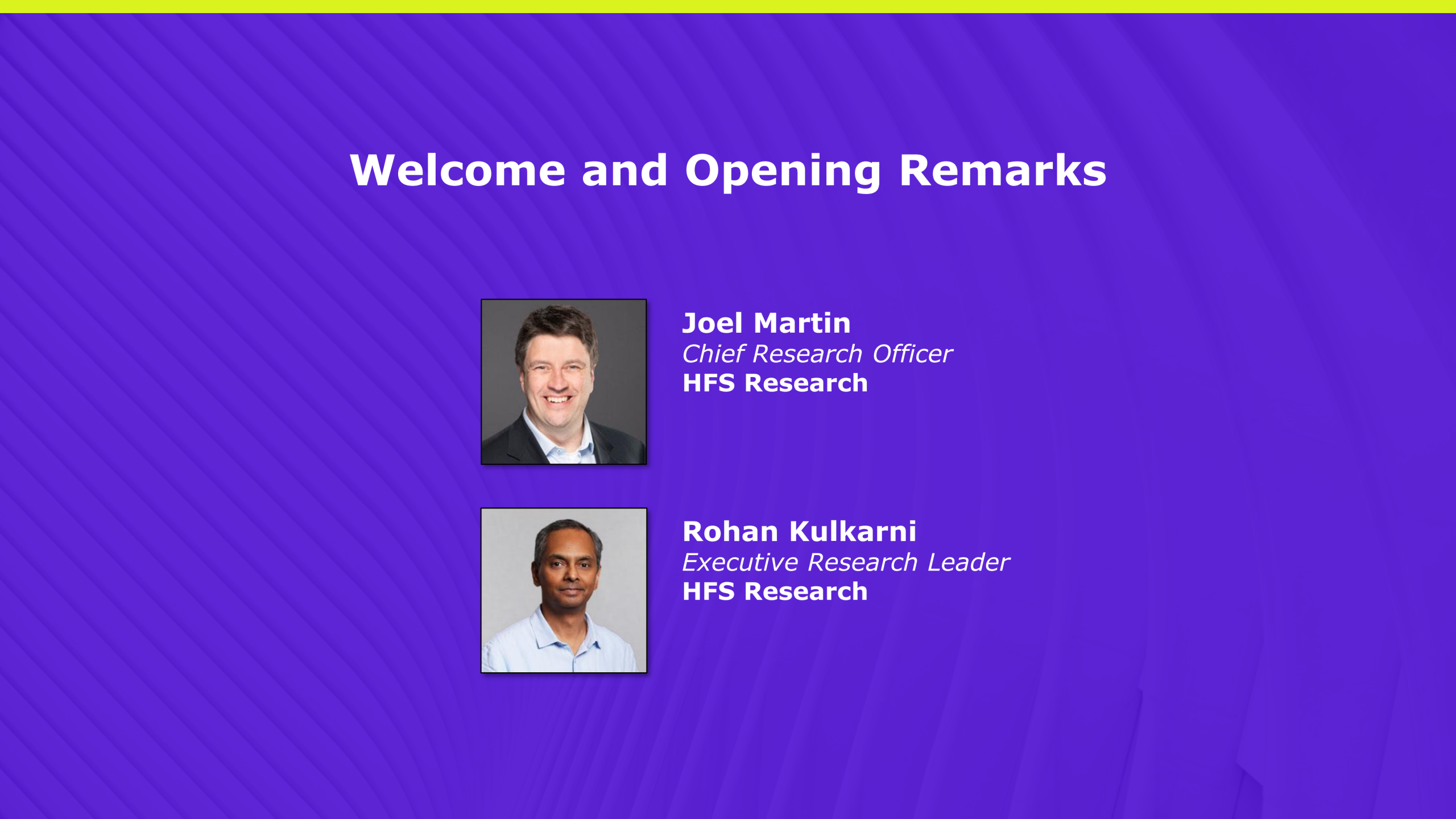
Joel Martin
Chief Research Officer, HFS Research

Joel Martin is Chief Research Officer at HFS Research, where he leads the firm's global research agenda at the intersection of IT services, enterprise technology, and artificial intelligence. He guides a growing, multi-disciplinary research organization worldwide.


Rohan Kulkarni
Executive Research Leader, HFS Research

Rohan Kulkarni is an executive research leader for HFS Research. He is responsible for coverage of the healthcare and life sciences practice, bringing to the table his vast experience across the healthcare ecosystem. Rohan's experience includes serving as the head of healthcare strategy at multiple Fortune 500 companies.

Summary

Joel Martin and Rohan Kulkarni open Day 2 of the HFS NY Spring Summit 2026 by framing AI through an industry and intentional-leadership lens. They draw on Day 1 conversations with Lisa Stump (Mount Sinai) on AI-led care delivery, Rahul Patel (KBC Bank USA) on the CIO and CEO partnership, and Josh Zalen (Independent Health) on disrupting expensive core applications with AI. They reintroduce two HFS programs running across both days: the HFS Data Intelligence Suite, with 1,800-plus AI deployments tracked and live analyst demos in room 203, and the AI-First Deal Lab interactive workshop at lunch, where Saurabh Gupta and Nigel Edwards translate Services-as-Software™ into 100-day contract plans.

Key takeaways
  • Intentional leadership has to be set in the context of the company and the industry it operates in, with the average CEO sitting on a five-to-eight year tenure and a transition to an AI operating model that often outlasts them.
  • Healthcare margins are shrinking under legislative pressure, but health systems sit on enormous clinical data sets that, when shared as intelligence, can become a material revenue stream powered by AI.
  • Joel's poll on Day 1 confirmed that middle managers lead on AI usage inside enterprises today, with senior executives finishing last. That puts pressure on the CIO and CEO to surface data out of disparate systems and into middle managers' and frontline employees' hands.
  • The HFS Data Intelligence Suite, launched the week prior, includes 1,800-plus tracked AI deployments and is staffed by HFS analysts (Ashish Chaturvedi, Hansa Iyengar, Jason Dann) in room 203.
  • Services-as-Software is defined as IP-led delivery versus people-led, orchestrating outcomes versus process sourcing, and using telemetry to realize value versus static KPI contracts.
  • The AI-First Deal Lab produces a 100-day plan, not ideation, so buyers leave with concrete contract changes and early milestones.
9:40 to 10:15 AM Panel

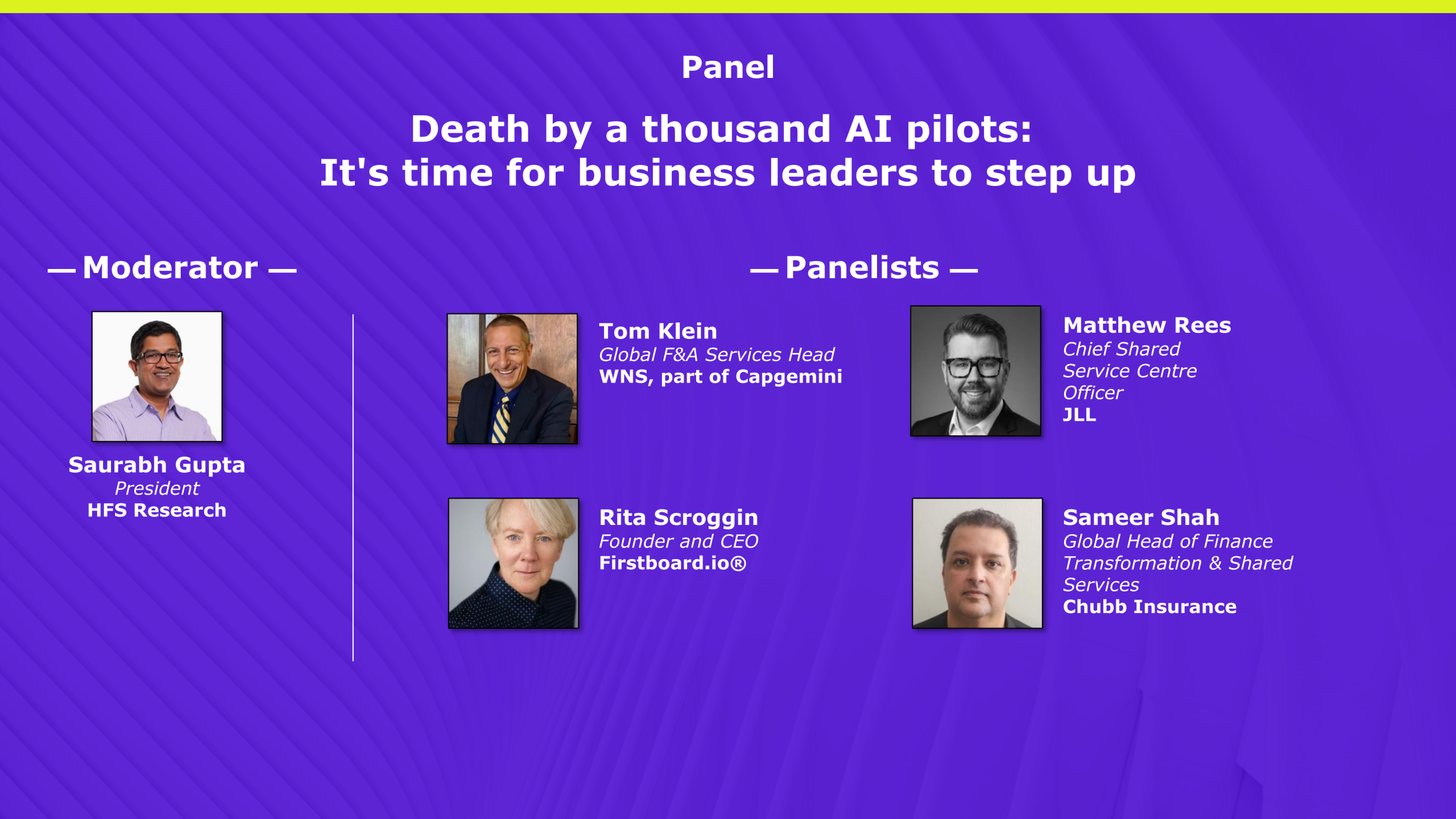
Death by a thousand AI pilots: It's time for business leaders to step up

YouTube · Click to watch
Speaker
Saurabh Gupta
President, HFS Research

Saurabh Gupta is President, Research and Advisory Services at HFS. He sets the strategic research focus and agenda for HFS Research, understanding and predicting the needs of the industry and ensuring that HFS maintains its position as the strongest impact thought leader for business operations and services research.


Tom Klein
Global F&A Services Head, WNS, part of Capgemini

Tom Klein is a business process transformation leader across F&A, Procurement, HR, CX, and industry-specific processes. With over 30 years of experience in driving client transformation initiatives, operational excellence, and technology-based services, he leads WNS' F&A Global Practice.


Matthew Rees
Chief Shared Service Centre Officer, JLL

Highly motivated, results-driven, internationally experienced global executive. Excellent track record of delivering value to the bottom line through the leadership of cross-functional multinational teams in change environments.


Rita Scroggin
Founder and CEO, Firstboard.io®

With more than 15 years of experience in executive search and leadership development, Rita has established transformative partnerships that have shaped innovative companies across Silicon Valley and beyond. She is a trusted advisor to leading Venture Capitalists, Founders, and C-Suite executives.


Sameer Shah
Global Head of Finance Transformation & Shared Services, Chubb Insurance

Sameer Shah is the Global Head of Finance Transformation & Shared Services for Chubb Insurance.

Summary

Saurabh Gupta moderates a four-person panel on why enterprise AI is dying death by a thousand pilots and POCs, and what business leaders (CFOs, COOs, GBS leaders, and boards) should do differently to get from AI ambition to AI reality. The panel argues that the blocker is no longer technology. Matthew Rees from JLL calls AI both an existential threat and an existential opportunity for global business services and says shared services leaders are now becoming end-to-end process owners. Sameer Shah from Chubb is explicit that his finance AI play is headcount reduction with aggressive targets attached and that this level of clarity has accelerated the program more than incremental use-case hunting ever did. Tom Klein from WNS introduces the AI-agentic-maturity scoring that his teams now apply to every agent built on the firm's Agile Target Operating Model (Atom) platform. Rita Scroggin of Firstboard.io makes the case that the boardroom itself must change. NASDAQ research shows that most boards lack deep AI and operating expertise and that many traditional, overboarded directors are not equipped to drive the AI growth agenda.

Key takeaways

AI is not stuck on technology. It is stuck on culture, change management, executive understanding, and middle-management readiness, according to all four enterprise panelists.

  • Sameer Shah (Chubb) is reducing the existing shared services footprint by 50% and is recycling the funds into global transformation, with the deliberate posture that AI in finance is about replacing roles, not shaving minutes off tasks.
  • Matthew Rees (JLL) says hundreds of thousands of roles will be disintermediated in the next 18 to 24 months, and the GBS operating model must be redesigned around end-to-end enterprise processes, not just the slice that sits inside shared services.
  • Tom Klein (WNS) scores every AI agent his team builds on how agentic it actually is (reasoning, autonomous decisions, operating against targets) on the firm's Agile Target Operating Model (Atom) platform. Most agents today are understood as hyperautomation on steroids, not truly autonomous.
  • Rita Scroggin (Firstboard.io) argues that most boards are AI-unready, weighed down by traditional, overboarded directors and missing operating expertise. NASDAQ research identifies AI and operating expertise as the core board capability gap.
  • Each panelist's one thing to start doing varied. Matthew Rees: pick one thing and really invest in changing it; stop believing your own AI hype. Rita Scroggin: think bigger and more imaginative. Sameer Shah: get clarity on what you are trying to achieve; stop spreading scarce talent across too many use cases. Tom Klein: stop the resistance and cannibalize faster.
  • Saurabh closes with the panel's consensus line: AI is ready. We are not.
10:15 to 10:40 AM Fireside chat

Industry 5.0 meets physical AI: The enterprise readiness challenge

YouTube · Click to watch
Speaker
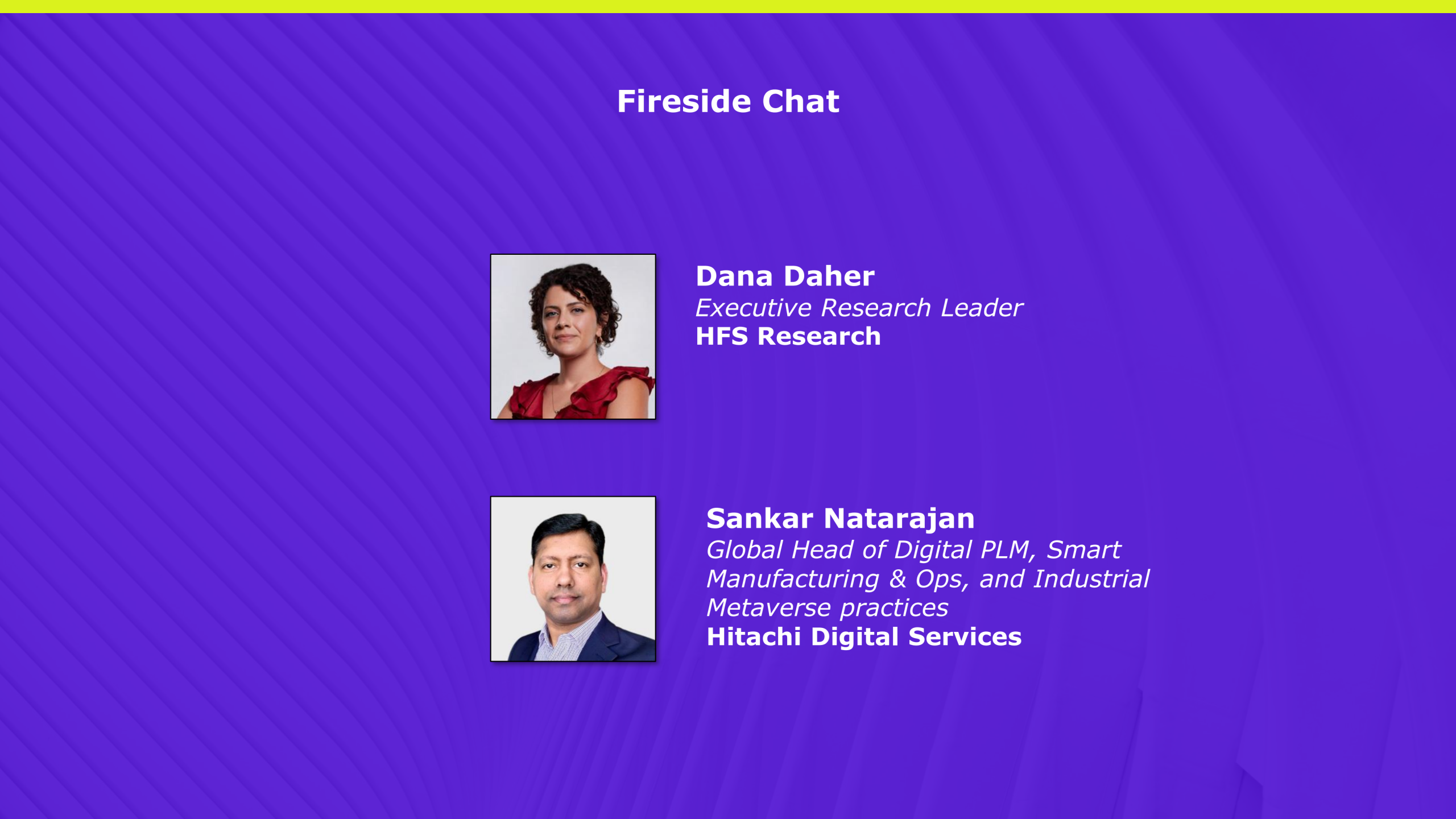
Dana Daher
Executive Research Leader, HFS Research

Dana Daher is an Executive Research Leader at HFS Research, spearheading research initiatives in emerging technologies and employee experience. With a unique blend of expertise in anthropology and IT, Dana leads cutting-edge research that shapes industry landscapes across various domains.


Sankar Natarajan
Global Head of Digital PLM, Smart Manufacturing & Ops, and Industrial Metaverse practices, Hitachi Digital Services

Sankar Natarajan is the Global Head of Digital PLM, Smart Manufacturing & Ops, and Industrial Metaverse practices at Hitachi Digital Services. He leads the global strategy, solutions, go-to-market initiatives, and delivery of integrated digital transformations across products, factories, operations, and sustainability.

Summary

Dana Daher and Sankar Natarajan unpack what physical AI and Industry 5.0 mean for enterprises that actually make and move things. Sankar frames three application areas for AI in industry: employee productivity, cognitive products, and cognitive operations, and argues the last two are where physical AI shows up. He grounds the conversation in hard numbers: 77% of manufacturers in Europe and the Americas cite labor shortage as their topmost challenge, and Hitachi rail cars now ship with about 1,200 sensors that have pivoted the business from selling rail cars and signaling systems to selling mobility as a service. The conversation closes on the readiness gap most firms face on people, process, data, and underlying technology, and on why pilots stall when companies do not run a parallel readiness assessment alongside their AI experimentation.

Key takeaways
  • Physical AI sits in two of the three AI application areas Sankar defines: making products more cognitive and intelligent (cars, trains, medical devices, aircraft) and making operations inside factories, warehouses, and distribution centers more adaptive. Employee productivity is a separate, well-trodden third area.
  • Industry 5.0 is here. Where Industry 3.0 was about automation, Industry 4.0 was about connectivity, and Industry 5.0 is about applying physical AI across products, assets, and operations with seamless human-machine integration.
  • 77% of manufacturers in Europe and the Americas now name labor shortage as their topmost challenge. That supply side bottleneck, not demand, is what makes physical AI a commercial necessity rather than a science project.
  • Hitachi rail cars now ship with about 1,200 sensors, which has pivoted the business from selling rail cars and signaling systems to selling mobility as a service. Sankar names Caterpillar as another industrial equipment example of the same operating model shift.
  • Pilots stall because companies run AI experiments without a parallel readiness assessment across people, process, data, and underlying technology. Sankar recommends running both tracks in parallel from day one.
  • Physical AI requires authoritative data flow from as-designed to as-planned to as-manufactured to as-sold to as-commissioned to as-serviced. Without that information thread, AI at scale on a factory floor or in a rail car is unsafe, not just inefficient.
  • Hitachi has deployed Boston Dynamics Spot robots with its own AI and vision models for rail-car quality inspection (welding, paint, surface defects), shifting workers from monotonous walk-arounds to analysis and action.
  • Edge plus cloud is the cost answer for physical AI. Round-tripping inference to the cloud breaks on latency, security, and operating cost, especially for brownfield factories where the modernize-versus-rebuild calculation is genuinely hard.
11:00 AM to 12:10 PM Hot Tech Vendors

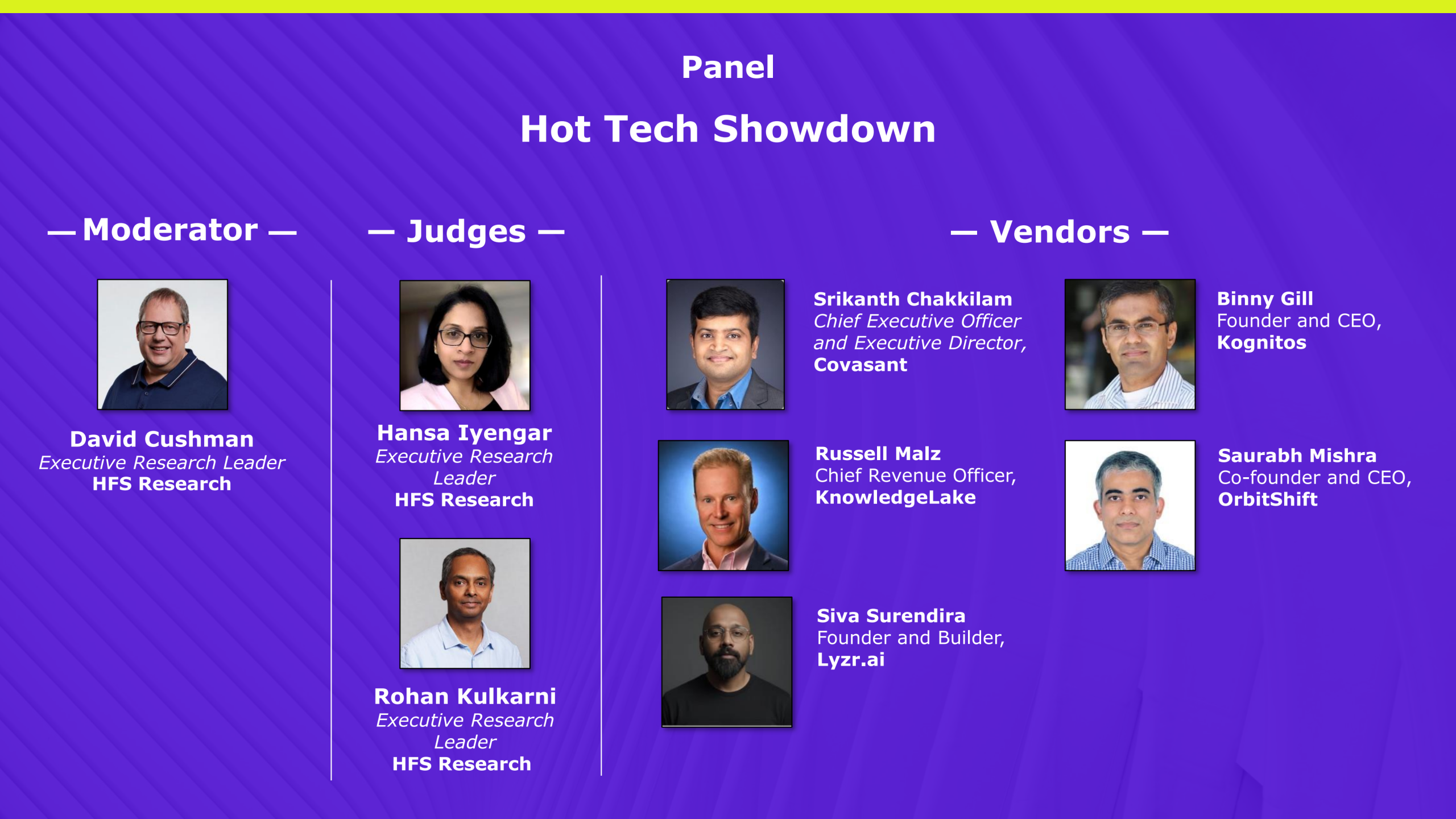
Hot Tech Showdown

YouTube · Click to watch
Speaker
David Cushman
Executive Research Leader, HFS Research

David is an Executive Research Leader at HFS, focusing on emerging technology, tracking OneOffice and OneEcosystem enablers from automation, AI, GenAI, data and design thinking, Web3 and metaverse, process orchestration, workflow, and intelligence to quantum computing.


Hansa Iyengar
Practice Leader, HFS Research

Hansa Iyengar leads the banking, financial services (BFS), and IT services research practice at HFS Research. She focuses on delivering practical, forward-looking insights that help BFS leaders navigate change across financial services and on providing critical analyses of service provider strategies.


Rohan Kulkarni
Executive Research Leader, HFS Research

Rohan Kulkarni is an executive research leader for HFS Research. He is responsible for coverage of the healthcare and life sciences practice, bringing to the table his vast experience across the healthcare ecosystem.


Srikanth Chakkilam
CEO and Executive Director, Covasant

Srikanth Chakkilam is a visionary entrepreneur and strategic leader, known for building high-growth, innovation-driven technology companies. As CEO, and Executive Director of Covasant, he leads the company's strategy and growth, focused on building Covasant into a global pioneer in Agentic AI services.


Russell (Russ) Malz
Chief Revenue Officer, KnowledgeLake

Russell (Russ) Malz is Chief Revenue Officer of KnowledgeLake.


Binny Gill
Chief Executive Officer, Kognitos

Binny Gill, the Founder and CEO of Kognitos Inc, started the company in 2021 on the belief that more people need to be able to instruct computers in natural language and that such a system must be built with complete auditability and explainability in mind.


Siva Surendira
Founder and CEO, Lyzr AI

Siva Surendira is the Founder and CEO of Lyzr AI, where he leads the development of next-generation enterprise AI by architecting scalable, production-grade agent frameworks.


Saurabh Mishra
Co-founder and CEO, OrbitShift

Saurabh Mishra is Co-founder and CEO of OrbitShift.

Summary

David Cushman hosts the HFS Hot Tech Showdown, a shark-tank-style session where five high-growth AI vendors get three minutes to pitch followed by six minutes of questions from HFS judges Hansa Iyengar and Rohan Kulkarni. Covasant's Srikanth Chakkilam, KnowledgeLake's Russ Malz, Kognitos' Binny Gill, Lyzr AI's Siva Surendira, and OrbitShift's Saurabh Mishra each show how they are operationalizing agentic AI in enterprise workflows, with case examples spanning manufacturing, document processing, finance and accounting, banking, and enterprise sales. The room votes with their phones at the end, treating the vote as if it were their own money. Lyzr AI takes the most-investable spot in this round. Across the five pitches, two HFS themes recur: AI augmenting humans rather than replacing them, and the maturing of Services-as-Software and outcome-based commercial models that HFS has championed for years.

Key takeaways

Five vendors pitched in shark-tank format: Covasant (agentic AI orchestration and governance), KnowledgeLake (document operating system for BPOs and GBSs), Kognitos (English-as-code deterministic AI), Lyzr AI (Architect, an AI that designs agentic pipelines), and OrbitShift (a system of work for enterprise sales).

  • Lyzr AI took the audience vote as the most-investable vendor of the day.
  • Covasant's Agent Management Suite reduced one manufacturing customer's frontline query latency from 20 seconds to four seconds, cut cost per 1,000 queries from $10 to $1.49, and lifted accuracy from 60% to 99%, with cost savings shared on an outcome basis.
  • KnowledgeLake helped US Imaging compress an 18-20-person manual indexing team to three, cut record turnaround from 2 to 10 days down to 30 minutes to half a day, and launched a new day-forward revenue stream for San Bernardino County deed processing.
  • Kognitos' English-as-code platform took a Wipro international payments process from failing bot automation to over 97% straight-through processing by capturing tribal knowledge as deterministic English flows, supported by forward-deployed engineers across 12 functions.
  • Lyzr's Architect crowdsources agentic pipelines from business users instead of consultants, runs 10,000 simulations per agent through a CI/CD pipeline, and registers every agent in a central registry with CIO security guardrails; one large bank cited inability to ship a conversational balance-check agent as its biggest failure of the last 12 months.
  • OrbitShift serves eight of the global top 15 technology providers (Infosys, HCLTech among them) with a curated, industry-specific data layer rather than a web-scraping LLM wrapper, claiming 60 to 80% reduction in existing sales solution databases and zero ramp time for sellers.
  • HFS judge takeaways: each of the five vendors targets industry-specific problems (Rohan Kulkarni) and each one augments humans rather than replacing them (Hansa Iyengar). David Cushman notes Sequoia Capital has now publicly acknowledged Services-as-Software as the future of the IT services market, after years of HFS calling it.
12:10 to 12:35 PM Fireside chat

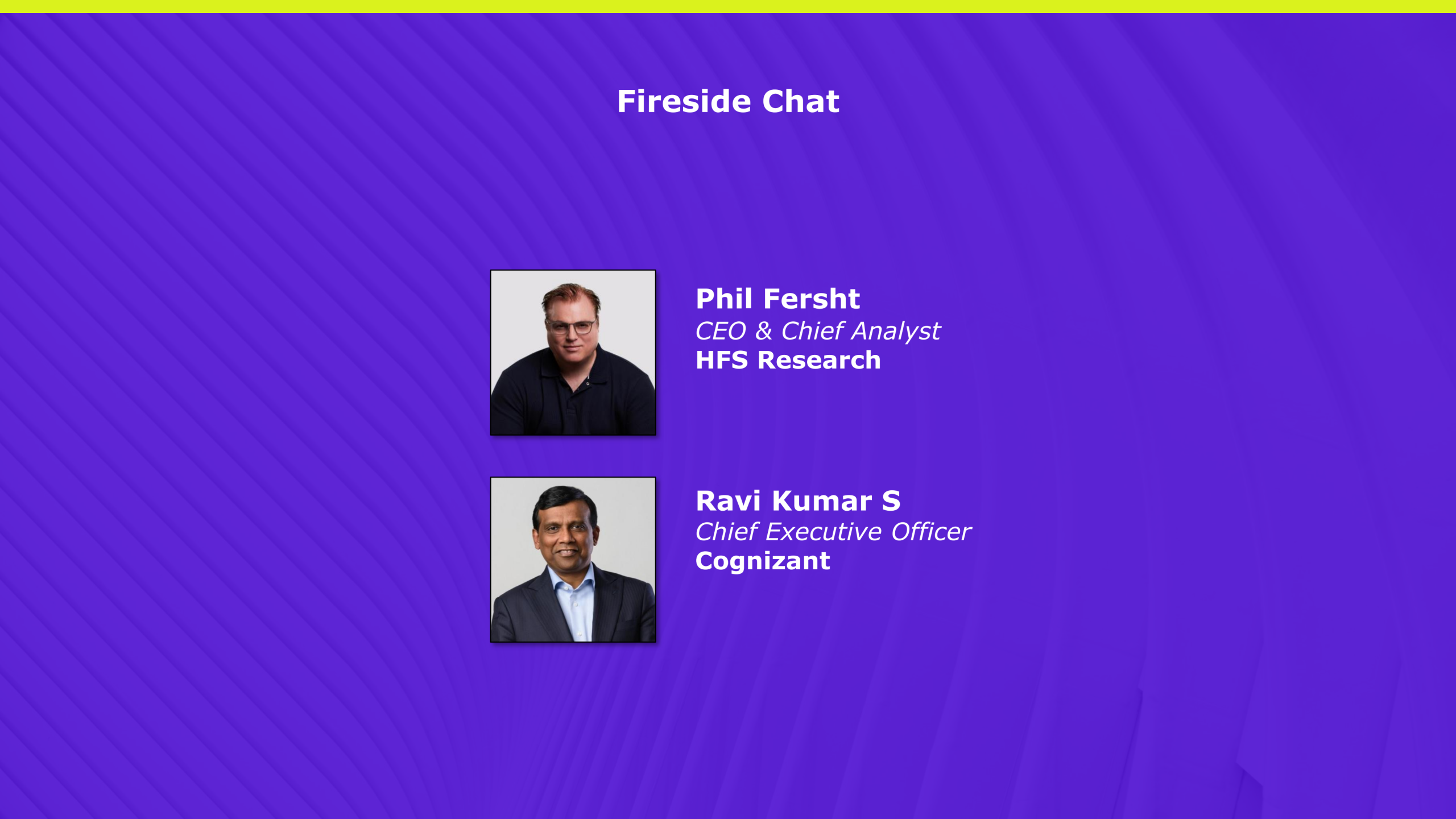
Fireside chat: Ravi Kumar, CEO, Cognizant

YouTube · Click to watch
Speaker
Phil Fersht
CEO and Chief Analyst, HFS Research

Phil Fersht is widely recognized as the world's leading analyst focused on reinventing business operations to exploit AI innovations and the globalization of talent. He recently coined the term "Services-as-Software" to describe the future of professional services, where people-based work is blurring with technology.


Ravi Kumar S
Chief Executive Officer, Cognizant

Ravi Kumar S was appointed CEO of Cognizant in January 2023. In his role as CEO, Ravi sets the strategic direction of the company, promotes Cognizant's client-first culture, and focuses on ensuring sustainable growth and driving long-term shareholder value.

Summary

Phil Fersht sits down with Cognizant CEO Ravi Kumar S for an unfiltered conversation on what has to change for IT services firms to stay relevant as enterprise AI moves from pilots to scaled operations. Ravi argues the industry has to reforge four first principles at the same time: from system integrators to bespoke AI builders; from a pyramid of engineering labor to interdisciplinary capability at the intersection of technology, domain, and operations; from pure services to platforms plus services; and from delivery to underwriting AI and business operations outcomes. He introduces the frontier operator as the new operating-model role for this shift, lays out an AI-infused rate card with four tiers from manual labor to fully autonomous labor, and makes the case that 70% of government revenue comes from labor taxes and that a temporary rethink of how capital and digital labor are taxed will be needed to avoid an employment shock. The session closes with audience questions on why frontier model companies cannot easily build services arms, and on how enterprises themselves must shift from buying capacity to buying outcomes.

Key takeaways
  • The four first principles of IT services are being reforged at once: system integrators become bespoke AI builders, the engineering pyramid becomes interdisciplinary capability, services become platforms-plus-services, and delivery becomes outcome underwriting.
  • Token consumption is not a business metric. Uber reportedly exhausted its AI tokens by the fourth month; the right metric is how much human effort a fixed token budget can replace or augment inside a customer workflow.
  • Cognizant is operationalizing this with an AI-infused rate card: A0 manual labor, A1 human labor verified by machines, A2 machine labor verified by humans, A3 fully autonomous labor.
  • Ravi calls the new role the frontier operator: an operator who manages AI outcomes for a client by intertwining digital labor, human labor, and domain context. Forward Deployed Engineers, in his view, came from a different worldview and are not by themselves enough to capture the AI operations opportunity.
  • Capital that thinks needs new fiscal rules. 70% of government revenue comes from labor taxes; if digital labor is competing with human labor, a temporary rebalancing of how capital is taxed can buy a smoother transition without driving capital flight.
  • Frontier model companies launching services arms are endorsement, not threat. Hyperscalers wanted to build services arms during the cloud revolution and largely did not; Oracle tried with Oracle Consulting in the 1990s and that did not stick.
  • Only about 0.25% of US car rides are autonomous in 2026, twenty years after the technology was demonstrated. The same heterogeneity-of-context problem is the real velocity gap in enterprise AI, not the models themselves.
  • Enterprises need to stop buying services as capacity. Roughly 25 to 30% of every major IT services book is time-and-materials, 50 to 60% fixed price, and only a small slice truly outcome based. The shift is from billing transactions to managing lives, claims, or operations end to end.
12:50 to 1:30 PM Interactive session

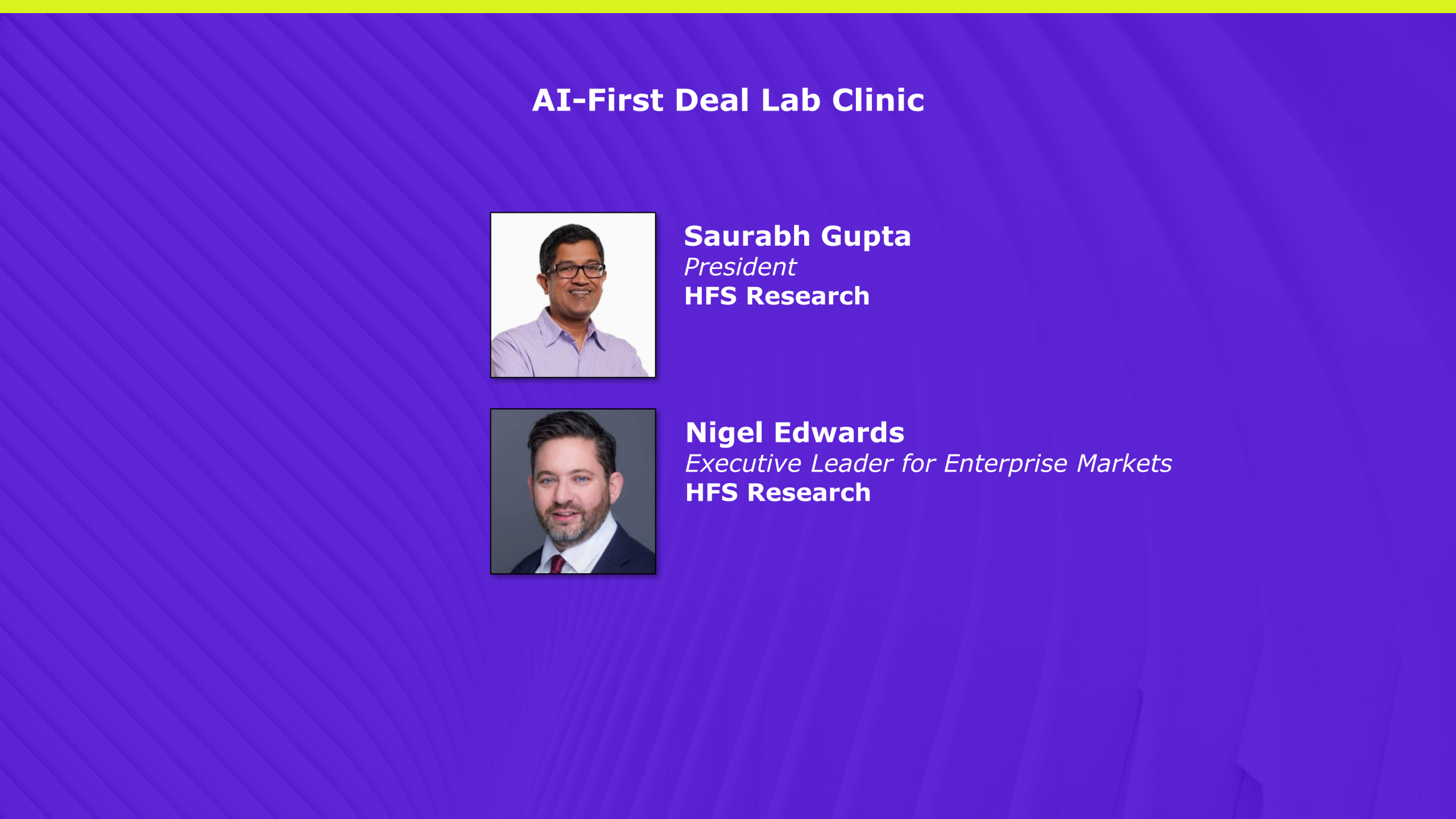
AI-First Deal Lab Clinic

YouTube · Click to watch
Host
Saurabh Gupta
President, HFS Research

Saurabh Gupta is President, Research and Advisory Services at HFS. He sets the strategic research focus and agenda for HFS Research, understanding and predicting the needs of the industry and ensuring that HFS maintains its position as the strongest impact thought leader for business operations and services research.


Nigel Edwards
Executive Leader for Enterprise Markets, HFS Research

Nigel Edwards is an Executive Leader for Enterprise Markets at HFS Research. This is his second stint at the firm, bringing almost 35 years of experience in business and IT services to the table. Nigel started his career as a sourcing and supply chain specialist before moving to PwC.

Summary

Saurabh Gupta and Nigel Edwards run a workshop-style clinic over lunch on Day 2, challenging the room to abandon the 1990s outsourcing playbook and structure deals for an AI-first world. Using a fictional but composite case of a global bank three years into a five-year, 1,800-FTE application management services contract, Saurabh walks attendees through what a restless CIO should actually do when SLAs are green but transformation is absent. The clinic introduces the HFS AI-First Deal Lab methodology: develop a one-page North Star, run a relationship assessment, build a research-based case study and a hackathon-style art-of-the-possible, then a one-to-two-day AI-first workshop with client, provider, and procurement in the same room. Saurabh maps the full eight-to-ten-week path to a letter of intent and a 100-day plan to restructure the contract, against the eight-to-ten-month alternative. The Four Ps of AI value, Services-as-Software, outcome-based pricing, and AI metrics in contracts run through the discussion as the operating frame for AI-first deal structures.

Key takeaways
  • The traditional sourcing lifecycle, FTE-based contracts, RFP theater, champion-challenger, six-to-eight-month evaluations, is structurally wrong for AI-first deals. Saurabh argues the entire lifecycle from strategy and planning through onboarding needs to be re-thought, not just decorated with better spreadsheet macros.
  • An AI-first business case should be built on the HFS Four Ps of AI value, not on cost arbitrage between Bangalore, Budapest, and Manila. RFPs that do not ask about AI bias, IP, and explainability are already obsolete.
  • The case study, a global bank with two years left on a five-year, 1,800-FTE AMS contract and a restless new CIO, mirrors the live situation that multiple attendees in the room said they are facing right now (including Becton Dickinson and a not-for-profit client of Nigel's).
  • The HFS recommended path: build a one-page North Star with the CIO and CFO, then run a two-day workshop with client, incumbent provider, and procurement in the room together. Day one is desired-state plus art-of-the-possible from the provider. Day two is pricing structure, service levels, and outcome metrics with procurement.
  • Pricing remained the sticking point in the real engagement: gain-sharing was popular in theory, but no client could budget for it and none was willing to share 25 percent of the gains from business outcomes with a provider. Outcome-based pricing structures, not price points, are where the work is.
  • The full AI-First Deal Lab sequence ran in eight to ten weeks for the bank from North Star to letter of intent, against an eight-to-ten-month traditional sourcing alternative, with a separate 100-day plan after the LOI to actually restructure the contract.
  • Audience consensus: the contract does not need to be blown up, but the conversation has to be escalated and contractual. Both sides are at fault when an incumbent provider has not proactively brought an AI value proposition to a CIO who is two years from renewal.
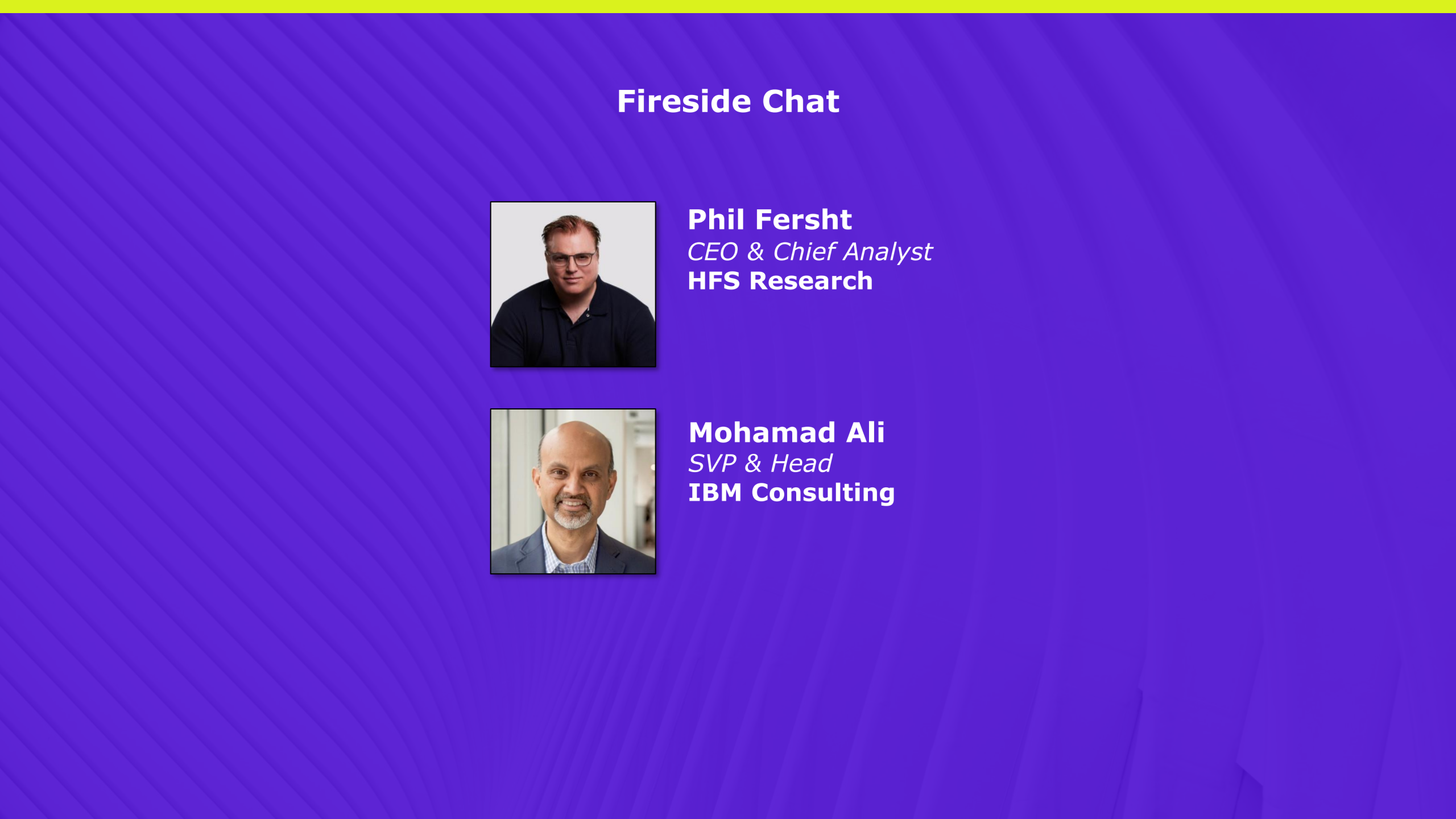
1:35 to 2:00 PM Fireside chat

Fireside Chat: Mohamad Ali, SVP and Head of IBM Consulting

YouTube · Click to watch
Speaker
Phil Fersht
CEO and Chief Analyst, HFS Research

Phil Fersht is widely recognized as the world's leading analyst focused on reinventing business operations to exploit AI innovations and the globalization of talent. He recently coined the term "Services-as-Software" to describe the future of professional services, where people-based work is blurring with technology.


Mohamad Ali
SVP & Head, IBM Consulting

Mohamad Ali is SVP and Head of IBM Consulting. In this role, he is responsible for all aspects of IBM Consulting, including scaling AI-enabled solutions to improve client innovation, growth, and profitability. Previously, Mohamad was CEO of IDG, a leading market intelligence and demand generation company serving the technology ecosystem.

Summary

Mohamad Ali, SVP and Head of IBM Consulting, joins Phil Fersht to map how IBM has moved AI from productivity experiments to revenue generation. Mohamad walks through IBM as client zero, decomposing the company into 490 workflows, attacking the top 70 inside a $25 billion spend pool, and using the IBM Consulting Advantage (ICA) platform to industrialize roughly 4,000 digital workers across delivery centers in Bangalore, Romania, and Louisiana. He contrasts an AI-first build (Riyadh Air, set up from scratch in 36 months to fly Riyadh to London on an AI-first stack) with re-engineering a 100-year-old company (IBM, where HR budgets are down 40% from 2022 levels and free cash flow has moved from $9 billion to $13 billion), then shows where new revenue shows up (a components manufacturer mining competitor catalogs for scarcity-priced parts, Providence Health hiring nurses 12 days faster on top of Oracle, and a Pearson-Credly business credentialing digital workers, a market that did not exist three years ago). He closes with a clear point of view on the Anthropic and OpenAI services pushes, on the limits of Forward Deployed Engineer (FDE) models, and on IBM's six-person Forward Deployed Unit (FDU) approach that re-engineers processes and deploys digital workers in 30 days.

Key takeaways

IBM Consulting Advantage (ICA) is now the industrialization layer, with about 4,000 curated digital workers running across IBM delivery centers and a hire-to-retire model that starves unused workers of tokens. ICA 2.0, launched the week of the summit, lets the platform build digital workers and reduce human-in-the-loop verification as guardrails mature.

  • IBM as client zero is SEC-reportable, not a slide. Arvind Krishna had the controller put the savings in the 10-K and 10-Q each quarter, and EBITDA expansion plus R&D moving from 9% to 12% of revenue plus SG&A changes add up to roughly $4.5 billion of savings, with free cash flow up from $9 billion to $13 billion.
  • Productivity is the on-ramp, but new revenue is the prize. The components manufacturer started with agents matching $2 parts to its own catalog, then extended the agents to mine competitor catalogs and price scarce parts at a premium; Pearson's Credly is being extended to credential digital workers, a market that did not exist three years ago.
  • The hard part is not picking an LLM or a coding tool, both of which Mohamad expects to be commoditized. The hard part is process re-engineering and change management, which is why IBM's six-person Forward Deployed Units replace the 30-person Forward Deployed Engineer model and aim to re-engineer a workflow and deploy digital workers in 30 days.
  • Anthropic and OpenAI moving into execution validates that re-engineering processes is the value, not the model. Traditional SI competitors taking over 7,000-person estates are running at a wall; the winners will be those who can decompose processes and deploy human-plus-digital workflows.
  • AI conversations have moved out of CIO land. Mohamad's deals now sit with CEOs, CFOs, and heads of HR, because the work is re-engineering core processes rather than buying technology.
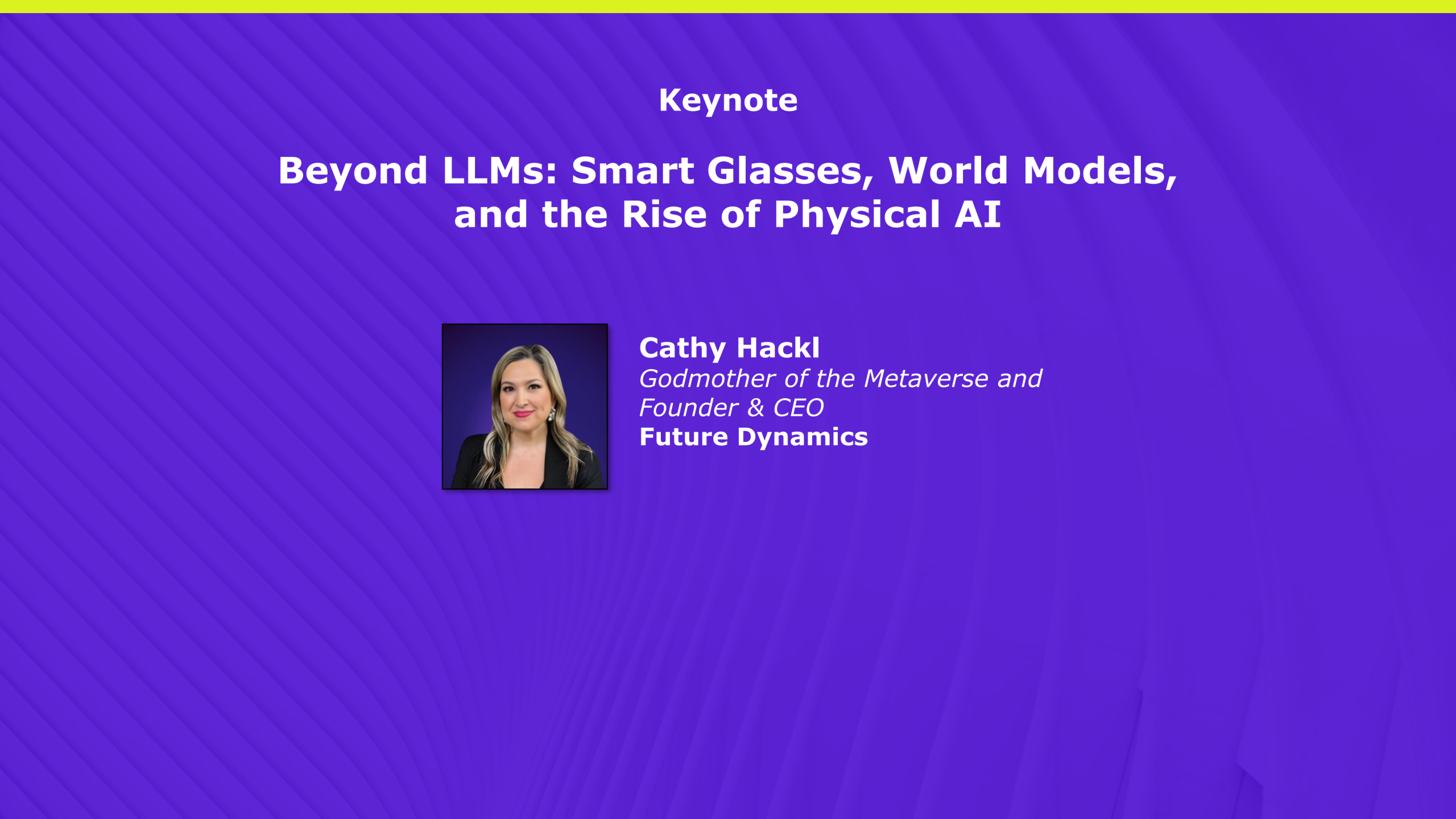
2:00 to 2:45 PM Keynote

Beyond LLMs: Smart glasses, world models, and the rise of physical AI

YouTube · Click to watch
Speaker
Cathy Hackl
Godmother of the Metaverse and Founder & CEO, Future Dynamics

Cathy Hackl (@cathyhackl), widely known in tech circles as the Godmother of the Metaverse, is a globally recognized futurist, tech and gaming executive, serial entrepreneur, author, and keynote speaker shaping what comes next at the intersection of AI, spatial computing, gaming, and human connection.


Phil Fersht
CEO and Chief Analyst, HFS Research

Phil Fersht is widely recognized as the world's leading analyst focused on reinventing business operations to exploit AI innovations and the globalization of talent. He recently coined the term "Services-as-Software" to describe the future of professional services, where people-based work is blurring with technology.

Summary

Cathy Hackl takes the room past the chat-window era of AI and into what NVIDIA's Jensen Huang plots as the next curve: perception AI, generative AI, agentic AI, and physical AI. Cathy lays out the physical AI stack (a body, an interface, a nervous system, connectivity) and argues that world models and large geospatial models, not bigger LLMs, are where the funding and the moat are moving. She points to Fei-Fei Li's World Labs, Yann LeCun's $1.1 billion seed round, NVIDIA Cosmos, Niantic Spatial, Maxar, and Roblox Reality as proof, and to meta Ray-Ban glasses, AirPods with cameras, and AI-RAN connectivity (NVIDIA, T-Mobile, Nokia) as the hardware and connectivity layers that move compute from cloud to edge to on-you. The closing message for leaders: audit your real-world and geospatial data, hire for game engines and spatial computing, and plan a connectivity strategy because 5G will not cut it.

Key takeaways
  • Physical AI is the next curve after agentic AI: LLMs predict the next word, world models predict the next frame of reality, and that is what robots, holograms, and embodied agents need to operate in the physical world.
  • World models and large geospatial models are where the money and the moat are moving. Yann LeCun raised a $1.1 billion seed round for his world-models company; Fei-Fei Li's World Labs, NVIDIA Cosmos, Google DeepMind, Niantic Spatial, Maxar, Waymo, Roblox, and Runway are all in.
  • Hardware is the new moat. Silicon Valley and China are racing to replace the mobile phone with smart glasses, AirPods with cameras, pendants, and other always-on form factors that continuously scan the physical world.
  • Compute is moving from the cloud to the edge to on-you, and the conversation is shifting from compute to connectivity. NVIDIA's investment in Nokia and the AI-RAN work with T-Mobile signal that 5G alone will not power millions of robots, drones, and glasses.
  • Game engines (Unreal, Unity, NVIDIA Omniverse, Roblox) are now critical AI infrastructure, used to train agents and robots inside virtual worlds before they hit the factory floor, the hospital, or the home.
  • Action items for leaders: audit your real-world and geospatial data, run pilots in the physical space (not just digital agents), hire for game engines and spatial computing alongside prompt engineering, and build a connectivity strategy that does not stop at 5G.
  • The ethics question Cathy is pushing to governments: virtual air rights. Who owns what is in your eyesight and earshot once smart glasses and AirPods-with-cameras are everywhere, and do we need sanctuary zones with no overlaid content?
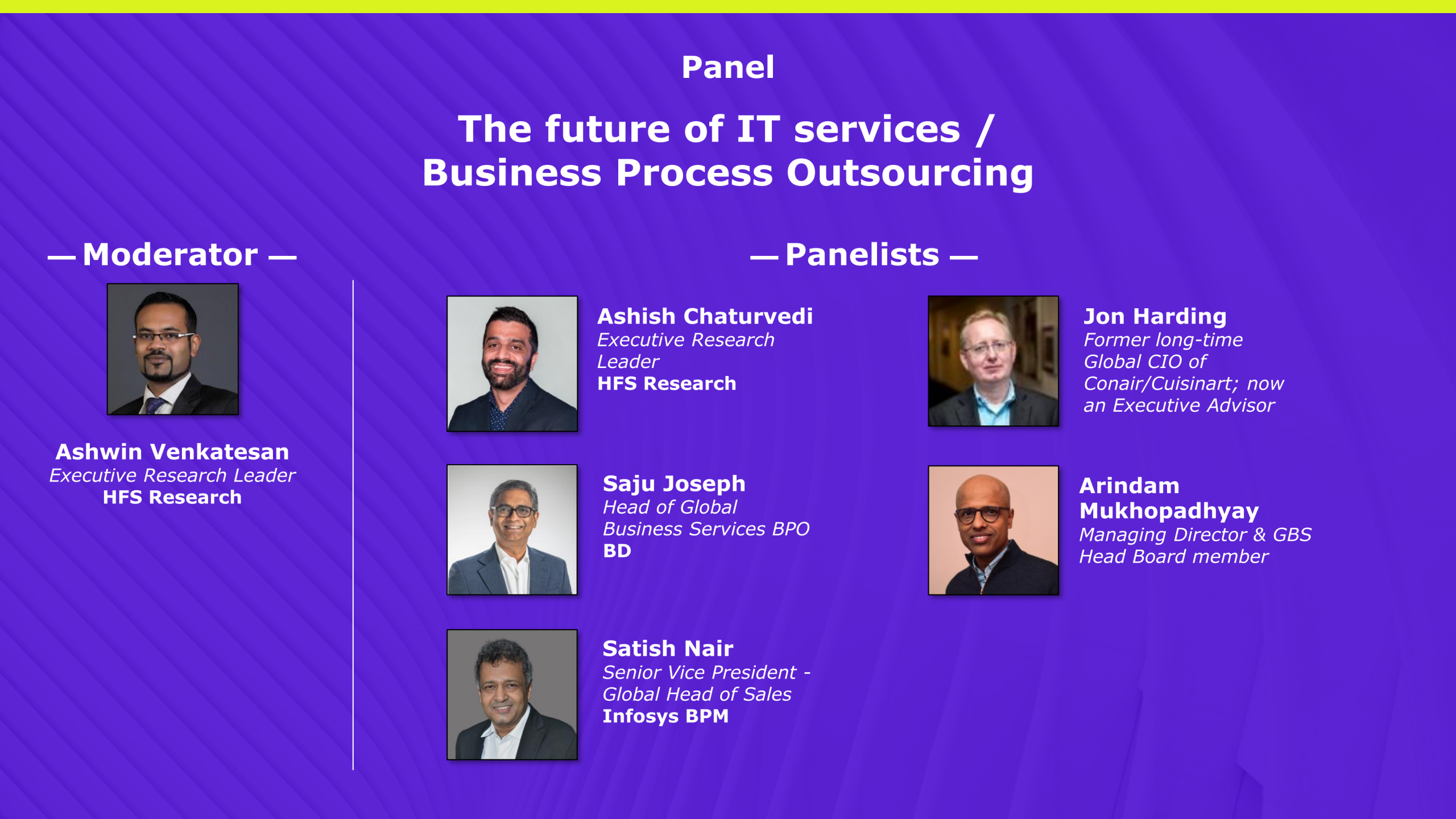
2:45 to 3:15 PM Panel

The future of IT services and Business Process Outsourcing

YouTube · Click to watch
Speaker
Ashwin Venkatesan
Executive Research Leader, HFS Research

Ashwin is an Executive Research Leader at HFS Research. He has more than 17 years of experience in the global business services (GBS) and technology services advisory space, with a proven track record as a trusted advisor for C-level executives and services leaders across Fortune 2000 enterprises and service providers.


Jon Harding
Executive Advisor; former Global CIO, Conair/Cuisinart

Jon Harding is Executive Advisor; former Global CIO, Conair/Cuisinart.


Saju Joseph
Head of Global Business Services BPO, Becton Dickinson

A transformational services executive with deep expertise in GBS, Saju Joseph leads GBS BPO at Becton Dickinson (BD), where he is stabilizing and transforming a large, complex global operation across multiple towers—including Quote-to-Cash, Source-to-Pay, Hire-to-Retire, and RPA.


Arindam Mukhopadhyay
Managing Director and GBS Head; Board Member

Arindam Mukhopadhyay has proven expertise in building, running and transforming global enterprise and data operations with demonstrated leadership in one of the largest global financial institutions (Citi) with $2.4T balance sheet and $81B in annual revenue. Rapidly scaled and led Global Business Services (GBS) for Finance and Technology worldwide.


Satish Nair
Senior Vice President and Global Head of Sales, Infosys BPM

Satish is the Senior Vice President and Global Head of Sales, managing global sales and client partnerships for Infosys BPM. Satish has been with Infosys BPM since 2004, handling various leadership roles across diverse business units, including Digital Services, Retail, CPG, Logistics, Insurance, and Life Sciences.


Ashish Chaturvedi
Executive Research Leader, HFS Research

Ashish Chaturvedi is an Executive Research Leader for HFS Research. He leads coverage for supply chain operations, the retail and CPG industry, and business 'data' services. He is an accomplished IT industry analyst, regarded as a top retail expert globally, and is featured regularly in various IT media publications.

Summary

Ashwin Venkatesan leads four enterprise and provider leaders plus HFS BPO research lead Ashish Chaturvedi through a 30-minute session on the future of IT services and BPO. The panel works through an HFS two-by-two framework (AI-disruptable, AI-enabled, platformized, and AI-immune services), the recomposition of the services industry across five building blocks (unit of work, pricing construct, talent pyramid, buyers in the room, and competition at the door), and why the AI anchor-partner pecking order, with hyperscalers first and BPO services fifth, masks where the real operating-model rewrite happens. Ashish Chaturvedi's airline analogy lands the punchline: hyperscalers build airports, technology companies sell airplanes, AI specialists offer autopilot, but when turbulence hits at 35,000 feet, the IT and BPO services providers are the air traffic control. Saju Joseph (Becton Dickinson), Arindam Mukhopadhyay (former Citi GBS), Satish Nair (Infosys BPM), and Jon Harding (former Conair/Cuisinart CIO) push hard on outcomes over contracts, the dollar-rupee depreciation that masked a decade of headcount addiction, and why deep process knowledge is the BPO industry's moment to shine.

Key takeaways

Services industry recomposition has five building blocks getting rewritten at the same time: unit of work, pricing construct, talent pyramid, buyers in the room, and competition at the door. Same atoms, different molecule (Ashish Chaturvedi).

  • 25% of the services market (the repeatable, deterministic, transactional bottom-left of the HFS framework) is being disrupted by AI; the remaining 75% has scope to become 2x the size and deliver 3x the value if providers move from vertical to horizontal relationships with buyers (Ashish Chaturvedi).
  • Lead with outcomes, then process, then contract. Leading a transformation with the contract is dead in the water; Arindam cites yesterday's Wipro fireside with Amit Kumar and today's IBM Consulting fireside with Mohamad Ali as proof points.
  • The industry's growth for 15 years rested on labor arbitrage plus a 49% Indian rupee depreciation against the US dollar since 2012. That macro tailwind, plus a headcount-as-power culture, is what providers and GBS leaders have to break out of (Arindam Mukhopadhyay).
  • Platform services is where Infosys BPM is seeing real demand. Infosys BPM is now the largest mortgage servicer in the Netherlands and has seen significant volume growth via its full-stack platform, plus autonomous sourcing platforms aggregating billions in spend across fragmented buying organizations (Satish Nair).
  • Talent recomposition is shifting from single-stack vertical hiring (accounting, finance, HR) to horizontal skill sets (reconciliation, math, analytics, processing). GBS organizations are over-indexed on process talent today and need to rebalance by adding change-management and sales talent inside the function, not just process talent (Saju Joseph).
  • Trust during the transformation is built by starting from business vision, working back to capabilities, and stacking quick wins, not by leading with the technology (Jon Harding).
  • Enterprise AI anchor-partner pecking order today: hyperscalers, then tech companies (SAP, Oracle), then AI specialists (Palantir), then IT services, then BPO services, then startups. The unfair advantage providers still hold is deep process knowledge, which AI transformation cannot succeed without (Ashish Chaturvedi, Arindam Mukhopadhyay).
  • Hyperscalers build the airports, technology companies sell the airplanes, AI specialists offer autopilot, IT and BPO providers are the air traffic control when turbulence hits at 35,000 feet (Ashish Chaturvedi).
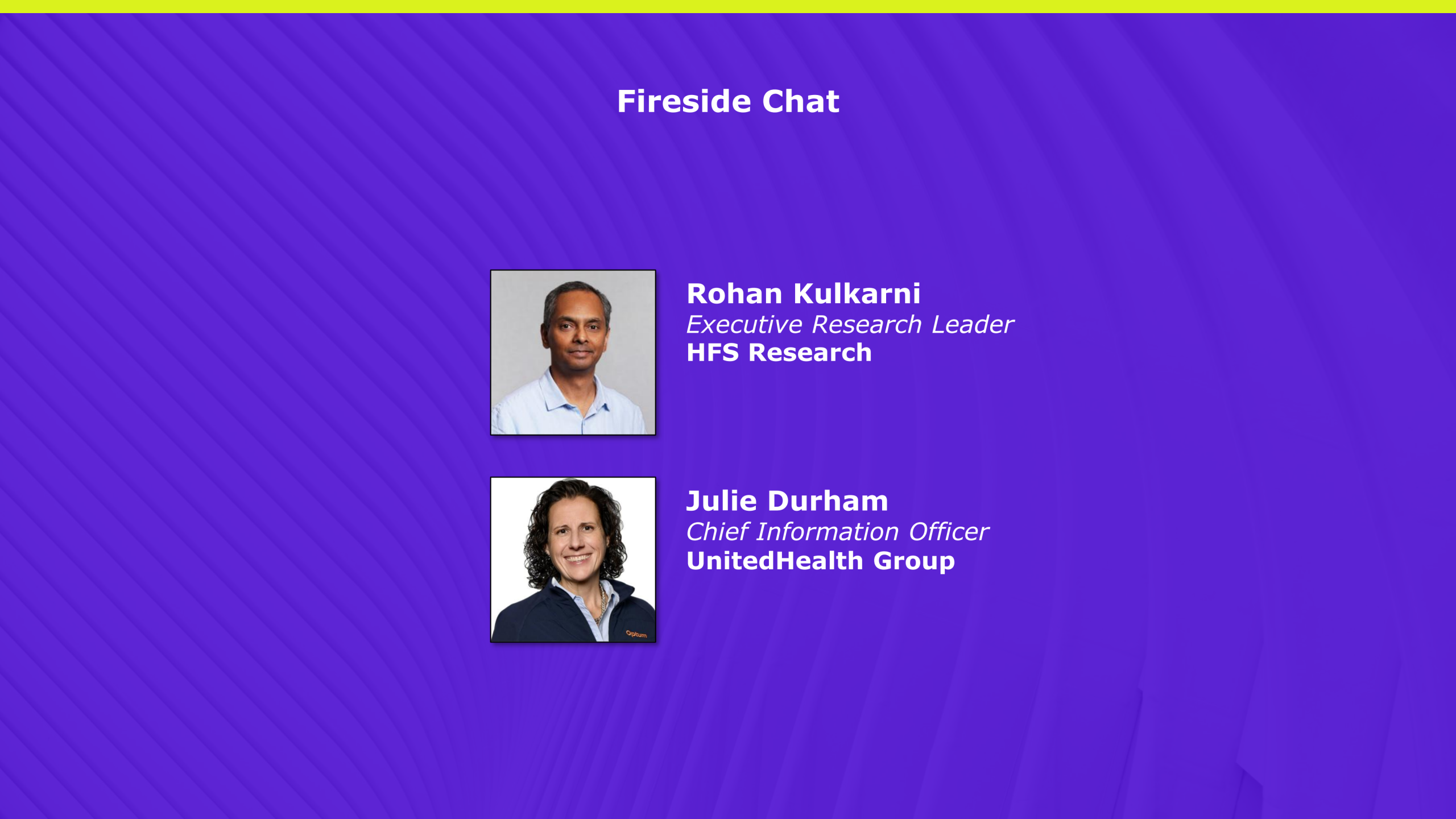
4:00 to 4:25 PM Fireside chat

Fireside chat: Julie Durham, CIO, UnitedHealth Group

YouTube · Click to watch
Speaker
Rohan Kulkarni
Executive Research Leader, HFS Research

Rohan Kulkarni is an executive research leader for HFS Research. He is responsible for coverage of the healthcare and life sciences practice, bringing to the table his vast experience across the healthcare ecosystem. Rohan's experience includes serving as the head of healthcare strategy at multiple Fortune 500 companies.


Julie Durham
CIO, UnitedHealth Group

Julie Durham is currently CIO of UnitedHealth Group. Previously, as Chief Digital Officer for UnitedHealth Group, she led the digital transformation and Consumer AI engineering teams across Optum and United Healthcare. With over 20 years of experience in software engineering, global product management, and AI platforms, she has a proven track record of building and leading organizations.

Summary

Rohan Kulkarni sits down with Julie Durham of UnitedHealth Group for the closing Day 2 fireside on what enterprise AI looks like inside a Fortune 3 healthcare company. Julie frames UHG as two halves, coverage through UnitedHealthcare and care through Optum, then walks the room through the moment she realised AI had moved from incremental to step-change: an India team demo of an LLM with RAG running on top of UHC's explanation-of-benefits document, which she says took the company from painting screens to forever living in a conversation. She lays out a three-bucket AI portfolio of empowering employees with frontier tools, automating known processes such as prior authorization and contact-centre voice, and reimagining healthcare from the ground up, and reports a 300% year-on-year increase in net-new Gen AI projects clearing UHG's responsible AI review board in Q1 alone. Her advice for the cross-industry room: it is still early, leaders are under-counting the productivity boost relative to cost takeout, and the winners in 2027 will be the ones who stay adaptable, trust their employees, and watch for the new always-on AI work pattern that is already keeping high-end engineers up at 2 AM.

Key takeaways
  • UnitedHealth Group is a roughly $430 billion, 450,000-employee company structured as coverage (UnitedHealthcare, the largest US insurer, serving roughly one in 10 Americans) and care (Optum, with roughly one in eight US physicians employed by or contracted with OptumCare). Optum Tech runs about 40,000 engineers; Julie leads about a quarter of them and the Applied AI organisation, including UHG's chief AI scientist and shared AI platforms.
  • The AI step change moment for Julie was an India demo where an LLM with retrieval-augmented generation answered free-form questions on UHC's redesigned explanation-of-benefits document. Her takeaway, in her own words: we went from painting screens to forever living in a conversation. UHG rerouted investment from app screens into conversational AI across chat and voice channels.
  • UHG's AI portfolio sits in three buckets: empowering all employees with frontier coding and reasoning tools (Claude Code, Cowork, Codex), automating known processes such as prior authorization and contact-centre voice, and reimagining healthcare. Julie expects the future where members do not even know prior authorization exists, the way they do not know Visa is processing a credit-card transaction in the background.
  • 300% year-on-year growth in net-new Gen AI projects cleared UHG's responsible AI review board in Q1 2026, a board that vets every new idea across clinicians, compliance, and accuracy before it ships.
  • Cross-industry advice from Julie: it is still early; no playbook exists; leaders consistently under-count the productivity and new-market-entry boost relative to cost takeout; and uncontrolled token utilisation in the employee base needs to be watched as carefully as the upside. CFO-defensible business cases need a separate lane for the exponential productivity bet.
  • On 2027 AI leadership: be adaptable, put more faith in what employees can build when they are no longer bogged down in operational work, and watch for the new always-on AI work pattern. Julie's high-end engineers are now getting up at 2 AM to prompt because they cannot stop building, not because anyone is asking them to.
4:25 to 4:50 PM Panel

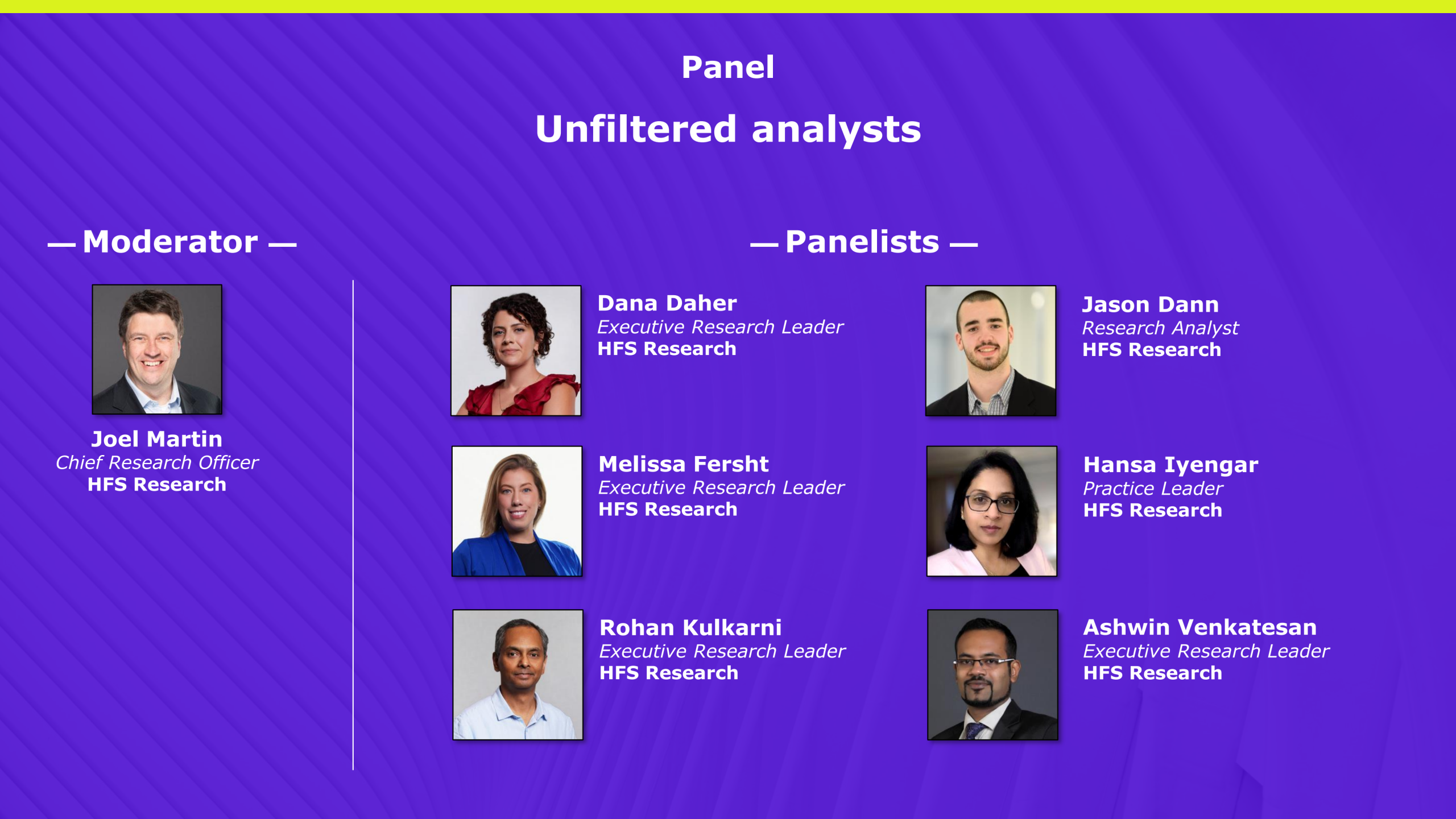
Unfiltered analysts

YouTube · Click to watch
Speaker
Joel Martin
Chief Research Officer, HFS Research

Joel Martin is Chief Research Officer at HFS Research, where he leads the firm's global research agenda at the intersection of IT services, enterprise technology, and artificial intelligence. He guides a growing, multi-disciplinary research organization worldwide.


Dana Daher
Executive Research Leader, HFS Research

Dana Daher is an Executive Research Leader at HFS Research, spearheading research initiatives in emerging technologies and employee experience. With a unique blend of expertise in anthropology and IT, Dana leads cutting-edge research that shapes industry landscapes across various domains.


Melissa Fersht
Executive Research Leader, HFS Research

Melissa Fersht is an executive research leader and head of the research innovation team for HFS Research. She leads all of HFS' research initiatives for customer experience, including contact center, digital marketing and sales, CX design, and conversational AI.


Hansa Iyengar
Practice Leader, HFS Research

Hansa Iyengar leads the banking, financial services (BFS), and IT services research practice at HFS Research. She focuses on delivering practical, forward-looking insights that help BFS leaders navigate change across financial services and on providing critical analyses of service provider strategies.


Rohan Kulkarni
Executive Research Leader, HFS Research

Rohan Kulkarni is an executive research leader for HFS Research. He is responsible for coverage of the healthcare and life sciences practice, bringing to the table his vast experience across the healthcare ecosystem. Rohan's experience includes serving as the head of healthcare strategy at multiple Fortune 500 companies.


Jason Dann
Research Analyst, HFS Research

Jason Dann is a Research Analyst at HFS Research and is based in Boston, MA. He focuses on the evolving landscape of sports technology and the broader services ecosystem that supports enterprise transformation. His work spans multiple industries.


Ashwin Venkatesan
Executive Research Leader, HFS Research

Ashwin is an Executive Research Leader at HFS Research. He has more than 17 years of experience in the GBS and technology services advisory space, and a proven track record as a trusted advisor for C-level executives and services leaders across Fortune 2000 enterprises and service providers.

Summary

Joel Martin hosts an unfiltered, unscripted panel of six HFS analysts near the close of Day 2. The panel rejects industry buzzwords (AI, moat, outcome-based, transformation, replacement, provider, integrator) and proposes sharper language built around impact, value orchestration, intent-based services, and human-centered AI. They predict the next two summits will be about ways of working, operating models, generational AI fluency, and human-AI relationships, not about the technology itself. The panel also closes with a clear point of view on the future of research services: less written content, more advisory, more relationships, and a higher revenue-per-analyst model as routine research gets automated and Services-as-Software™ reshapes how the firm delivers intelligence.

Key takeaways
  • Buzzwords the analysts want to retire: AI (Rohan), Claude-generated language and moat (Melissa), outcome-based (Hansa), transformation (Dana), replacement (Jason), and provider or integrator (Ashwin). Suggested replacements lean on impact, value orchestration, and intent-based services.
  • Two years from now the conversation is not AI, it is ways of working, operating models, human and AI relationships, generational AI fluency, and (Ashwin) potentially quantum AI on a roughly three-year Q-Day horizon.
  • The future of research services is more advisory, more relationships, and codifying analyst intelligence into tools. As Hansa put it, HFS is eating its own Services-as-Software dog food. AR briefings can no longer just be a packet someone reads.
  • Scaling advisory means raising revenue per analyst and putting unconventional thinkers in a room together, not adding headcount. Ashwin compares the analyst industry to professional services: the grunt research work gets automated, the value moves up the stack.
  • Human values, ethics, systems thinking, and critical thinking become more important, not less, as AI output looks polished by default and produces a sea of sameness. Dana frames the risk: people stop questioning the output because it looks clean.
  • Running jokes worth keeping: Jason Dann is the room favorite in the sinking-boat hypothetical (three of five panelists pick him to save); #HowToHuman emerges as a candidate hashtag for next year's summit.
4:50 to 5:05 PM Keynote

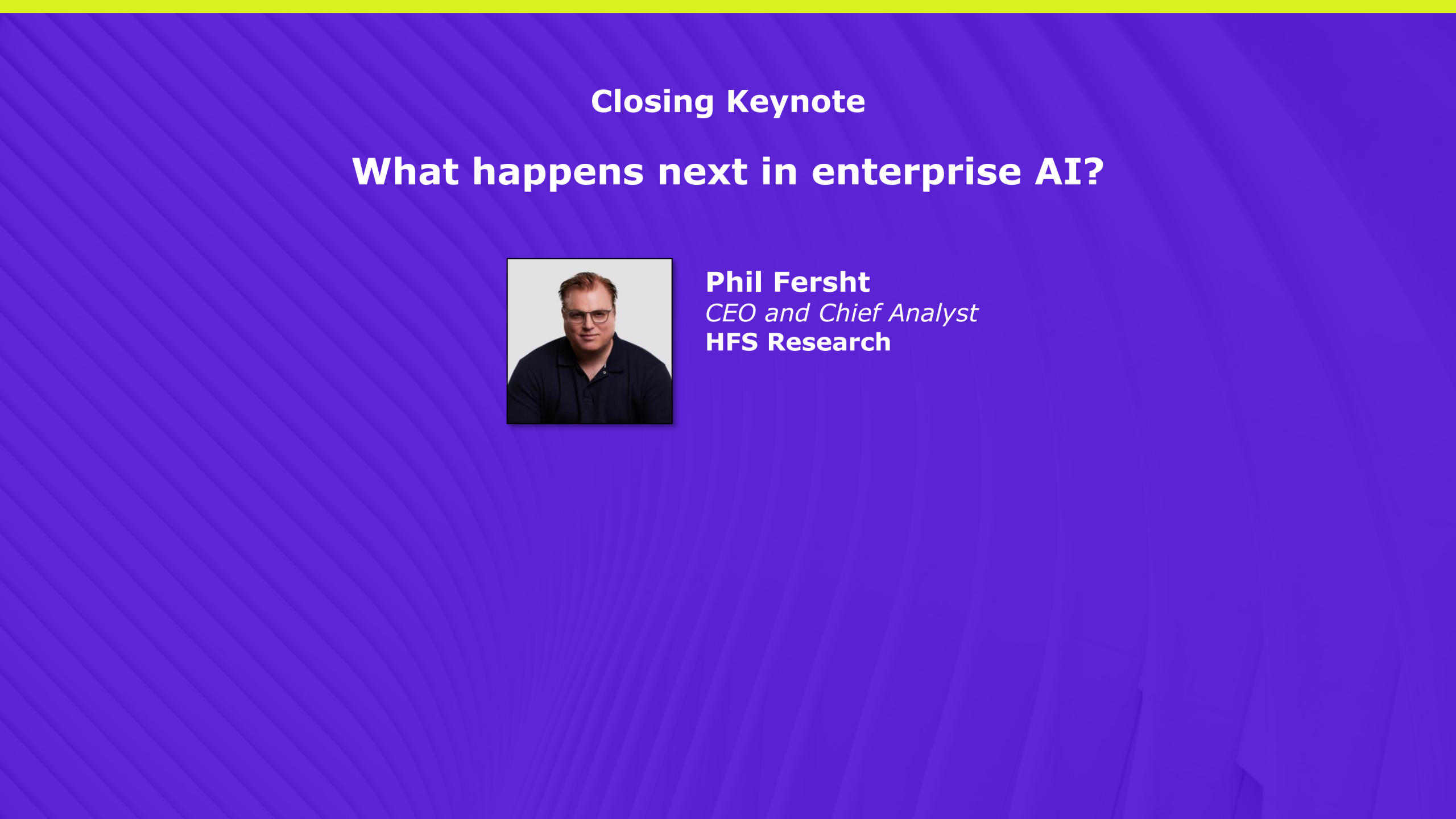
Closing remarks: What happens next in enterprise AI?

YouTube · Click to watch
Speaker
Phil Fersht
CEO and Chief Analyst, HFS Research

Phil Fersht is widely recognized as the world's leading analyst focused on reinventing business operations to exploit AI innovations and the globalization of talent. He recently coined the term "Services-as-Software" to describe the future of professional services, where people-based work is blurring with technology.


Saurabh Gupta
President, HFS Research

Saurabh Gupta is President, Research and Advisory Services at HFS. He sets the strategic research focus and agenda for HFS Research, understanding and predicting the needs of the industry and ensuring that HFS maintains its position as the strongest impact thought leader for business operations and services research.

Summary

Phil Fersht and Saurabh Gupta close out the HFS NY Spring Summit 2026 with an unfiltered audience feedback round on what enterprise AI buyers, providers, and investors are taking home from the two days. The dominant signal in the room is a shift from technology to business: outcome-based commercial models are moving from theme to consensus, change management for hundred-thousand-person services firms is the next gating problem, and there is fresh accountability landing at the C-suite and the board. Attendees flag different frontiers from their seats. Gio Moriano of IBM points to physical AI, quantum, and the importance of humans remaining relevant. Puneet, on the equity-investor side, presses traditional vendors to be more proactive about defining an AI-first delivery model rather than ceding the ground to OpenAI and Anthropic. Sameer of JK Tech and Kevin from the provider side echo the move toward business outcomes. Phil's own summary is that this is the first HFS conference where the conversation moved decisively from tech, tech, tech to how do we actually use this.

Key takeaways

The conversation in the room has shifted from technology to business: outcome-based delivery is now the consensus direction, not an aspiration. Phil calls it the most decisive tech-to-business shift he has seen at an HFS summit.

  • Change management at provider scale is the next gating problem. Hundred-thousand-person services firms cannot quietly remix into AI-first delivery; the case study Saurabh shared earlier in the day is held up as a warning, not a template.
  • Equity investors are asking what an AI-first services model actually looks like. Puneet challenges traditional providers to be more proactive in remixing toward AI delivery rather than ceding the ground to OpenAI or Anthropic.
  • Physical AI and quantum computing are the frontiers attendees flag as next, but humans remain the constant. Provider voices land on AI plus human agency winning over AI replacing jobs.
  • There is fresh accountability landing at the C-suite and the board for AI outcomes, with the exec-and-below layer showing visible awareness and a seeking posture. The provider side added that empowering frontline employees to exercise agency in using AI is a clear signal from C-suite voices at the summit.
  • The HFS NY Spring Summit 2026 closes with thanks to the HFS event team (Aubrey and Perlina), the staff at Apella, and the attendees who stayed through to the final session, with drinks and continued conversation moving outside.

Sign In

Sign up for a free
research account

With the exception of our Horizons reports, most of our research is available for free on our website. Sign up for a free account and start realizing the power of insights now.

Digests/Newsletters: Overviews of the latest news, insight, and research by HFS.

HFS Events: Exclusive invitations to HFS webinars, roundtables, and summits, bringing together key industry stakeholders focused on major innovations impacting business operations.

By registering you agree to our privacy policy.

I hereby consent that HFS Research can process my personal data.

Premium Access

Our premium subscription gives enterprise clients access to our complete library of proprietary research, direct access to our industry analysts, and other benefits.

Contact us at [email protected] for more information on premium access.

Help

If you are looking for help getting in touch with someone from HFS, please click the chat button to the bottom right of your screen to start a conversation with a member of our team.

[email protected]

    Contact Ask HFS AI Support