
Despite the ongoing emergence of new nimble disruptors, incumbents in the banking and financial services (BFS) industry have remained unphased, continuing to operate on the same legacy systems, reassured by major barriers to entry in the market. However, defending against these disruptors is only half the battle as the spotlight from governments and corporate clients is putting more pressure on banks to sort creaking IT. We can see a recent example in the UK, where parliament highlighted the poor state of IT in the sector. The Treasury Committee published a unanimously agreed report on IT failures in BFS, in which they agreed the current rate of failures was “unacceptable.” The window for traditional BFS firms to evolve is closing as regulators and customers alike recognize the industry’s pitfalls; if these legacy BFS enterprises don’t act swiftly, their creaking IT systems will combine with digital disruptors in a lethal pincer movement.
Ulster Bank is a prime example of computer systems working against a business
The current economic climate means that negative interest rates are becoming regular occurrence for financial services firms. For banks, this means passing the cost of holding money on to their customers or footing the bill themselves. For UBS, this resulted in the most dramatic “computer says no” moment in recent years. When the firm’s IT systems were developed, it was deemed unthinkable to charge customers a negative interest rate, so the systems were simply unable to handle the request. For the bank, this meant absorbing the cost of the interest rates, spending to introduce this capability to its systems, as well as handling the public reaction and negative press created.
This must serve as a warning to others who operate in the BFS space; in a time of such unpredictability, it is essential that IT systems are able to adapt, or risk similar consequences.
Differentiating in the financial services industry is difficult, making brand image a crucial ingredient to any bank’s success.
As it becomes increasingly easy to switch between banks, whose offerings are simultaneously becoming homogenous, it is essential that banks invest heavily in building brand loyalty. Ultimately, even a slight blunder can affect customers’ perception of a bank, be it anything from security to ethical practices. Within minutes, thousands of customers can switch to a competitor. Ulster Bank was once again in the news for another IT breakdown, which saw payments delayed. This left many customers without their salaries or, in some case, social welfare payments, for several days. This is the exact publicity banks must avoid, as it may result in customers looking toward competitors over fears of a similar event impacting them.
Change agents foster transformation, but financial services are investing broadly rather than adopting a focused approach
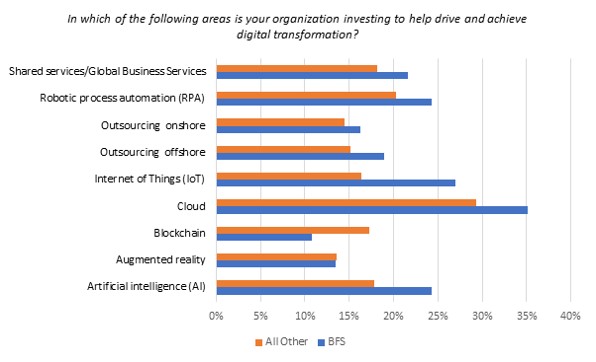
The annual HFS Digital Transformation survey asked a mix of business and IT leaders about their digital transformation plans. Exhibit 1 shows the areas BFS executives are investing in to achieve digital transformation compared to all other sectors. Surprisingly, given that they are mostly running on legacy IT systems, the BFS sector is leading in the number of technologies it boasts in the production environment—but that could also be the industry’s downfall.
BFS firms are spreading too thinly, leaving themselves unable to unlock the full potential of a valuable few technologies which in turn is hindering their efforts to modernize their IT systems.
Exhibit 1: BFS firms are investing too broadly in a range of change agent technologies
Source: HFS Research, 2019
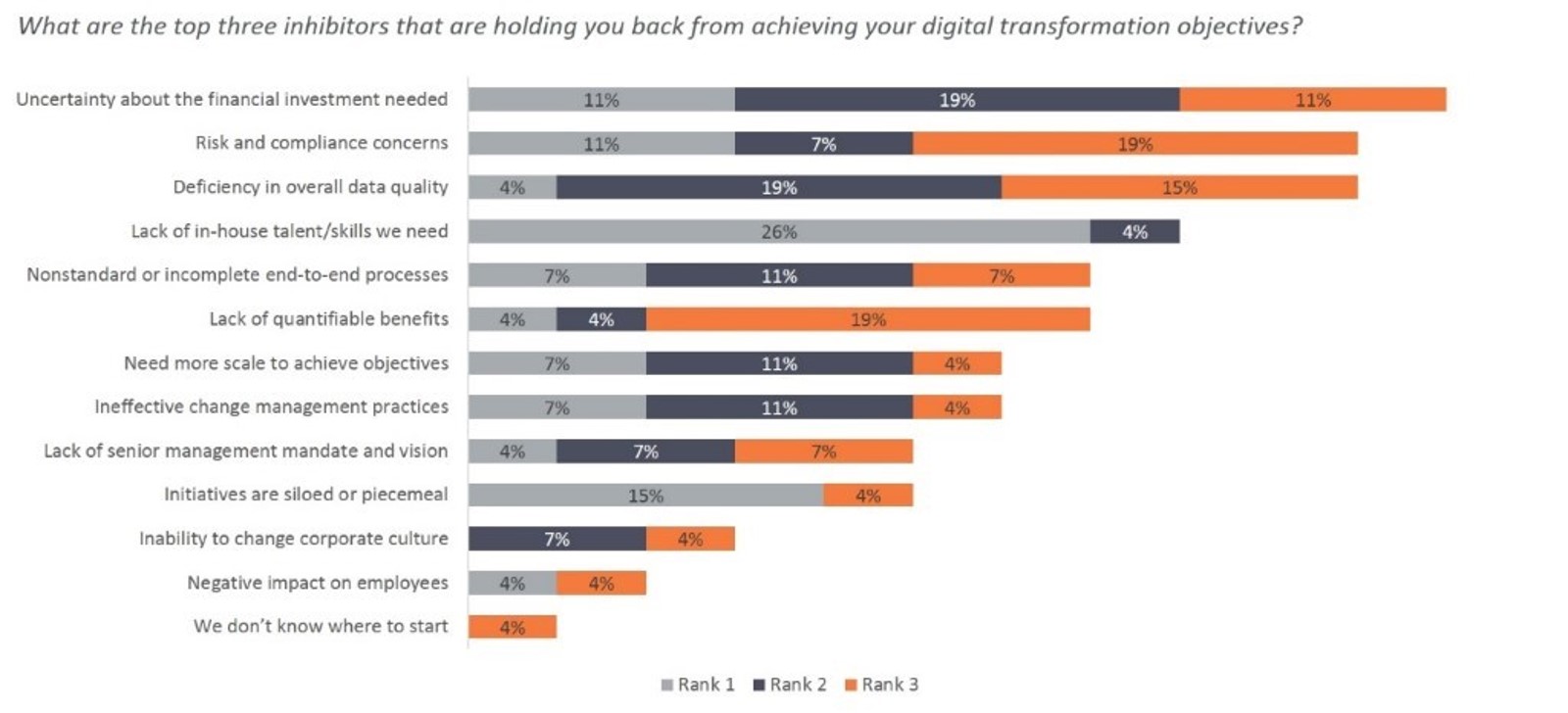
Exhibit 2: Risk and compliance concerns are one of the top inhibitors for BFS firm’s transformation objectives
Source: HFS Research, 2019
But this isn’t the only problem; financial services is a highly regulated industry, and a single wrong decision can have significant consequences
Understandably, given the assets it deals with, the BFS industry is heavily regulated, and the consequences of failing to comply are sizable. You don’t have to look further than the landmark £183 million fine dished out to British Airways to prove it. Much like every industry, this leaves banks trying to satisfy customer needs through digital transformation while maneuvering complex regulations like GDPR, as well as the likes of PSD2, which are industry specific. In fact, the severity of the problem is outlined in Exhibit 2, in which risk and compliance concerns were ranked the second largest inhibitor for digital transformation.
Service providers are ready to help incumbent banks navigate their digital transformation journey
Recently there has been a flurry of providers signing agreements with banks to drive them into digital: Bank of China expanded its relationship with IBM to enable digital transformation, TCS implemented the Reserve Bank of India’s centralized IT management system, and CGI signed a contract with National Bank of Canada to enhance the bank’s payments ecosystem. These agreements demonstrate providers’ readiness to support digital transformation in this sector.
The Bottom Line: If traditional banks don’t commit to focused digital transformation that solves concrete problems for their customers, they face public outcry and critical financial losses as their systems can no longer cope with the uncertainty of today’s global economy.
As most industries continue to leap forward with their digital transformation efforts, the spotlight will increasingly shine on the BFS sector to do the same. Thus far, most banks have failed to keep up the pace set by disruptors, and people are noticing—which will only get worse after the UK’s parliament labelled bank’s IT systems as “unacceptable.”
Ultimately, banks must learn from the mistakes of Ulster Bank and others in order to ensure their IT systems are prepared for all eventualities. Failing to do so could result in revenue loss and a vicious battle to rebuild brand image while maintaining customer loyalty.
Register now for immediate access of HFS' research, data and forward looking trends.
Get StartedIf you don't have an account, Register here |
With the exception of our Horizons reports, most of our research is available for free on our website. Sign up for a free account and start realizing the power of insights now.
Our premium subscription gives enterprise clients access to our complete library of proprietary research, direct access to our industry analysts, and other benefits.
Contact us at [email protected] for more information on premium access.

