
HFS’ 2019 State of Industry survey results portray total confusion surrounding cognitive technologies and machine learning (ML) in the “industrial” space of manufacturing and energy (including oil and gas):
It’s time to give these technologies a dedicated place at the industrial C-suite’s table and in firms’ holistic strategies, or else risk failed projects, sunk investments, and falling behind the industry’s pioneers.
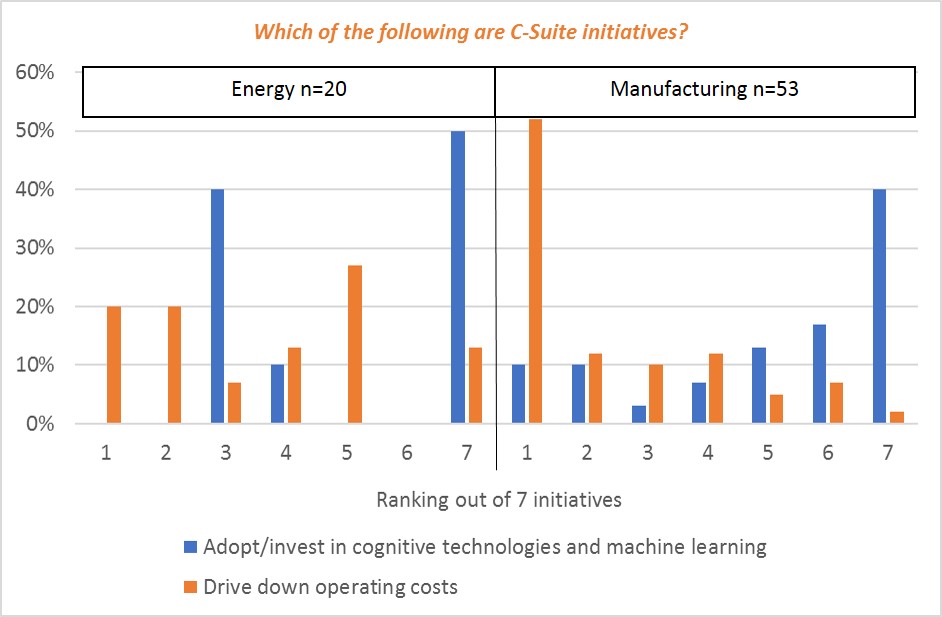
Driving down operating costs remains a firm focus in manufacturing, with over half of executives ranking it as their number one priority. Adopting cognitive and ML technologies, however, remains low on the priority list, with only 10% keeping it on that pedestal. Forty percent (40%) see it as their lowest out of 7 priorities. This also holds true in the energy space, where 50% rank it lowest; see Exhibit 1.
It’s unlikely that this mindset will change without a push; 90% of energy executives in the same survey are happy (70% very satisfied and 20% satisfied) with their state of cognitive and ML priority, and a similarly large majority are happy with their mindset of driving down operating costs. Manufacturing exhibits the same state of contentedness with their cost and cognitive priorities.
Exhibit 1: Driving down operating costs dominates manufacturing, while both manufacturing and energy place little interest in cognitive technologies and ML
Source: HFS Research, State of Industry 2019
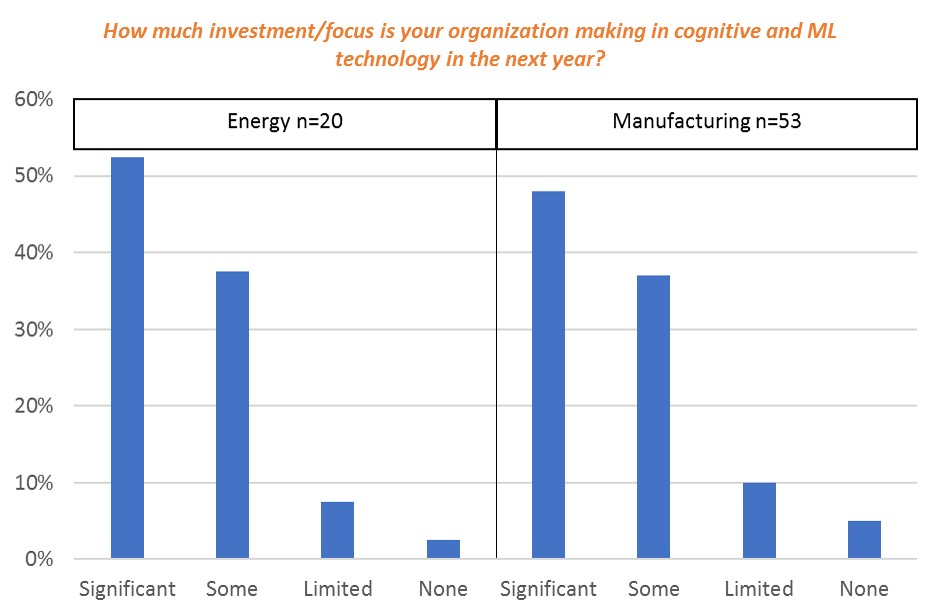
In both energy and manufacturing, large majorities of the same executives cite significant or some focus and investment (see Exhibit 2). Adding to the picture, HFS’ 2019 Business and IT Industry survey found that the two industries are very much in the implementation phase when it comes to the same technology.
Industrial strategists seem to be confused about their direction, priority, and confidence in these cognitive and ML technologies. They need to re-think their holistic strategies with far greater clarity; cognitive and ML technology must have a place at the highest level of industrial enterprises’ minds.
Leading players in the industrial sector are pulling ahead with their cognitive adoption. Proactive cement manufacturers are ingraining AI throughout their core operations and supply chains in view of the existential threat to their business posed by both damning environmental concerns about the cement industry’s emissions and by alternative materials development. At a high level, these applications extend through both process (such as cement) and discrete manufacturing (car or electronics production, for example).
Also, in the process industry, Azure AI is facilitating predictive modeling of equipment like heat exchangers and pumps. On a novel tangent to improving industrial operations, Eightfold’s ML is aiming to solve manufacturing’s talent shortage through retraining and retaining insight.
Exhibit 2: Across energy and manufacturing, the vast majority of executives are putting significant, or at least some, investment and focus on AI and ML, despite Exhibit 1 showing a lack of priority…
Source: HFS Research, State of Industry 2019
Fifty-four percent (54%) of manufacturing executives cited uncertainty about the necessary financial investment as a barrier to achieving their digital transformation objectives—the biggest barrier among all possible factors; 34% feel the same way in the energy industry.
The manufacturing and energy sectors need to move away from the idea that these technologies alone are the answer to their problems. HFS has said it before, and we’ll say it again: Start with the target outcome or start with a business problem, and let the vendors sort out the technology that will get you there. Industrial sectors are no different from any vertical in this respect.
Register now for immediate access of HFS' research, data and forward looking trends.
Get StartedIf you don't have an account, Register here |
With the exception of our Horizons reports, most of our research is available for free on our website. Sign up for a free account and start realizing the power of insights now.
Our premium subscription gives enterprise clients access to our complete library of proprietary research, direct access to our industry analysts, and other benefits.
Contact us at [email protected] for more information on premium access.

