
Business operations leaders are constantly on the lookout for ways to improve the running of core enterprise functions. Traditional business intelligence and process mapping tools and process discipline methodologies such as Lean Six Sigma have been the primary approaches over the past two decades. Process mining tools are emerging as contributors toward this cause, using data from a company’s own systems and application logs. In this POV, we describe the definitions and techniques process mining experts use today, with one fundamental underlying principle—data is the foundation of a business process, and its analysis can unlock better ways to orchestrate activities between systems, platforms, and people.
Process mining is the science of collecting enterprise operations data and pre-defined process models and applying data mining and data science techniques to reveal the current state of process standardization. The goal is to find opportunities for making improvements, and consistently monitoring and improving enterprise operational performance. Process mining can use a combination of automation, AI, and analytics technologies to capture various kinds of enterprise data, create process maps by linking activity data, analyze and present as-is processes against existing process models, make recommendations on what actions to take to improve performance, and provide ongoing monitoring and benchmarking analysis to track progress.
The discipline of business process re-engineering, process improvement, and process optimization has long tried to reduce friction and waste within key company activities and instill process discipline. On the back of this, concepts such as Lean Six Sigma have proliferated among Global 2000 enterprises in the last two decades, spurring cultural changes to eliminate inefficiencies and create more standardized business processes. Process mining tools have evolved to add a critical missing ingredient in these efforts—gathering a continuous treasure trove of actual data about how processes are being run, toward more consistent monitoring of process improvements.
We can trace academic research into process mining back to the 1990s. Software vendors are now applying this research with the use of emerging technologies and significant enterprise interest. Academic research points to process mining as “a new scientific discipline on the interface between process models and event data,” and it has arisen from the growing need for data-driven workplaces.
Prof.dr.ir. Wil van der Aalst, one of the leading researchers in the field of process mining, outlines the context of its rise: “Data science is the profession of the future, because organizations that are unable to use (big) data in a smart way will not survive. However, it is not sufficient to focus on data storage and data analysis. The data scientist also needs to relate data to process analysis.”
The new breed of process mining tools adds a critical link between the need to continuously monitor and analyze business processes and the requisite technical knowledge and technologies. According to the Process Mining Manifesto, published by the IEEE Task Force on Process Mining in 2011, “Process mining is a relatively young research discipline that sits between computational intelligence and data mining on the one hand, and process modeling and analysis on the other hand. The idea of process mining is to discover, monitor, and improve real processes (i.e., not assumed processes) by extracting knowledge from event logs readily available in today’s (information) systems.”
Process mining digs into your chosen workflows and finds exactly which processes your customers, suppliers, and front- and back-office employees are using, whether prescribed or improvised. You can use these results to make processes run as efficiently as possible using the following process mining techniques and tools:
Exhibit 1: Process mining techniques have a linkage to broader data and automation initiatives
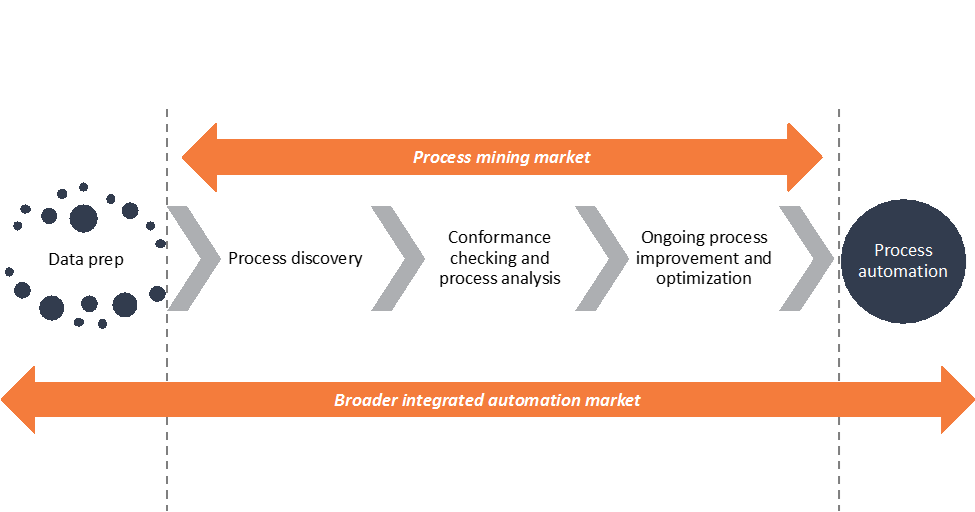
Source: HFS Research, 2020
A well-documented example of the potential power of process mining can be found in the case study of Siemens’ work with process mining vendor Celonis. In 2014, Siemens established an internal unit to use process mining to analyze diverse as-is business processes and identify inefficiencies, including purchasing and ordering logistics and follow through to production, order handling, and delivery to customers. Siemens has reportedly saved double-digit millions every year by using process mining. It continues to use the technology today, with over 2,500 active users discovering new business cases.
The definitions and methodologies for using process mining techniques are continuing to evolve as more vendors and enterprise clients
The Bottom Line: The wave of using real-time data to drive enterprise operational improvements is on the rise, and thanks to process mining tools, it is getting better.
The emerging application of process mining techniques and tools brings a much-needed ingredient—real-time process data—to the traditional disciplines of operational process excellence. Every enterprise operations leader must explore its potential within their organization, in particular, the proclivity of teams to use operations data to make changes and incentivize the right behaviors that lead to sustained process improvements. Enough with the guesswork. Let’s use real-time data to drive real process improvement.
Register now for immediate access of HFS' research, data and forward looking trends.
Get StartedIf you don't have an account, Register here |
With the exception of our Horizons reports, most of our research is available for free on our website. Sign up for a free account and start realizing the power of insights now.
Our premium subscription gives enterprise clients access to our complete library of proprietary research, direct access to our industry analysts, and other benefits.
Contact us at [email protected] for more information on premium access.

