
AI is everywhere, but enterprise performance isn’t budging. Recently, in New York, the HFS–IBM roundtable convened senior enterprise leaders from various industries to confront a hard truth: AI is automating broken work rather than transforming it. The consensus emerging in the room was unmistakable. In essence, AI will not deliver enterprise-level outcomes until leaders adopt a modern “operating model” based on SaS. To achieve this new paradigm, enterprise CIOs and COOs must eliminate brittle processes, unify decision-making rights, and develop modern talent and data capabilities.
The roundtable (see Exhibit 1) surfaced a consistent pattern across industries. Each insight pointed to a deeper operating model failure and reinforced why SaS is the prerequisite for any meaningful AI ROI.
First, AI is scaling without moving the revenue needle. Enterprises are deploying AI widely for automation and personalization, yet it contributes less than 1% to top-line growth. Leaders increasingly accept that the constraint is not the technology stack. It is the operating model into which AI is being injected.
Second, organizational design is strangling AI investments. Most AI initiatives are constrained less by legacy systems than by fuzzy decision rights, antiquated processes, weak governance, and slow change velocity. When nobody owns outcomes end‑to‑end, AI becomes another experiment in an already crowded portfolio.
Third, siloed execution keeps value trapped. Wins in marketing, service, or supply chain often remain local victories. Fragmented key performance indicators and process debt fracture value before it can scale across the enterprise. Each team improves its own slice of the journey while the customer still experiences the seams.
Fourth, personalization does not yet equal performance. Marketing and branding teams are seeing real benefits from AI‑driven personalization and content optimization. However, those wins rarely translate into enterprise-level metrics, such as revenue growth, margin improvement, or customer lifetime value. Personalization remains a tactic, not a systemic capability.
Finally, talent debt and driving culture change are becoming a competitive liability. Automation that removes tasks without redesigning roles and career paths erodes domain knowledge. The organization loses the people who understand the processes, data, and context that AI needs to be trustworthy. Over time, this hollows out the capability to govern and improve AI‑enabled services. Additionally, adopting completely new ways of working is not easy, especially when a significant portion of your workforce has spent decades following a different modus operandi.
Together, these insights represent the backbone of the discussion. In essence, AI is not the bottleneck, but your model for running the business is. That is precisely where SaS becomes essential.
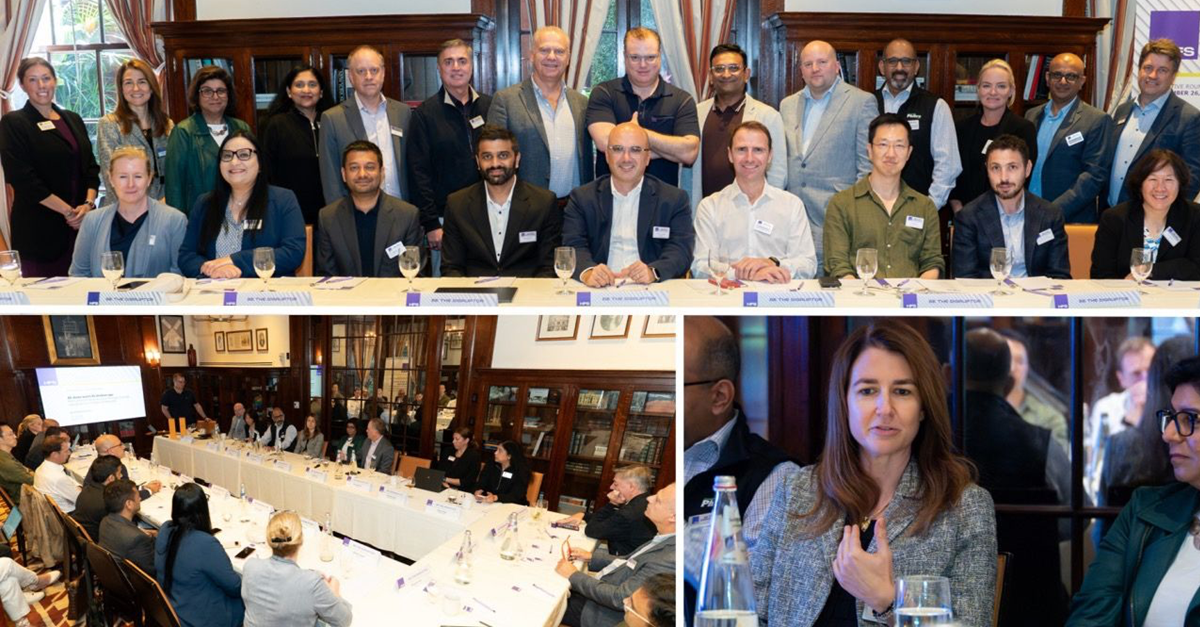
Source: HFS Research, 2025
At the roundtable, IBM shared its own transformation as “client zero,” treating itself as the first customer of the operating model it wanted to deliver to the market. The sequence was crucial: First, rebuild the “operating system” (OS), then scale AI.
IBM began by enforcing unified data standards and governance, simplifying processes through agile and shared services, and modernizing core platforms such as Adobe and Salesforce. Only after stabilizing this foundation did the company accelerate AI automation, personalization, and productivity on a large scale.
The outcomes have been significant. Over the course of three years, IBM unlocked approximately $3.5 billion in productivity gains as streamlined workflows and modern platforms gained traction. Revenue growth improved from -3% to +5%, underscoring the deep interconnection between operating performance and commercial performance.
Operationally, IBM’s AskIT capability now resolves around 86% of critical IT issues, reflecting both AI adoption and the simplification of underlying processes. The modernization of infrastructure and applications has delivered more than $600 million in optimization benefits, while supply chain improvements have contributed $316 million in savings since 2022.
One of the most compelling stories is in content operations. After re‑architecting the content supply chain, including standardizing workflows, clarifying ownership, and embedding governance, IBM applied AI to generate and personalize content at scale. This resulted in content cycles shrinking from months to minutes, creation spend falling by roughly 80%, engagement increasing 26-fold, performance improving threefold, and the company unlocking $145 million in savings with a strong double-digit ROI.
Once IBM rebuilt its operating system around modular, governed services, AI shifted from isolated efficiency plays to a driver of enterprise-level performance.
Phil Fersht, HFS’s Chief Analyst and CEO, defined the path from experimentation to performance as the convergence of people, data, and platforms into a frictionless engine for growth, the HFS Digital OneOffice ethos. He mentioned that enterprises’ next operating model must run on SaS, or AI spend will never scale. He went on to discuss packaging know-how, workflows, and decision logic into scalable, IP-led solutions consumed via subscriptions and outcomes, rather than bodies and hours.
He highlighted three moves anchoring this shift.
Erase the wall between business intent and execution (“vibe coding”). Let domain leaders and engineers co-create with AI copilots in natural language so requirements compile into running services. This is how you collapse cycle time and cost, from months to minutes.
Unify decision rights and funding. Create a single decision-making spine that owns data policies, models risk, and drives value realization. In essence, have one backlog, one wallet, and one set of guardrails to scale responsibly across functions.
Build modern talent, beyond just tooling. Marketing, IT, and service functions demonstrate that with the right roles and skills, GenAI impact emerges within 15–16 months. Use this runway to grow consultative, domain‑centric AI skills and rebuild the early‑career ladder.
The overall roundtable conversations, IBM’s example, and HFS field research enabled everyone in the room to conclude that AI scales only when enterprises replace project thinking with a SaS operating system.
Here is the playbook the leaders in the room aligned on.
1. Rebuild one high-impact workflow end-to-end
Start narrow but deep. Choose a workflow that is both high-value and measurable, such as the content supply chain, customer care triage, or know-your-customer onboarding, where data is serviceable, and outcomes are clear.
Do not bolt a model on top of the current mess. Instead, redesign the work from first principles:
Only once this operating foundation is in place should AI models and copilots be embedded to automate, orchestrate, and personalize at scale.
2. Turn the redesigned flow into a reusable enterprise AI service
Treat the reimagined workflow as a productized service. Codify the service, including its policies, prompts, guardrails, APIs, approval logic, and performance metrics. Publish it into an internal service catalog so that other teams can discover and consume it, rather than rebuilding it. Adopt vibe‑coding patterns so domain teams can adjust and extend the service safely in natural language, while engineers curate the technical and risk controls behind the scenes. At the same time, shift the funding model from projects to product subscriptions, with incentives tied to the service’s performance over time, rather than just delivery milestones.
3. Scale impact through chaining, governance, and transparency
Once one service is stable and performing, expand its impact by chaining adjacent services. For example, connect content operations to offer decisioning, merchandising, or pricing optimization so value compounds across the journey rather than remaining isolated.
Capture risk management and change control under a centralized governance framework. Maintain a model inventory, a bias and robustness testing regimen, and a structured approval process, enabling the enterprise to scale confidently.
Finally, publish a quarterly value ledger that makes the impact of SaS and AI visible across productivity, performance, prediction, and personalization. Transparency sustains sponsorship and guides where to scale next.
Without SaS, existing process debt only deepens. AI amplifies the inconsistencies embedded in legacy workflows, spawning new exceptions, workarounds, and shadow processes that are even harder to diagnose. Each new AI use case introduces another variant, making end-to-end control increasingly fragile. Enterprises that adopt SaS and rebuild work as scalable services will see AI shift from incremental optimization to enterprise-level performance.
Also see the associated blog from Jean-Stephane Payraudeau, Managing Partner, IBM Business Operations.
Register now for immediate access of HFS' research, data and forward looking trends.
Get Started

If you don't have an account, Register here |
Register now for immediate access of HFS' research, data and forward looking trends.
Get Started
