This Market Impact Report is for CIOs, CTOs, and sourcing leaders evaluating how to replace rigid, headcount-based BPO contracts with Services-as-Software™ platforms that deliver outcome-based pricing, embedded AI, and measurable business results.
The business process outsourcing (BPO) industry is at a tipping point. Decades of headcount-based delivery, fixed pricing models, and labor-intensive operations are increasingly misaligned with enterprise needs. In a digital-first, AI-enabled economy, speed, agility, transparency, and outcomes matter more than volume, offshore delivery centers, and full-time employee (FTE) counts. To stay relevant, the industry must embrace its next chapter: adopt the Services-as-Software™ (SaS) playbook of BPO services as modular, intelligent platforms. HFS has quantified the SaS market opportunity at $1.5 trillion, proving that enterprises are ready for this shift (see Exhibit 1).
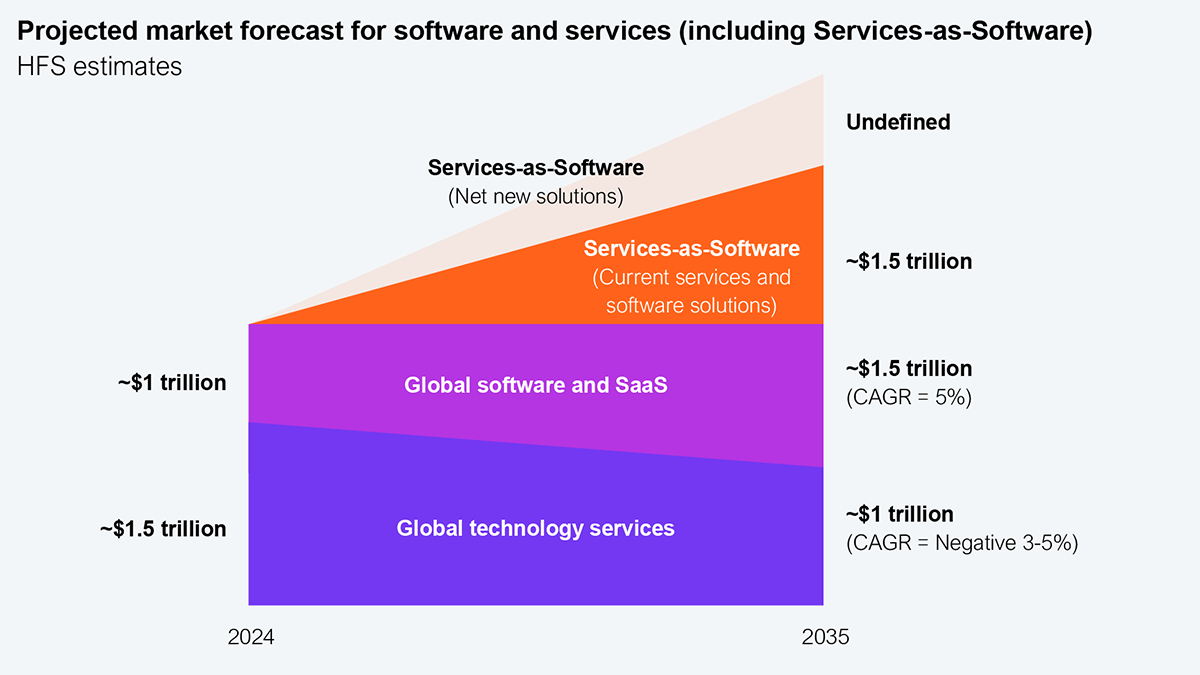
Source: HFS Research, August 2025
As GenAI and agentic automation mature, the industry will shift from monolithic services to productized digital workflows. But the path is gated by cultural inertia, data debt, and the need for credible, interoperable partners.
In this report, HFS Research, in partnership with Firstsource, explored why enterprise leaders are changing service strategies, what hurdles are holding them back, and how they must adapt. We interviewed enterprise technology leaders (CIOs, CTOs, and CISOs) to understand their willingness to shift from FTE based contracts to outcome-driven, platform-based models.
Enterprises can’t expect greater outcomes when the entire hardware, software, IT services, and BPO stack is not integrated and under unified control. Integrating data and workflows is essential, ensuring accuracy and embedding deep domain expertise into software. Enterprises that don’t demand outcome-driven services risk falling behind. Traditional, FTE-heavy BPO models are outdated, leading to high costs and stagnant growth.
Business leaders are no longer satisfied with the status quo. Despite outsourcing for years, they still encounter many systemic problems: inflexibility, inefficiency, and an inability to adapt to changing business demands (see Exhibit 2). Outsourcing contracts designed on the FTE model incentivize vendors to “do the work” rather than reduce it, and enterprises are left paying for headcount instead of value. Rigid change protocols, manual ramp-ups, and siloed delivery reinforce the problem.
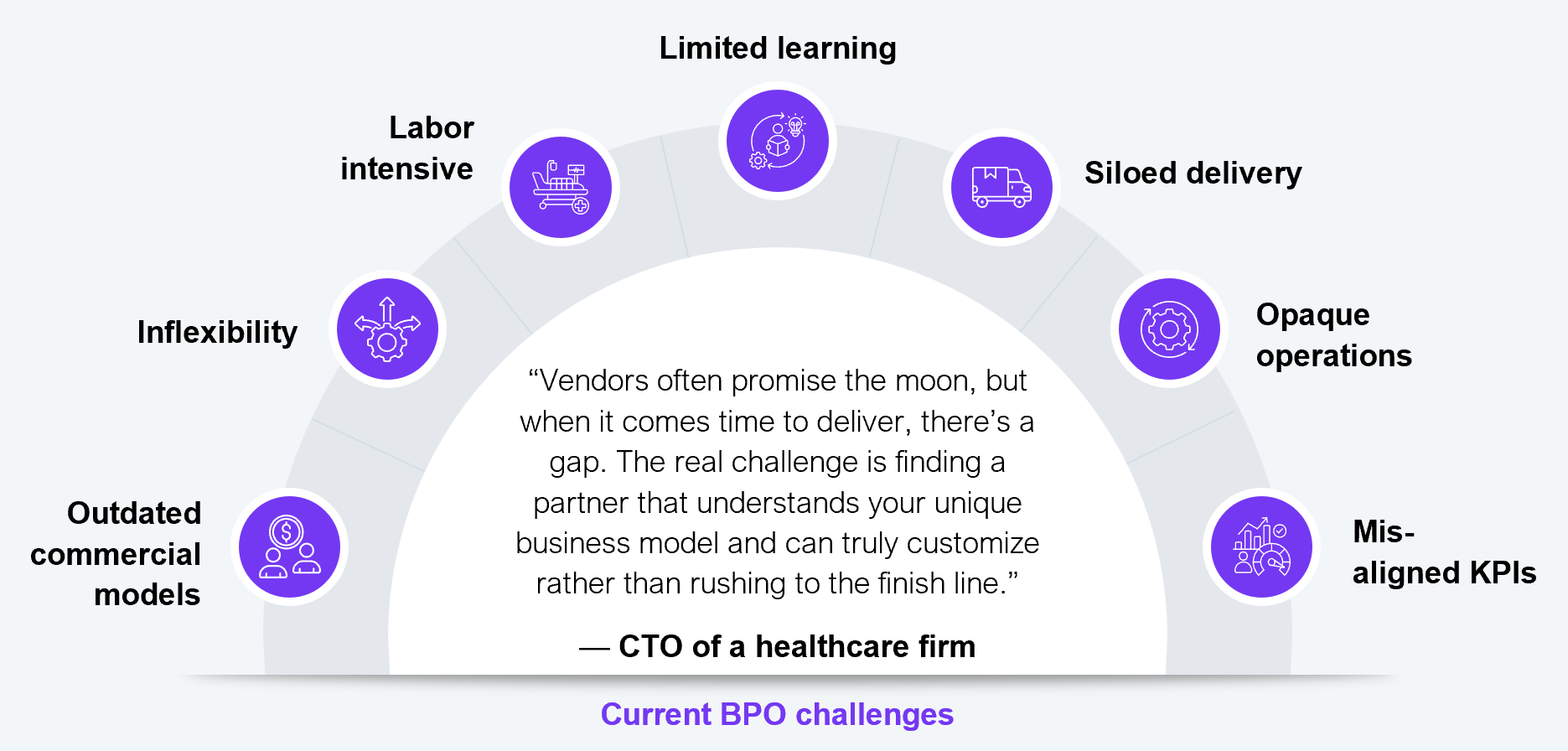
Source: HFS Research, September 2025
Digital-native companies have raised the bar, increasingly demanding intelligence and agility. BPO service providers continue to fall short: they frequently overpromise, lack a deep understanding of business models, and fail to drive innovation beyond ticket resolution. This has created hidden gaps, delays, and operational inefficiencies such as:
A senior executive from a financial institution cited rigid change request protocols that made it impossible to adapt outsourced services to evolving compliance needs quickly. Another lamented the lack of learning across repeat M&A onboarding projects.
Despite having completed multiple similar transactions, our provider continues to onboard each new process from scratch without applying lessons learned.
— CIO of a financial services firm
Outcome-based models are the first step toward broader transformation. However, providers still need a delivery model designed for agility and automation to make outcomes stick and help enterprises sustain their growth in a rapidly changing business and economic environment. Over the next three years, engagements will move from FTE and T&M to hybrid models, followed by next-gen BPO models such as flexible outcome-driven or shared revenue types.
An HFS survey of more than 500 executives showed that reliance on FTE-based models is expected to drop from 42% to 28%, while outcome-based models are projected to nearly double from 20% to 39% over the next three years. At the same time, hybrid models (combining fixed fees with outcome-based or subscription-plus-performance tiers) are forecast to grow from 8% to 14% (see Exhibit 3).
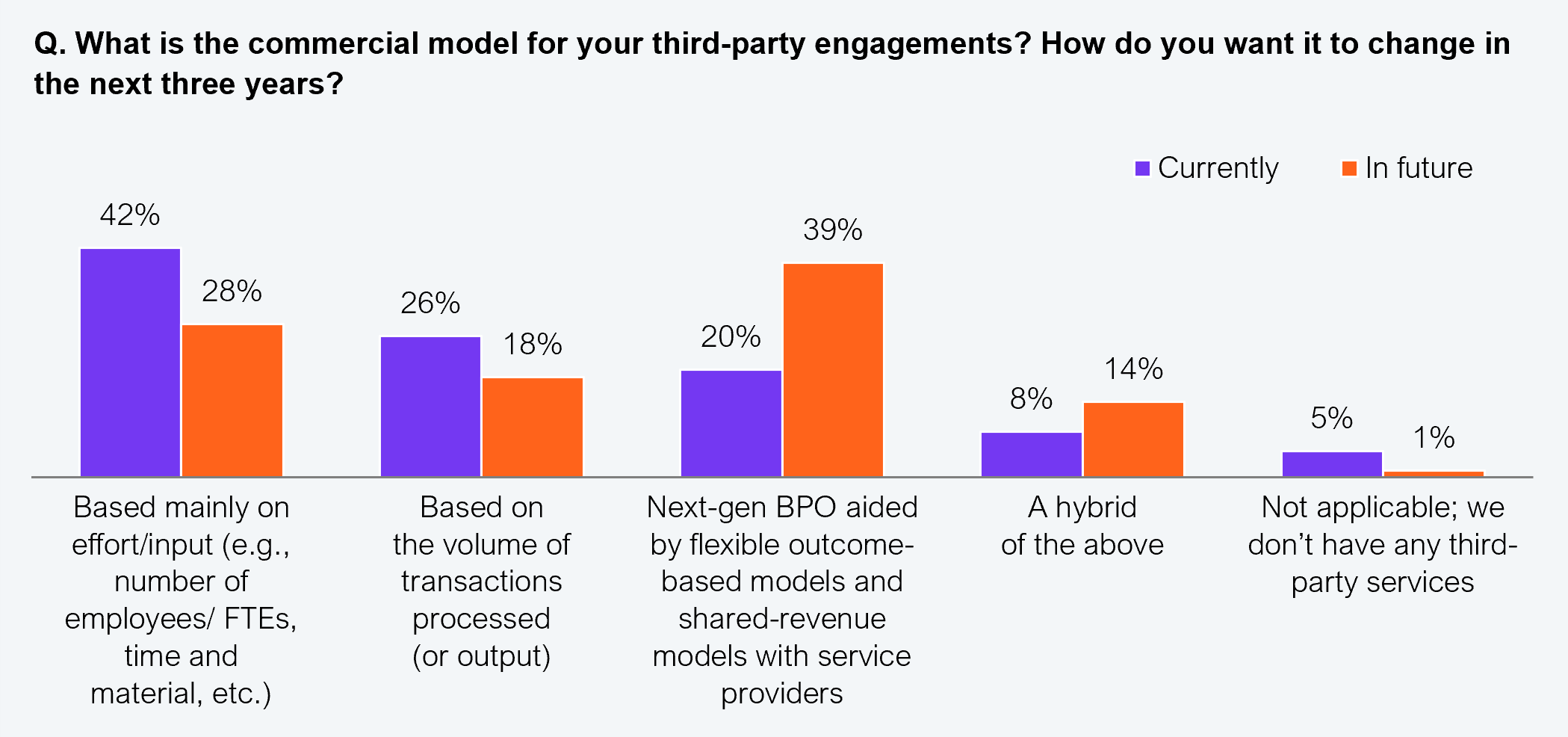
Sample: 500+ survey participants
Source: HFS Research, August 2025
Given enterprises’ current challenges and expectations for third-party engagements on outcome-based and hybrid commercial models, the optimal solution is SaS-based BPO services. This approach transforms outsourcing into a platform-driven strategy that aligns incentives with scalable execution, ensuring that businesses meet their evolving needs.
The growing demand for AI-driven solutions, adaptability, and self-optimizing workflows calls for a SaS approach that moves away from rigid, monolithic contracts tied to static services. The SaS model transforms outsourcing into platform-led services that operate like cloud software, giving enterprises what they have long been looking for:
Enterprises should adopt intelligent, AI-driven, platformized, modular, and interoperable BPO agreements (see Exhibit 4). This shift is crucial for distinguishing B2B offerings, increasing efficiency, and facilitating the development of non-linear, outcome-focused business models.
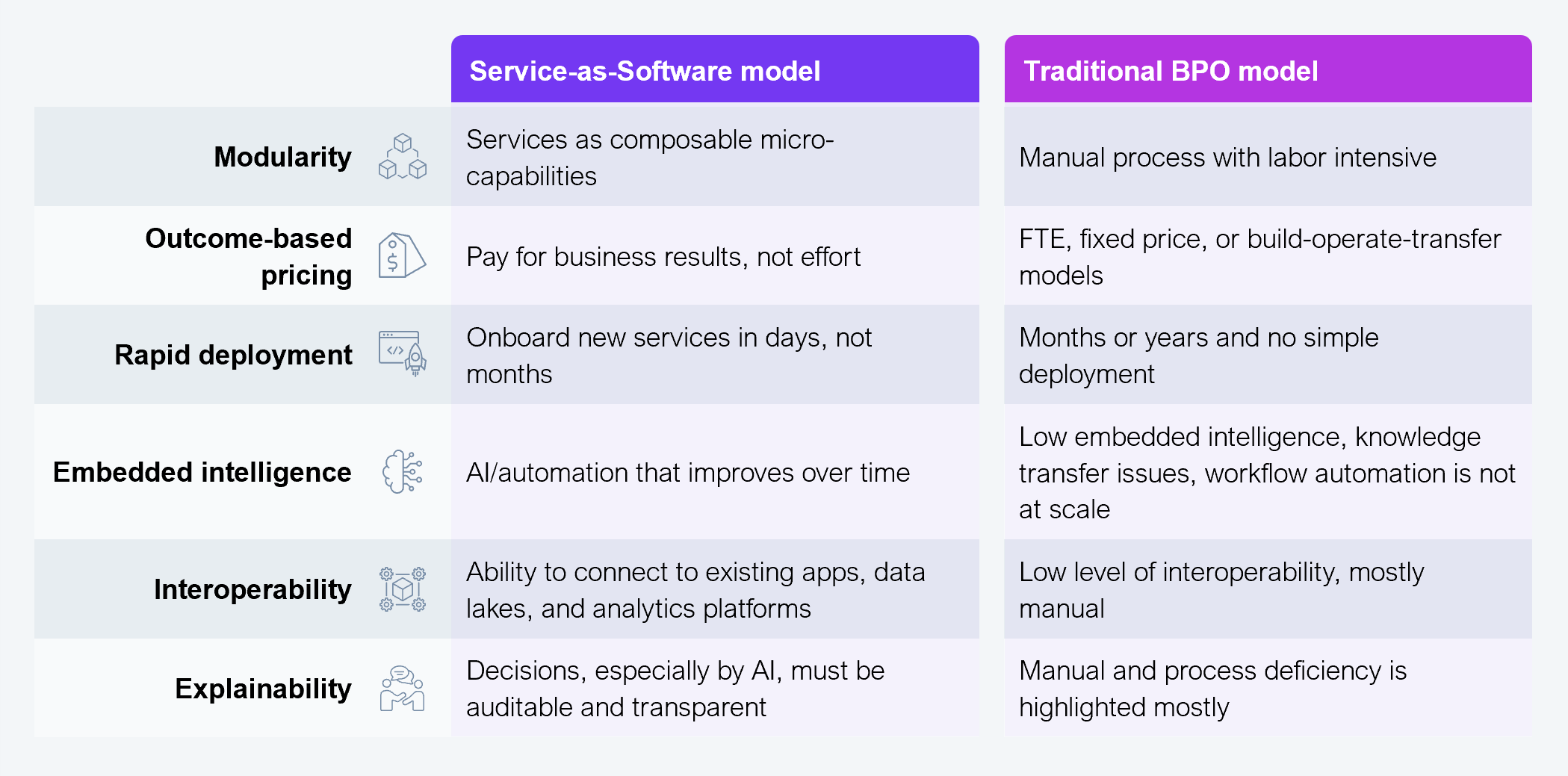
Source: HFS Research, 2025
HFS Research’s survey data revealed that more than 40% of enterprises plan to shift customer experience delivery to AI-led models over the next three years. Supply chain and F&A (30% each) and marketing (27%) followed closely (see Exhibit 5). This reflects recognition that SaS-based BPO delivers scalability, speed, and transparency.
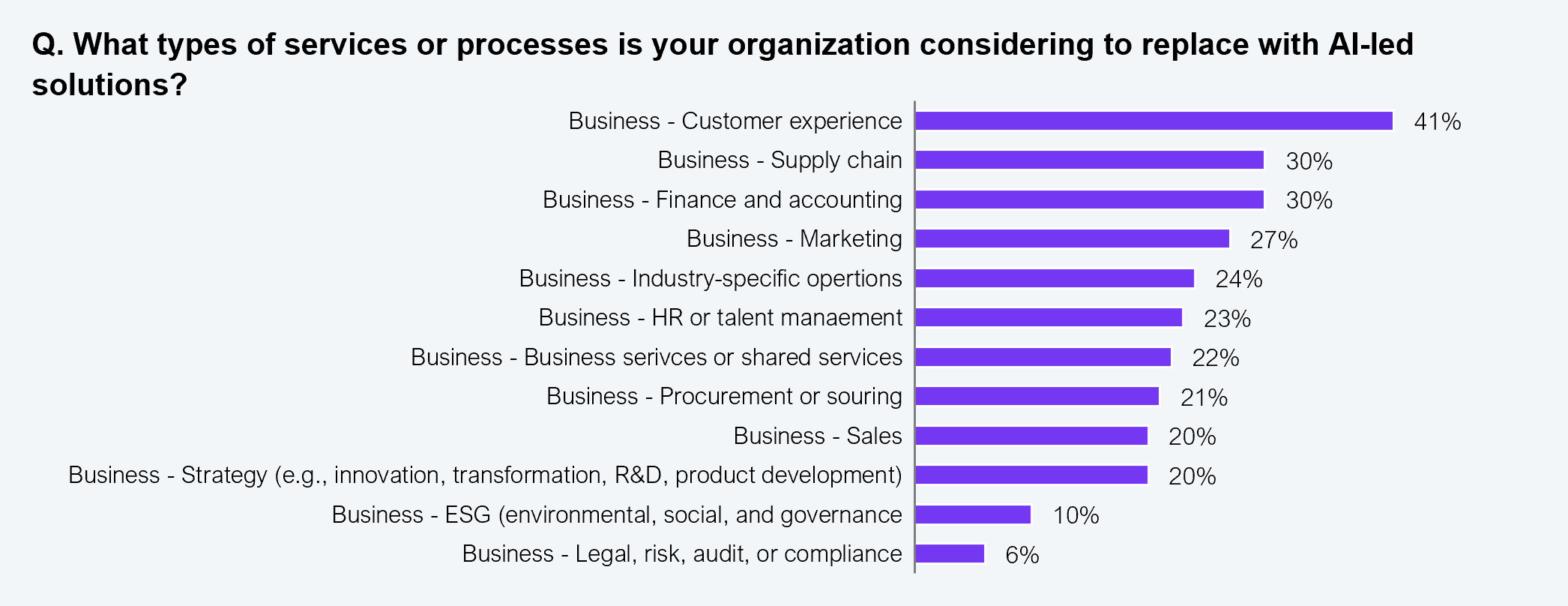
Sample: N=230 Forbes G2000 company executives in the BPO domain
Source: HFS Pulse Survey, 2025
An executive from the HR tech space emphasized the need to replace outdated fixed-price models that don’t reflect the efficiencies made possible by automation.
The most beneficial model would be a BPO where AI agents handle 70–80% of the work and humans manage the rest with complete transparency on what’s automated and where human oversight is still needed.
— Head of Technology at a global real estate services firm
Freed from multi-year contracts and manual workflows, enterprises can experiment faster, scale smarter, and reallocate talent toward high-value innovation instead of process chasing. With real-time performance insights, speedier onboarding, and the freedom to adjust services as business demands shift, the focus shifts from chasing SLAs to driving outcomes—objectives and key results (OKRs) that matter to the business.
Services-as-Software makes budgeting more predictable. The key is using a platform model that frees people to deliver more proactive, predictive, value-added services instead of spending time on mundane processes.
— SVP of Technology at a life sciences company
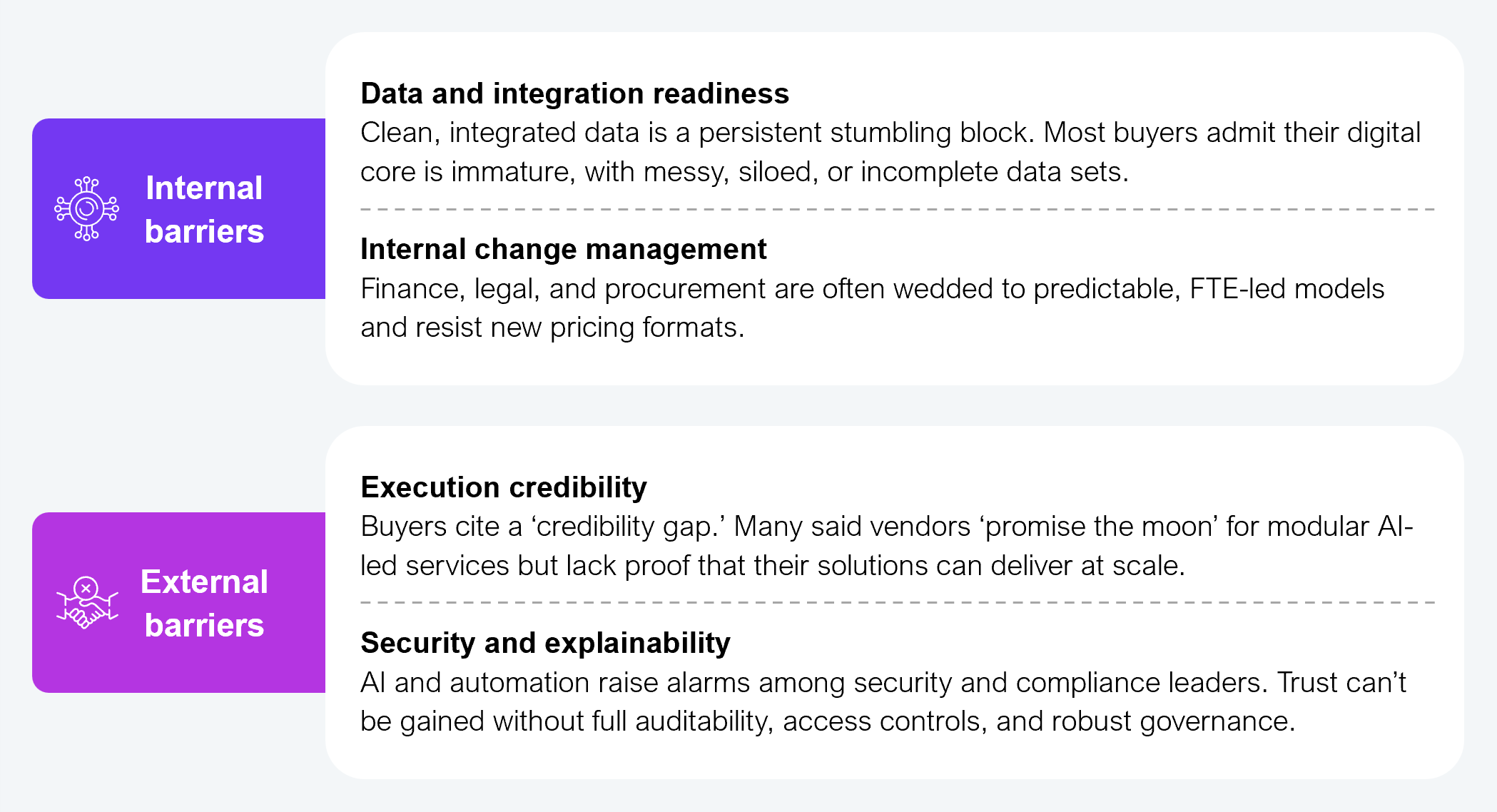
But if the SaS model is so appealing and flexible for enterprises, why hasn’t it become the norm yet? The answer lies in a mix of organizational inertia and structural obstacles. Legacy procurement frameworks still prioritize predictable costs over flexible value. IT systems are often fragmented and lack the necessary data hygiene for effective automation. Many providers also struggle to implement the new model at scale. As a result, the intention to make this shift often outpaces actual implementation.
Legacy procurement habits, fragmented systems, and vendor credibility gaps are slowing down AI adoption far more than its availability. An executive shared that while they wanted to move to outcome-based contracts, their finance and procurement functions insisted on flat-rate pricing for predictability.
Another leader from the cybersecurity space highlighted the lack of data governance as a dealbreaker for adopting AI-enabled services. Without clean, auditable data, there’s no foundation to build on. Still, there’s plenty of hope around the ability of platformized, AI-first BPO to deliver faster and better outcomes than the traditional model.
Not all client requirements can be met with a fully integrated platform or AI-driven solutions. Therefore, AI and technology-led solutions must be integrated into traditional BPO models. This integration will require developing customized solutions and partnerships within managed services.
Understanding these barriers (see Exhibit 6) is crucial because AI isn’t just an enabler of the SaS model. It’s becoming the foundation that makes it possible and tempers the path to scaling SaS adoption.
AI can make mistakes at machine speed. We need transparency in how it thinks.
— CISO of a payroll and HR solutions company
Source: HFS Research, 2025
Enterprises today face a dual reality in outsourcing readiness. Traditional FTE-heavy BPO services, while entrenched, struggle with inflexibility, slow ramp-ups, and inefficiencies, especially in regulated or seasonal industries. In contrast, SaS approaches, platform-based models, and AI-embedded models offer appealing modularity, scalability, and cost predictability.
Enterprises are most willing to experiment where performance is measurable (collections, underwriting time, call handling, SLA attainment). Adoption rises with transparent measurement and credible proof points. For SaS-based BPO to work, ROI must be measured differently. The conversation must shift from cost takeout and productivity improvement to speed-to-market, business agility, and customer impact. While many leaders agreed that traditional KPIs (average handle time, number of tickets closed, and compliance rates) remain relevant, they stressed the need to reinterpret them, with many aiming to assess time-to-value and predictable results.
Readiness for these models varies by sector. Healthcare leaders identify staffing shortages and inefficiencies as drivers for AI adoption in revenue cycle management and denial management. In financial services, enthusiasm is balanced by Securities and Exchange Commission/Financial Industry Regulatory Authority (SEC/FINRA) regulations, with ongoing experimentation in fraud detection and identity verification areas. Media and technology firms are more comfortable with experimentation but must shift their metrics from throughput SLAs to qualitative KPIs focused on customer experience and growth.
A CISO described how organizations are reimagining the mean time to respond (MTTR) in machine-speed triage, prioritizing prevention and root cause elimination over pure reaction time. Another executive outlined a shift from SLA compliance to OKR based governance, with goals tied to retention, NPS/CSAT, and revenue per client.
With AI in the mix, KPIs will fundamentally speed up. We’d shift more toward OKRs, things like call satisfaction rather than just math-based metrics.
— Head of Technology at a global real estate services firm
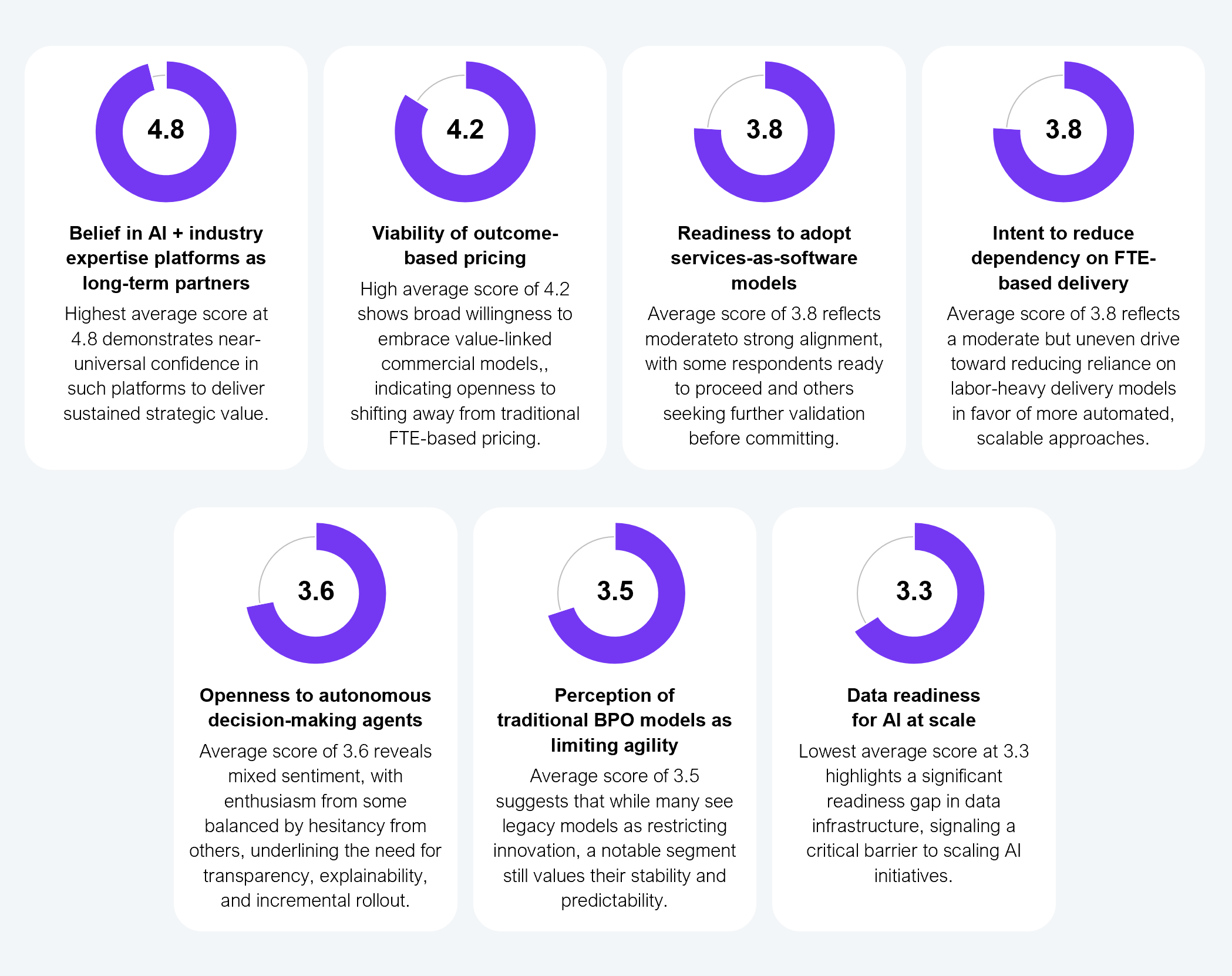
In our interviews with enterprise leaders, we assessed the readiness for AI-led, platform-based BPO services (see Exhibit 7). Many leaders prefer subscription or outcome-based contracts, valuing faster resolution times and proactive AI capabilities over labor-centric models. However, adoption timelines differ; while readiness for AI partnerships rated high (4.8 out of 5), challenges such as data gaps and compliance issues slow full-scale transitions (3.5 out of 5).
Source: HFS Research, August 2025
Enterprises desire to leverage proprietary data and deep domain know-how, encapsulated into narrow, domain-specific language models for differentiation, enabling non-linearity, outcome-driven models, and favoring platformization. However, not all client engagements allow for a full-platform play. They must adopt a phased approach where AI or tech-led solutions are infused into traditional BPO models. The future of BPO services is AI-first, focusing on integrating human input where necessary.
The journey to a modular, AI-enhanced BPO model isn’t a leap; it’s a progressive, multi-phase transformation. Enterprises begin with tactical pilots based on module-based service pricing alongside existing models, building confidence before scaling to more complex domains. This incremental adoption approach is practical, risk-aware, predictable, and aligned with how technology transformations succeed.
AI is reshaping how BPO is designed, delivered, and experienced. We are moving beyond rules-based bots to agents that plan, decide, collaborate, and adapt to achieve outcomes that mirror high-impact teams. This shift enables the delivery of technology services such as AI, automation, and analytics, even when operations are kept in-house.
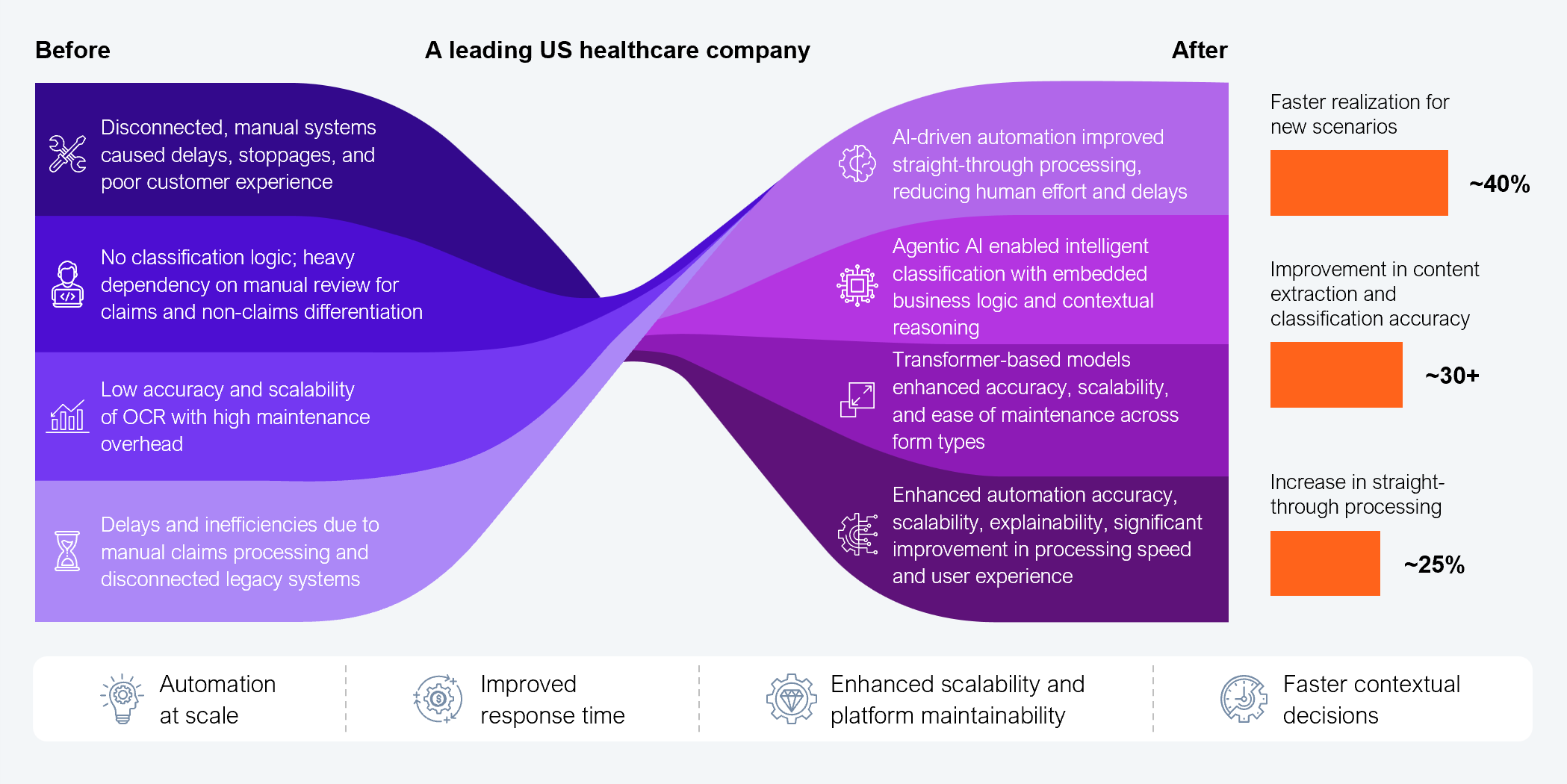
Enterprises are adopting an “inch-wide, mile-deep” strategy, leveraging domain expertise to drive transformation. The future of work will emphasize gig sourcing, micro-tasking, and micro-service architectures, introducing technology arbitrage by building platforms and solutions in domains of expertise. AI must be viewed as a thinking model, not just a technology, requiring internal adoption before external evangelism. AI-led BPO solutions have already been developed and successfully deployed at a US healthcare firm (see Exhibit 8).
Next-gen BPO will be AI-first but not AI-only. You still need a human in the loop, especially in regulated industries, with provable traces and responsible AI frameworks to pass stringent audits.
— CTO of a consulting and advisory firm
Source: HFS Research and Firstsource
A few BPO providers, such as Firstsource, are helping blaze this trail. By rethinking service delivery as productized platforms, they showcase how BPO can be rebuilt around composability, AI augmentation, and continuous improvement. Their efforts reflect a growing realization across the industry: transformation doesn’t come from headcount reductions, but from redefining how services are constructed, delivered, and monetized. This example proves that the SaS vision is not just aspirational; it’s operational.
With AI and automation, the road ahead for BPO is about higher levels of automation without losing service quality. If it improves service levels and lowers costs, it makes the relationship even more valuable.
— CIO of a major US bank
Organizations must balance stability with innovation by keeping legacy metrics for operational accountability and introducing OKRs for strategic direction. The platform model supports this dual focus, helping enterprises meet established performance baselines faster while adding richer, outcome-focused measures that resonate with operations teams and the C-suite.
AI adoption must begin internally across HR, finance, procurement, marketing, and other functions. This requires training, enablement, and access to tools and sandboxes across the organization, building a digital-native or AI-native culture supported by robust infrastructure and governance.
Enterprises that kill their legacy BPO models before the market does it for them will set the pace. Those who embrace this shift will unlock speed, insight, and resilience. GenAI and agentic automation can turn repeatable processes into software-defined services that can be measured, versioned, and improved in production.
Providers that want to lead must invest in productization, build AI-powered capabilities, and measure success in business terms. Services-as-Software is not just a trend; it’s the inevitable evolution for any BPO provider that wants to remain relevant in the AI era.
Register now for immediate access of HFS' research, data and forward looking trends.
Get StartedIf you don't have an account, Register here |
With the exception of our Horizons reports, most of our research is available for free on our website. Sign up for a free account and start realizing the power of insights now.
Our premium subscription gives enterprise clients access to our complete library of proprietary research, direct access to our industry analysts, and other benefits.
Contact us at [email protected] for more information on premium access.