HFS RUNWAY is the CIO’s path to unlock net-new value in the AI era. It is a governance framework that pairs unbounded ideation with bounded execution, helping enterprises tackle the governance debt that keeps them stuck in cost takeout by moving from governing automation to governing always-on innovation using AI.
This matters as many enterprises direct their AI investments into doing the same work faster to increase productivity. Even with the latest AI-led innovations such as vibe coding (see Exhibit 1), our data shows that enterprise expectations for transformational growth (measured by new revenue) sit at the bottom of the heap.
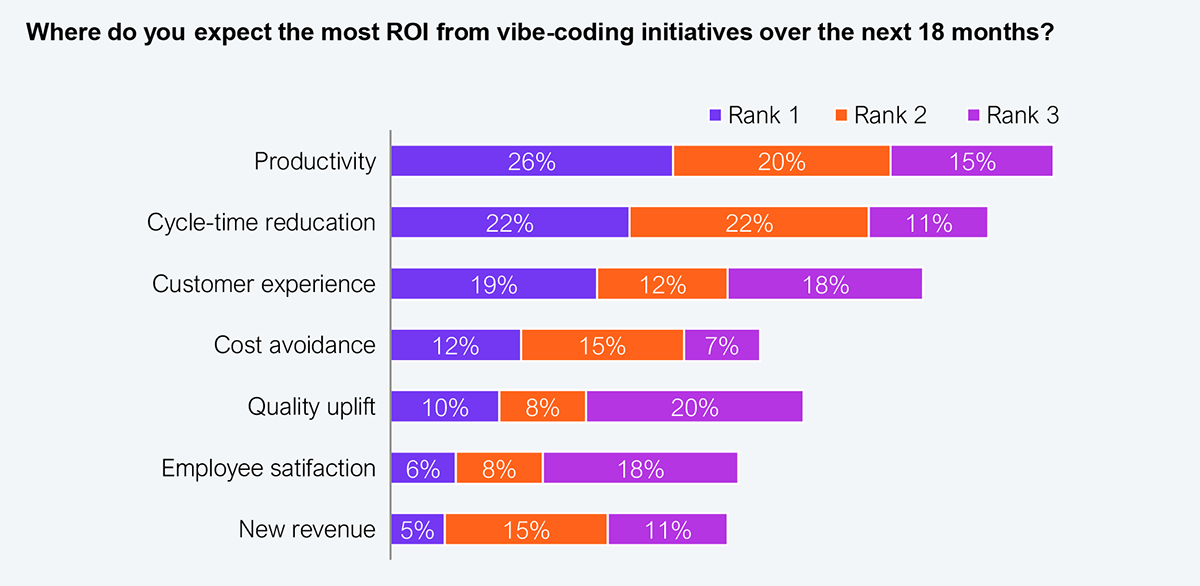
Source: HFS Research 2026, supported by Cognizant
The default within enterprises is to repeat known processes a little faster and with fewer humans involved. This is entrenched in AI governance, controlling both ideation and execution to such an extent that AI systems can deliver only productivity gains. Insights from a recent HFS Roundtable revealed that enterprises are deploying AI widely for automation and personalization, yet it contributes less than 1% to top-line growth.
The upshot is mechanized decision making. Rather than unleashing AI’s human-like cognition to enable discovery, we make it pick from a short list of pre-defined choices. If that is your approach, it is hardly surprising that your AI spend is failing to generate net-new value. You invested in a new intelligence without enabling it to improve how you work or innovate net-new approaches. You built a compliant option-picking latency reducer, when you had the opportunity to unleash always-on innovation at scale. Instead of governing for automation capability, you must govern for innovation capability.
While governance remains important, it must be redesigned to reduce the limits we too often impose on AI ideation while increasing control on undesired actions and outcomes, complete with the telemetry to close learning loops fast. HFS calls this approach RUNWAY.
CIOs must let agents propose anything but ensure they only take action after passing through some form of control gate, whether human or automated. To enable this level of creative freedom for agents, they should separate the cognitive and actuation layers of governance (see Exhibit 2). The cognitive layer covers reasoning, proposing, exploring, and hypothesizing, while the actuation layer pertains to actions such as writing to systems, sending emails, pricing, trading, deploying code, and approving claims.
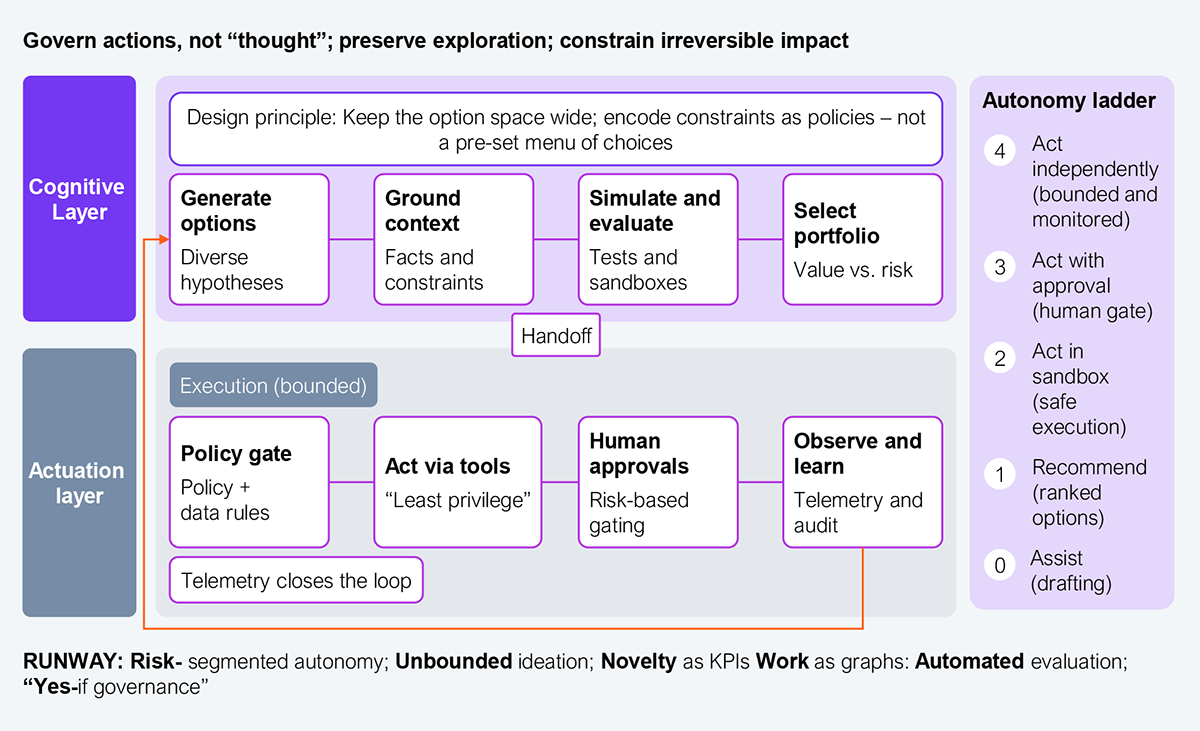
Source: HFS Research, 2026
RUNWAY is the standard CIOs must adopt when governing AI products as they move through ideation in the cognitive layer and are then handed off to the actuation layer, where consequential actions (such as sending an email, updating a database, or updating pricing) are performed.
RUNWAY brings together the following:
Risk-segmented autonomy: Not every workflow should be granted the same level of autonomy (see Exhibit 2 – autonomy ladder). You should create a risk taxonomy tied to each of the ladder’s rungs and consider data sensitivity, financial impact, regulatory issues, reversibility, and attack threats.
Unbounded ideation, bounded execution: Instead of narrowing the range of cognition, your job is to focus on creating policy gates, tools, and telemetry to act as the controls on selection and action across the cognition and actuation layers.
Novelty as KPI: Set net-new as a measure to prevent your organization from slipping back to speed and efficiency-only ROI accounting. Look for outcomes such as the percentage of items on your roadmap (resulting from agent-generated options) and net-new revenues.
Work as a graph: Be prepared to model for work that doesn’t follow the lies we tell ourselves in process flow charts (see Exhibit 2 – ground context). Adopt ontologies and knowledge graphs to provide enterprise-specific context regarding your customers, contracts, products, and other entities; the relationship between all these as well as that between your teams; who holds what decision rights; and the unwritten constraints and variables no one ever writes down (your “tribal” knowledge). These are essential in supporting agents in reasoning across the enterprise to avoid brittle RPA-style workflows.
Automated evaluation: You must automate evaluation to avoid a return to older, slower governance-by-committee bottlenecks. Adopt regression evaluations, tool misuse, policy compliance tests, and measurable and applicable control thresholds to support progression up the autonomy ladder.
Yes – if governance: By applying the controls laid out for progression through the cognitive and actuation layers, you will get rid of “Dr. No” and welcome “Dr. Yes.” The RUNWAY approach to governance allows you to shift the default from “No, too risky,” to “Yes.” This is only when, for example, you act at the appropriate rung of the autonomy ladder, meet the relevant approval threshold, or achieve automated evaluation scores. As the CTO, you must establish and publish repeatable “Yes – if governance” guidance (see exhibit 2 – policy gate) so your teams avoid negotiating governance from scratch every time they want to progress an innovation.
Only a minority of firms are delivering significant success with AI. Failure to tackle tech, skills, process, and data debts remains critical. HFS estimates that Global 2000 firms hold $10 trillion in those combined debts. RUNWAY won’t fix those on its own. But by resolving your governance debt, you unleash rising autonomy to tackle the tech, process, and data debts, estimated at roughly $7.5 trillion of the total.
When AI’s ability to ideate is limited, firms end up in the cul-de-sac-of-control, where safe-looking, constrained AI delivers little more than cost takeout. Worse still, you create new risks by driving employees to find their own solutions for shadow autonomy, routing around with uncontrolled tools and copy-and-pastes into unknown workflows.
RUNWAY tackles both the cul-de-sac-of-control and shadow autonomy. It allows novelty and places boundaries around impact, learning, and iteration, enabling autonomy to increase based on evidence of success. By supporting the scaling of autonomy focused on creating new value, your firm will move faster toward AI maturity.
Capgemini’s “perpetual KYC” role-based agents, which mirror human roles across the KYC value chain, is one of many examples in which elements of RUNWAY are in action. This is not a case of AI picking from fixed drop-down options. Instead, agents operate like a team with clear decision rights, sandbox testing, and escalation boundaries.
Risk-segmented autonomy has been applied, and humans are in the loop to handle both exceptions and final sign-off. Unbounded ideation and bounded execution are supported by agents doing the “thinking” work, while humans serve as a gateway for irreversible calls. Yes – if governance is deployed, provided that explicit exceptions and approvals are made and handled.
The outcome is a 20-minute reduction in processing time as agents triage alerts, with humans only stepping in for exceptions.
The AI era demands you adopt a new framework for governance, one that enables the technology’s creative “thinking-like” capabilities and applies the right level of control in the right circumstances, with an iterative feedback loop built in to drive increasing levels of autonomy. RUNWAY is your opportunity to take off for that new-value future, shifting from the tech-led focus on governing automation to the business-enabling governance of always-on innovation.
Register now for immediate access of HFS' research, data and forward looking trends.
Get StartedIf you don't have an account, Register here |
Register now for immediate access of HFS' research, data and forward looking trends.
Get Started