Enterprises must shift from effort to outcome and value-based commercial constructs and stop overpaying for modernization programs. As AI drives efficiency beyond scaling human effort, the old FTE-based pricing logic no longer applies. Enterprises can no longer treat modernization as a labor-based service when AI and agentic systems are already rewriting how modernization is priced and delivered. We saw several examples of this during our research for the HFS Horizons: Legacy Application Modernization Services, 2025 report.
As systems integrators (SIs) embed agentic and generative AI into delivery, productivity is no longer tied to human hours, and the traditional time-and-materials model collapses. Standardized pipelines and orchestration frameworks are turning modernization into a software assembly line. For CIOs and sourcing leaders, the next generation of modernization deals will hinge less on day rates and more on measurable outcomes, value delivered, and overall impact across the ecosystem. What once required bespoke project teams can now be packaged, priced, and delivered with predictable unit economics. IBM’s T-shirt and unit-based “factory pricing” model is an example of this shift, where modernization is being treated less as a project and more as a product.
AI has also changed the underlying cost structure. As automation replaces manual analysis, refactoring, and testing, contracts must evolve to recognize machine productivity as part of the value equation. Just as the work of an “agentic factory” does not scale by headcount, contracts must reward verified outcomes rather than the perception of effort exerted. These shifts intersect with new ecosystem dynamics. Hyperscalers are increasingly willing to co-fund modernization alongside SIs and clients, offering credits, co-sell funds, and price protections that alter total program economics. The tri-party construct that TCS established with AWS and Experian is an early signal of how modernization will increasingly be financed through ecosystem collaboration rather than one-to-one contracts.
Furthermore, with automation and AIOps freeing operational spend, modernization is being reframed as self-funded transformation. SIs like Hitachi Digital Services, Brillio, and Mphasis are linking “run” and “change” within a single commercial structure, using savings in run budgets to finance transformation sprints. These emerging commercial models around AI-driven legacy modernization should be on CIOs’ radars, as they offer an alternative to the traditional time-and-materials (T&M) and fixed-price models currently prevalent (see Exhibit 1).
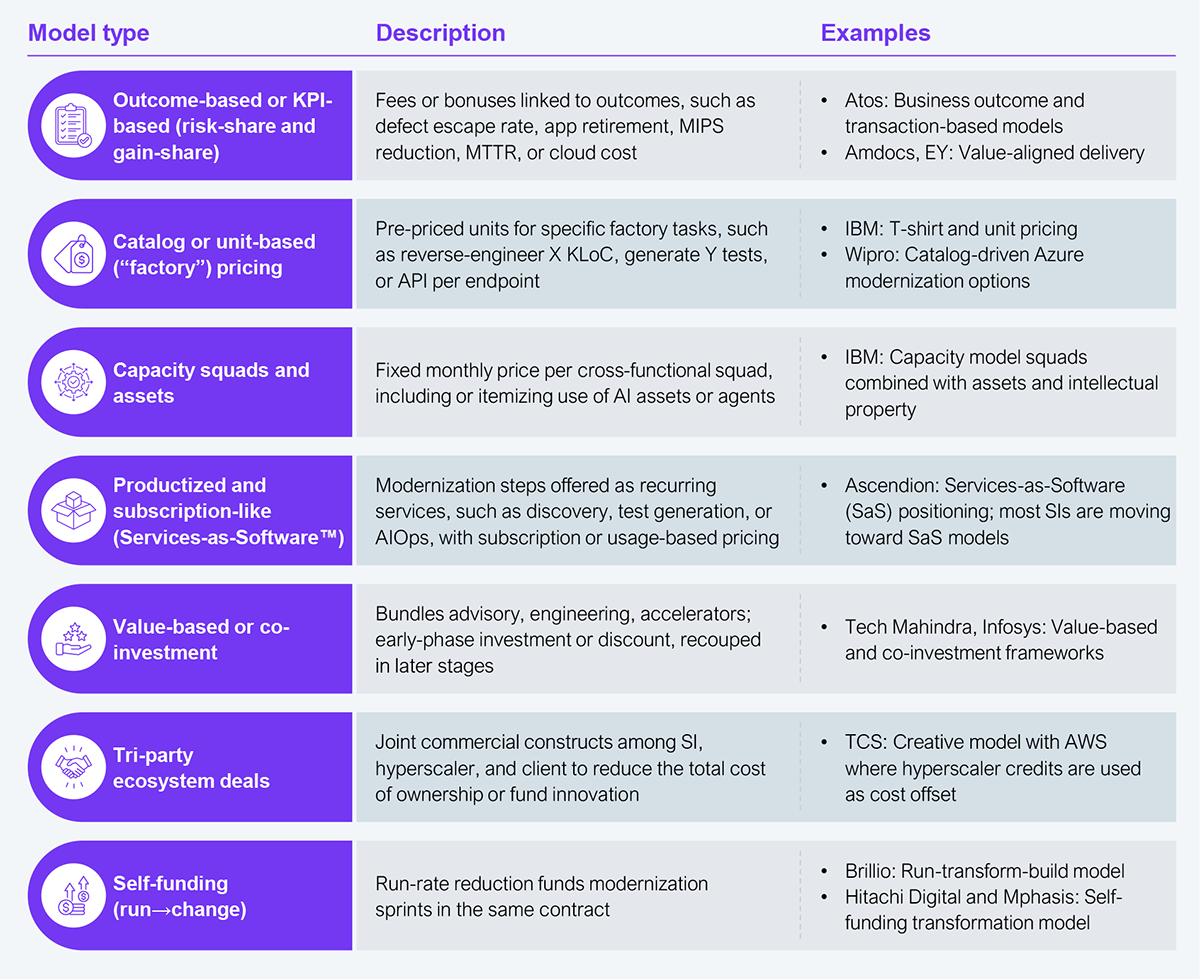
Source: HFS Research, 2026
Taken together, these dynamics mark a structural reset in how modernization is priced and funded. Sticking with the “good-old” T&M and fixed-price models may be familiar and comfortable, but you can be certain that you’re leaving money on the table. CIOs must demand that their SIs deliver measurable run-rate reductions and recycle that value into accelerated modernization for building long-term adaptability and innovation in the enterprise.
As agentic factories reshape how work is performed, contracts must evolve to manage a dual reality: part human, part machine. Modernization agreements are shifting from rate cards to composite structures that price repeatable work efficiently, reward verified outcomes, and govern how humans and AI collaborate.
This is taking shape in several forms. A two-track contract structure is popular. One track covers the AI-factory layer, priced through catalogs or unit rates for standardized tasks like code analysis, test generation, or API wrapping. The second track governs outcome-linked milestones, tying payment to tangible modernization results. For example, IBM’s Factory and capacity squad models combine predictable unit economics with variable, performance-based incentives. For CIOs, this means contracts must define not only what is delivered, but what it achieves.
This model succeeds only if outcomes are measurable. Without measurement, outcome clauses can collapse into nothing more than good intentions. The Horizons legacy app modernization (LAM) research found that leading SIs now anchor outcome payments to metrics like lead time, defect-removal efficiency, mean time to recovery (MTTR), or cloud cost reduction. Atos’ gain-share construct proves that outcome clauses fail without observability built into governance.
The contracts are also expanding to include ecosystem clauses, reflecting the growing role of hyperscalers in modernization economics. When AWS, Azure, or GCP credits and co-sell funds are in play, tri-party agreements become essential to define how hyperscaler credits, funds, and protections actually flow to clients. The TCS–AWS model demonstrates that these tripartite agreements can materially reduce total program cost if structured transparently. CIOs should ensure these clauses explicitly tie ecosystem benefits to delivery milestones and total cost of ownership reduction, not just marketing alignment.
Finally, the rise of agentic delivery introduces a new class of commercial artifact, agent, and asset terms. Traditional intellectual property (IP) and license clauses aren’t sufficient for a world where parts of delivery are executed by proprietary AI models, reusable agents, and accelerators.
Contracts now need to define program ownership, license scope, “agent run” unit pricing, human-effort pricing, the cost of model training data, compute, and governance costs. IBM’s Factory model already references these asset terms explicitly, setting precedent for agent-based delivery IP frameworks. For CIOs, it is imperative to have clarity on who owns the intelligence and artifacts created by automation to determine compliance posture and future flexibility.
Rate cards are dead. CIOs must now design contracts that pay for verified outcomes, not perceived effort. Composite structures that price repeatable work efficiently, reward verified outcomes, protect ecosystem value, and govern the interplay between humans and agents are the new norms of the game. The future of modernization isn’t about cutting costs. It’s about restructuring the modernization economy itself.
Register now for immediate access of HFS' research, data and forward looking trends.
Get StartedIf you don't have an account, Register here |
Register now for immediate access of HFS' research, data and forward looking trends.
Get Started