A critical mass is building: momentum that proves sustainability works unequivocally across the environment, society, and economy to pull politics, consumers, and businesses toward the systems change we need. But it is building too slowly compared with the scale and speed of change required. In parallel to politics, CEOs and boards must change this from the top and join the “coalition of the willing.”
COP30 showed that critical mass is not waiting for 100% consensus, despite the best efforts of lobbyists. There are always countless opinions following COP summits. COP30, the UN’s climate change summit in 2025, was no different. But what do you, as a business leader, actually do about it? This year, that became increasingly clear.
Any leader can find their own critical mass, but those outside the coalition of the willing are missing the leadership opportunity of the century. They will also be dragged along when “voluntary” sustainability becomes forced by tipping points—when the cost of capital, regulation, market access, and license to operate tighten their grip.
We’re already hitting dangerous tipping points: irreversible coral reef bleaching, ocean current disruption, and arctic ice melting that could catastrophically release stored methane in a devastating feedback mechanism. Simultaneously, inequality is growing globally, a pattern that has historically preceded societal collapse.
But we are also reaching positive tipping points that are shaping policymaking, consumer behavior, and entire industries. These include plummeting renewable energy costs and higher investments, transition planning among asset owners like pension funds, and the realization that sustainability delivers value now—whether through energy efficiency, resilient supply chains, or employee wellbeing—not just in the future.
At COP30, businesses and countries lobbying and vetoing didn’t even attempt to hide in the shadows. But that made it easier to see the coalition of the willing—the governments and companies acting… and those that aren’t.
For CEOs and boards, the message is clear. No one is coming to impose change; businesses must choose to lead. And they must choose to lobby positively while their peers do the opposite or stay silent.
Every COP gives you a mix of optimism and anxiety. COP29 saw an increase in fossil fuel lobbying, as better actors stayed away. COP28 cemented the “COP emotion.”
Sustainability was always voluntary, reflected in inadequate regulation and past COP summit agreements (e.g., the Paris Agreement for net-zero by 2050). Anything forced comes from systems change. Once that shift takes place, tighter regulation, lawsuits, customer sentiment, and sheer business competition will increasingly favor early movers over those forced to catch up.
Despite stripping out terms from the final COP30 text—fossil fuels, deforestation, and critical minerals with their abhorrent supply chain human rights records—a coalition of the willing will press forward. A critical mass is in the making, leaving late-moving enterprises trailing behind.
Eighty-five countries will build a science-based roadmap for phasing out fossil fuels outside the consensus deadlock of COP summits and pair it with a pathway to halt deforestation. Colombia and the Netherlands will host the first Global Fossil Fuel Phase-Out Conference in 2026, giving the Fossil Fuel Treaty movement a new platform to tackle timelines, equity, finance, and protections for workers without vetoes from petrostates. The energy transition has long made the enterprise case for integrated transition planning clear.
COP30 also launched the Tropical Forest Forever Facility: a $125 billion mechanism to reward forest preservation. Funding for adaptation was tripled to $120 billion per year till 2035 (compared to the $360 billion projection of need and the original target of 2030, it falls short, but it’s better than rolling back). We recently covered the need for enterprise CSR budgets to focus on impact, not greenwashing offsets.
Global cities also contributed to the optimism, giving business leaders another chance to be part of a critical mass. The C40 Cities (now over 100 cities) have agreed to halve fossil fuel use by 2030. An analysis by C40 and partners found that mitigation and adaptation actions increased tenfold in the past decade and cities now have efforts in place to address 85% of high-risk climate hazards, up from 69% six years ago.
Outside COP, the UN is making positive strides on new economics—moving beyond a sole focus on GDP—through the new High-Level Expert Group. It must focus more on transition planning toward that new economics, however, and we’ll continue to feed that into the group.
COP30 saw another rise in fossil fuel lobbyists over other delegates, helped by the fact that too many companies are staying silent, re-allocating their budget, or even avoiding COPs for fear of being seen as greenwashers or adding to the problem (see Exhibit 1). New York Climate Week saw the same trend. Since November 2024, we’ve been seeing who is truly committed and willing to take a stand.
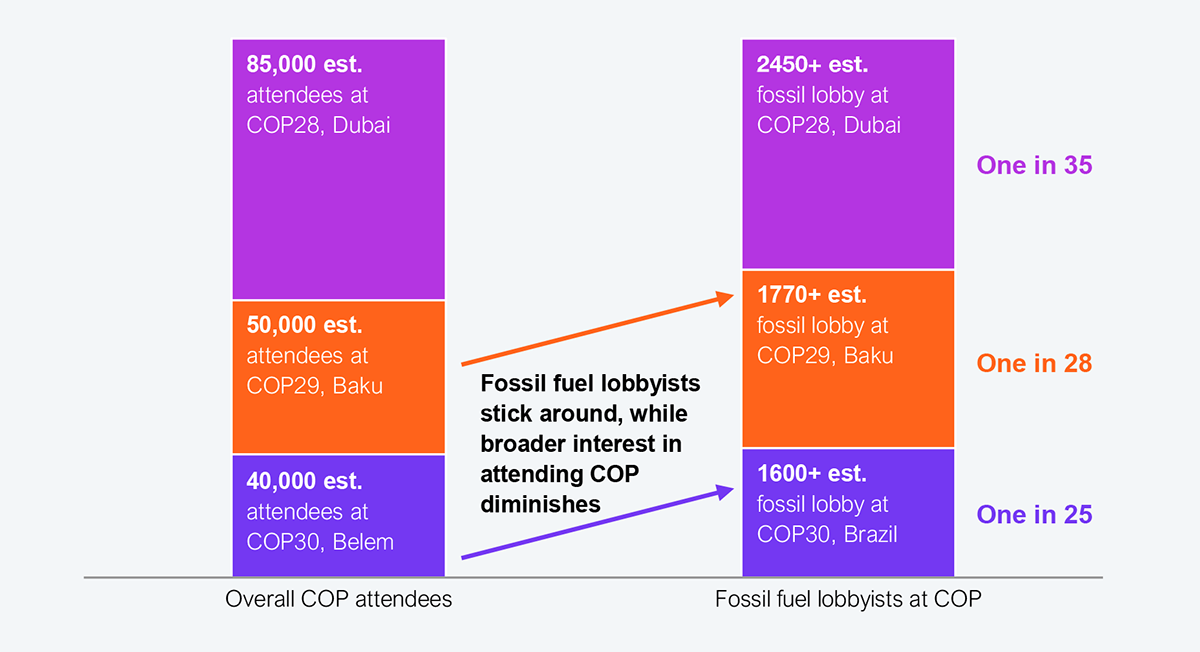
Source: Kick Big Polluters Out (KBPO), The Guardian, The New York Times, and Nature
The true extent of fossil fuel lobbying at COP is higher, as many countries come with heavy pro-fossil agendas and economies. Many lobbyists also enter via underhanded means such as affiliations to industry and campaign organizations.
Agriculture too has a vested interest in delaying action over deforestation. DeSmog and The Guardian found that lobbying numbers from industrial cattle, commodity grain, and pesticide were up 14% compared to COP29.
So it’s clear that as a business leader, you must stay in the room and lobby positively. Otherwise, you’ll be judged as the “good people doing nothing,” letting the climate and broader sustainability emergency thrive.
Action, not COP agreements, will fix the climate and sustainability emergency. COP30 made it clear: you need to proactively join the coalition of the willing for sustainability. If you wait any longer, you risk being seen as followers forever.
Those at the heart of the critical mass will become the go-to-leaders, ones that politicians, customers, and businesses look up to as they’re forced to change.
HFS has published several guides on how to find your critical mass and sphere of influence, breaking down the global context and crafting a compelling case. We’ll be updating our critical mass and systems change call for 2026 soon—alongside our key focus areas for the year.
Register now for immediate access of HFS' research, data and forward looking trends.
Get StartedIf you don't have an account, Register here |
Register now for immediate access of HFS' research, data and forward looking trends.
Get Started