Embracing the challenge of agentic AI puts CTOs on the fast track to a new foundation for continuous change. The rise of ontologies and other forms of enterprise context such as knowledge graphs is a robust route to agentic AI you can trust and help power your way through tech debt and accelerate innovation.
Ontologies have been fundamental in the success of AI firms such as Palantir and are at the front and center of Mphasis Ontosphere-powered agentic platform, launched at Lord’s Cricket Ground in London this month (January 2026). Ontologies offer the ability to capture, confirm, and iterate how and why things are done in your organization beyond simple enterprise data. They provide a constantly updatable live asset that can act as a trustworthy foundation for an always-on approach to modernization.
Ontologies are an operational layer mapping digital assets to real-world objects and processes, capturing how things work in a business. They can be thought of as an operational digital twin, providing a structured blueprint that gives data meaning and enables machines to understand and reason with it.
An ontological system (see Exhibit 1) defines both semantics (what things mean) and the ontology that structures and connects the meaning. It clarifies what your company means by certain terms like “customer,” “order,” or “complaint” and what additional meaning accrues from the inter-relationship between such semantic elements. A customer complaint is handled very differently than an order, for example.
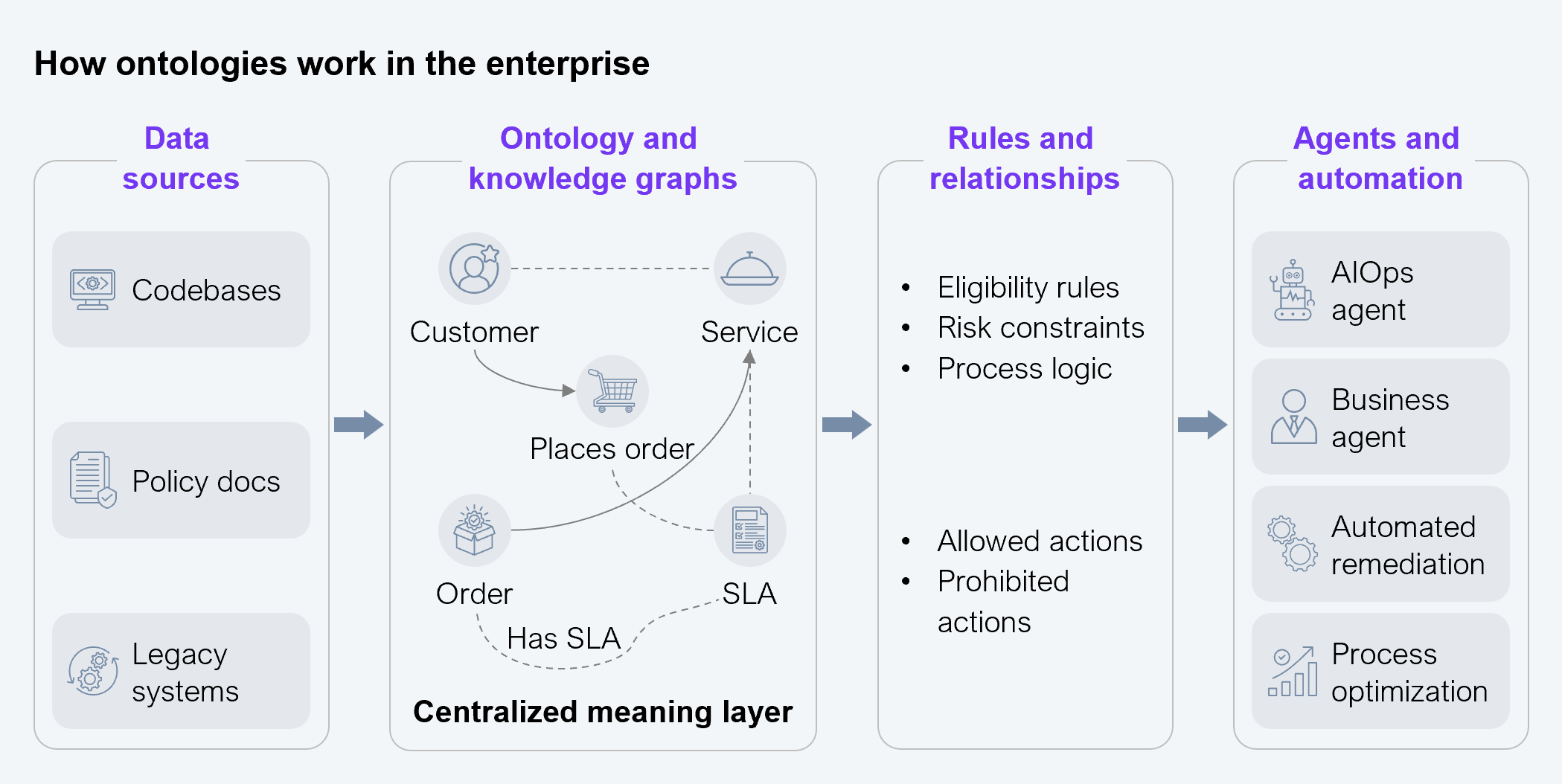
Source: HFS Research, 2026
Such modeling brings together the code paths, exceptions, runbooks, policies, and tribal knowledge held in scattered artifacts across an organization. Without an effective ontology, every attempt at modernization, migration, or automation gets delayed or derailed while engineers spend time interpreting the meaning of systems and processes and the intentions behind them instead of improving them.
Agentic AI brings urgency to the need for ontologies. It accelerates execution, but without an explicit ontology, agentic AI risks scaling the wrong intent.
Ontologies, paired with an enterprise-specific knowledge graph (as applied in Mphasis Ontosphere), offer a new control plane that enables agents to act safely and make modernization continuous rather than episodic. Mphasis Ontosphere captures enterprise rules and logic in a living and constantly updated asset. This becomes your foundation for continuous change, aligning with the rapid pace of innovation every CTO is being tasked with tackling.
Mphasis Ontosphere is at the heart of the Mphasis NeoIP suite, applying tuned domain knowledge graphs to your firm’s business transaction information.
In one customer example of how an ontology plus knowledge graph control plane can be applied in practice, a global insurer is enabling agentic AI-led ITOps and observability, achieving 67% accuracy in major incident prediction with 3–5 hours of early warnings and a 50% reduction in mean time to detect, acknowledge, and resolve.
The rise of agentic AI is your moment to shift from sporadic modernization efforts to an always-on approach. Adopting ontologies and knowledge graphs will not only deliver agentic that works in your enterprise. It also gives CTOs the opportunity to capture and constantly maintain the meaning of your organization, ready to be applied to every new innovation.
Register now for immediate access of HFS' research, data and forward looking trends.
Get StartedIf you don't have an account, Register here |
Register now for immediate access of HFS' research, data and forward looking trends.
Get Started