This HFS Research Take 5 report, produced in partnership with Unqork, is for CIOs, CTOs, and enterprise architects evaluating how to break the code sprawl and SI dependency cycle that inflates tech debt, crowds out innovation, and keeps transformation spending trapped in maintenance rather than value creation.
Executive summary
New research serves as a wake-up call for CIOs and CTOs bleeding budget on integration and managed services.
Enterprise transformation isn’t short on software; it’s weighed down by code sprawl and the ecosystem built to maintain it. Each new bespoke line of code adds a maintenance tail that inflates services spend and tech debt, pulling budgets into integration and upkeep while software-led innovation stalls and reliance on systems integrators increases.
Artificial intelligence (AI) will compound the problem if it simply generates more code on legacy stacks; however, used within guardrails to refactor, standardize, and assemble governed components, it can reduce tech debt. The current operating model must evolve.
HFS Research, in partnership with Unqork, surveyed 123 large enterprises (revenues greater than $1 billion) to understand IT budgets, services-to-software ratios, systems integrator (SI) relationships, AI adoption, and governance patterns.
The survey uncovered five key takeaways:
-
-
We are living in a “keep-the-lights-on” doom loop. Enterprises spend two to seven times as much on services as they do on software.
-
Technical debt is a self-inflicted bottleneck. Only about a third of code is reused, while two-thirds is rebuilt.
-
AI presents a paradox of promise and peril for software development. Organizations show the highest confidence in AI’s ability to reduce costs (84% agree). Yet, 43% acknowledge that AI may create more tech debt, which ultimately increases costs.
-
The two-step model of “buy software, then hire an SI” must change. A majority (58%) say the traditional SI model will be unsustainable within five years, and 76% want integration bundled with software.
-
Nearly all (98%) of the decision makers surveyed are ready to offload legacy systems to a Services-as-Software™ model (buying outcomes where integration, operations, and governance are features of the product, not separate projects).
The Bottom Line: Flip the spending, shrink the surface area, and demand outcomes instead of buying obligations. This is how transformation becomes sustainable.
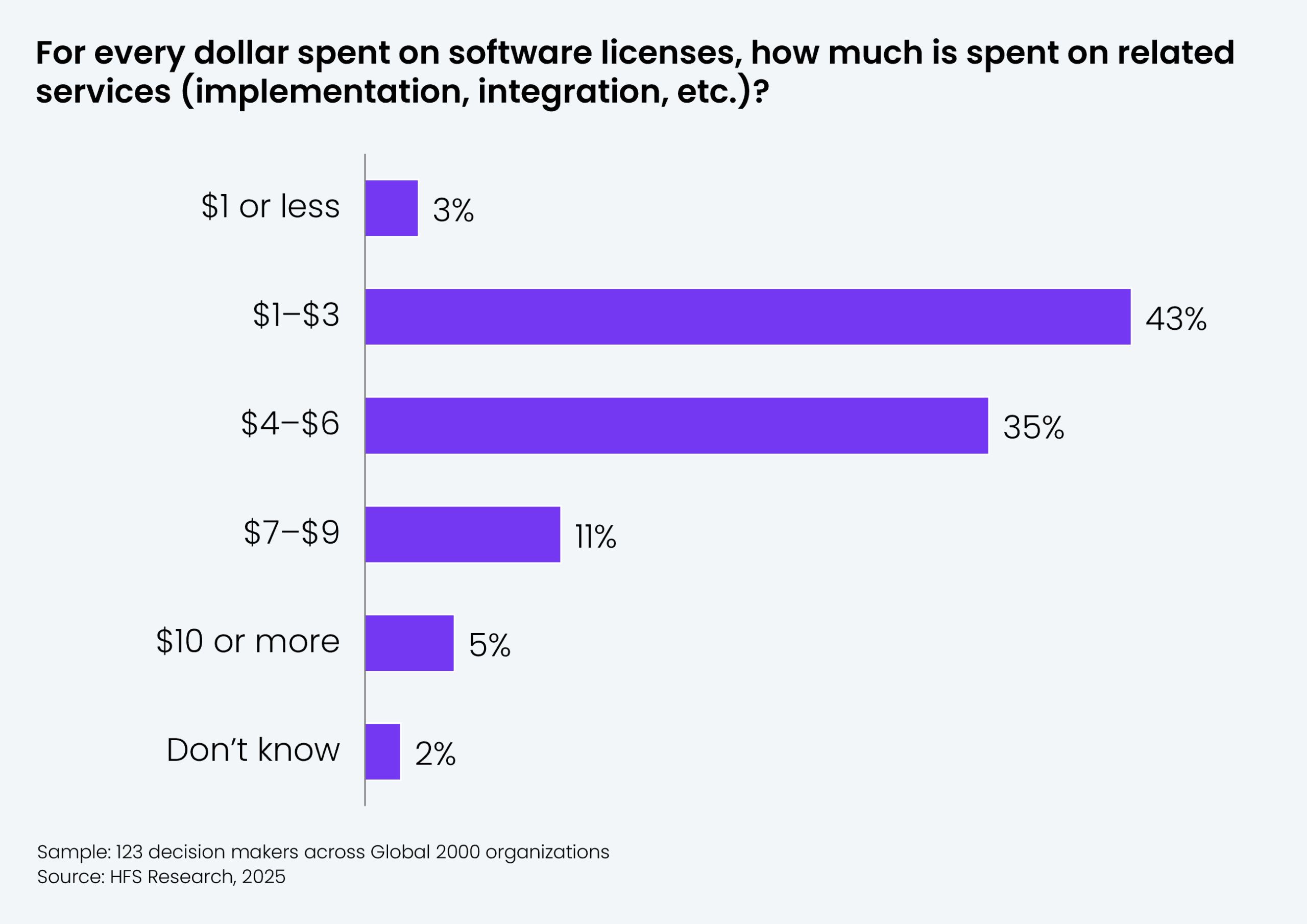
- A $1 million software license typically becomes a $2 million to $7 million total commitment after services and maintenance, eroding ROI and crowding out innovation.
- The solution:
- Avoid software that demands a standing army of engineers to keep it running.
- Reorient internal IT and systems integrators toward innovation by standardizing on architectures where costs decline with scale through reusable components and pre-built integrations.
- The era of labor arbitrage has run its course; squeezing rates has not reduced code and architecture complexity. They created an architecture and ecosystem that curtails innovation and agility.
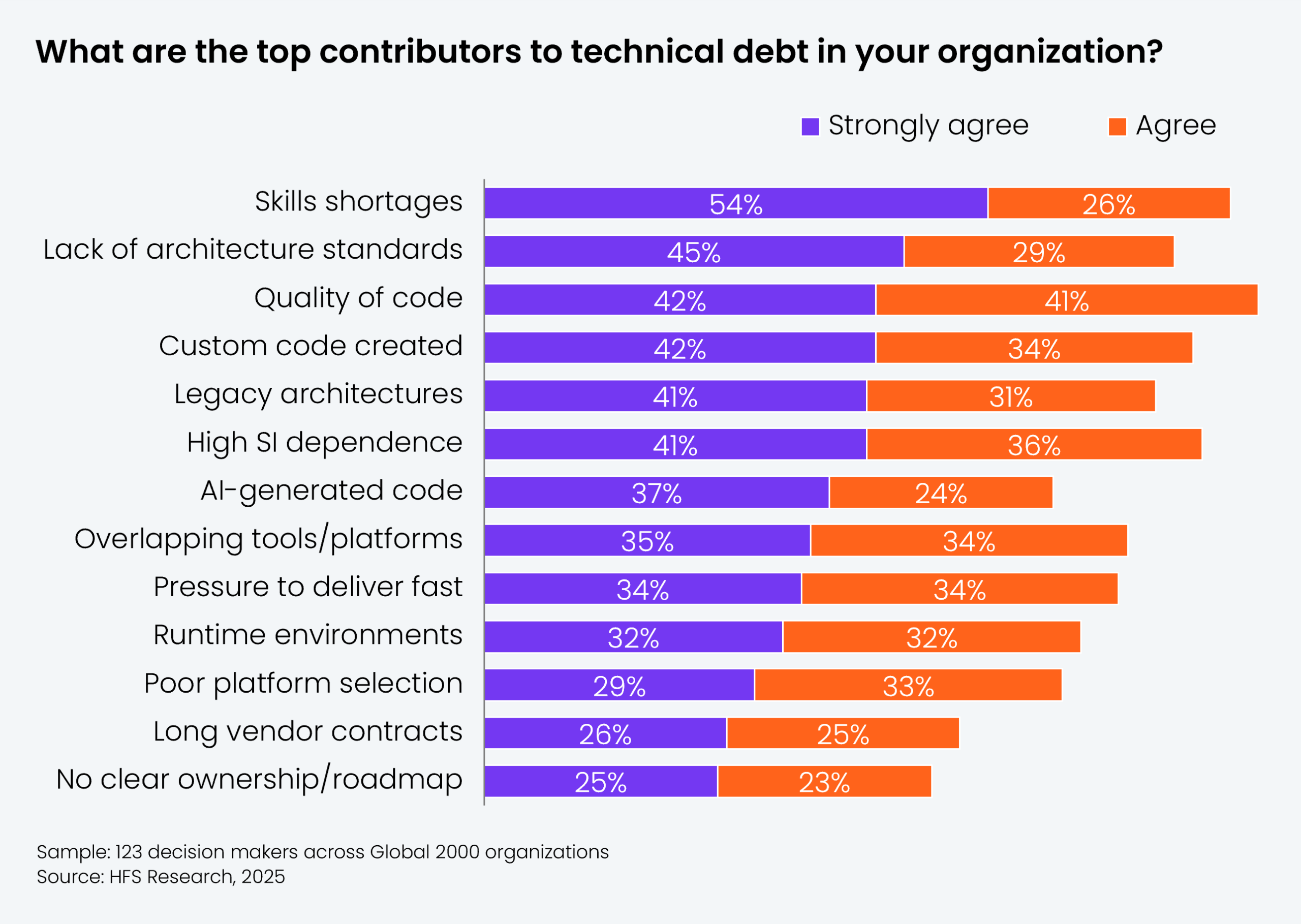
- Technical debt (tech debt) is the cumulative cost, risk, and effort required to operate, secure, and evolve what’s already been built.
- Verifiable data to quantify tech debt is scarce. Estimates suggest that global tech debt exceeds $1 trillion and is a key obstacle to an enterprise’s ability to achieve its strategic goals.
- Leaders surveyed cite human and structural drivers of tech debt: poor code quality (83%), skills gaps (80%), over-reliance on systems integrators (77%), custom code proliferation (76%), and missing standards (74%).
- Simultaneously, businesses are demanding more from IT. For some, with the right platforms and tools, citizen development is a key strategic priority, reflecting that traditional IT delivery speeds are insufficient. This creates the risk that business units will attempt to do it themselves, further exacerbating tech debt.
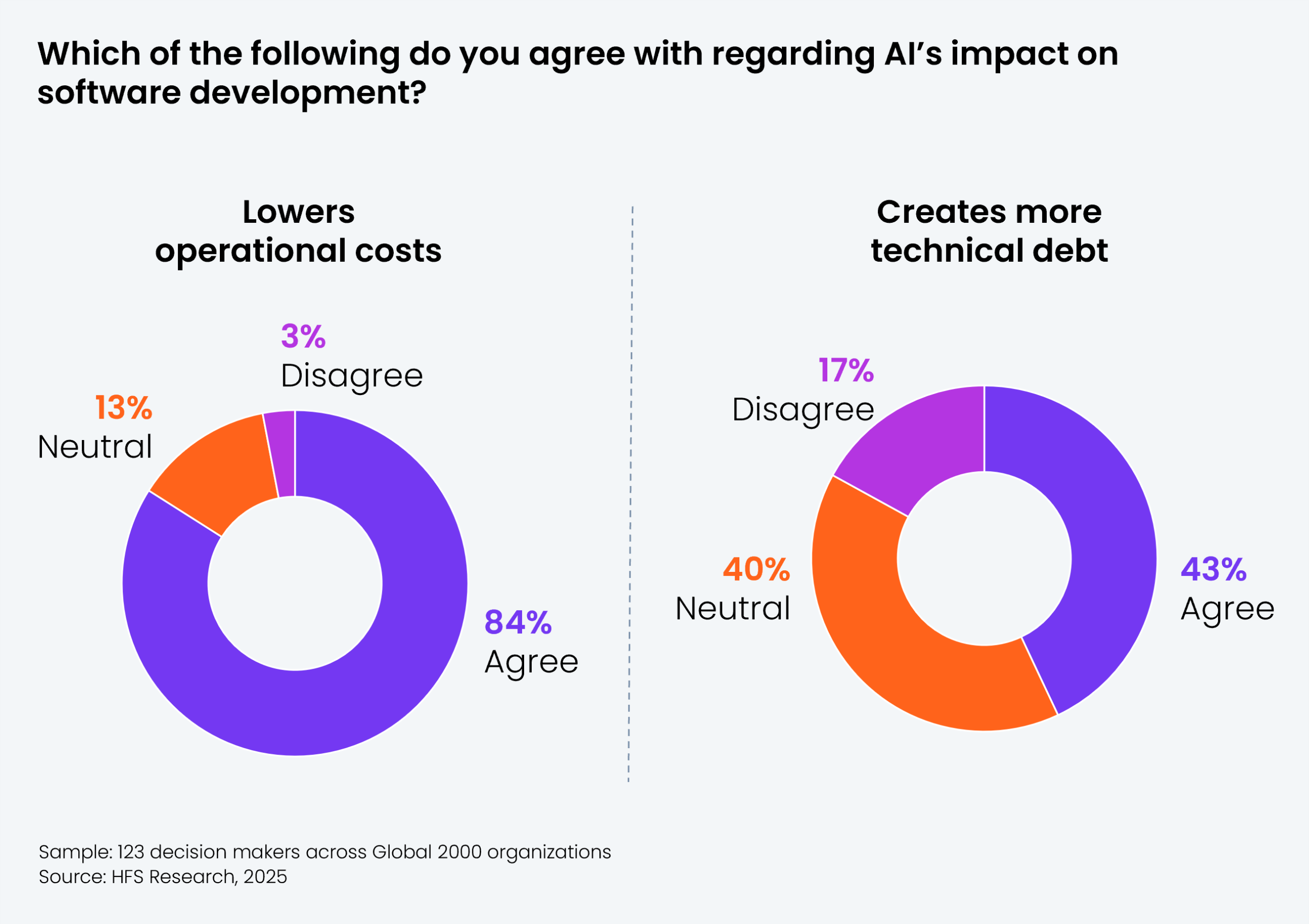
- Organizations show the highest confidence in AI’s ability to reduce costs (with 84% agreement). Yet, 43% acknowledge that AI may create more tech debt, which ultimately increases costs.
- If AI is primarily used to generate more bespoke code on legacy stacks, it amplifies maintenance and accelerates the creation of tech debt.
- Deployed inside guardrails, AI can refactor, standardize, and assemble governed components, lowering run costs and debt while improving speed.
- If not implemented strategically, AI presents a paradox of promise and peril for software development.
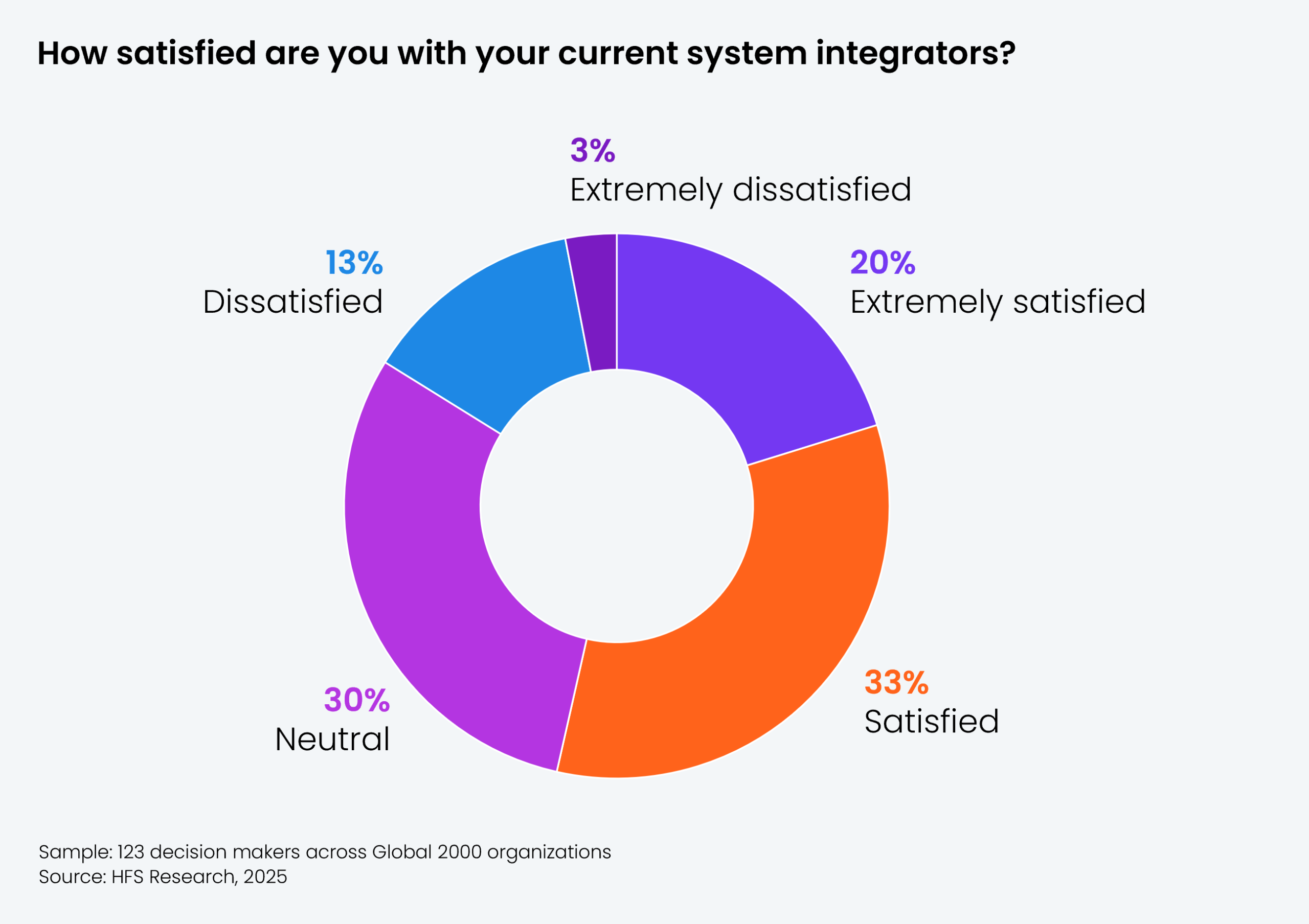
- The survey data reflects that satisfaction with SIs is tepid. Only 20% of decision makers are “extremely satisfied.”
- Continuing to accept moderate satisfaction from partners who consume most of the transformation budgets guarantees that transformation outcomes will remain moderately successful at best.
- Systems integrators remain essential, but the value is shifting upstream to design standards, reusable patterns, and platform enablement, with less bespoke delivery and more productized outcomes. The integrator’s role in the enterprise IT ecosystem will evolve accordingly.
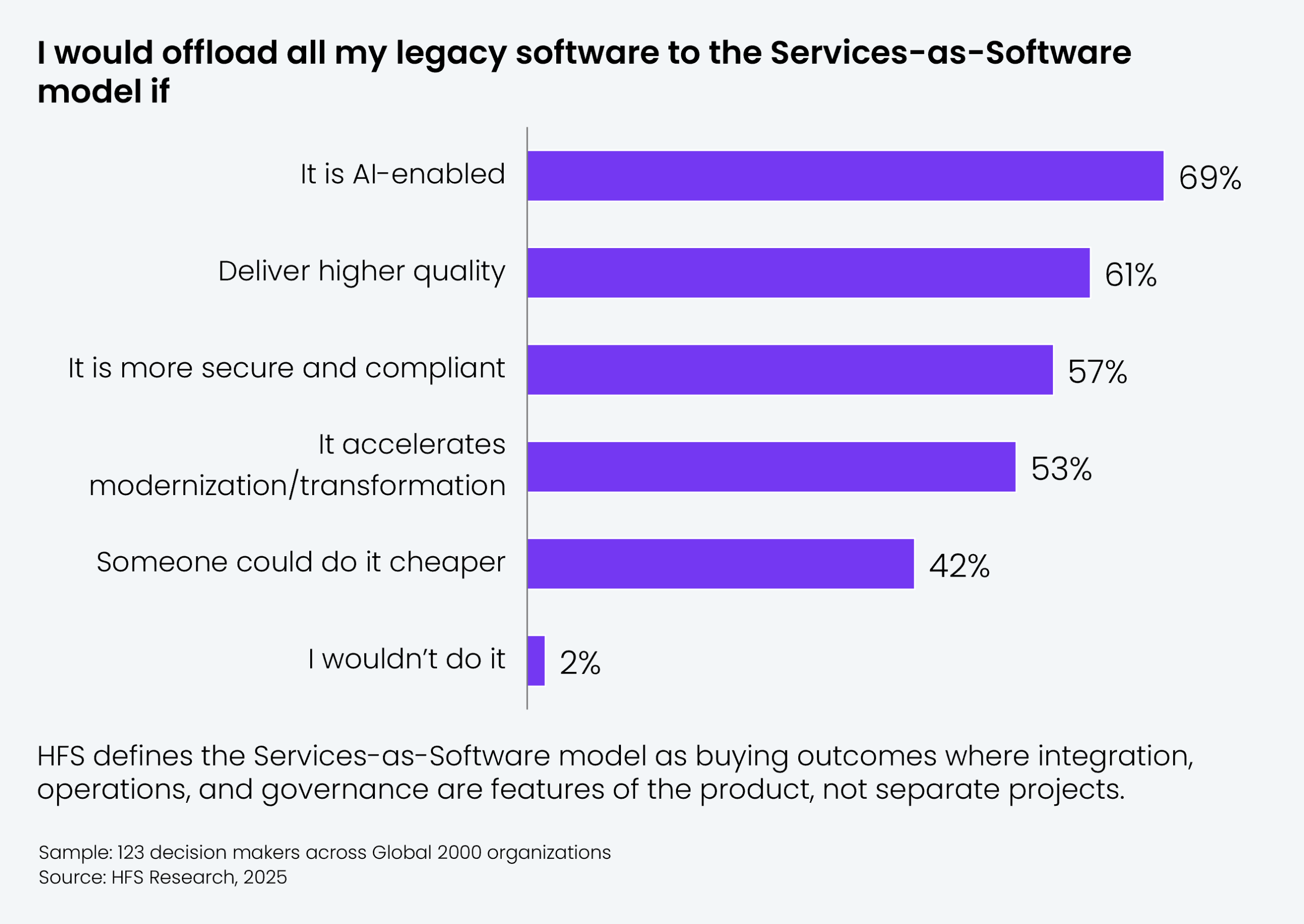
To change the current models that consume budgets, slow delivery, and harden tech debt, enterprises must
- Transition from services-heavy delivery to Services-as-Software, bundling integration and operations into the platform to productize outcomes.
- Meet the demand for businesses to build apps with IT-set guardrails for data, security, integration, and reuse, bringing “shadow” into the light.
- Design for code reuse with governed, versioned components to cut rebuild, risk, and run costs.
- Use AI to refactor, standardize, document, and test within a governed platform, reducing debt instead of creating it.
The Bottom Line: Flip the spending, shrink the surface area, and demand outcomes instead of buying obligations.
This is how transformation becomes sustainable.
Code generated in the enterprise, by both humans and AI, requires maintenance, which increases service costs and compounds tech debt.
Transformation is stymied by the status quo: an ecosystem built to manage the maintenance burden of infinite code creation, not innovation. What’s needed is a new model that rewrites the economics of transformation to unlock innovation, embrace AI responsibly, and accelerate development without compounding cost and adding complexity.
Enterprises must pivot now to upend the status quo and help evolve an ecosystem that prioritizes code maintenance.
-
-
Avoid buying software that requires a standing army of services to function.
-
Mandate integration-included models with enforceable reuse ratios.
-
Use AI within platforms that constrain complexity rather than multiply it.