
This Market Impact Report is for BFSI GCC leaders, enterprise heads of global operations, and senior executives in banking, financial services, and insurance who are ready to move their India-based centers from cost arbitrage to strategic leadership.
Global capability centers (GCCs) have evolved from corporate back-office afterthoughts to strategic powerhouses that increasingly define how global enterprises operate. Born from labor arbitrage, GCCs in countries such as India were once pigeonholed as low-cost execution arms. Today, they are rewriting that narrative, emerging as hubs of innovation, leadership, and competitive advantage.
What began as a cost-saving tactic has morphed into a mission-critical capability, with GCCs driving complex, high-value outcomes that fundamentally reshape business models. They are no longer ‘nice-to-have’ extensions but indispensable anchors of enterprise transformation, enabling innovation and high-value outcomes.
Yet the journey hasn’t been linear. GCCs have faced resistance, outdated structures, and credibility gaps that limit their full potential. Many still struggle to shake off the legacy perceptions of being transactional offshore centers rather than true partners in growth.
This paper, a collaboration between HFS Research and Cognizant, distills insights from interviews with 10+ senior BFSI GCC leaders and a digital roundtable of 20+ BFSI GCC executives. It cuts through the noise to provide a blunt, actionable roadmap for turning GCCs from ‘captive’ to ‘catalyst’—a playbook for those ready to lead, not follow.
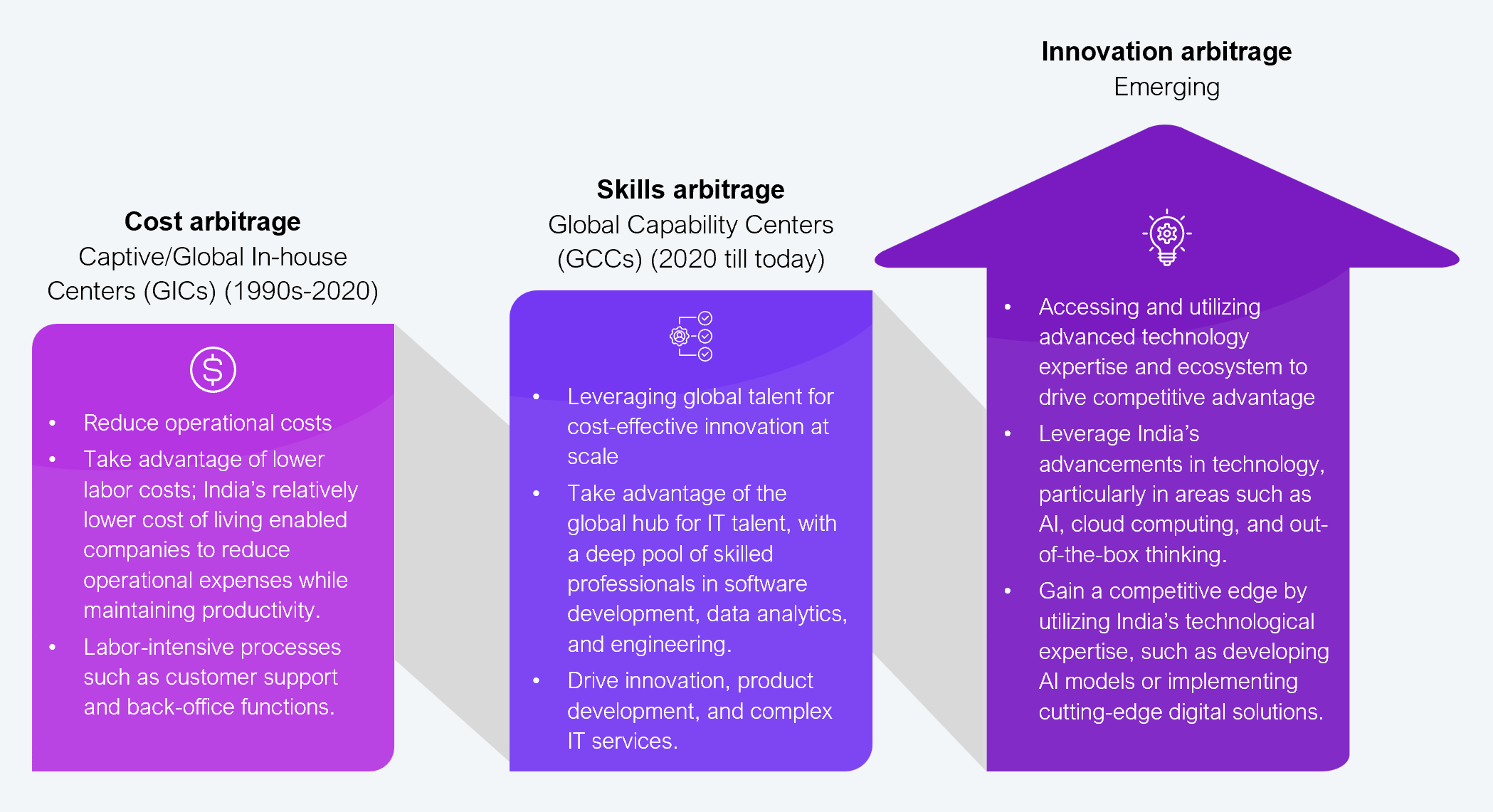
Source: HFS Research, 2025
From these conversations, five unapologetically bold ambitions emerged, challenging every BFSI GCC to rethink its purpose, power, and future in the global enterprise. This paper unpacks those, showing how forward-thinking BFSI GCCs can redefine value, transform talent, scale responsible technology, and finally claim their rightful seat at the strategy table.
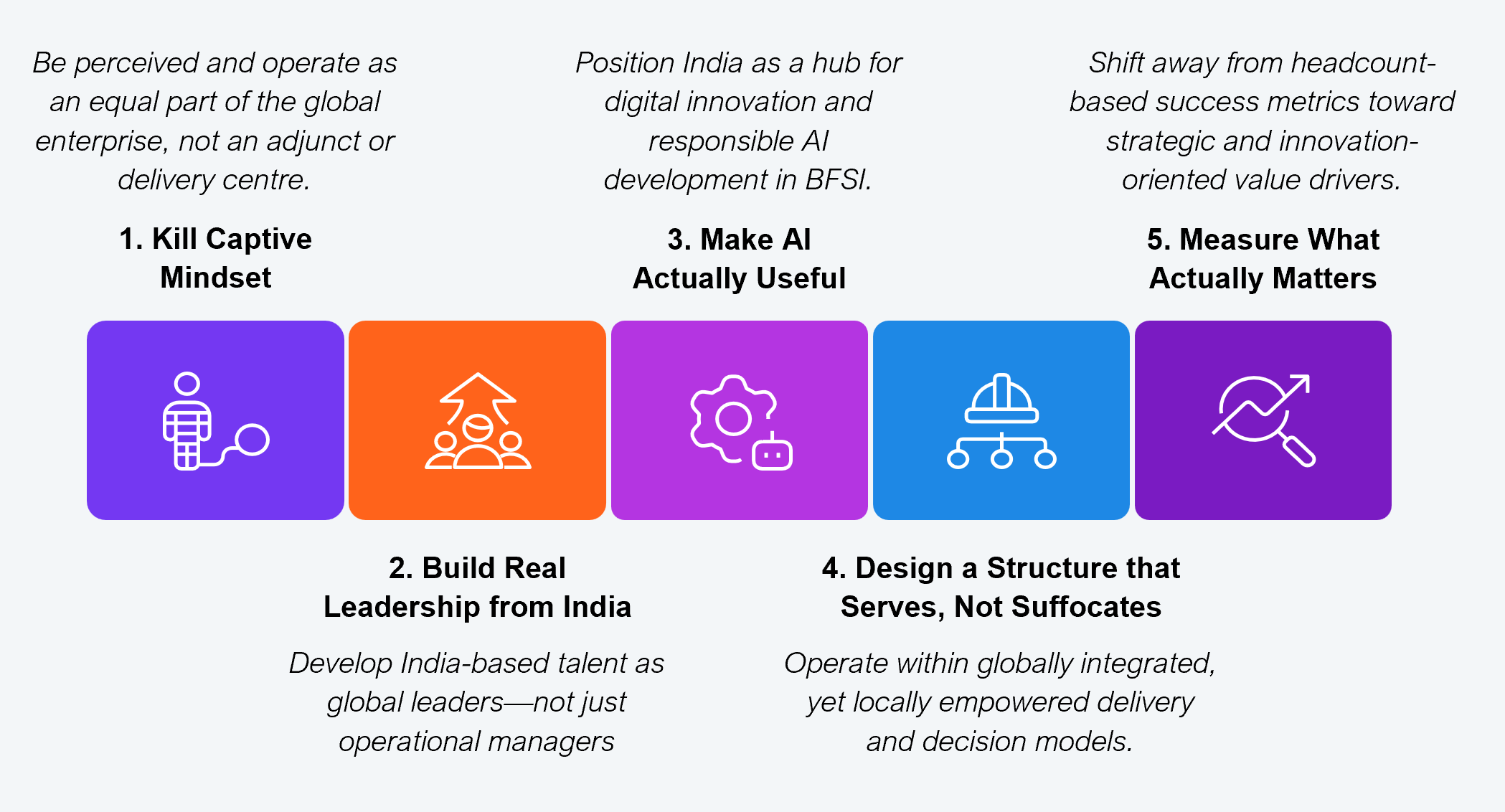
Sample: Qualitative interviews with 10 BFSI GCC Leaders
Source: HFS Research in partnership with Cognizant, 2025

Transform BFSI GCCs from cost-driven, offshore support centers to fully integrated, strategic business hubs with global standing and ownership.
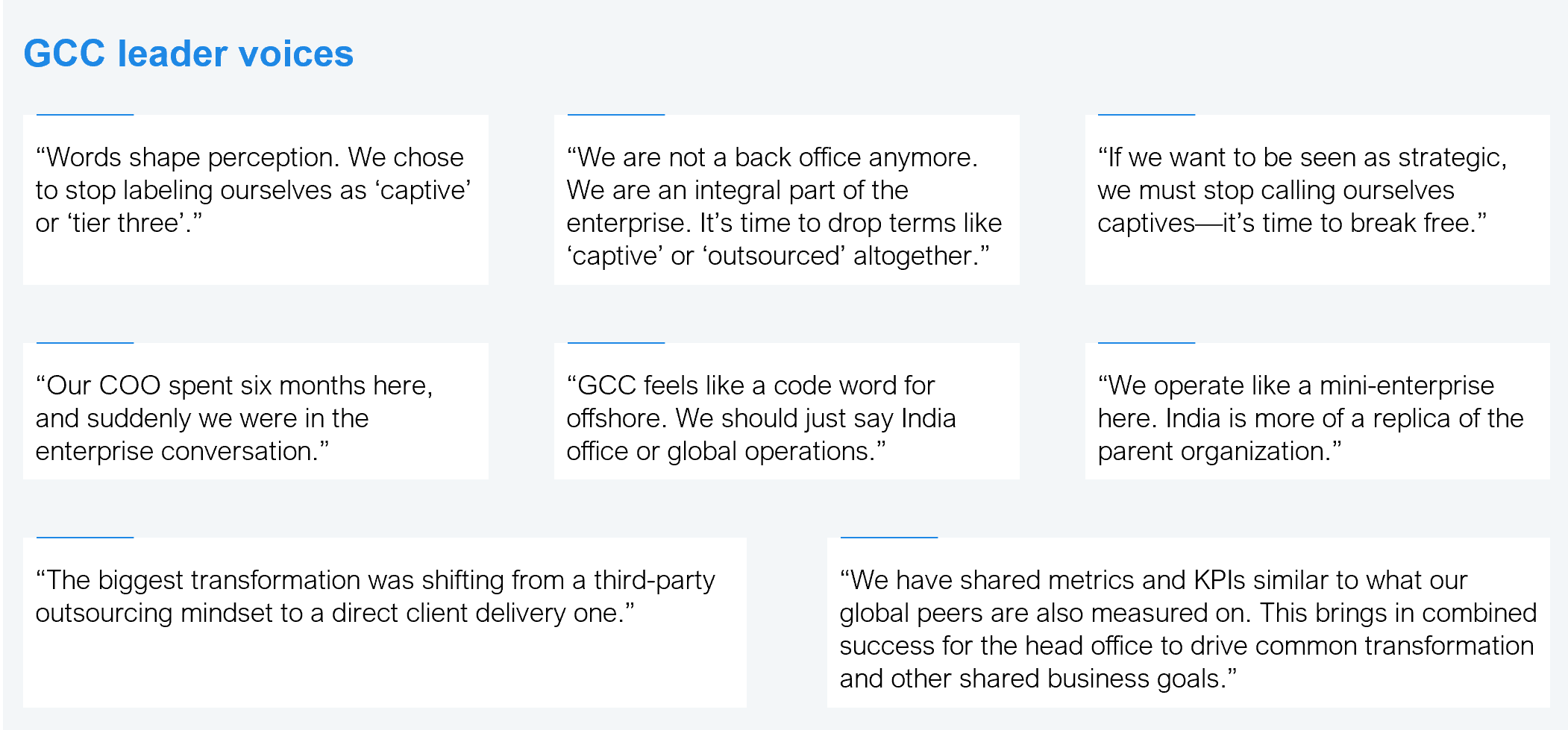
CCs today deliver full-stack ownership, functional leadership, and domain depth that rival any global hub. Yet terms such as ‘captive,’ ‘offshore,’ and even ‘GCC’ still anchor perceptions in a low-cost, low-value world. These quietly reinforce a second-class status that limits influence and denies these centers their rightful seat at the global strategy table. If GCCs truly want to be seen as critical engines of innovation, they must shed not only the name but the mindset that goes with it and rewire their brand narrative to match their strategic reality.
Despite decades of progress, these labels persist and subtly reinforce a subordinate status. Headquarters often hesitate to hand over genuine decision rights, and local GCC leaders sometimes lack the confidence to push back or proactively stake their claim in strategy. Structural hierarchies and outdated role definitions continue to position GCCs as a follower rather than a co-creator of business impact.
GCCs must rebrand and reinforce enterprise parity by:

Elevate GCC talent from pure execution to empowered, globally credible leaders who own decisions, drive strategy, and shape outcomes.
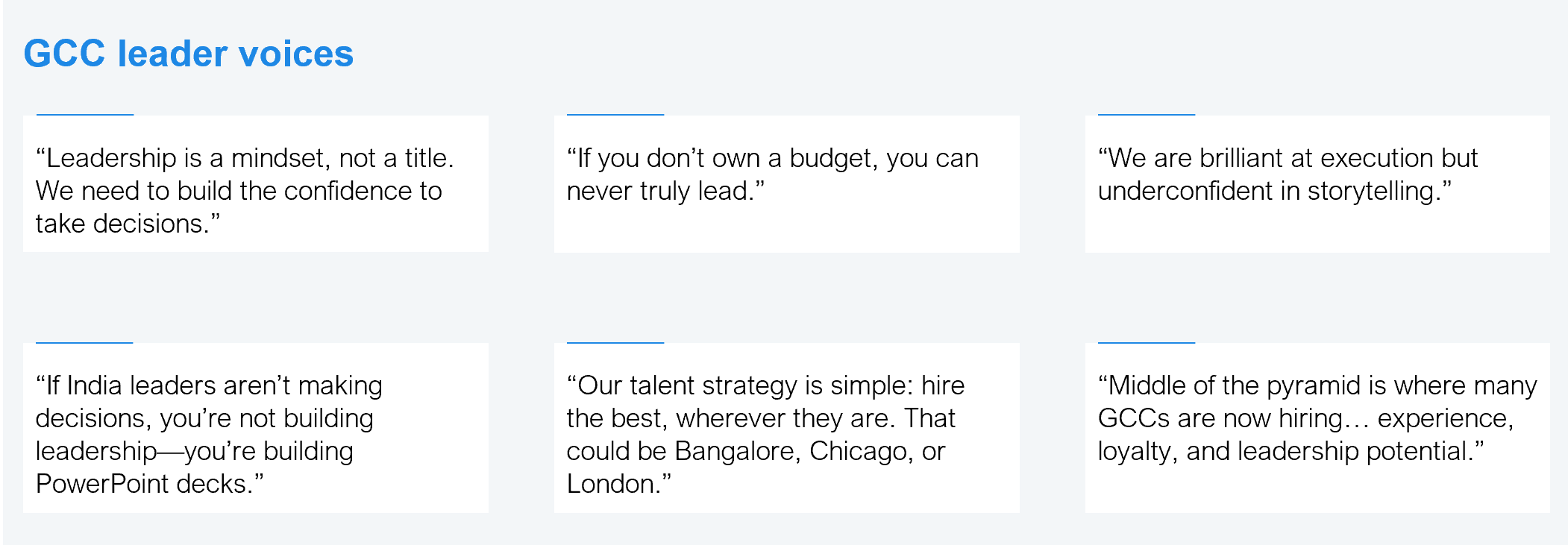
Without decision-making authority, even the best local talent remains boxed into an execution mold. Strategic ownership is essential for GCCs to be taken seriously as a leadership engine rather than a downstream support arm. Their role will shift from ‘doing’ to ‘directing’ only when Indian leaders control budgets, product direction, and market-facing priorities.
Headquarter stakeholders are often reluctant to delegate authority, fearing risk and perceived skills gaps. Locally, Indian leaders may have technical brilliance but lack storytelling and influencing skills to challenge traditional power structures. Leadership programs frequently fail to move beyond project skills to develop authentic global confidence. Moreover, there are regulatory constraints in placing local talent into high-impact roles across investment, risk, and client management.
Empower Indian leaders with ownership and voice by:
Developing global leaders demands business acumen and strong leadership skills. Embedding culturally attuned, globally experienced talent from day one is essential for long-term success. Also, mapping out precise, multi-year career trajectories is critical for retention. Organizations are adopting a holistic approach, combining targeted training with real-world exposure to create a resilient talent engine encompassing:

Drive AI initiatives from scattered pilots to trusted, industrial-grade, production-scale solutions that truly transform the enterprise.
Too many BFSI GCCs are stuck in the ‘AI theater,’ showcasing pilots that never deliver sustainable business value. If GCCs want to lead enterprise transformation, they must focus on data, explainability, and measurable commercial outcomes rather than chasing the next buzzword. AI must become a true engine of business outcomes, not a PowerPoint trophy.
Fragmented data, legacy environments, compliance complexity, and explainability challenges make BFSI especially wary of pushing AI into mission-critical areas. Executive pressure to showcase something new has led to flashy pilots without commercial grounding. Lack of ownership across business, technology, and risk teams further slows adoption.
Build data foundations and business-aligned AI by:
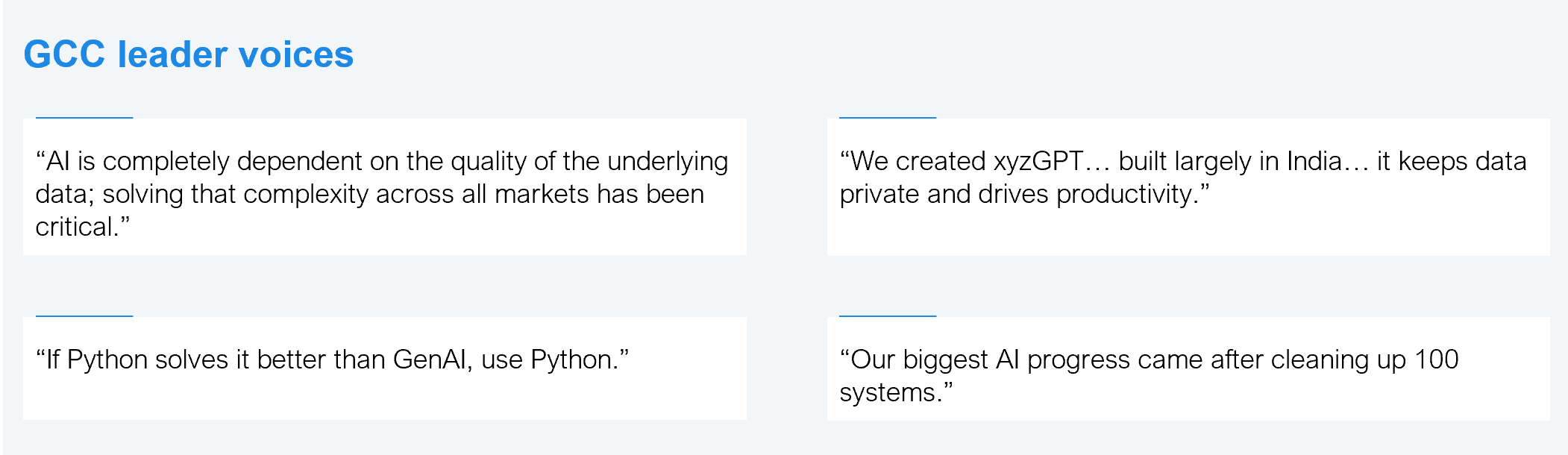

Reshape GCC operating models for speed, resilience, and integrated cross-functional ownership, removing silos that stifle innovation and responsiveness.
Most BFSI firms struggle with fragmented structures—multiple legal entities, siloed reporting lines, and over-centralized decisions. Such complexity lacks accountability and hinders strategic intent. Legacy structures designed to control cost and manage compliance can now actively block innovation and collaboration. To act as true enterprise partners, GCCs must deliver with speed, local accountability, and cross-functional teamwork. Structural simplification is key to eliminating bottlenecks and unleashing business impact. A modern GCC should behave as a strategic micro-enterprise—locally accountable and globally aligned.
Siloed legal and reporting structures, disconnected verticals, and multi-layer approvals keep GCCs locked in slow, risk-averse patterns. Different KPIs between India and global headquarters fragment ownership and breed confusion. Regulatory overlays add complexity, making it hard to change without confidence in local governance. As a result, teams still feel permission-based rather than mission-driven. Simplifying structures unlocks accountability and creates fertile ground for embedding AI in decision-making. The convergence of tech, ops, and risk within unified teams opens the door for automation, faster governance, and scalable innovation—areas where vendors can also play a potential catalytic role through deep collaboration.
Simplify, integrate, and empower local teams by:
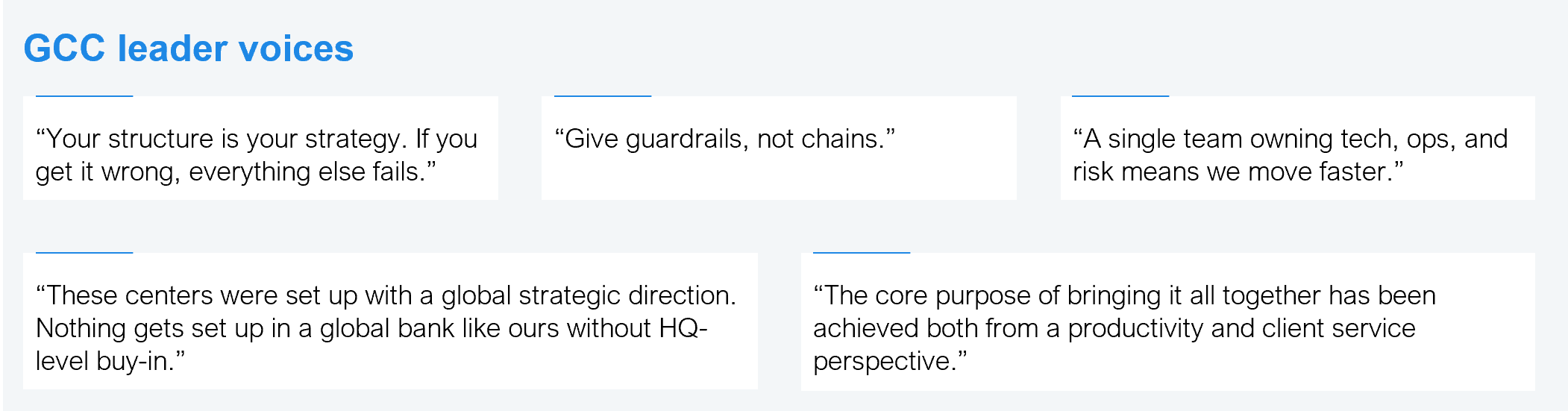

Move GCC performance measurement away from labor and headcount metrics to indicators that reflect strategic value, innovation, and growth impact.
If the only metric the enterprise sees is ‘people count,’ GCCs will forever be relegated to an efficiency narrative. To claim their role as enterprise-critical growth partners, they must measure and communicate their impact on revenue, resilience, and customer experience, not just cost.
Legacy performance dashboards still over-index on traditional labor arbitrage KPIs. Innovation impact, leadership maturity, and ecosystem influence are rarely measured rigorously. This leaves GCCs unable to prove their role in enterprise transformation, missing a powerful storytelling opportunity.
Build future-proof metrics and tell impact stories by:
Leading organizations have moved to impact-driven indicators that reflect strategic value:
Many third-party service providers and consulting firms are actively moving in this direction. They build success through client partnerships by co-creating impact-driven solutions tied to tangible transformation outcomes, innovation, and talent leadership, signaling a subtle but significant shift from traditional delivery narratives.
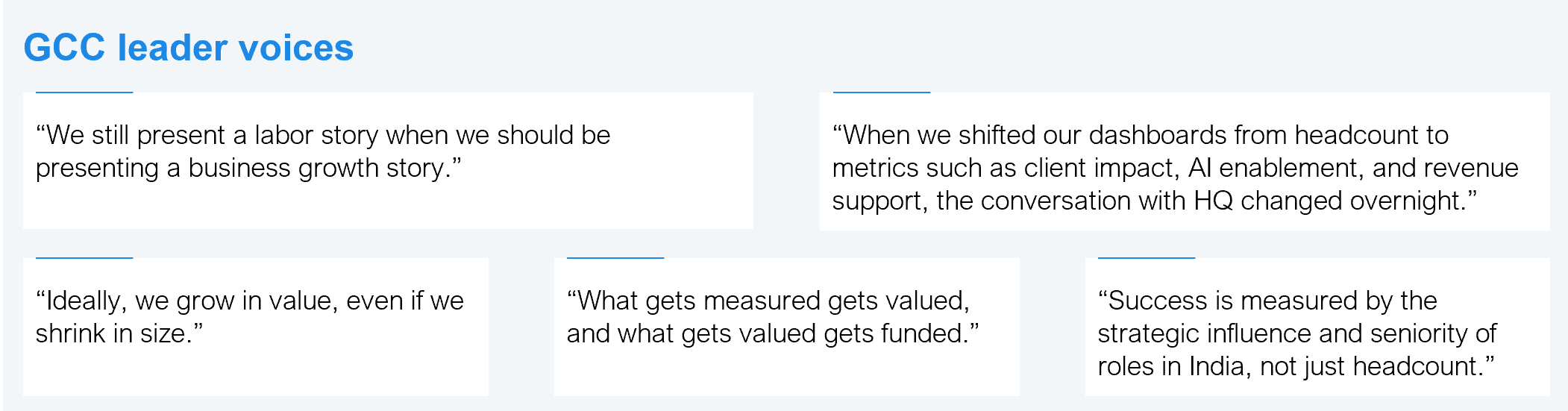
The age of the captive is over. BFSI GCCs that cling to legacy mindsets, labor metrics, and outdated labels will fade into irrelevance. Those that rewire their identity, embrace comprehensive talent upskilling, empower their leaders, industrialize AI, build agile structures, and measure what truly matters will not just survive but also define the future of the global enterprise. Future-ready GCCs are embedding accountability through structure, building cohesive global-functional synergies, and enabling faster decision-making and collaboration.
The path ahead is not without resistance. Cultural inertia, regulatory hurdles, and legacy operating models still linger. But for those willing to confront these challenges head-on, the opportunity is immense: to become indispensable drivers of enterprise transformation and innovation. BFSI GCCs have the talent, scale, and ambition to lead. They must now claim their place—not behind the scenes, but at the very center of the enterprise strategy.
We interviewed 10 BFSI GCC leaders in India to understand what’s working, what’s stuck, and what it’ll take to break through the noise:
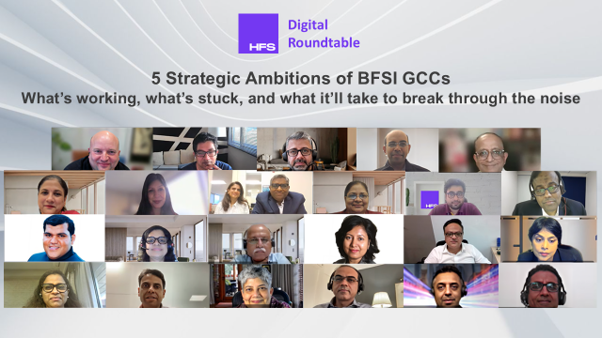
The research is also supported by the perspectives of 20+ BFSI GCC leaders on the 5 strategic ambitions in a digital roundtable.
Register now for immediate access of HFS' research, data and forward looking trends.
Get Started

If you don't have an account, Register here |
With the exception of our Horizons reports, most of our research is available for free on our website. Sign up for a free account and start realizing the power of insights now.
Our premium subscription gives enterprise clients access to our complete library of proprietary research, direct access to our industry analysts, and other benefits.
Contact us at [email protected] for more information on premium access.

