Application modernization isn’t new; what’s new is that the future of the business now depends on it. The HFS Horizons: Legacy Application Modernization Services, 2025 research revealed that enterprises still burdened by mountains of technical debt will essentially be locked out of the next wave of AI-native value creation. Enterprise tech leaders must rethink their IT operating models to stay in the race for AI-driven market dominance.
Most enterprise tech leaders already know that we’ve passed the point where legacy is just a few clunky systems and processes or a hindrance to transformation. They are the silent corroders of AI’s return on investment. Every AI pilot that fails to scale can be traced back to brittle architectures, fragmented data, and project-centric delivery models that simply don’t align with the demands of real-time, AI-enabled decision making and orchestration. The resulting technical, process, data, and culture debt slows time-to-market and exacerbates compliance risks from outdated controls. Business cases don’t materialize, and AI is unable to scale beyond proofs of concept (POCs) because the tech architectures can’t support it (see Exhibit 1).
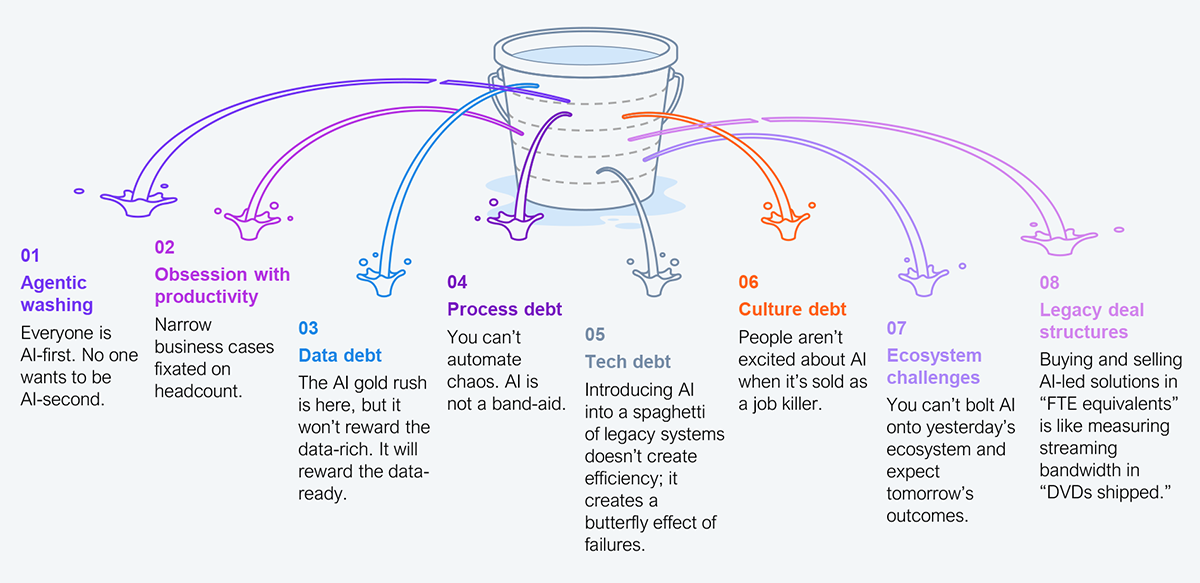
Source: HFS Research, 2025
Worse still, the subject matter experts who built the legacy systems are retiring, and the next generation is reluctant to work on them. Organizations are losing the knowledge they need to maintain and transform these systems. The explosive growth of AI in the enterprise makes it clear that the future of the business is AI, and good AI demands connected, governed, real-time systems with API-first architectures.
AI is raising expectations for speed, quality, explainability, and agility that legacy environments can’t meet. The message for enterprise tech leaders is clear: If your tech stack isn’t AI-ready, your transformation agenda is already behind.
Most enterprises are stuck not because they don’t know what to modernize, but because they’re modernizing the wrong way (see Exhibit 2).
They treat modernization as
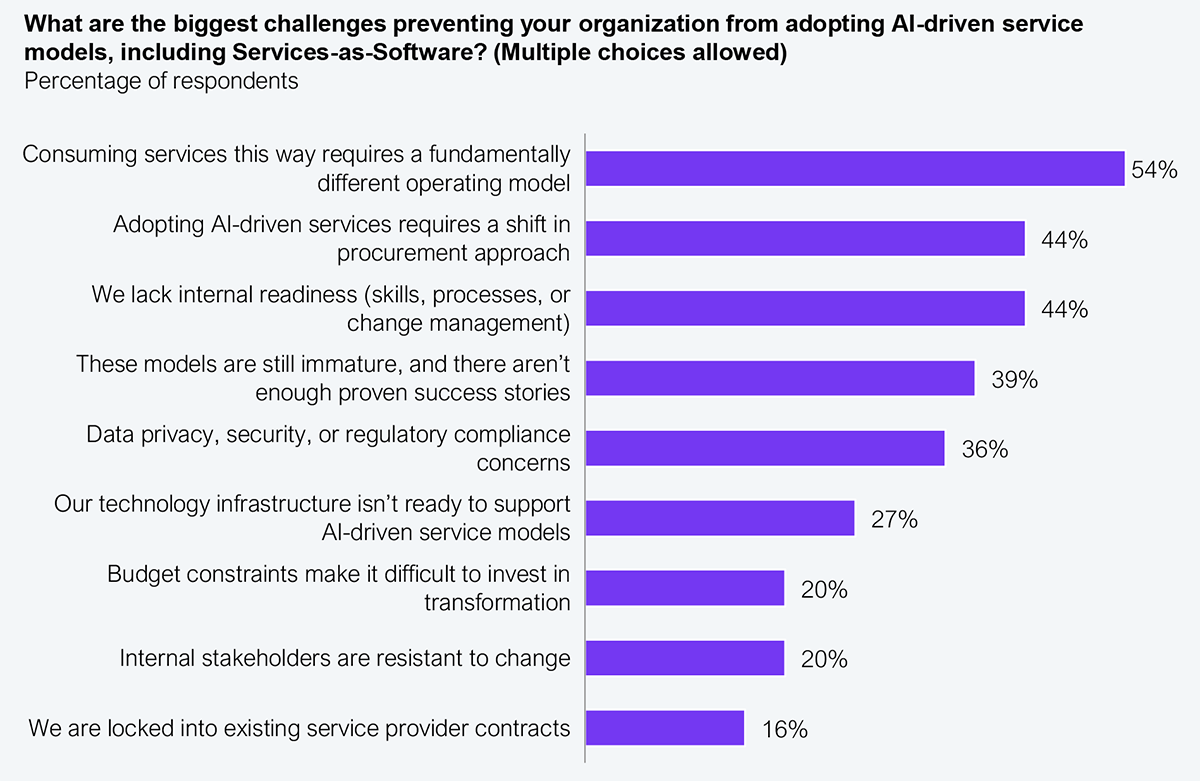
Sample: N=608 Global 2000 enterprises, 2025
Source: HFS Research, 2025
Future-forward enterprises are doing the opposite. They’re converging build and run, deploying digital guardrails, measuring outcomes against key performance indicators, and moving toward AI-infused product-aligned teams that ship faster and operate with confidence.
For instance, ING moved to cross-functional “squads and tribes” that own products end-to-end, resulting in faster time-to-market, higher engagement, and productivity. Goldman Sachs adopted a platform and site reliability engineering model with scalable guardrails and centralized observability, allowing product teams to own reliability while operating safely. In both these examples, we see a pivot away from treating modernization as a remediation exercise and elevating it to the center of AI roadmaps.
By centralizing modernization, enterprises can unlock value at scale from their AI deployments. HFS sees repeatable, enterprise-scale results when organizations adopt these foundational shifts:
Enterprises that break out of application modernization inertia do so by treating it not as migration, but as the first step in becoming AI-native.
Transformation leaders who change how the enterprise builds and runs technology, rather than just swapping tools, separate themselves from the rest. Reframe application modernization and its role in your AI strategy to avoid getting stuck in the past.
Register now for immediate access of HFS' research, data and forward looking trends.
Get StartedIf you don't have an account, Register here |
Register now for immediate access of HFS' research, data and forward looking trends.
Get Started