This Market Impact Report is for procurement leaders, CPOs, and sourcing and supply chain executives looking to move AI adoption beyond pilots and into measurable operational outcomes.
HFS Research partnered with DPW to identify how procurement leaders and teams can most effectively ‘Put AI to Work.’
Our research shows that legacy procurement technology no longer meets enterprise demands. Teams urgently need faster, better decisions. With the influx of AI-powered tools entering the market, most procurement teams are stuck in pilot purgatory—running tests without scaling results. The real barriers aren’t technology or budget, but trust, talent, and dirty data.
We identified five pragmatic ways to break free:


Procurement doesn’t need AI for AI’s sake. It needs real workflows, measurable outcomes, and faster decisions. The leaders we spoke to are achieving this by grounding AI in practical operational wins, not abstract innovation goals.

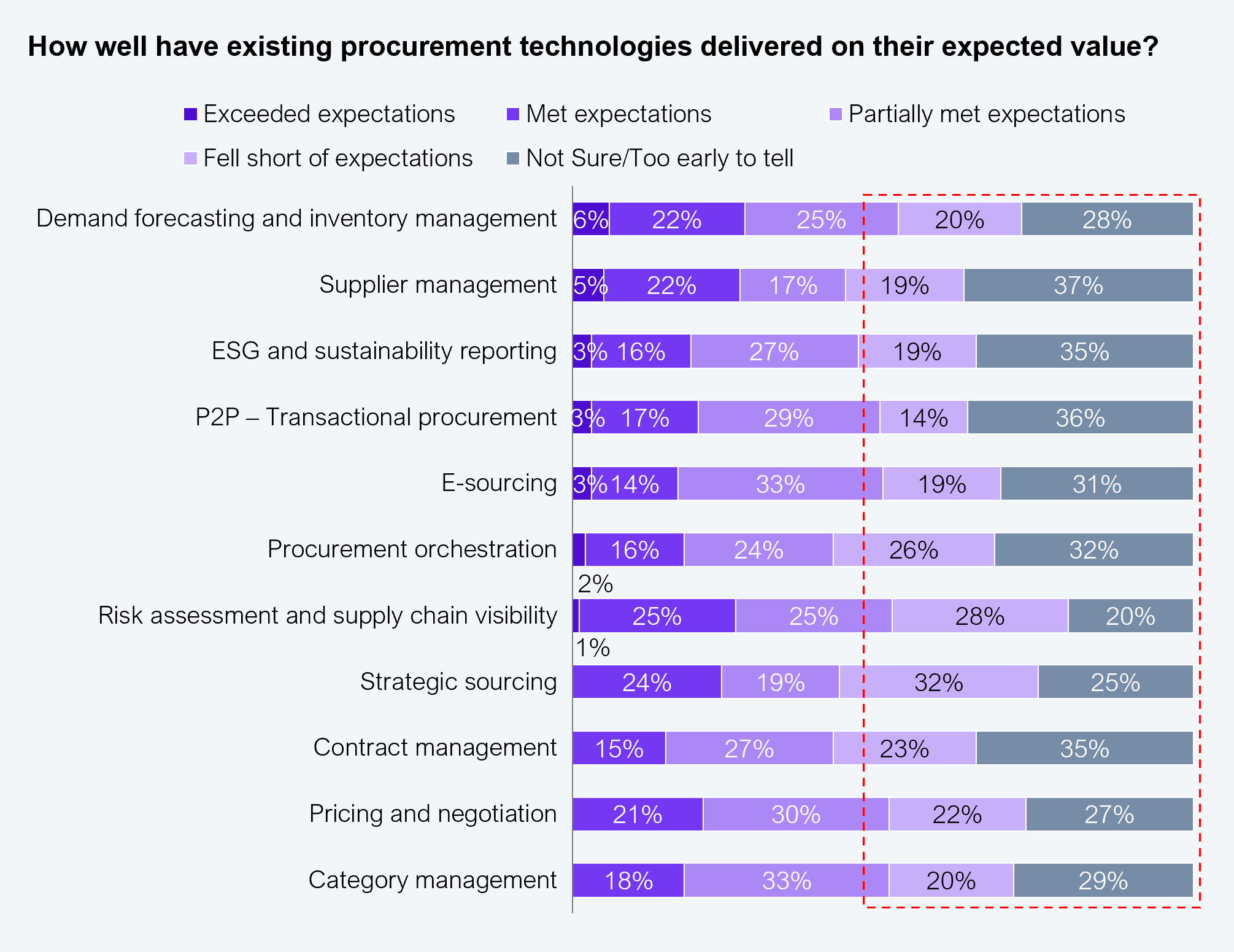
Across key functions, procurement leaders said their current tech stack hasn’t delivered. In strategic sourcing and procurement orchestration, 32% of respondents said the tools were too early to assess, while 26% said they didn’t meet expectations (see Exhibit 1). Even in basic foundational areas such as supplier management and e-sourcing, less than a quarter of buyers said their systems met or exceeded expectations. Imagine spending that much only to end up getting such a ‘meh’ result.
Source: HFS Research, 2025

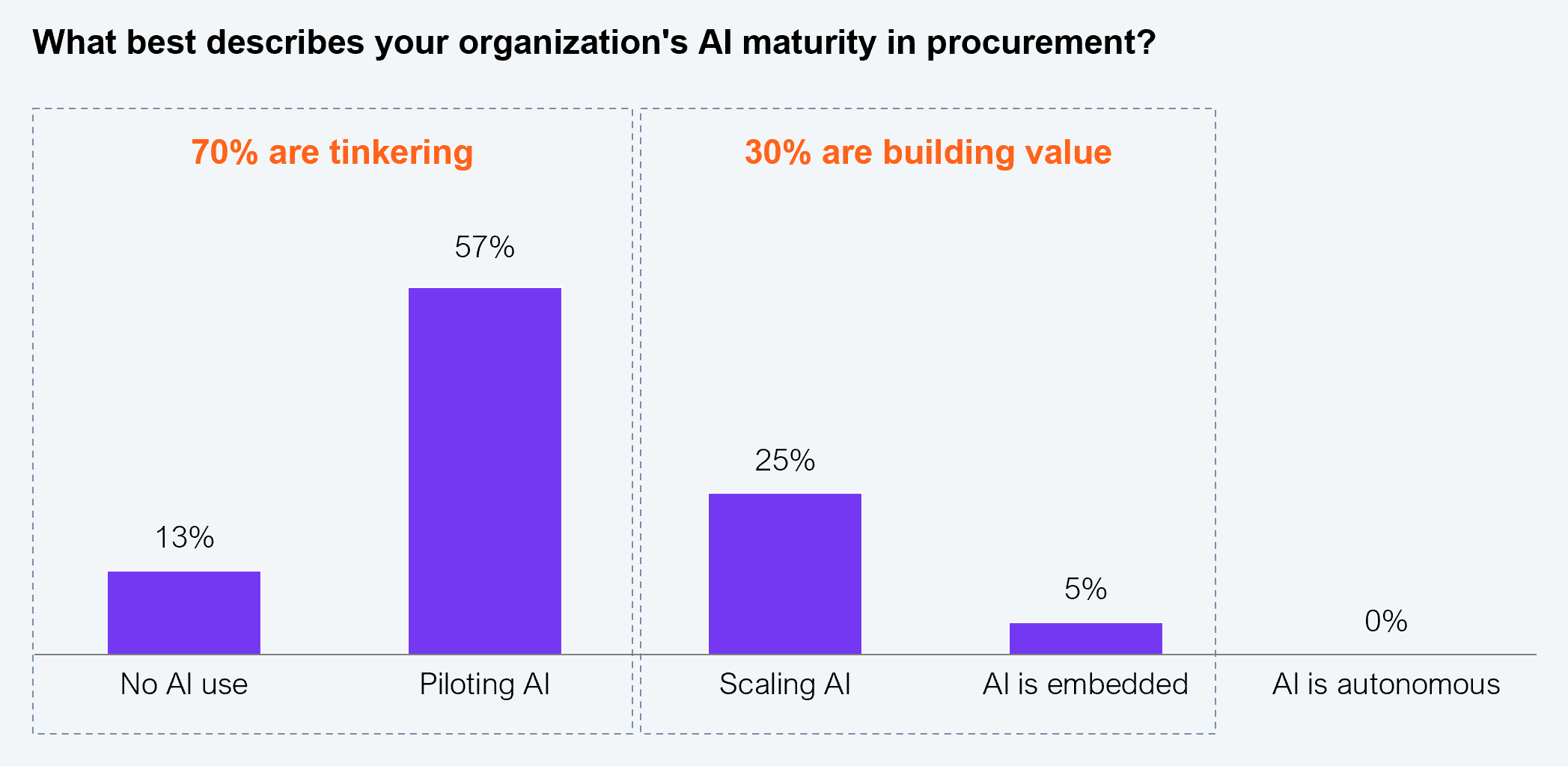
Despite the growing interest in AI, most procurement teams haven’t moved beyond the testing phase. Our research showed that 57% of procurement organizations are trialing pilot projects, while 13% haven’t started using AI at all. Only 25% have scaled their efforts, and just 5% have truly built AI into their operations. Fully automated AI is almost unheard of (see Exhibit 2).
Sample: 87 Procurement Executives
Source: HFS Research, 2025
About 70% of teams are still experimenting instead of making real changes. AI is visible but not yet useful. It’s being tested in separate projects, not built into everyday work where it can show real results. Leaders are often stuck proving small examples, running trials, and chasing quick wins that don’t grow into anything bigger. The result is uncertainty, lost momentum, and no business value.
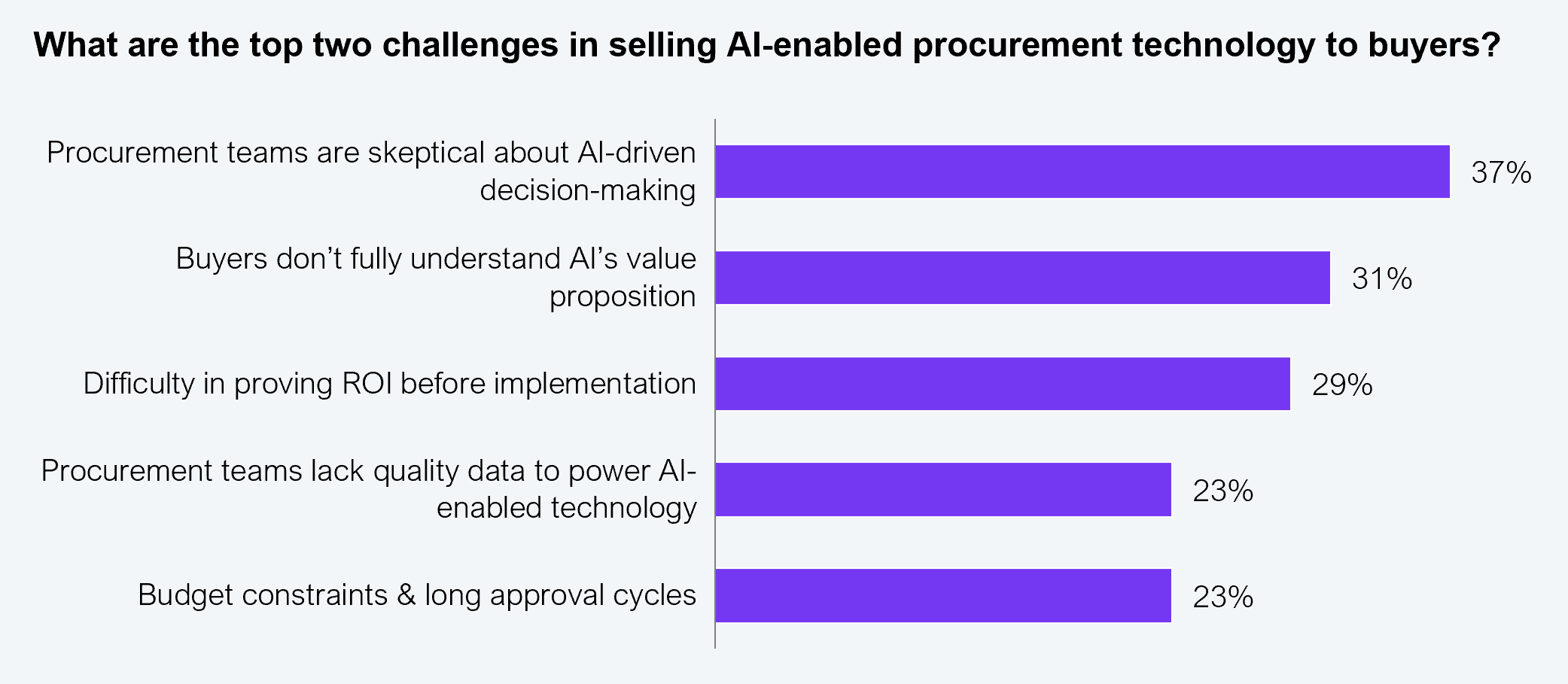
After thousands of pitches, tech and services providers are now aware that the challenge isn’t the tech; it’s trust around the usage of tech. 37% of providers cited buyer skepticism about AI-driven decision-making as the top obstacle (see Exhibit 3). Another 31% pointed to buyers not fully understanding AI’s value proposition. There’s also the issue of proving ROI before implementation (29%), a serious challenge in areas such as contract management and e-sourcing where ROI is soft.
Sample: 37 Procurement Service and Technology Executives
Source: HFS Research, 2025
These aren’t minor issues. They go straight to the heart of why AI is stalling in procurement. Many teams were fooled in the past by tools that overpromised and underdelivered (remember their ‘meh’ feelings about incumbent tech?), breeding skepticism about delivery. Now buyers demand confidence; they want to see clear outcomes, not just tech demos or buzzwords.
Until procurement service and tech providers can ground AI in tangible operational outcomes and show tangible business impact beyond models and capabilities, AI in procurement will remain in pilot purgatory. The result is a growing disconnect between AI’s theoretical potential and its practical adoption.
Recommendation: Heavy demos and clear integration requirements are the best way to test the technology, not pilots. Provide your data to the technology provider, and let them show you how it works in demos. Skip the pilot, trust your deep half or even full-day demos and requirements testing, and then get busy implementing and adopting the technology.
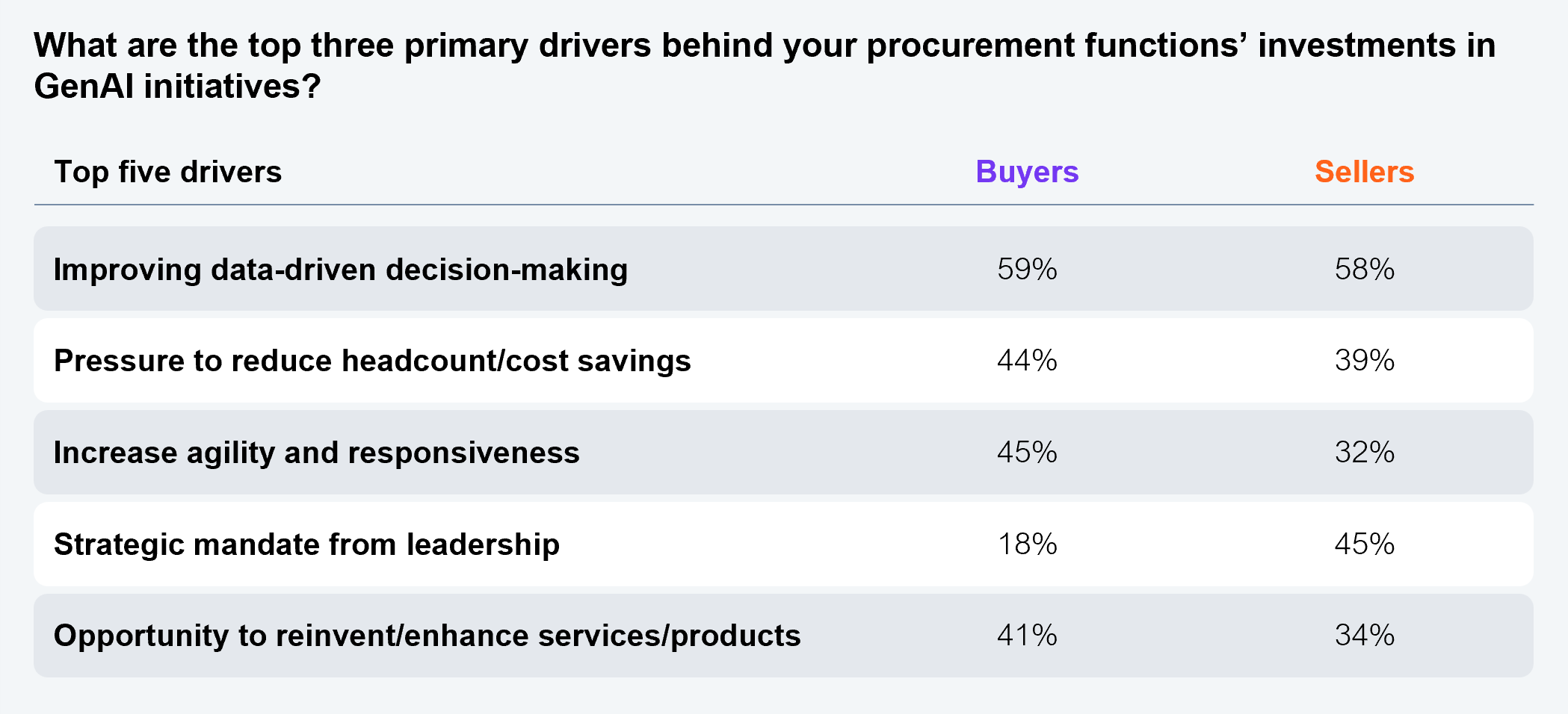
Both buyers and sellers agree that they’re pursuing GenAI to improve decision-making. In fact, 59% of procurement leaders and 58% of providers cited this as the top driver behind their AI investments. Reducing headcount, boosting agility, and enhancing services also ranked high (see Exhibit 4).
Sample: 87 Procurement and 37 Procurement Service and Technology Executives
Source: HFS Research, 2025
The ambition is present, but execution lags. Most AI efforts remain disconnected from the day-to-day realities of procurement work. Leaders invest in tools without fully integrating them into sourcing, contracting, or operational workflows.
Transformation efforts are bound to fail when nobody takes accountability for delivering results and pilots lack deadlines, checkpoints, and real performance metrics. Though teams may be excited about change, the results won’t show up without strong execution.
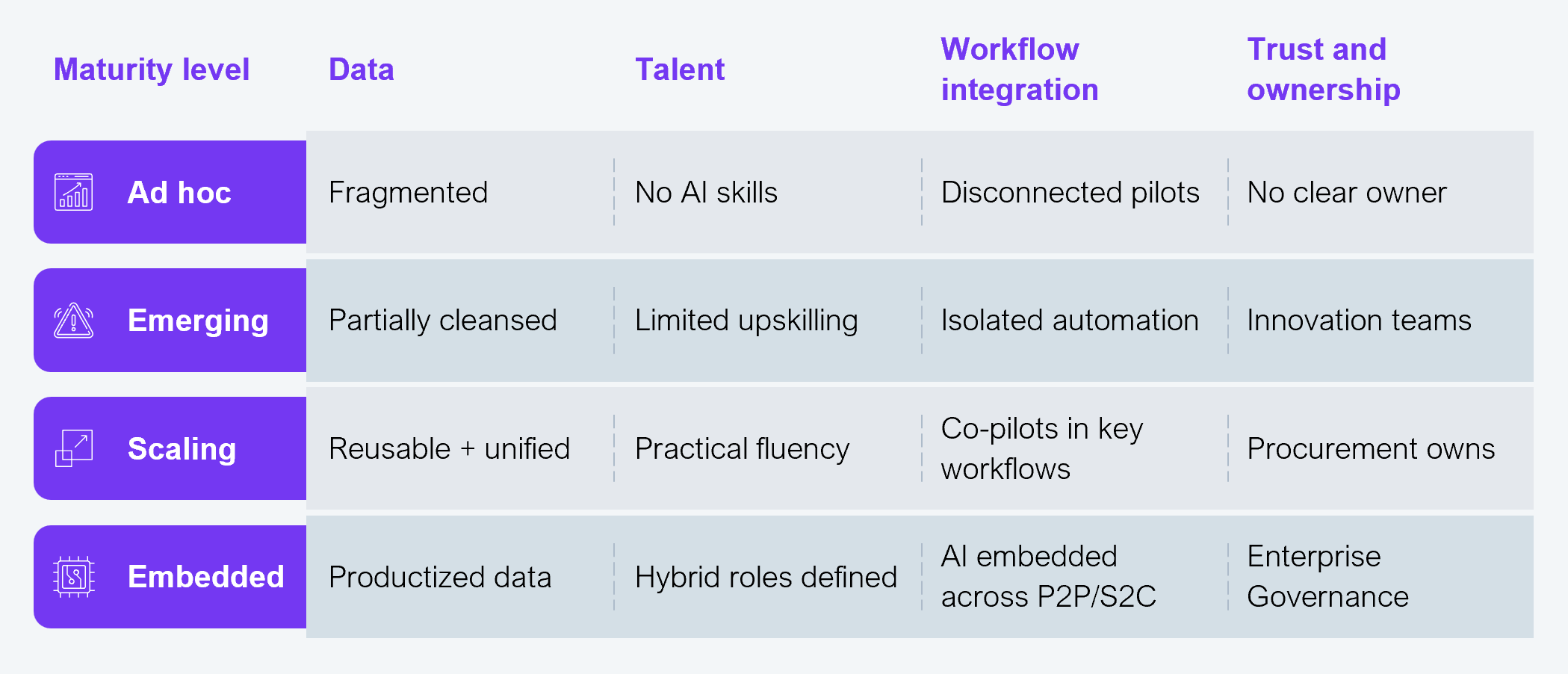
Staying in pilot mode is no longer an option. Enterprises that are making progress treat AI as a product, not a proof of concept. But most procurement teams don’t know where they truly stand, let alone how to scale. That’s where our simple maturity matrix kicks in, helping enterprise leaders benchmark their readiness and take decisive action (see Exhibit 5).
Source: HFS Research, 2025
This maturity matrix is intended to act as a mirror rather than a scorecard. Procurement leaders should use it to see where the procurement function stands in reality and define the bold steps needed to move from experimentation to enterprise-scale impact. At some point, your systems need to integrate, and you need to plan for that eventuality.
The biggest challenge is to accept that AI is a skill, not a tool. Organizations should start with pilots to learn how to make AI part of daily work. The rollout then becomes demand-driven, not an IT or board push.
— Procurement leader
There’s so much hype around AI that people don’t want to hear about it anymore. We must show what we’ve built and demonstrate real results because so many fake AI vendors are out there using chatbots and calling it AI.
— Procurement leader

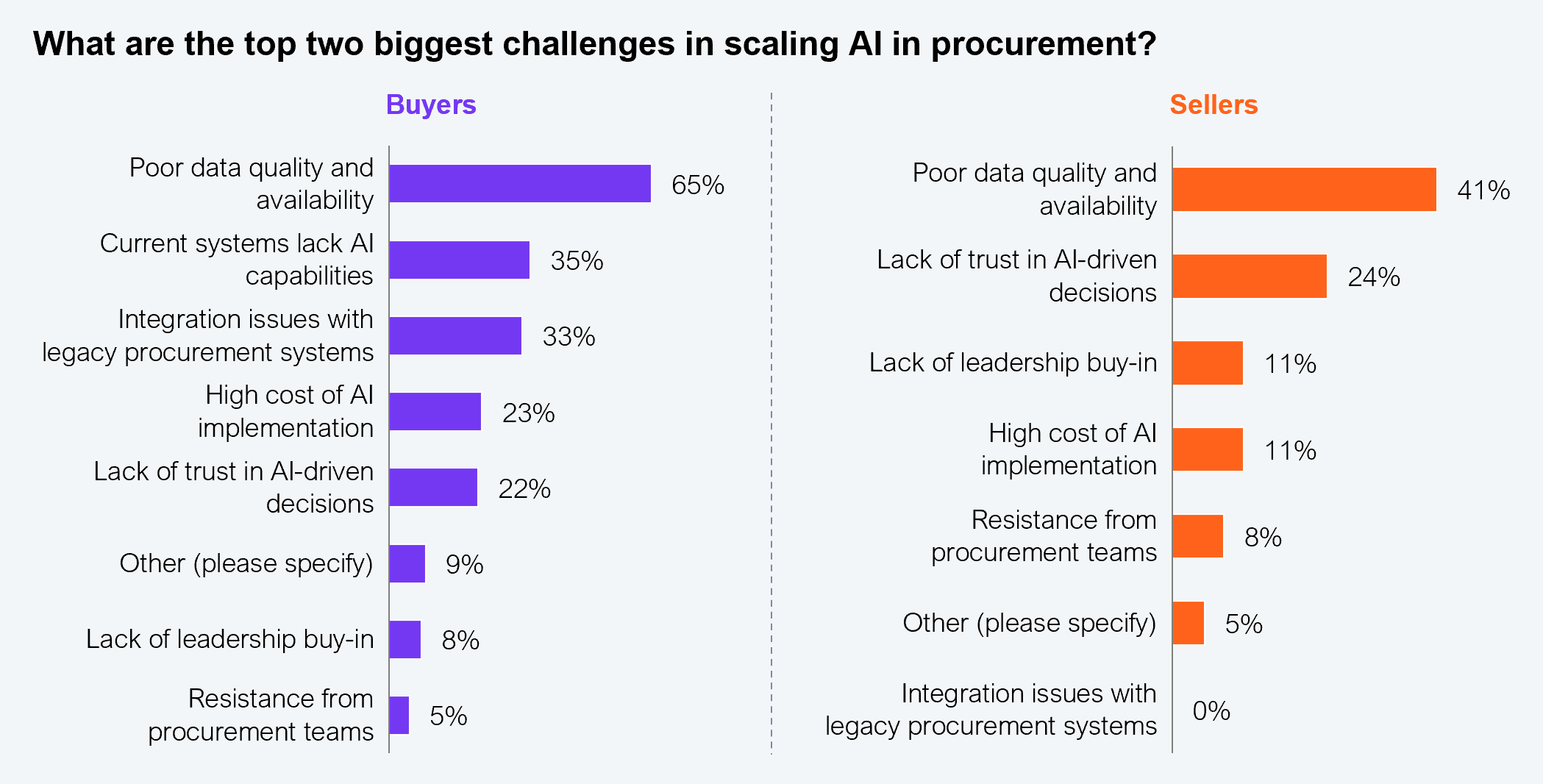
65% of buyers said poor data quality and availability is the top blocker to scaling AI. Even 41% of sellers agreed, making it the most cited challenge on both sides. Unsurprisingly, AI can’t generate value from fragmented supplier records, misaligned taxonomies, or legacy systems with inconsistent logic (see Exhibit 6).
Beyond data, buyers called out the lack of AI capabilities in current systems (35%) and integration issues with legacy procurement tech (33%), pointing to infrastructure issues. In contrast, sellers downplayed system concerns and emphasized trust in AI (24%) and leadership buy-in (11%).
There’s also a disconnect between buyer needs and how sellers interpret them. Buyers seek help fixing data and systems before engaging with higher-order value, while tech providers want to sell products in isolation (hence the pilots).
The cost of AI isn’t the issue; only 23% of buyers and 11% of sellers mentioned it. What’s missing is clean, connected, and usable data that’s tightly linked to workflows. Teams that treat data as a product instead of a byproduct are putting AI to work beyond the pilot phase, and that’s the strategy all procurement organizations should adopt. You can’t manage it if you can’t measure it.
Sample: 87 Procurement and 37 Procurement Service and Technology Executives
Source: HFS Research, 2025
The robustness of the data (not just the live data now) and the data sets that informed the AI make people skeptical about its utility. Procurement data from past systems is often incomplete or wrong.

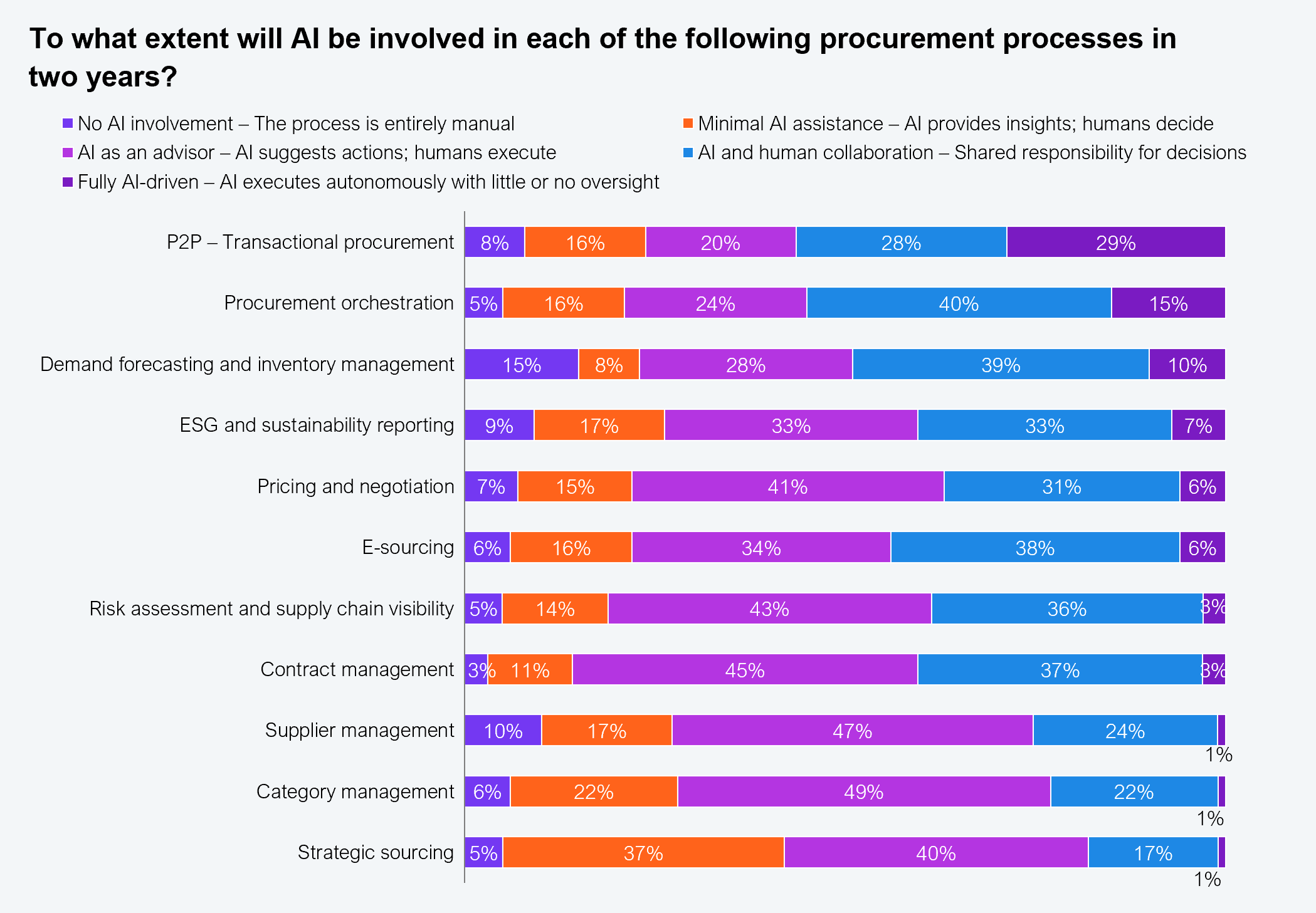
Across procurement processes, buyers envision AI as a co-pilot rather than a takeover tool. For example, 49% expect AI to be an advisor in category management, and another 22% foresee shared responsibility for decisions (see Exhibit 7). The same holds for contract management (45% advisor, 37% shared) and risk and supply chain visibility (43% advisor, 36% shared). Fully autonomous AI is still on the fringes, with only 1–3% expecting it across any process. This tells us that procurement leaders want speed, not surrender. They expect AI to help them execute faster, which is why ROI is hard to find—‘faster’ doesn’t necessarily guarantee more hard savings.
Sample: 87 Procurement Executives
Source: HFS Research, 2025
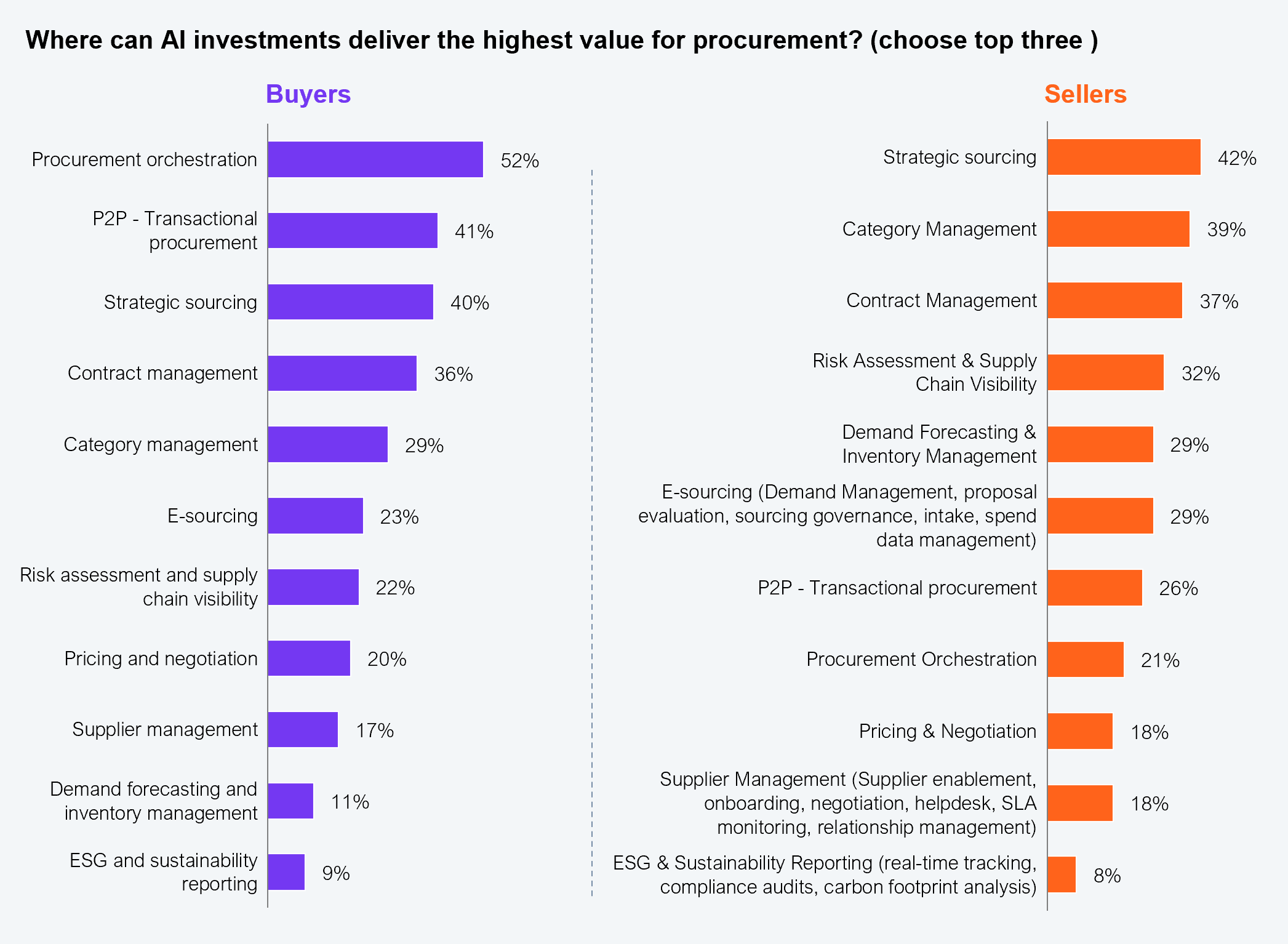
Most of the AI traction today sits in downstream activities such as supplier onboarding, invoicing, and triage. For example, 47% of buyers expect AI to help manage suppliers, and 38% want AI support in e-sourcing (see Exhibit 8). However, procurement’s real impact lies in upstream activities such as sourcing, contracting, and category planning. That’s where sellers are doubling down, with nearly 80% expecting AI to play an advisory or shared role in category management. The gap is not just technical but organizational. Our data shows stronger buyer expectations downstream, but sellers are already looking upstream for bigger wins. That disconnect is where AI momentum risks getting stuck in the middle. Buyers are fixing the basics, and sellers are chasing strategic impact. In between, AI momentum risks stalling.
Sample: 87 Procurement and 37 Procurement Service and Technology Executives
Source: HFS Research, 2025
Procurement doesn’t need an AI revolution. It requires better workflows, faster decisions, and fewer manual processes. Leaders that are making progress aren’t chasing end-to-end transformation; they’re starting with where AI can quietly remove friction and free up real capacity. Most of that momentum is seen in downstream use cases, but the bigger unlock lies upstream where strategic impact awaits. The challenge lies in connecting the two and converging to bring out the best of both worlds.

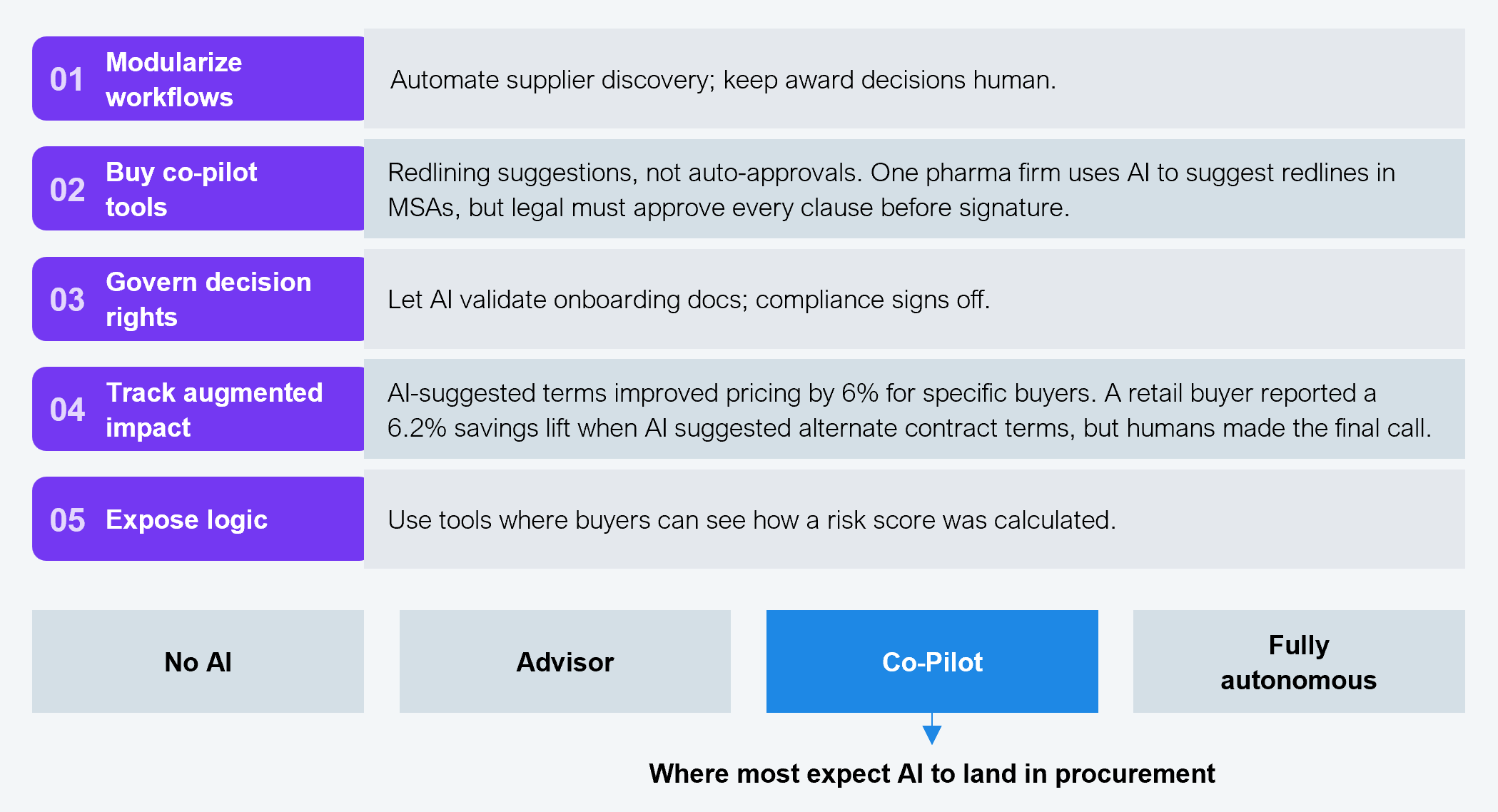
Most procurement leaders aren’t looking for an autopilot. They want tools that make drafting, supplier discovery, and risk analysis faster and easier without compromising control. For example, 41% of buyers expect AI to act as an advisor in pricing and negotiation, while 50% of sellers envision AI and humans sharing decisions in these workflows (see Exhibit 9).
In real-world terms, a pharma firm is using AI to suggest redlines in MSAs, but legal still approves every clause. A retail buyer achieved a 6.2% pricing lift from AI-suggested terms, with a human reviewer giving the final nod.
Procurement teams are starting to invest in co-pilots that help them draft clauses, flag risk, compare supplier bids, and explain scoring logic without hiding the math. The co-pilot works best when it earns trust through transparency, not mystery.
Source: HFS Research, 2025

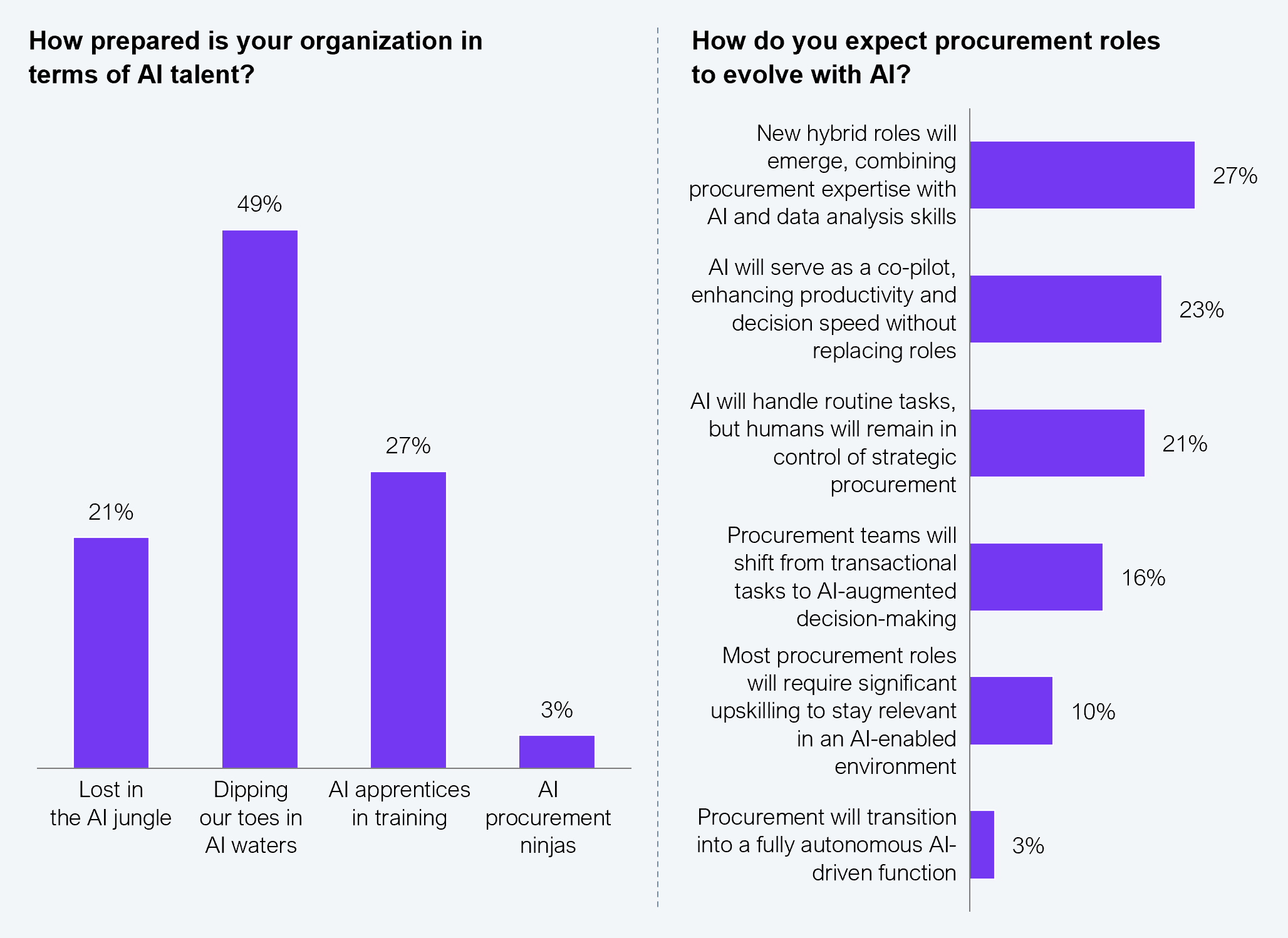
Nearly half of procurement teams say they’re just ‘dipping their toes’ into AI talent development. Meanwhile, service providers expect bold reimagination of roles and workflows. This disconnect is why AI isn’t scaling: we’re asking teams to adopt co-pilots without equipping them to drive them (see Exhibit 10).
Sample: 77 survey participants
Source: HFS Research, 2025
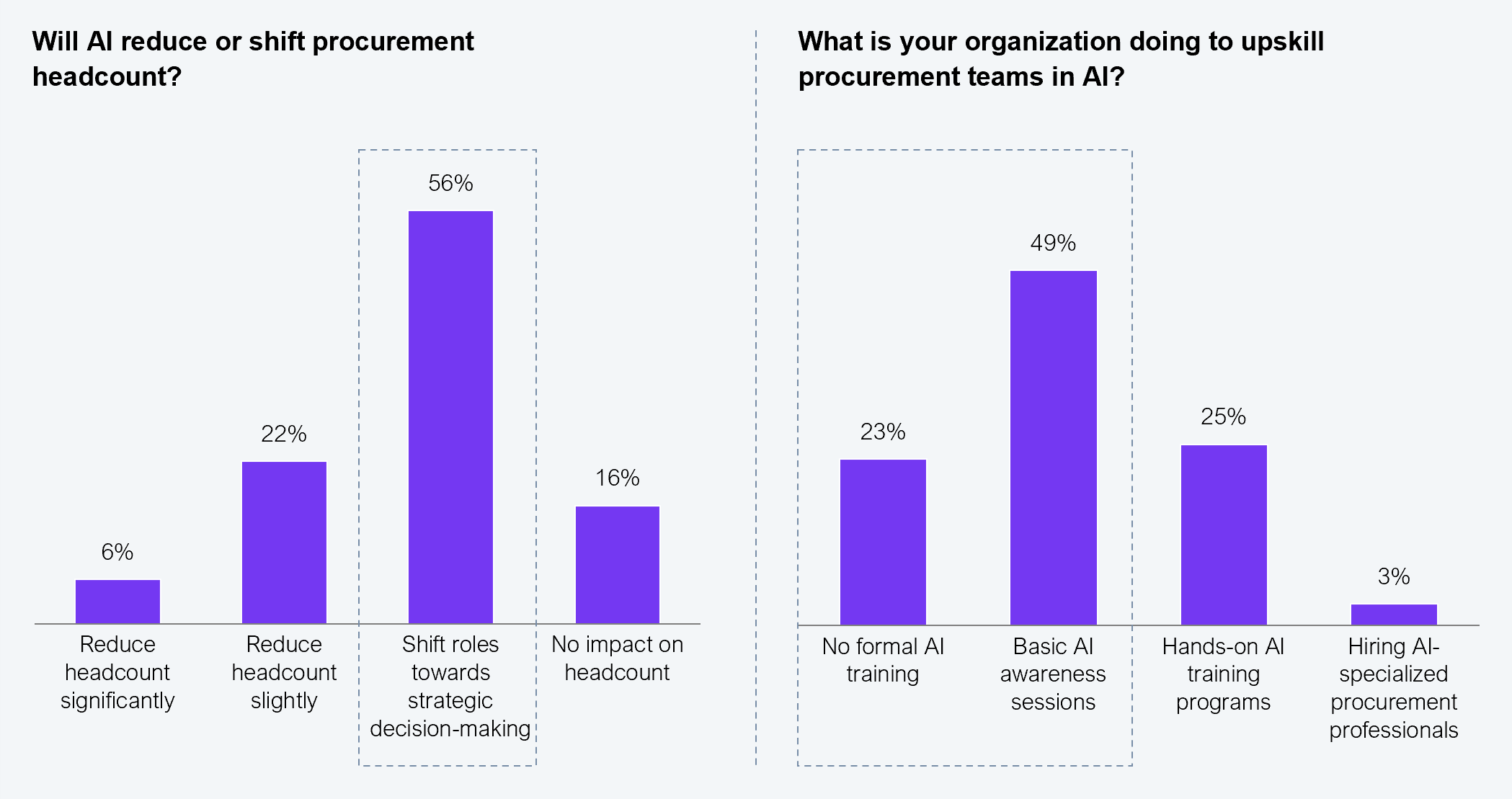
While most buyers agree AI will augment and not replace procurement jobs, few have defined the new job descriptions, learning paths, and KPIs to support this shift. Until that happens, adoption will stay shallow and outcomes will stall (see Exhibit 11).
As co-pilots take on a more operational lift, the real differentiator will be how fast teams build AI fluency. This starts with practical learning pathways, sandbox environments, and incentives tied to usage and impact, not slideware.
People are afraid of AI and thus resistant. There’s active pushback— not because of tech failure, but job disruption. We need real education on risks and benefits, not buzzwords.
Sample: 77 survey participants
Source: HFS Research, 2025
It’s not just about putting new tools on top of old processes. Enterprises should rethink how work gets done and who’s trusted to shape that change. The organizations making progress aren’t waiting for perfect tech or fully baked transformation plans. They’re starting with the messy challenges upfront—manual tasks, clunky workflows, slow decisions while backing their people to lead the transformation by giving them space to test, learn, and build the judgment AI can’t replicate.
This is where the real value kicks in—not just AI that works, but teams that know how to work with it. Procurement needs progress that sticks. And that starts when teams stop circling in pilot mode and start making AI part of how things get done.
Register now for immediate access of HFS' research, data and forward looking trends.
Get StartedIf you don't have an account, Register here |
With the exception of our Horizons reports, most of our research is available for free on our website. Sign up for a free account and start realizing the power of insights now.
Our premium subscription gives enterprise clients access to our complete library of proprietary research, direct access to our industry analysts, and other benefits.
Contact us at [email protected] for more information on premium access.