
Most GCC-led AI programs are stalling not because the technology is immature, but because ownership is unclear, data is fragmented, and talent strategies are reactive. If you’re waiting for alignment before acting, you’re already behind.
To successfully scale AI implementations in GCCs, it’s essential to standardize data and processes in workflows before starting, clearly define AI ownership, grant leadership autonomy over AI projects, and align AI implementations with enterprise outcomes. Reimagining GCCs as distributed enterprise ownership centers and exploring Services-as-SoftwareTM-driven models can also accelerate the value of AI-driven workflows across the organization.
HFS Research, in collaboration with EdgeVerve, a unified platform that integrates operations and service management workflows, organized a roundtable discussion with global GCC leaders in February 2026. The focus was on GCCs’ current priorities, challenges (see Exhibit 1), ideal state, and solutions to build value-based operating GCCs.
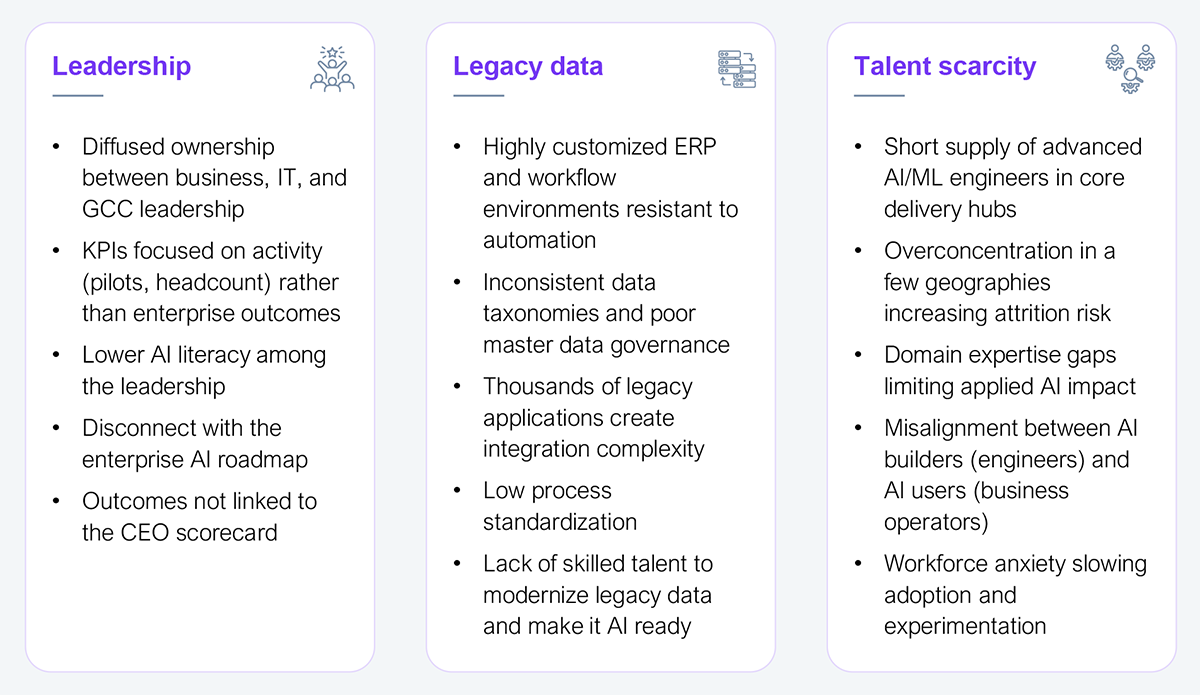
Source: HFS Research, 2026
The barrier to scaling AI within GCCs is not funding or tooling, but the lack of executive courage. Boards should incorporate AI-driven profit and loss (P&L) accountability into their strategic KPIs, creating a clear line of sight from enterprise value creation to GCC leadership teams that are responsible for delivering and scaling AI initiatives.
The solution is to improve AI literacy at the board level and build internal AI skills and expertise. GCC leaders should also convince the board to align data, technology, and business owners with the enterprise AI roadmap while identifying long-standing issues (e.g., invoice anomalies and duplicate payments) to make processes autonomous.
One such perennial challenge is invoice processing automation. GCCs lack the most appropriate optical character recognition (OCR) tool to automate the invoice process. AI will make this process easier. We need to identify repetitive tasks that can be automated with the highest accuracy.
— Shipping and logistics GCC leader
HFS OneCouncil leaders highlighted that AI amplifies existing issues rather than resolving them. It reveals data anomalies, incorrect records, and inconsistencies in master data management caused by siloed systems. A global oil and gas company with more than 10,000 applications across various business units, countries, and functions faced AI implementation delays due to a lack of communication. Real progress with AI will occur only when enterprise systems are integrated, contextualized, and orchestrated across disparate platforms, interacting seamlessly as if they were a single unified system.
No GCC has the luxury of re-engineering the entire data process at scale at this juncture when AI is advancing rapidly, unless it is a greenfield GCC.
— A Global FMCG GCC Leader
For GCCs to become the “brain” of enterprises, they must unify enterprise-wide data to create a roadmap with predictable outcomes. This way, they can close the AI velocity gap by modernizing internal tools, improving the digital experience, and focusing on high-impact business areas rather than broad experimentation during the AI deployment. Also, to create contextualized data and unify it at the enterprise level, GCCs require skilled professionals with a deep understanding of the domain and function, which they currently lack.
A recent HFS survey found that the biggest challenge for enterprise leaders in the current AI rush is the shortage of a skilled AI workforce (see Exhibit 2). Some GCC leaders at the roundtable described AI as both hope and hype while acknowledging its transformation potential.
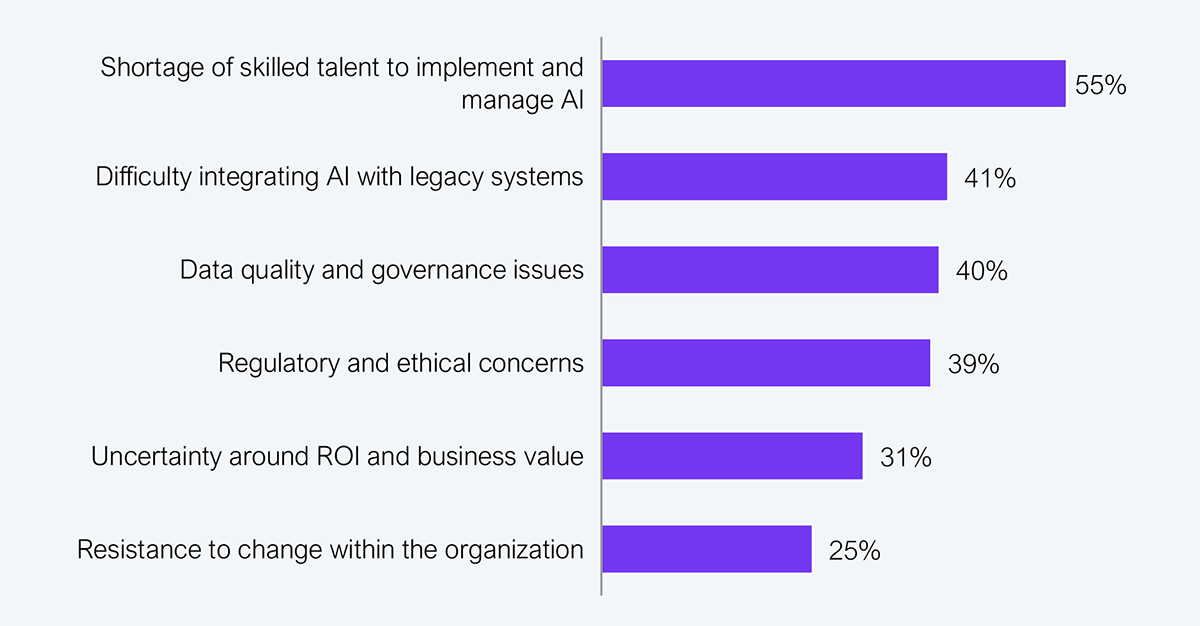
Survey respondents: 608 leaders from Forbes Global 2000 companies
Source: HFS Research, 2026
With the emergence of GenAI, many GCCs have stopped hiring and firing existing resources, but haven’t moved an inch forward with AI initiatives due to the lack of skilled AI talent. They are making up for this by investing significantly in skilled, high-profile talent and offering exorbitant compensation to drive their AI ambitions. However, throwing money at AI talent is not a strategy. The real opportunity lies in redesigning workflows so that average talent delivers AI-enabled outcomes.
To achieve lasting success, GCCs with AI initiatives must move from reactive hiring to building talent capabilities. This involves enhancing employer branding, offering unique employee value propositions, creating leadership pipelines, and collaborating with academia and government to boost early-career talent. The focus should be on structured talent strategies and ecosystem partnerships rather than just increasing headcount.
The roundtable discussion highlighted that GCCs face issues in owning AI initiatives due to siloed data platforms. Poor data integration across applications and the inability to scale skilled talent for large-scale deployment further complicate AI implementations. GCC leaders need AI literacy to understand data complexities, understand the process of unifying it, align outcomes with the enterprise AI vision, and build AI talent for initiatives. Platforms such as EdgeVerve enable these transformations, preparing data and processes to support the enterprise AI agenda.
Register now for immediate access of HFS' research, data and forward looking trends.
Get Started


If you don't have an account, Register here |
Register now for immediate access of HFS' research, data and forward looking trends.
Get Started
