For most COOs, operational autonomy seems out of reach because every attempt to scale AI increases supervision rather than reducing it. This can only be achieved when AI runs multi-step, cross-system workflows using industry-native context (workflow topology, institutional exceptions, regulatory constraints, system dependencies) and embedded trust architecture (explicit risk tolerance, policy-based escalation, and real-time auditability at the outcome level).
Announced in February 2026, the Infosys–Anthropic collaboration, pairing Claude models with Infosys Topaz and the Claude Agent SDK, is a direct bet on addressing this gap.
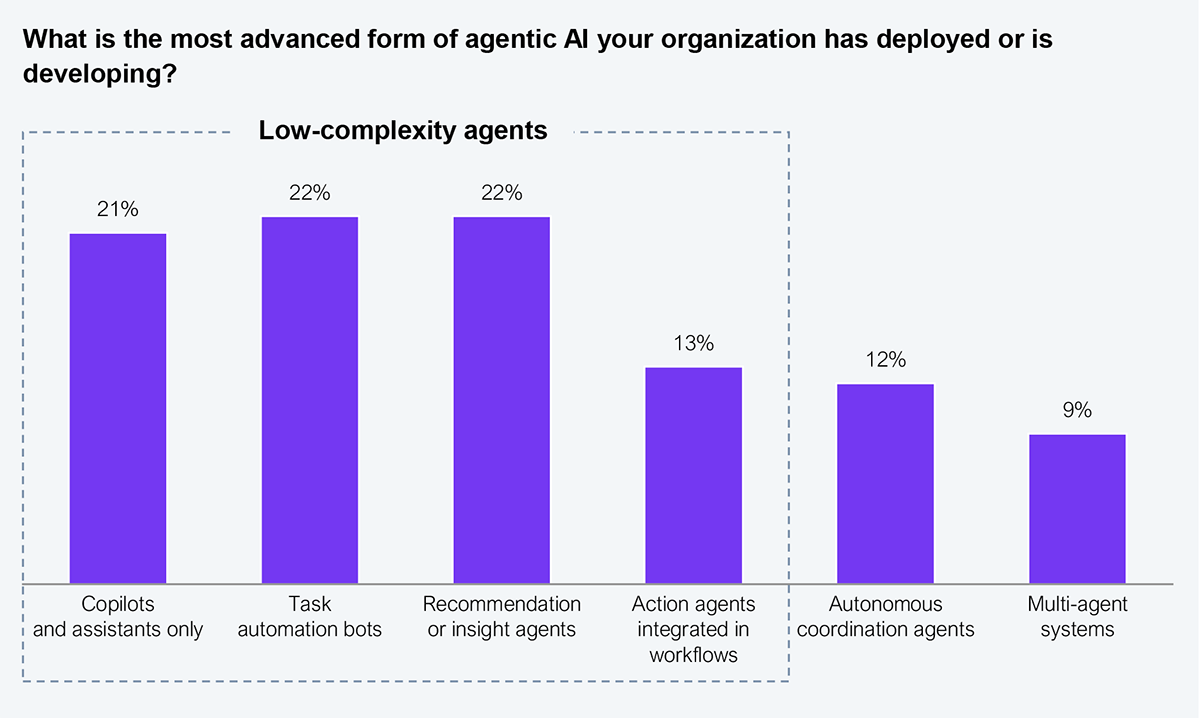
A recent HFS Research study showed that roughly two-thirds of enterprises remain stuck in low-complexity, assistive copilot deployments, concentrated heavily in software development, customer service, and general knowledge work. That’s not surprising; these are domains where “answers” are accepted quickly, and the cost of being wrong is usually limited or recoverable (see Exhibit 1).
Source: HFS Research, 2026
But for COOs, the true value lies in core business workflows: order-to-cash, accounting, network operations, field service, demand planning, operations management, and quality management. We’ve been seeing many individual and specific use-case demos in these areas, but nothing that works end-to-end. The Infosys–Anthropic partnership is explicitly designed to target multi-step workflow execution in system-heavy operations where copilots have fallen short.
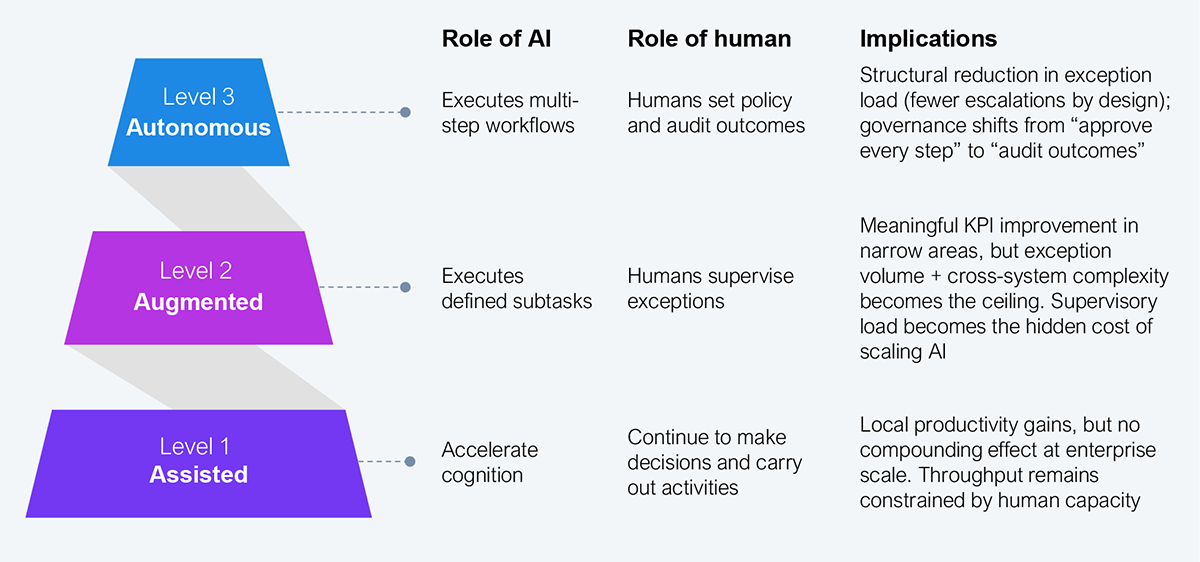
A clean way to separate agent demos from operational autonomy is to ask where the program sits relative to the autonomy threshold (see Exhibit 2).
Source: HFS Research, 2026
Most enterprises are stuck at level 1 and see level 2 as the best they can get to. The move to level 3 is not a continuum but a step change constrained by two bottlenecks:
Enterprises trying to address these challenges in their organizational silos often get stuck because they underestimate the difficulties of codifying fragmented institutional knowledge and designing a trust architecture that can safely scale.
Infosys and Anthropic came together with three goals in mind:
The real test is whether these COEs become more than just another press release and slide in service provider proposals. Proof of success will come from referenceable production deployments and reusable industry IP, contributing to the US$1.5 trillion Services-as-Software™ economy.
Enterprises can’t achieve operational autonomy just by identifying more uses case to build agents. The Infosys–Anthropic partnership signals that industry-native design with domain translation and trust architecture lays the foundation for the operational autonomy needed to scale agentic AI across the organization. Without this, enterprises will continue deploying copilots that generate insights but can’t act safely across workflows without constant supervision.
Register now for immediate access of HFS' research, data and forward looking trends.
Get StartedIf you don't have an account, Register here |
Register now for immediate access of HFS' research, data and forward looking trends.
Get Started