This HFS Research Point of View is for payer CFOs, chief medical officers, and population health leaders evaluating how proactive, technology-enabled care protects medical loss ratio and margin.
Payers can expect a three-plus point reduction in medical loss ratio (MLR) and a 1.6-point increase in margin over three years if they shift left to prevent disease, delay its onset, and better manage it. MLR is the ultimate barometer of financial health for any health plan; it’s the difference between premiums and claims. Financially healthy payers maintain MLR between 82% and 86% to avoid having to rebate premiums or allow margins to shrink. Increasingly, payers are struggling to maintain that MLR within the sweet range (see Exhibit 1), suggesting higher claims driven by a rapidly aging population with rising disease prevalence and higher medical costs driven by clinician shortages and provider consolidation. Both erode payers’ leverage.
Every year of delay in the onset of diabetes saves over $12,000 in medical costs. Aggregated, this is a game-changer. The good news is that AI, medical IoT, and other technologies can help payers shift left and reimagine their delivery paradigm.
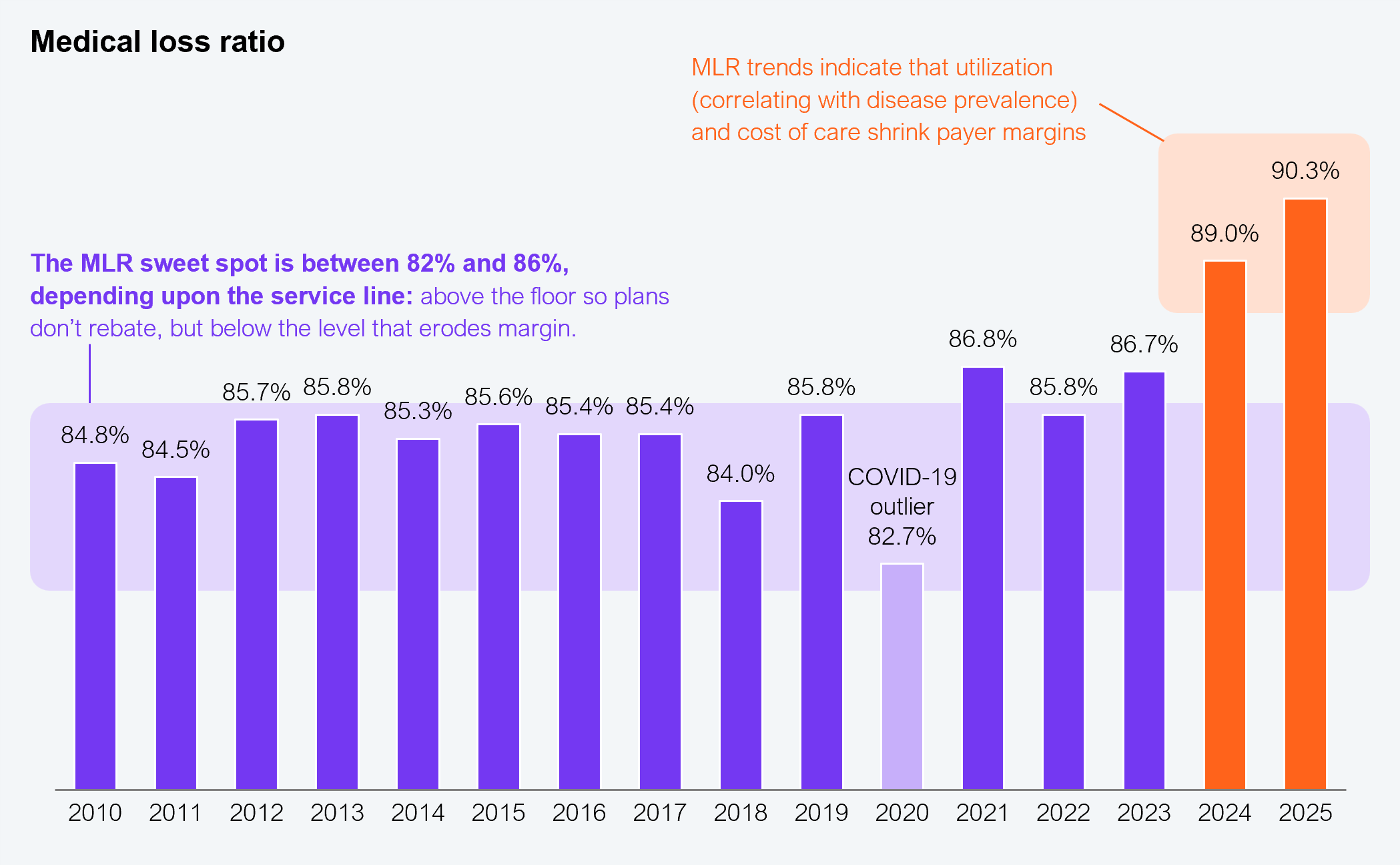
Sample size: varies year over year from 950 to 1,160 filers per year
Source: NAIC, HFS 2026
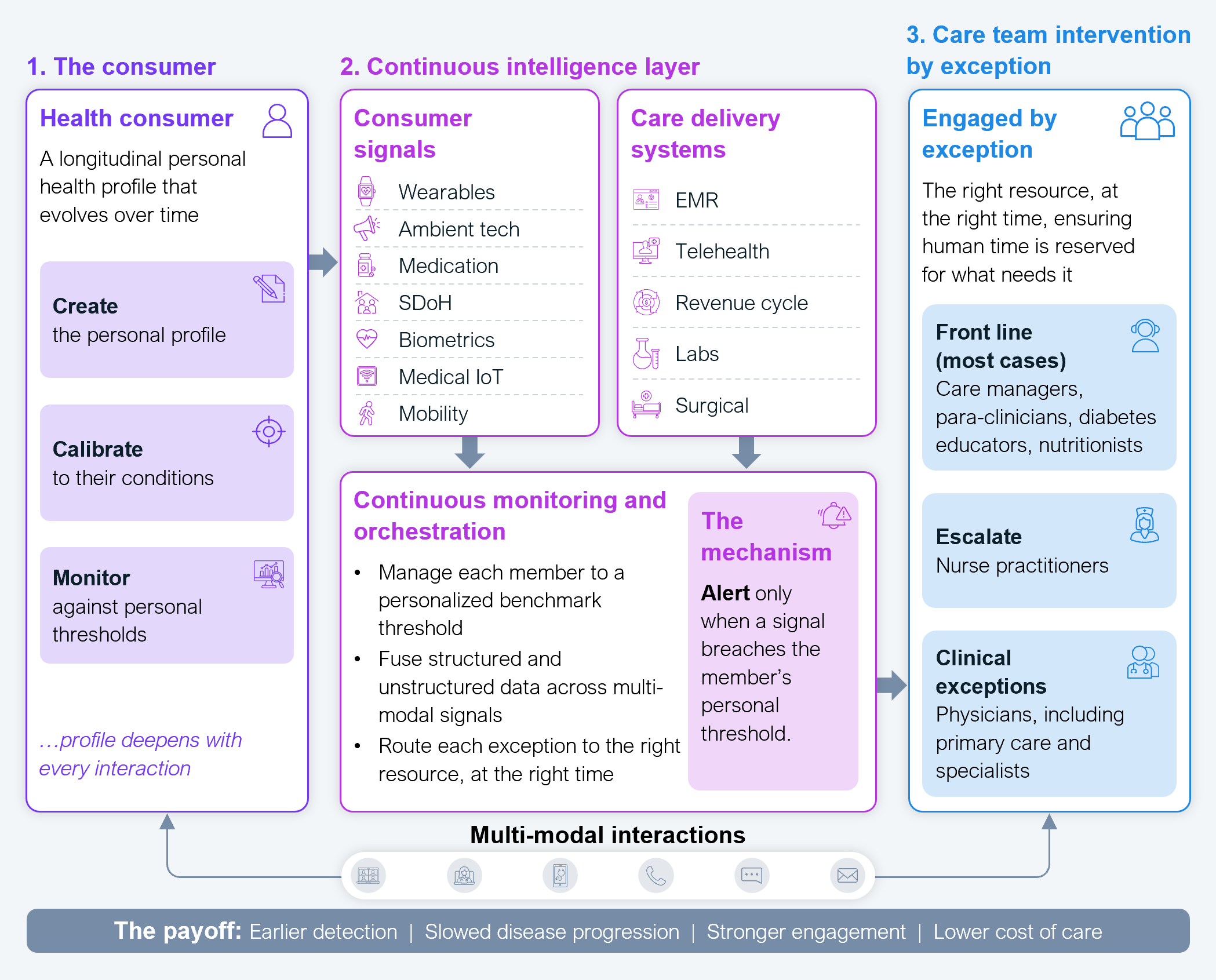
Shifting left must drive three coordinated moves. First, proactively engage members in wellness to prevent disease and delay its onset. Second, enable and accelerate the early identification of disease and pre-disease so you can still bend the trajectory. Finally, proactively manage those who are already sick to slow progression and head off the high-cost events such as the avoidable admission, the start of dialysis, or an amputation. Exhibit 2 shows that existing technologies, such as wearables, ambient tech, and IoT, that leverage AI to identify, monitor, and drive effective interventions can help shift left today.
It is not a theoretical supposition for a time in the future. It’s possible today, and some pockets, such as cardiology and orthopedics, are embracing it.
Source: HFS Research, 2026
The historical objection to proactive care was labor. More engagement meant more clinician touches, which, in a market with acute clinician shortages, was very expensive and hard to sustain. However, that objection is now obsolete. Ambient listening and documentation, consumer wearables, and medical IoT enable a small, largely non-physician team to continuously monitor and manage a large panel, escalating only the exceptions that genuinely require a scarce clinician’s judgment. The enabling infrastructure is already in members’ pockets and living rooms, and 95% of employer plans already cover telemedicine.
The operating model is straightforward and available today. Risk-stratify the membership to isolate the high-cost/high-risk quartile. Enroll those members in a tech-led, low-touch management program. Equip them with connected devices such as a cardiac monitor, continuous glucose monitoring, a Wi-Fi-enabled weighing scale, a toothbrush, and AI-driven monitoring that flags changes to personalized thresholds early. Intervene based on personalized health thresholds and with the least expensive modalities, measure the cost curve against a do-nothing baseline, and reserve human clinical time for the exceptions that genuinely need it. This is a program a payer can stand up now, not a decade-out moonshot.
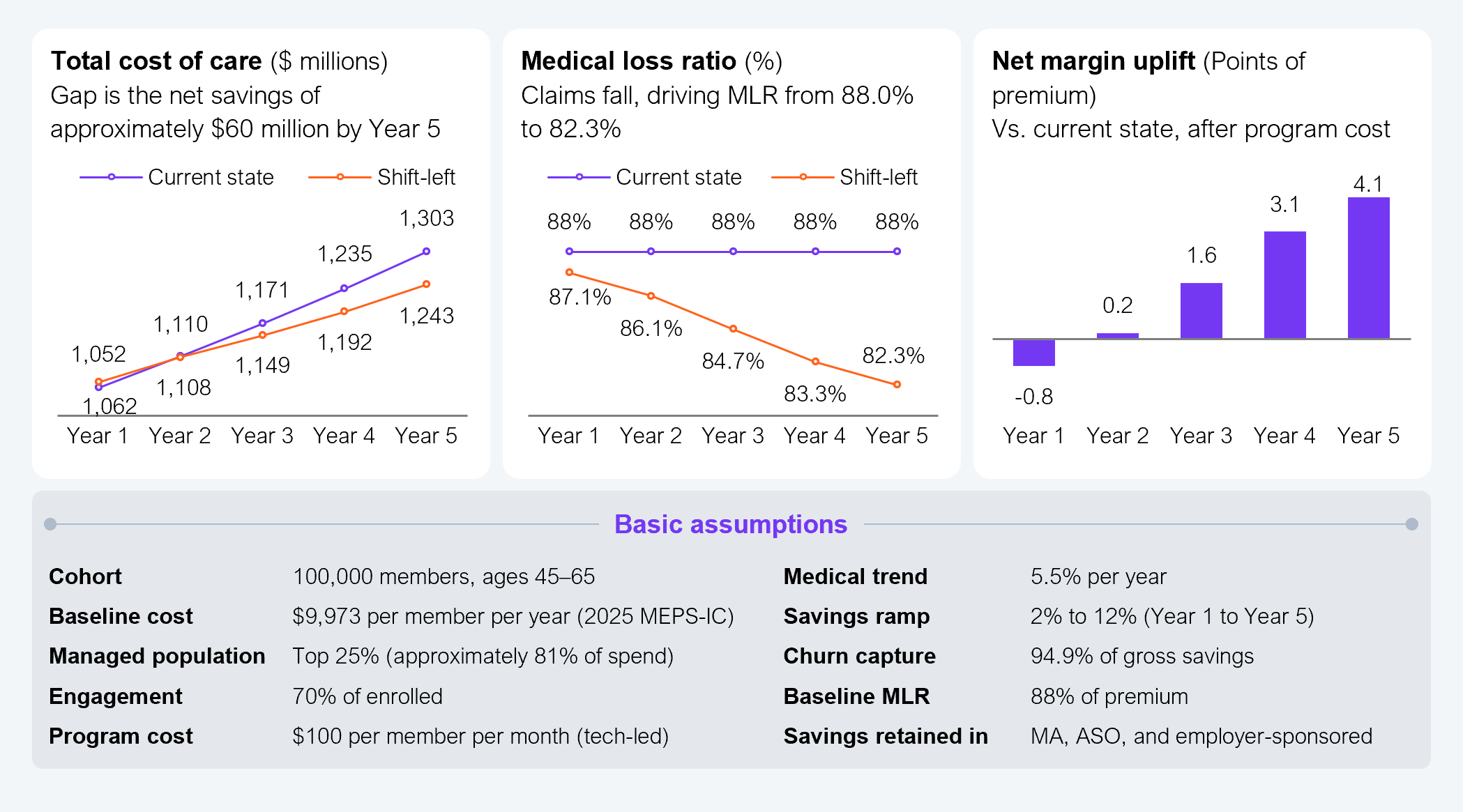
Shifting left is not an academic technology or operational exercise; it is a real shift in how health and care must be delivered to drive meaningful improvements in financial and physiological health. It is a paradigm with financial outcomes that will excite a payer CFO (see Exhibit 3) with meaningful improvements in MLR (the difference between the current state and shift-left in the center chart, 0.9 points in Year 1 to 7.7 points in Year 5) and margin (1.6 points in Year 3 to 4 points in Year 5).
Source: HFS Research shift-left model, 2026
The shift-left paradigm was modeled on a representative commercial cohort of 100,000 members aged 45 to 65 years. The baseline cost, approximately $9,973 per member per year, is based on the 2025 MEPS Insurance Component premium data. The target member cohort is a high-cost, high-risk-of-disease quartile enrolled in a tech-led program that costs $100 per member per month. Savings are assumed to begin conservatively at 2% and ramp up to 12% by year five as a delayed onset and slowed progression compound.
When netted against program costs and member churn, the result is decisive as reflected in Exhibit 3. The program turns net-positive in year three, delivering $118.5 million in cumulative net savings over five years, returning about 2x. Measured against the population actually managed, that is a nearly 10% reduction in cost by the fifth year. The model assumes conservative percentages applied to a highly concentrated cost base, and it already accounts for the two objections skeptics raise: member churn and the multi-year lag before prevention pays and still yields a positive return.
Two things make the case robust rather than aspirational. First, it is built on current, primary data that includes 2025 premiums, age-specific MEPS concentration, and American Diabetes Association economics showing more than $12,000 in excess annual cost per diagnosed patient, as well as an independent bottom-up check of disease progression using the top-down model. Second, the return is strongest wherever the payer keeps what it saves: Medicare Advantage, self-insured employers, administrative services only (ASO) arrangements (which cover the majority of covered workers), and provider-sponsored plans. In the fully insured book, medical-loss-ratio rules return most of the savings to members, so the shift left is a growth and retention play rather than a margin play.
No financial, regulatory, or technology limitation should prevent payers from shifting left. Most of the operational muscle, technology connections, and financial motivations are in place. However, leadership’s willingness to attempt something different from what they have been accustomed to doing for many decades, their inability to appreciate the new numbers, and the associated cultural and people change management pose potential internal headwinds. While that is legitimate, it is insufficient to maintain the status quo, as the business’s health is rapidly deteriorating. It is time to act now.
Register now for immediate access of HFS' research, data and forward looking trends.
Get StartedIf you don't have an account, Register here |
With the exception of our Horizons reports, most of our research is available for free on our website. Sign up for a free account and start realizing the power of insights now.
Our premium subscription gives enterprise clients access to our complete library of proprietary research, direct access to our industry analysts, and other benefits.
Contact us at [email protected] for more information on premium access.