IT architecture leaders, CFOs, ops, and automation CoEs each bring their own list of demands to the application of multi-agent AI. They need solutions that prevent breakdowns caused by integration complexity and uncontrolled failure cascades, and they must have controls on security and costs.
Sonata’s recently announced Agentbridge is a cloud-agnostic response for multi-agent orchestration, workflow automation, and enterprise integration, focused on regulated verticals such as banking and financial services, healthcare and life sciences, and manufacturing and retail.
CIOs, CTOs, and architecture leaders want a clear integration inventory, an understanding of data volumes, and an understanding of the dependencies involved in the nuts and bolts of multi-agent execution. CFOs and COOs want cycle times reduced, clarity on payback, and workflows simplified. The automation CoE and transformation leads need templates, governance, repeatability, and rapid deployment. Governance teams need clarity on policy coverage and auditability measures.
Agentbridge is focused on meeting the need for accelerated enterprise adoption for all these enterprise constituencies through domain blueprints, low-code/no-code orchestration, and deployable infrastructure packaging to reduce the challenges of putting multi-agent workflows into production. In regulated multi-cloud environments, it offers integration, observability, and ROI governance.
Agentbridge’s wide scope reflects the range of enterprise teams that must come together to make agentic AI deliver in the enterprise. The cross-silo responsibilities and capabilities required to make agentic AI work emphasize the need for firms to adopt an HFS OneOffice (Exhibit 1) approach when tackling AI.
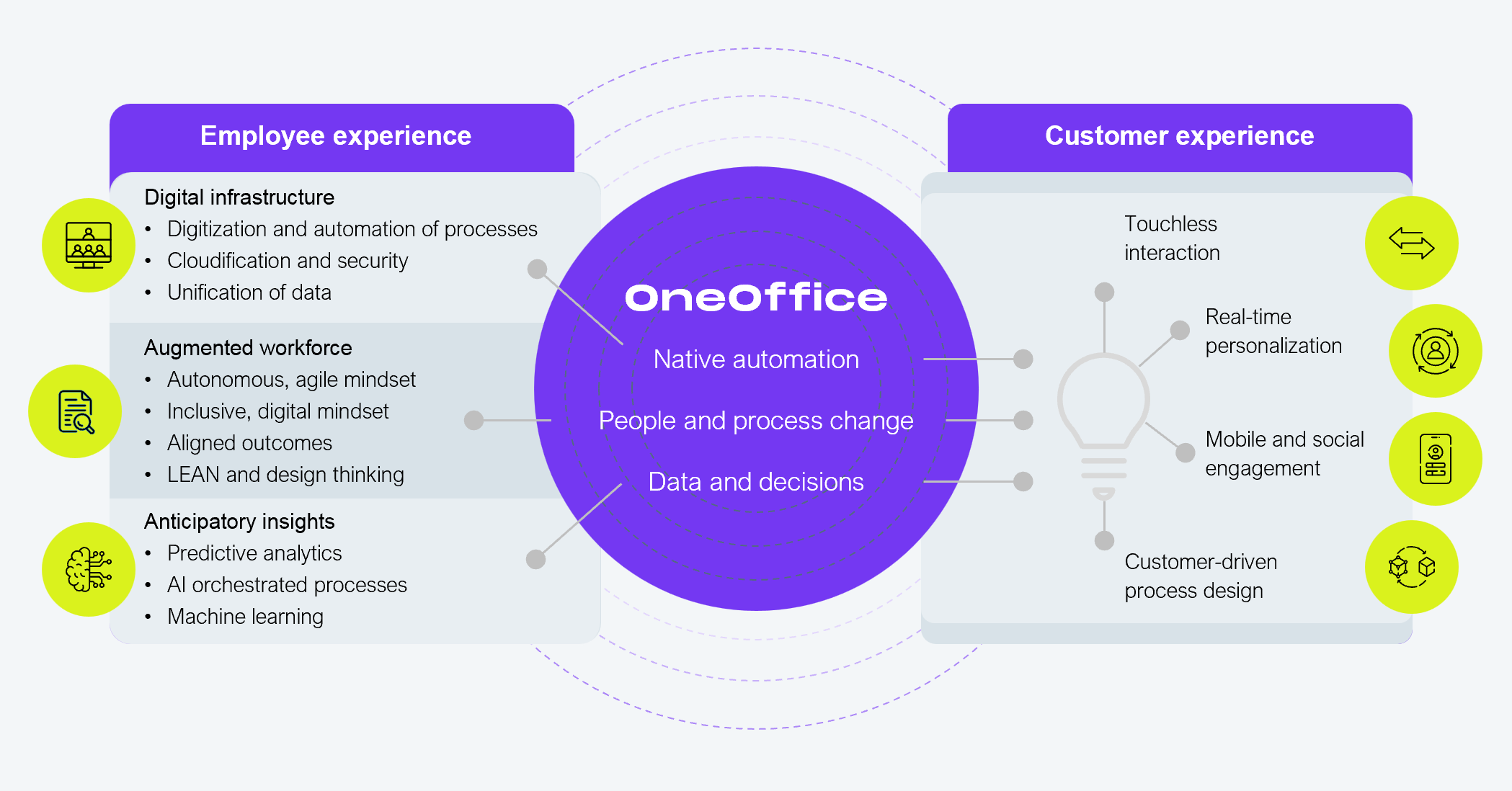
Source: HFS Research, 2026
Sonata’s accelerator works across three planes. Blueprint templates mean you aren’t starting from scratch, with domain-specific approaches available, prepared, and ready to go. Fusion Studio handles orchestration; packaged deployment, with enterprise-ready infrastructure profiles and cost predictability, is also part of the deal.
Sonata has mapped the enterprise’s needs to technical solutions. Agentbridge’s approach could help enterprises transform from a pipeline of proof-of-concept failures into multi-agent systems creating real value across OneOffice. Enterprise leaders would be wise to ask hard questions to turn the claims into realizable goals before signing on the dotted line.
For example, the COO and the ops team must request assurances regarding the number of full-time equivalent (FTE) hours saved, increases in straight-through processing (STP) rates, and reductions in resolution times. The CFO’s office needs evidence on ROI per workflow, cost per execution, and time-to-value. Sonata claims reports covering cycle time reduction, payback period, annual savings, workflow complexity, ROI and profitability calculations, and even “people takeout” are baked in. Now, they must prove this to the market with case studies beyond their own experience as client zero.
Enterprise leaders should also push for reports tracking end-to-end OneOffice outcomes to ensure cross-silo value is also being delivered.
Buyers do have the reassurance of Sonata’s track record with its Harmoni.AI framework, which combines AI-powered service delivery platforms, technology accelerators, and industry-relevant frameworks. For evidence of Harmoni.AI’s impact, read the HFS report, Sonata’s Harmoni.AI is embedding responsibility at the core of enterprise AI.
Agentic AI cannot be left to one enterprise department. Its impact crosses traditional boundaries and forces the breakdown of enterprise silos in line with HFS OneOffice. Agentbridge reflects this emerging need in its wide scope. One accelerator won’t change how you operate, but it should act as a wake-up call for any firm grappling with the people and change challenges that live alongside the technical challenges of making agentic AI work in the enterprise.
Register now for immediate access of HFS' research, data and forward looking trends.
Get StartedIf you don't have an account, Register here |
Register now for immediate access of HFS' research, data and forward looking trends.
Get Started