Compliance leaders are nearing a structural inflection point because volumes are rising, supervisory scrutiny is tightening, and the cost of “just adding headcount” keeps climbing even as the work becomes harder to defend under review. The operating-model choice is now stark: Will regulated enterprises redesign compliance around agent-prepared judgment, or keep scaling humans to manage machine-generated alerts?
UiPath’s acquisition of the WorkFusion platform is a bet rather than a niche experiment. The significance is not broader automation coverage, but a shift from compliance as a staffing model to compliance as a governed, agent-prepared workflow, where domain-trained agents operate inside regulatory control frameworks without breaking the evidence chain.
Compliance functions are absorbing more alerts, complexity, and regulatory scrutiny than their operating model was built to handle. The traditional response has been linear expansion, hiring more analysts, adding more review layers, and documenting more rigorously. That approach sustains throughput in the short term, but it compounds cost per case, increases cognitive fatigue, and introduces documentation variability that weakens audit defensibility over time.
AI has been positioned as the release valve, yet scaling it inside regulated environments has proven harder than expected. Our research shows that enterprises do not see model capability as the primary barrier to expanding autonomous workflows. Instead, they cite data and infrastructure readiness, cybersecurity exposure, skills gaps, legacy processes, and governance constraints as the dominant obstacles (see Exhibit 1). In other words, intelligence is not the bottleneck. Architecture is.
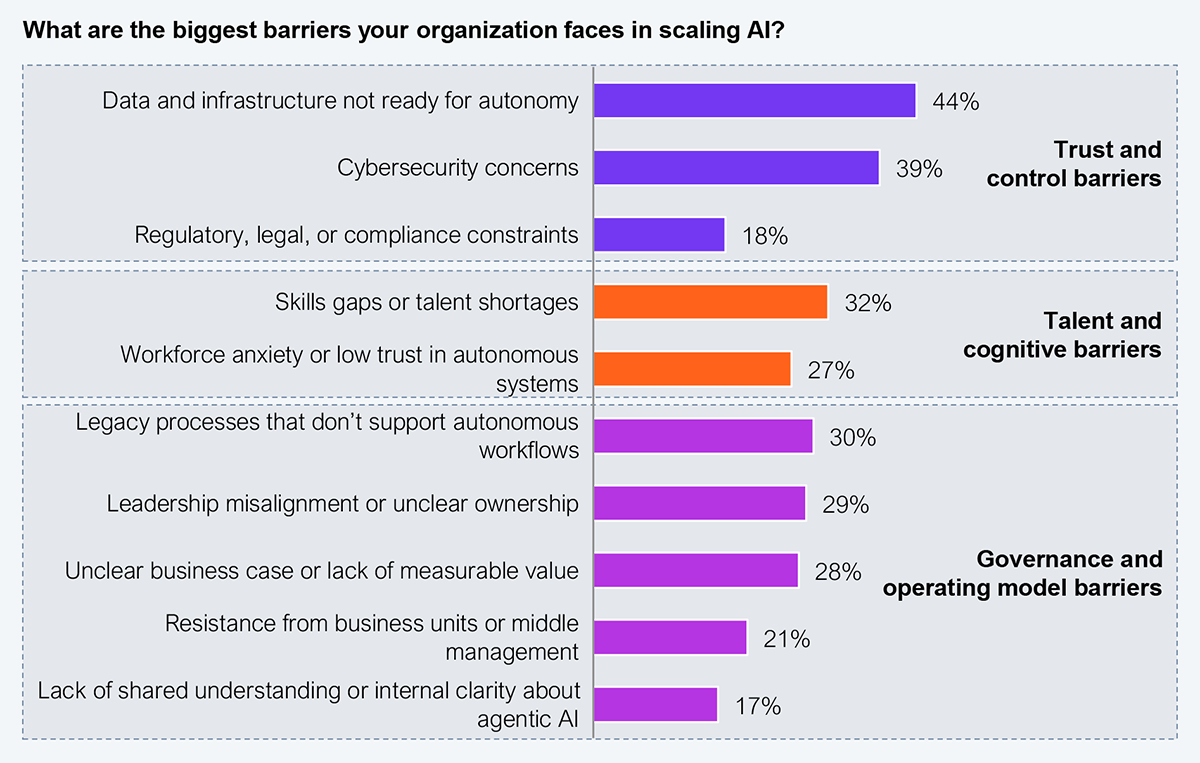
Source: 505 global enterprise leaders, HFS Research, 2026
This matters because the preparation layer of regulated investigations is where compliance operating models break first: case assembly, documentation packaging, and controlled handoffs that determine defensibility.
WorkFusion has traditionally positioned itself as a pioneer in AI “digital workers” for financial crime compliance (FCC), serving enterprise customers such as Deutsche Bank, BMO, and Raymond James. Its focus has largely been narrow and intentional, automating the most labor-intensive aspects of FCC while operating inside governance-heavy environments.
For UiPath, the value is not simply a library of domain-native agents, but an opportunity to move beyond horizontal task automation toward vertically specialized, agentic solutions designed to operate within regulatory control frameworks. Following its earlier acquisition of Peak to deepen its retail and supply chain intelligence, UiPath is building industry-specific agent portfolios in which autonomy must coexist with oversight. This latest move by UiPath is less about adding bots and more about embedding domain trust into the platform.
Financial crime compliance, particularly anti-money laundering (AML) and know your customer (KYC), is the closest example of this transition because it is where investigative overload and regulatory scrutiny collide most visibly.
Today, investigators spend disproportionate time on pre-investigation work, gathering signals, validating customer records, reviewing transaction histories, checking prior alerts, and assembling documentation. Even in automated environments, humans are the key orchestrators.
If agents handle pre-investigation by structuring case context, surfacing anomalies, and prioritizing risk, the operating model fundamentally changes:
In such a scenario, the speed of automation is hygiene while the core differentiator shifts to auditability, governance, and defensible decision pathways.
Additionally, this does not dilute human judgment; rather, it concentrates it. As repetitive preparation work declines, the cases that reach investigators become more complex and higher risk, helping the compliance analyst to evolve from a processor to a risk strategist.
For compliance leaders, the next hurdle is establishing regulatory-grade trust in any move toward agent-driven operations. HFS data reinforces that cybersecurity and control concerns sit at the top of enterprise scaling barriers, and that leadership hesitation intensifies in governance-heavy environments. This is where agent ambition collides with enterprise caution. The enterprise decision is whether to redesign investigations around agent-prepared judgment with provable controls or keep scaling humans to keep pace with alert growth and regulatory scrutiny.
Compliance leaders need to chart a path that preserves defensibility, strengthens oversight, and ensures that any shift toward agent-assisted investigations enhances the organization’s ability to demonstrate control intensity to regulators.
To move beyond pilots, UiPath needs to prove autonomy actually strengthens controls. That means regulator-interrogable decisions, human accountability, governance aligned with segregation of duties, and resilient operations with built-in audit trails.
WorkFusion brings domain depth; UiPath brings scale in orchestration and governance. But adoption will depend on defensibility under supervisory scrutiny. If agents can operate credibly in AML (a highly regulated and complex sector), the approach can be extended to other regulated decision-making workflows.
Enterprises that rely solely on task automation will keep scaling humans to manage machine-generated alerts. That model compounds cost and cognitive fatigue while doing very little to redesign decision-making.
Meanwhile, competitors that shift toward agent-prepared investigations will operate with faster resolution cycles, stronger documentation integrity, and more focused human expertise.
Register now for immediate access of HFS' research, data and forward looking trends.
Get StartedIf you don't have an account, Register here |
Register now for immediate access of HFS' research, data and forward looking trends.
Get Started