This Market Impact Report is for C-suite executives, chief AI officers, and technology and business leaders in banking and financial services evaluating how to build a global AI strategy, govern AI responsibly, and move beyond productivity gains to unlock enterprise-wide competitive advantage.
Thank you GenAI for kicking the door open to help banking and financial services (BFS) enterprises bring AI out of back-office oblivion. GenAI served as the catalyst to get AI back in the boardroom, and not a moment too soon, as the advance of AI technologies such as agentic AI is far exceeding the ability of established BFS firms to meaningfully assess, adopt, and apply AI in strategically meaningful ways. And by “strategically meaningful,” we mean doing more than hitting the low-hanging fruit lever of productivity with a side of potential cost savings. There is a massive opportunity for BFS enterprises to become AI-First leading with AI and automation to gain efficiencies, create new value, and drive competitive advantage rather than continuing to lead with people and manual processes.
HFS Research, in partnership with Infosys, set out to better understand how financial institutions around the globe are addressing the burgeoning AI opportunity. We surveyed 505 BFS leaders across major geographies to better understand why, what, and how BFS firms can be AI-First:
The sample included an intentional mix of IT and business leaders across banks and capital markets firms. We complemented the survey with detailed drill-down interviews with BFS leaders to road-test our analysis and develop pointed recommendations for AI success across the C-Suite–the “so what.” The report includes a case study on Citizens Bank’s AI journey to showcase a tangible example of BFS progress towards being AI-First.
The study reveals that BFS enterprises are all in on a formalized and funded embrace of AI. However, they risk failure if they don’t drive global, enterprise-wide AI strategies that contemplate more than people-centric bottom-line gains. To unlock the AI-First opportunity, BFS firms must recognize that their AI strategy IS their business strategy, with C-suite leadership driving clarity of purpose.


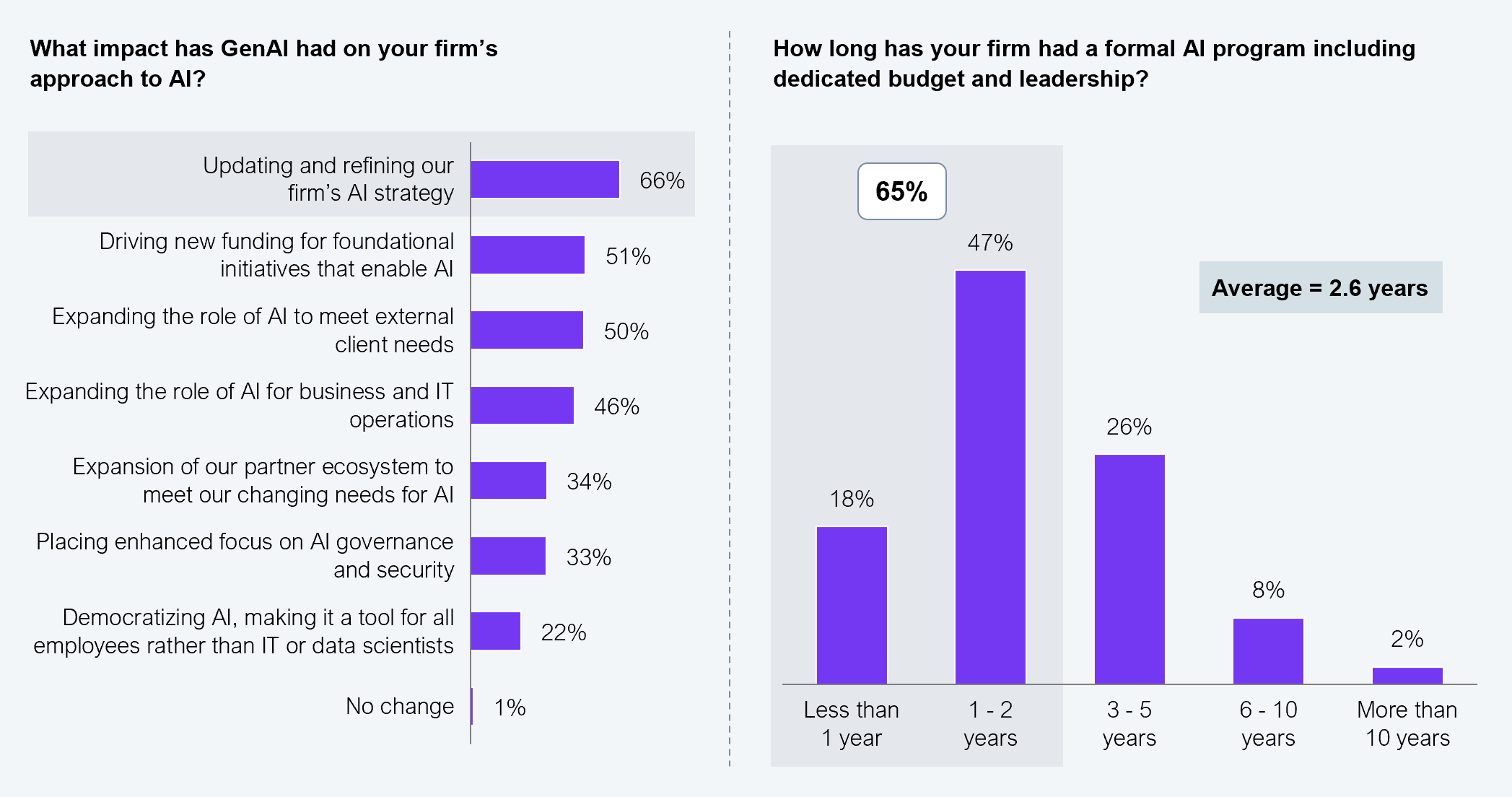
Thank you GenAI for kicking the door open to help BFS enterprises bring AI out of back-office oblivion. In the global BFS market, AI has been in use since the 1970s in various forms, spanning uses such as algorithmic trading, fraud detection, robo-advisory, risk management, underwriting, customer service, and more. Despite this entrenched AI baseline, there were few formal, sustained AI programs with dedicated leadership and budgets. AI was instead part of applied operations at the function, region, or LOB level.
ChatGPT3 was launched in November 2022. Its swift proliferation in the consumer world forced the business world to take rapid action. For the first time since the mobile phone revolution, a technology was being proactively adopted by users. For BFS firms, this meant they needed to rapidly assess, opine, and manage this new technology because employees around the globe were using it at work and no one was sure of the implications, safety, or value.
We asked 505 financial services leaders from around the globe to weigh in on this trend. As depicted in Exhibit 1, 66% of respondents indicated the biggest impact GenAI had on their firms’ approach to AI was mass updating and refinement of their AI strategies. We see the impact of this mass formalization when we asked BFS respondents how long they have had formal AI programs complete with dedicated budget and leadership. 65% of BFS firms’ AI programs are less than two years old. Take that in for a moment.
The longevity of AI in BFS firms is not at all the same as having formal and funded AI programs. For most firms, it took the advent of GenAI to elevate AI to something more than a category of tools used as part of processes. AI has evolved into a critical change agent relevant across most facets of BFS enterprises. Given the staggering rate AI is moving at, these formal programs are more important than ever.
Dhiraj Rattan, CIO – Consumer Banking and Enterprise Product Engineering, Citizens Bank, agreed with this trend but offered some thoughts on why this is more than just the ChaptGPT effect:
We already had well-established AI capabilities, especially in ML and supervised learning, that pointed at areas such as fraud, underwriting, and personalized communications. Over the past 18 months, the bank has been exploring the value of GenAI. But not just because it’s a fad. We’ve escalated our focus because all the work and investment we’ve been doing in adopting modern architectures and the cloud for all our platform and data workloads have enabled us to adopt new ways of bringing and using intelligence. You can’t go from no intelligence to full intelligence in one step. You need an interim step. But we are ready to adopt newer concepts and do more with AI.
— Dhiraj Rattan, CIO – Consumer Banking and Enterprise Product Engineering, Citizens Bank
Sample: 505 global banking and financial services leaders
Source: HFS Research in partnership with Infosys, 2025
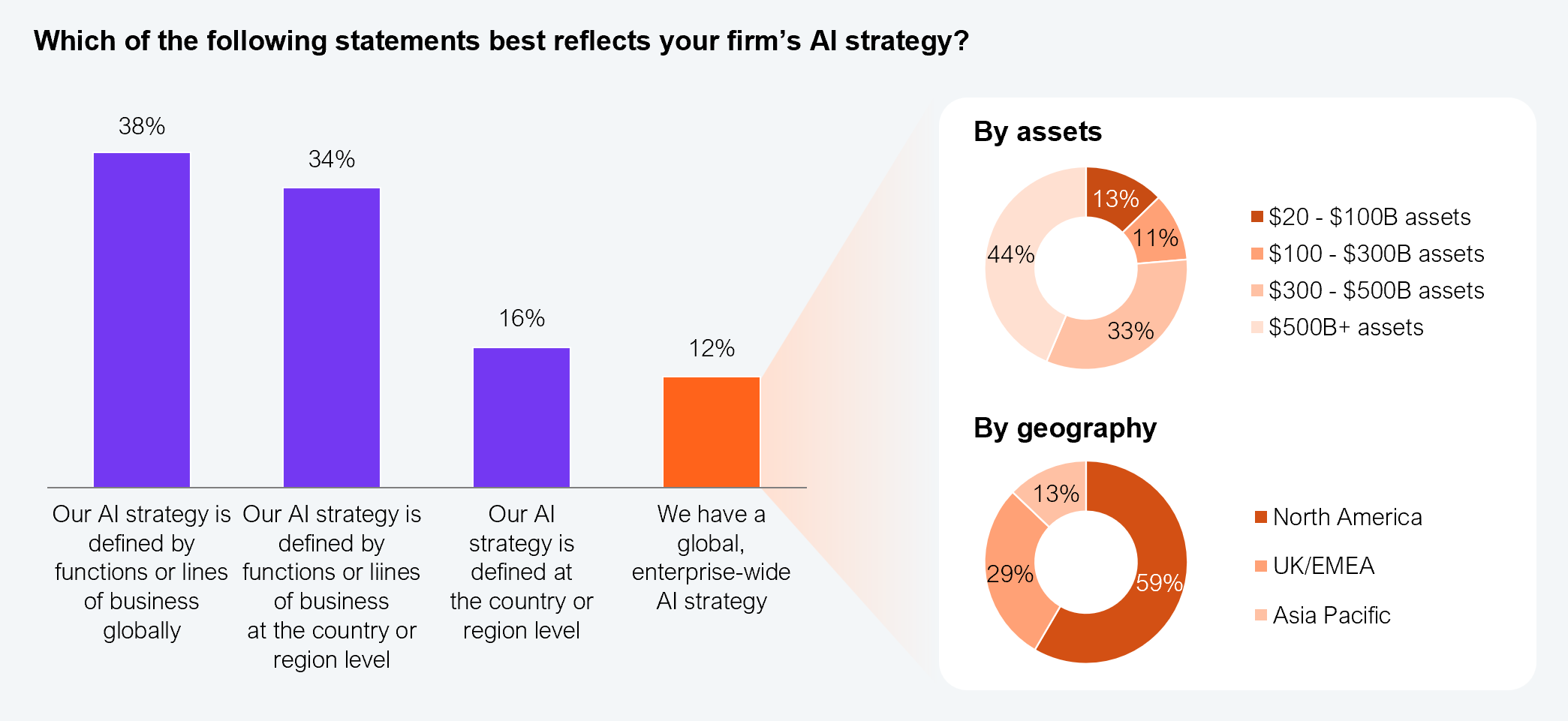
BFS enterprises are getting real about AI, but they need to get their approach right or risk lackluster, unintegrated results. We asked BFS respondents to tell us how their AI strategies are organized. As illustrated in Exhibit 2, just 12% of BFS enterprises have global, enterprise-wide strategies. The other 88% are defined by region, function, or LOB, which tends to yield silos of unintegrated use cases that do a poor job of achieving enterprise-wide business objectives. Those with global, enterprise-wide AI strategies are large firms with more than $300 billion in assets based in North America, the UK, and Europe.
The creation of global, enterprise-wise AI strategies is critical because they align AI strategy with business strategy, providing guidance to the entire global business about how AI supports business priorities tied to the topline, bottom line, and stakeholder value. BFS enterprises that lack global, enterprise-wide AI strategies are essentially allowing functions, divisions, LOBs all the piecemeal functional and geographic silos to define what works for them without any clear alignment with overarching business priorities. BFS enterprises need top-down AI strategy guidance and bottoms-up AI strategy execution by the functions and LOBs that know their domains better than anyone. Defining AI strategy in silos risks minimizing value for the broader enterprise. Those enterprises that think small get small results. Ashok Panduranga, AI and Automation Lead Executive, American multinational financial services firm shared his views on this top-down, bottoms-up dichotomy:
Our firm has an enterprise-wide AI strategy. This is essential to help us bring together and manage AI and drive economies of scale. Strategy is defined at an enterprise-level, executed at a federated level and tracked and managed centrally. This gives us great visibility and helps us centralize resources, talent, skills, models, tools, etc. and prioritize use cases and investments. Without an enterprise-wide AI strategy, we would have no way to manage the competing agendas of different functions and silos.
— Ashok Panduranga, AI and Automation Lead Executive, American multinational financial services firm
Sample: 505 global banking and financial services leaders
Source: HFS Research in partnership with Infosys, 2025
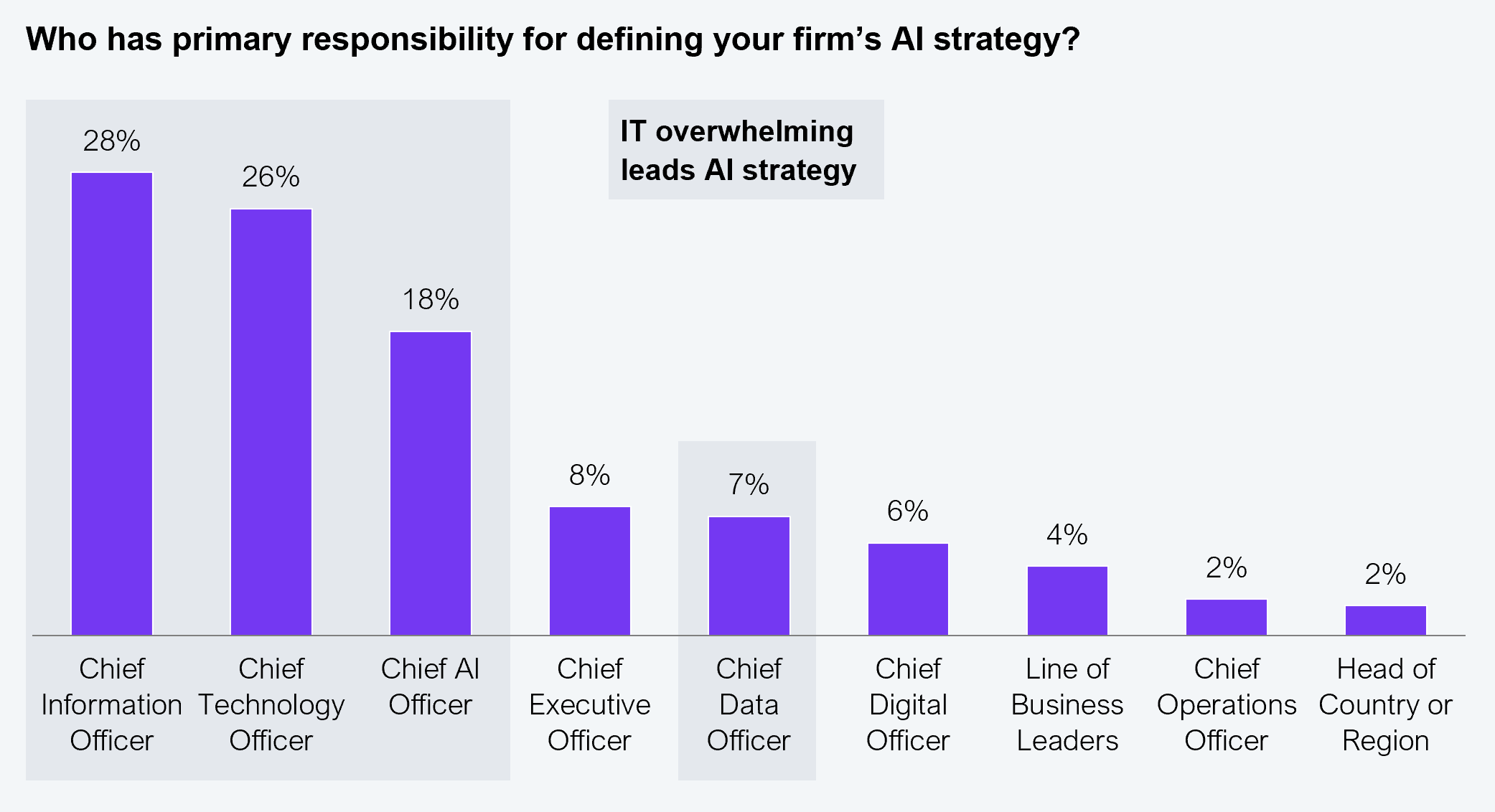
When we asked respondents who is defining their AI strategies, the overwhelming majority of 79% across various tech roles specified that IT sets the AI strategy (see Exhibit 3). While this makes sense from a technology and architecture definition standpoint, enterprise AI strategies must be defined by the core C-Suite, including the CEO, CFO, COO, CIO, and chief risk officer (CRO), to ensure alignment with overarching business objectives. AI strategy is not IT strategy. This data helps explain why so few firms have enterprise-wide AI strategies as IT leadership is highly aligned to regions, LOBs, and functions.
We note the rise of the chief AI officer, a new role cropping up in enterprises tasked with owning the subtle specifics of AI strategy, execution, and governance. They are also increasingly serving as the chief unifiers—working to drive cohesive AI programs.
Sample: 505 global banking and financial services leaders
Source: HFS Research in partnership with Infosys, 2025
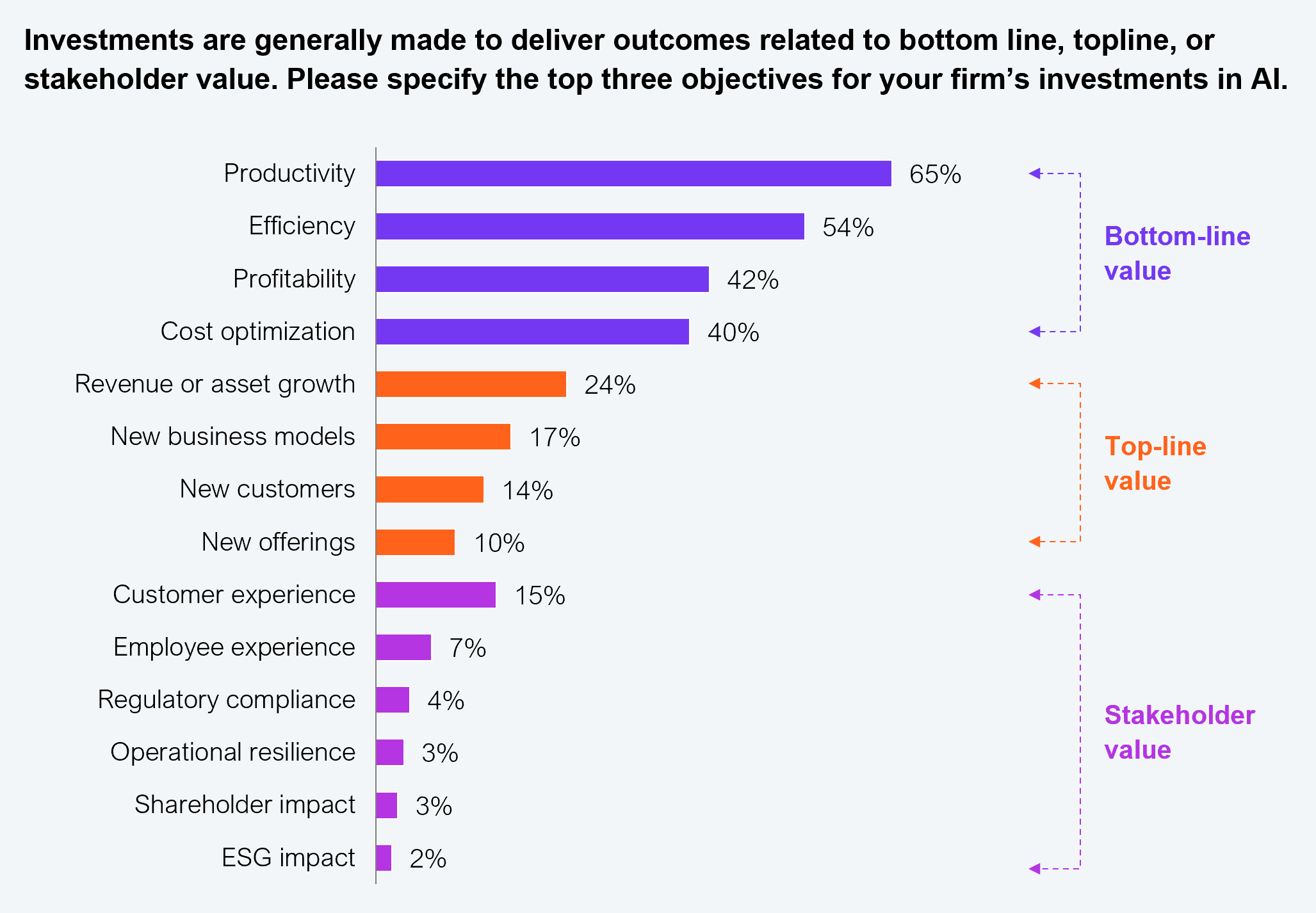
The impact of allowing AI strategies to be defined in silos and led by IT is already visible in the value and benefit being realized in BFS enterprises. HFS queried BFS leaders on their top objectives for their AI investments related to generating topline, bottom line, and stakeholder value. The results are overwhelmingly focused on bottom-line value, with productivity at the top of the stack (65%). As shown in Exhibit 4, the realization of topline value, such as revenue or asset growth or stakeholder value such as customer experience, barely registered.
When AI strategies are managed in silos, it pushes the responsibility for defining focus and purpose down to the lowest common denominator. This yields a focus on low-hanging fruit use cases and problem statements with LOBs, functions, and domains tending to showcase quick results and viability that meet their respective needs but likely have limited intentional alignment to corporate business strategy. The focus on productivity is not accidental. It’s the easiest thing to measure. BFS firms are riddled with manual processes screaming for tech interventions. Productivity gains offer quick wins and fundable use cases.
The Head of AI Platforms for a major ANZ bank agreed with this assertion but also underscored how smart banks will ensure that productivity impact translates into growth potential:
As a firm, we are very metric-driven and want to get our cost-to-income ratio in better shape compared to peers. Productivity and cost are our top priorities for AI initiatives at this time. We believe that if we get the bottom-line impacts right, it creates the opportunity to focus more on top-line value and stakeholder value. We have to drive enhanced productivity, efficiency, and cost to help us free up capital and resources to drive growth in revenue and asset expansion.
— Head of AI Platforms for a major ANZ bank
When there is no enterprise-wide AI strategy to align to, business silos make their own choices, which may be valid and viable but rob the broader enterprises of focus, best practices, and economies of scale. The value of enterprise-wide AI strategies is alignment with the enterprise business strategy. Last time we checked, the strategies powering the world’s top financial services brands are not built on bottom-line impact alone. AI can and should also drive topline and stakeholder value; otherwise, you’re just treading water.
Sample: 505 global banking and financial services leaders
Source: HFS Research in partnership with Infosys, 2025
The “So What” recommendation for the C-Suite
AI is the new transformation lever. Don’t squander this opportunity with a siloed, overly IT-centric approach. Treat your AI strategy as an extension of your business strategy that ensures appropriate alignment with topline, bottom-line, and stakeholder value objectives. AI is not a hammer looking for a nail. It should complement your business strategy. Involve the core C-Suite leadership team in AI strategy definition to ensure a comprehensive centralized strategy and well-communicated federated execution.
In late 2022, the world welcomed ChatGPT3. 2023 became the year of “what is it?” with lots of cautious experimentation and absolutely no planned budgets. 2024 was the year of “death by 1,000 pilots,” where BFS enterprises experimented with use cases with very limited discretionary spend but were able to build some decent business cases to justify spending in 2025. As inflationary and interest rate pressures start to recede globally, BFS enterprises are poised to drive AI progress in 2025. This AI progress will be enabled by a mix of foundational investments to address data, technology, and process debt with a side of bet-hedging GenAI assistants with some decent IT and business collaboration across functions and LOBs. Get ready to sprint.
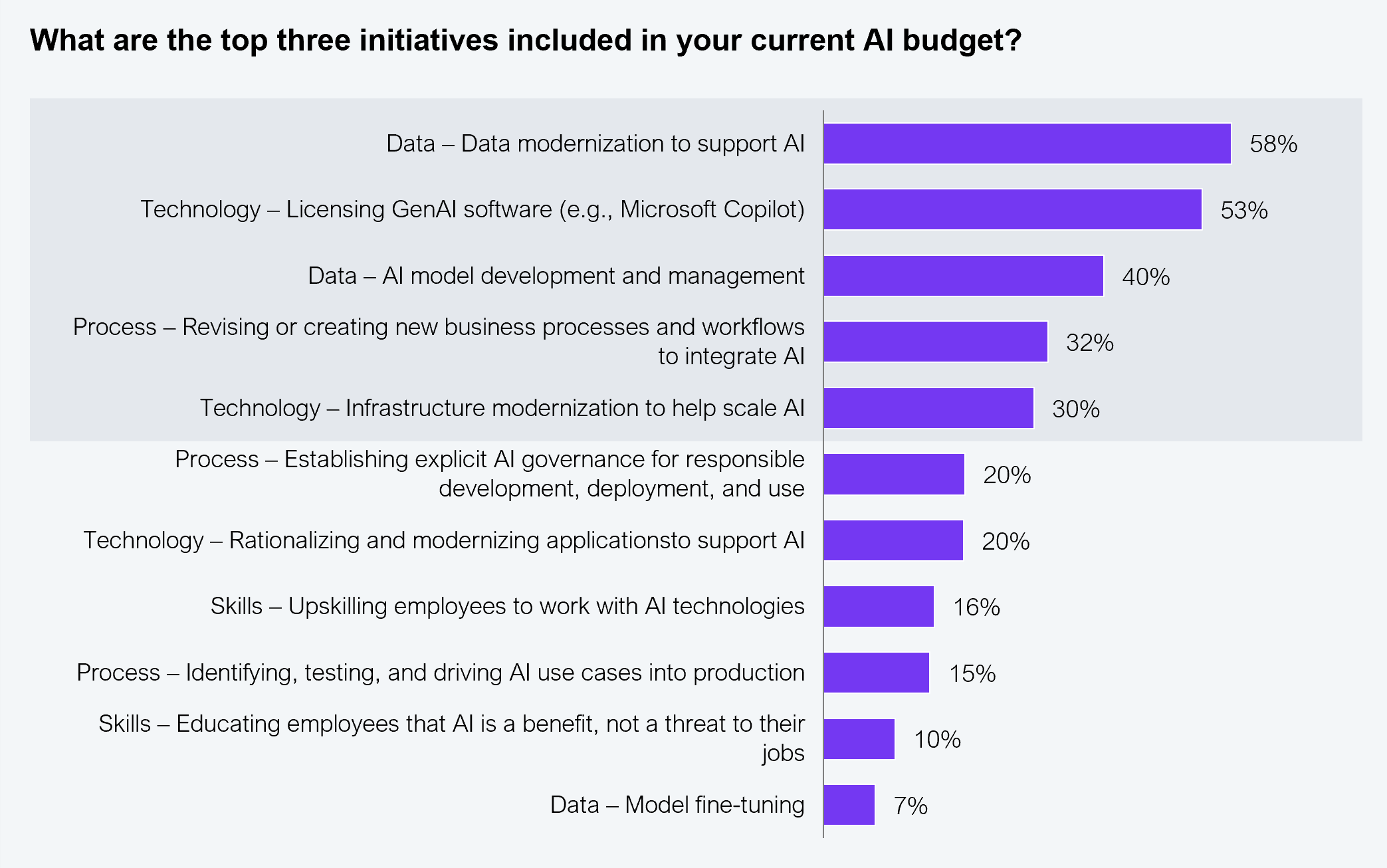
We asked BFS leaders how they plan to spend their AI budgets in 2025 across four major categories—data, technology, process, and skills. Data came up big (see Exhibit 5). This is not surprising as data powers AI. Data modernization to support AI topped the list (58%), with AI model development and management securing the third position (40%). Data investments encompass data access and quality of data to feed AI models and enhance data infrastructure, management, and analytics to support advanced AI applications. While banks have been investing in data modernization for what feels like decades, the Head of AI Platforms for a major ANZ bank helped contextualize why GenAI is driving new requirements:
So much of the data modernization in banks has been focused on structured data. In many generative AI use cases, we’re grappling with unstructured data, which is creating some challenges. Trying to synchronize unstructured data into chunking methods and keeping vector stores up to date is proving to be complicated.
— Head of AI Platforms for a major ANZ bank
About a third of the sample cited process reinvention as a critical investment focused on revising or creating new processes and workflows to integrate AI. Changing how work is done internally and how partners and customers interact with your firm across various facets of BFS processes requires focused change management to appropriately refine existing processes and ensure that adjacent processes are duly updated.
Tech infrastructure modernization to help scale AI rounded out the top five investments. This includes elements such as storage for AI training data sets, compute resources to power training and inference, hybrid cloud capabilities to enable dynamic resource allocation, edge computing to optimize performance, security including encryption and data anonymization to protect customer financial data and personal information and, of course, middleware and APIs to help enable integration with legacy systems.
HFS characterizes these investments as foundational investments. They largely represent modernization and transformation initiatives BFS firms must undertake to enable progress with AI. BFS firms are also investing in the happy path—out-of-the-box GenAI assistants such as Microsoft CoPilot and ChatGPT—to drive sanctioned GenAI into the hands of its workforce. Licensing GenAI software is rated as the number two AI investment (53%). While GenAI tools are driving strong license revenue, adoption rates continue to be lukewarm—serving as a reminder that tools without clear problems to solve don’t fare well.
Sudhakar Gopal, EVP & CIO, Head of Engineering and Operations – Enterprise Data, Advanced Analytics, API Middleware and Integration Platforms, Citizens Bank, articulated his views on the importance of foundational investment in AI enablement:
Over the past three years, we have revamped our data strategy with C-Suite support across six key pillars: 1. driving data centralization, 2. data democratization, 3. real-time data, 4. infrastructure modernization, 5. data sources, and 6. advanced analytics and AI. These initiatives are all about enabling the enterprise, and we have made phenomenal progress. While all of this work and investment were not solely to activate AI, it is a piece of the approach and has really put us in a position to tackle AI at scale.
— Sudhakar Gopal, EVP & CIO, Head of Engineering and Operations – Enterprise Data, Advanced Analytics, API Middleware and Integration Platforms, Citizens Bank
We’ve captured more detail on the AI journey of Citizens Bank in this case study:



A final thought on investments: it’s always critical to look at what is not being funded. Our data shows governance and skills are lower links in the priority chain. While everything can’t be a priority, appropriate AI guardrails and employee skills enablement are essential to progress.
Sample: 505 global banking and financial services leaders
Source: HFS Research in partnership with Infosys, 2025
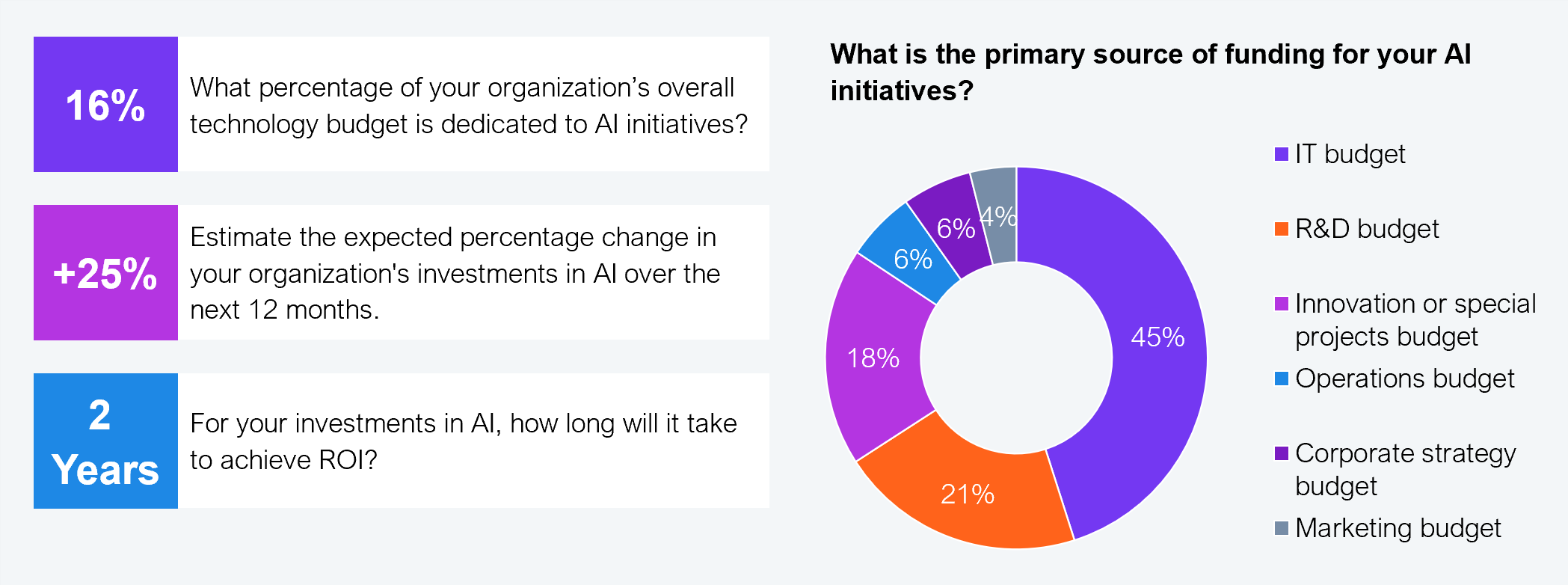
BFS leaders, great job building fundable AI business cases in 2024 to power the 2025 budget cycle. As shown in Exhibit 6, BFS respondents are dedicating an average of 16% of their tech budget to AI in 2025. This sounds like a significant chunk of change, but when you consider the foundational investments, showcased in Exhibit 5, it makes sense. BFS respondents estimate they will increase their AI budgets by 25% this year, underscoring the return of discretionary spend.
Gone are the days of 5–7 year transformation cycles. BFS firms expect ROI from their AI investments within two years on average. While many foundational investments may not be complete in this time frame, many AI business cases are built with value realization starting in year one and then building from there. A lot depends on data and technology readiness.
We also explored the primary sources of funding for AI. Unsurprisingly, IT is the top source for AI budgets (45%), given the focus on foundational investments. R&D budget places a distant second (21%), followed by innovation or special projects (18%)—signifying we are moving out of the experimental stage with AI. Dennis Gada, Executive Vice President and Global Head of Banking & Financial Services at Infosys, shared his views on aligning AI investment with impact:
Financial institutions worldwide are actively climbing the value chain, leveraging AI to move beyond cost reduction and drive efficiency, modernization, revenue growth, and stakeholder value creation. The HFS-Infosys study reinforces this shift, proving that AI is exponentially becoming a strategic priority, with BFS firms expected to increase AI budgets significantly. However, AI success is not just about investment—it requires a well-orchestrated strategy that aligns technology with business objectives to maximize the impact. At Infosys Financial Services, we observed emerging patterns where AI adoption is accelerating for high-impact business processes alongside broader technology modernization efforts, as well as the evolution of the software engineering model. The latest Infosys Bank Tech Index also highlights how banks are aligning their tech spend and prioritizing AI for business value, with a focus on responsible AI.
— Dennis Gada, Executive Vice President and Global Head of Banking & Financial Services at Infosys
Sample: 505 global banking and financial services leaders
Source: HFS Research in partnership with Infosys, 2025
LOB leaders and functional leaders will typically have different goals and objectives for their areas of responsibility. LOB leaders are generally laser-focused on revenue and growth parameters, while functional leaders are operations and cost-focused. What they have in common is they are all domain experts in their respective areas of responsibility. This domain expertise brings a keen awareness of what works, what doesn’t, and informed opinions on what must change. Great AI use cases are spawned within domains by leaders and their teams who want to solve problems and impact key metrics.
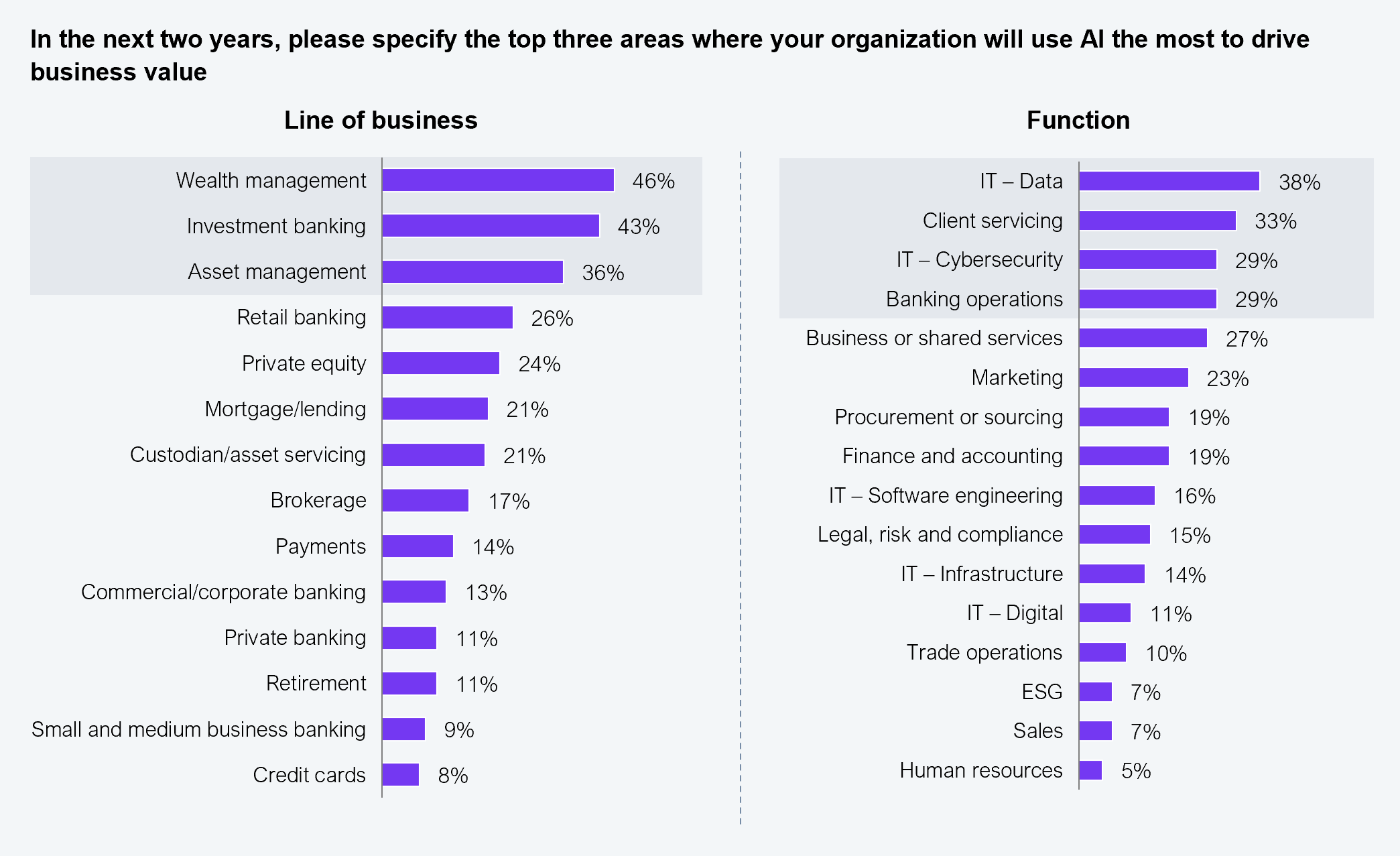
HFS asked survey respondents to comment on which LOBs and functions they plan to use AI over the next couple of years to drive business value (see Exhibit 7). From the LOB perspective, there is a decided focus on capital markets domains across wealth management (46%), investment banking (43%), and asset management (36%). Retail banking is a distant fourth (26%), which is relevant as it reminds us that these responses likely represent the next wave of AI initiative focus. LOBs such as retail banking have been leveraging forms of AI for years to drive self-service with customers, mitigate fraud, and hasten loan processing and underwriting. Data-heavy businesses such as these capital markets domains are ripe for AI-led initiatives that can drive growth and expand offerings in areas such as data monetization, portfolio optimization, and deal structuring and contracting. While our study covers the full canon of AI technologies, these responses likely lean toward the use of GenAI as the newest AI technology.
From the function standpoint, there is a balanced prioritization between IT and business functions. The top IT functions prioritized for AI initiatives include data (38%) and cybersecurity (29%). This likely represents both enablement investments aligned to Exhibit 5 as well as the use of AI to improve functions such as real-time data processing, automated data cleansing, and threat detection. The top business functions prioritized for AI initiatives include client servicing, including contact center (33%) and banking operations 29%. Global business services (shared services) is just a hair behind banking operations. These functions continue to be ripe for productivity and cost optimization.
As noted by Darrell White, Head of Technology Transformation & Enablement, Customer Success Platforms at PayPal:
Financial services firms spend a ton of money supporting IT and servicing clients. It’s a fundamental cost of doing business. So when firms are assessing potential use cases for various forms of AI, the cost centers are always top of the list. These are not necessarily the best use cases from an innovation standpoint, but they are the low-hanging fruit with distinct volume potential to drive cost savings.
— Darrell White, Head of Technology Transformation & Enablement, Customer Success Platforms at PayPal
Sample: 505 global banking and financial services leaders
Source: HFS Research in partnership with Infosys, 2025
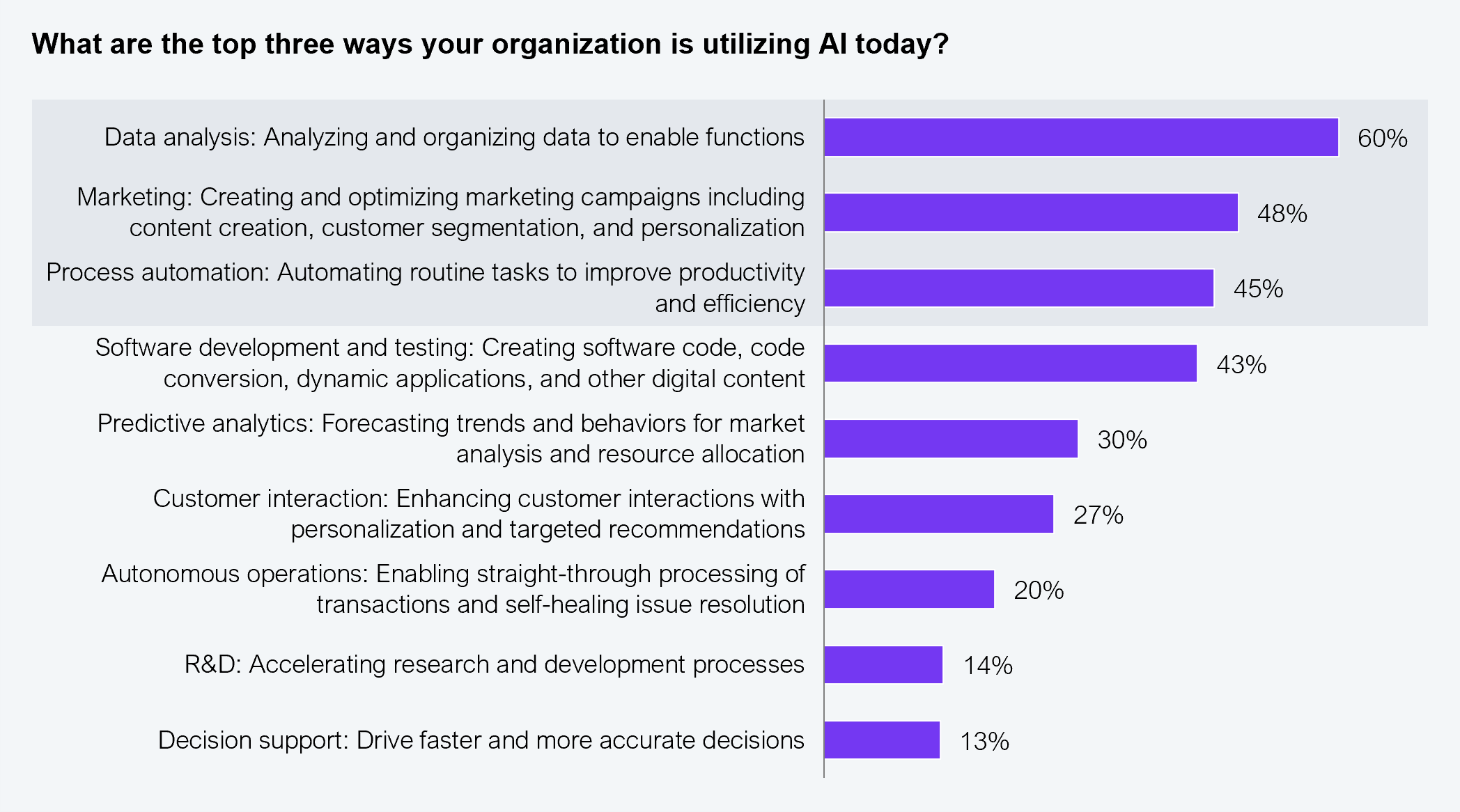
When we asked BFS leaders about their top pattern-based uses for AI (see Exhibit 8), data analytics topped the list (60%). It’s the ultimate low-hanging fruit that comes bearing its own training data and clear computational superiority over humans for depth, speed, and quality. This category covers many of the classic, effective applied AI use cases in BFS firms—fraud detection, credit risk assessments, anti-money laundering transaction monitoring, algorithmic trading, sentiment analysis, and others.
Another proven classic clocked in at number three—process automation (45%). While much of the history of process automation is tied to deterministic technologies such as RPA and business process management tools, AI excels at adding cognitive capabilities to automation, thus the terminology “intelligent automation.” If there is data to be consumed in processes such as transaction data, invoices or statements, onboarding materials or loan application content, AI models can be built to add cognitive capabilities.
A couple of emerging stars also rated well, enabled by the advent of large language learning models (LLM) powering GenAI. GenAI’s superpower is generating content from data. Marketing secured the number two position with 48% of respondents indicating it is a top AI use case. GenAI has revolutionized the segmentation, personalization, and generation of tailored content.
Software development and testing, with 43% of BFS respondents indicating this as a top AI use case, is the top performer. LLMs are being trained on large code bases, which is helping to drive code conversion, legacy code modernization and improvements, code refactoring, containerization, documentation, and quality assurance. This use case offers massive speed and quality benefits for legacy modernization, especially in an era of declining COBOL engineers.
Ben Rayner, Head of Analytics and Process Optimization, Citi Chief Operating Office, commented on Citi’s foray into GenAI:
Citi has rolled out two initial tools across the firm. It took just a few months from ideation to production. Citi Assist searches internal bank documentation to help navigate commonly used policies and procedures across HR, risk, compliance, and finance. Citi Stylus is able to summarize or search multiple documents at the same time. We launched in December 2024 and have about 100K people using them across various geographies. This is a very intentional top-down approach where we are perhaps under-utilizing the capabilities of GenAI but it is helping to build the culture of AI use. We are getting people familiar with the tools, while supporting change and governance. This will ultimately help us go fast, but we are purposeful and steady at the moment. Failing fast is not the right approach for GenAI.
— Ben Rayner, Head of Analytics and Process Optimization, Citi Chief Operating Office
We note that autonomous operations rated near the bottom of current use cases. Given the escalating hype around agentic AI—AI with autonomous decision-making abilities that can execute complex tasks without human intervention based on data and defined objectives, we expect significant experimentation with autonomous agents in 2025.
Sample: 505 global banking and financial services leaders
Source: HFS Research in partnership with Infosys, 2025
The “So What” recommendation for the C-Suite
2025 is the year BFS enterprises make AI real. Foundational investments in data and tech modernization are essential to enable AI progress, while licensing GenAI tech can drive sanctioned AI into the hands of users. Beware over-rotation on tech investment without clarity of vision on how AI supports the broader business strategy. Your AI strategy is your business strategy NOT your IT strategy. Guidance from senior leadership to LOBs and functions will help ensure they consider AI use cases beyond productivity and cost savings.
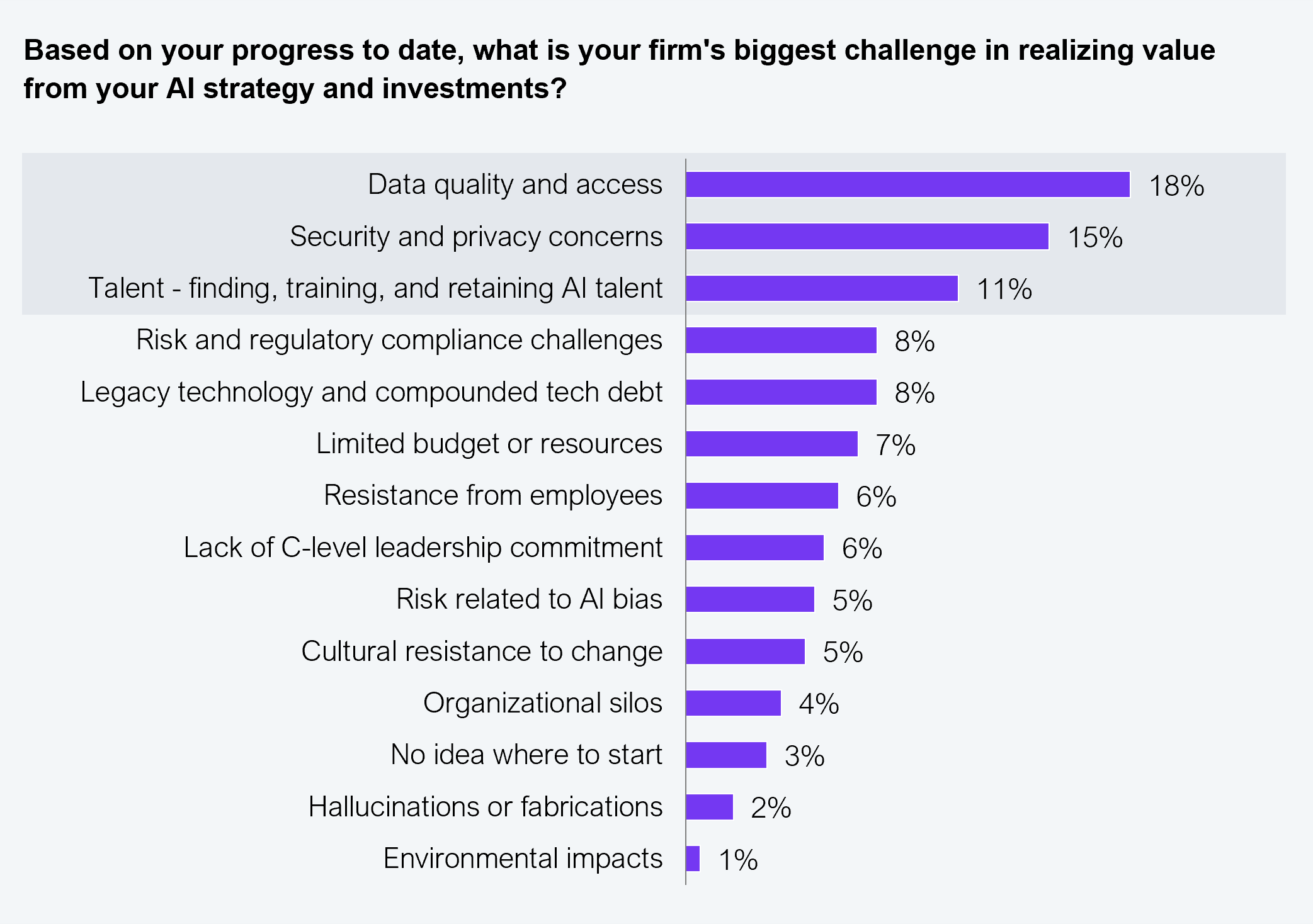
BFS enterprises on the journey to being AI-First are faced with three key challenges to unlocking value from their AI strategies and investments—data quality and access, security and privacy concerns, and talent (see Exhibit 9). This is consistent across geographies, business versus IT, and size of firms.
The data quality and access challenge align with the top area of planned investment in AI—data modernization (see Exhibit 5). This is not accidental as AI is powered by data. The heart of the data access issue is availability across silos and divisions—an area banks have been working on for years. This is compounded by the growing need for real-time data, multi-format data, and vast quantities of data to power AI models. While approaches such as integration platforms, data lakes, API-based data access, and data virtualization have driven vast data access improvements, silos persist and data quality is often not fit for purpose. Inaccurate, incomplete, imbalanced, noisy, poorly labeled, metadata issues, biases and more all lead to data quality issues that drive significant risk into AI models and results. While this roadblock can be partially addressed by data modernization, it additionally points to the need for associated AI governance.
Ashwin Roongta, Head of Technology – Business Applications, Infrastructure & Services at Wedbush, shared his views on tackling data challenges:
We’ve got a chicken or egg situation going on right now with AI data investments. Many say wait until you understand your use cases and then invest and build. We decided to let tech lead instead of the use cases. We built an integrated data lake with AI fabric with smart, integrated design that is meeting our needs. We tackled centralized data and reporting first, which helped massively with data quality. This, in turn, helped with our glide path to AI. Data quality is always an ongoing issue, but we were able to start with relatively clean data.
— Ashwin Roongta, Head of Technology – Business Applications, Infrastructure & Services at Wedbush
Security and privacy is the second biggest challenge to AI progress. Given the vast array of sensitive personal and financial data handled by BFS firms, maintaining data privacy, and ensuring robust cybersecurity measures including encryption, access controls and threat detection systems are essential practices. Given the strict regulations around data use, access as well as location and sovereignty, most banks have functional programs. The shortfall often comes down yet again to immature governance programs.
Talent took third place, with BFS firms lamenting how hard it is to find, train, and retain AI talent. While AI technical talent is critical to cultivate, BFS firms should take their employees on the AI journey by upskilling them to use and benefit from AI investments. In the future, all talent must be AI talent. Ben Rayner, Head of Analytics and Process Optimization, Citi Chief Operating Office, agreed with this perspective, commenting on the importance of process expertise in designing effective AI:
AI is not a technology discipline. It is a process discipline. Unless you know the process to educate the AI, it will not work. We’ve underestimated the need for process talent when designing AI.
— Ben Rayner, Head of Analytics and Process Optimization, Citi Chief Operating Office
Sample: 505 global banking and financial services leaders
Source: HFS Research in partnership with Infosys, 2025
Over a decade ago, the Basel III framework in BCBS 239 laid out principles for risk data aggregation and reporting for large banks and financial institutions that directly impact AI governance today. GDPR and regional regulations such as the California Consumer Privacy Act have added various personal data protections over the years with provisions around responsible AI governance. The EU AI Act was adopted and entered into force in August 2024. It is the most comprehensive set of AI laws in the world, taking a risk-based approach to regulating AI systems. Obligations will come into play over the ensuing 24 months. Meanwhile, in the US, the new Trump administration swiftly eliminated the Biden-era AI Act. Love or hate regulations, they drive programmatic response—something that is sorely needed for AI to safely and systematically progress.
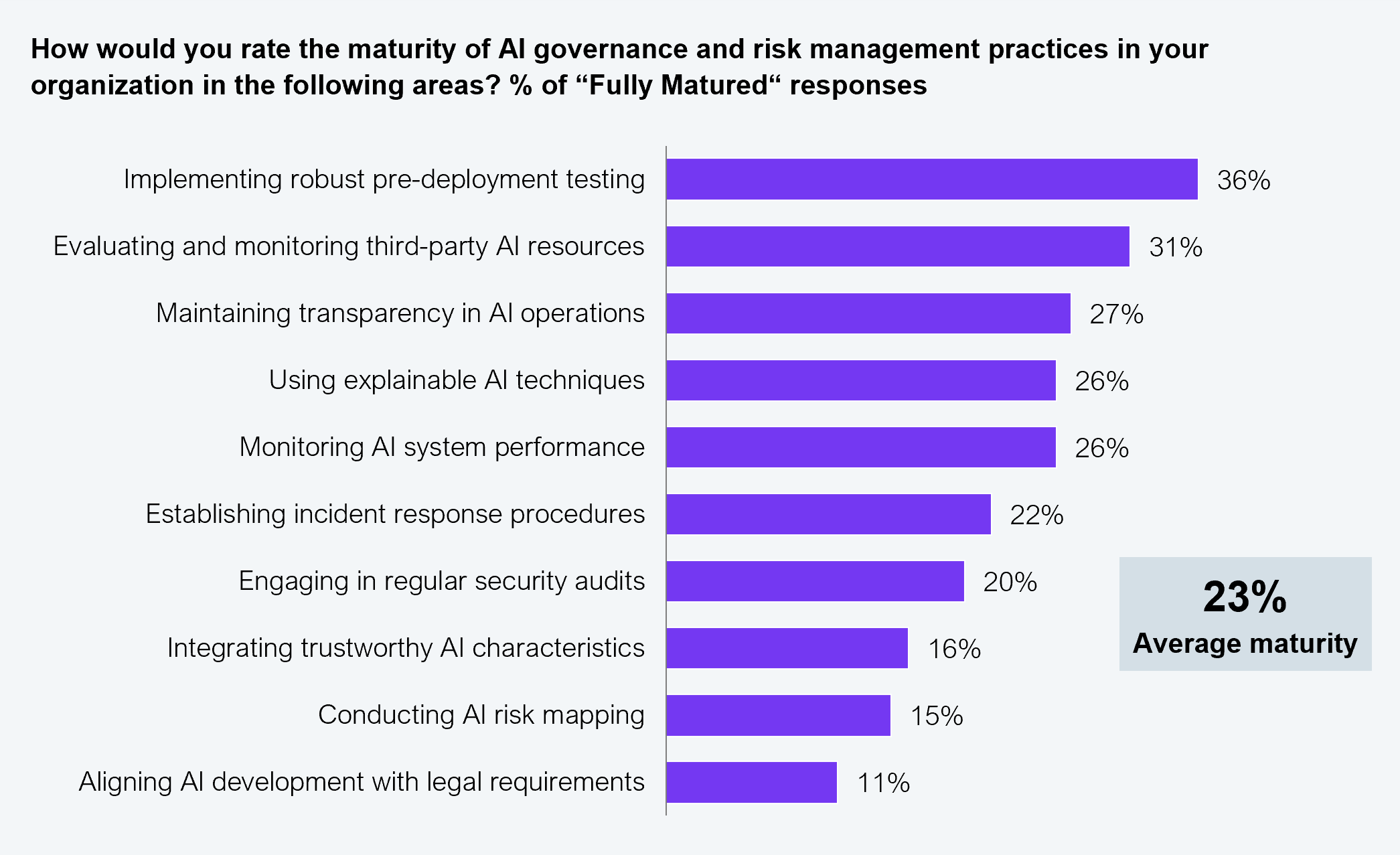
AI governance programs in banks address strategy, compliance, data quality, model management, security, ethics, and accountability. We asked respondents to comment on their maturity across a range of AI governance and risk management elements. Exhibit 10 reveals that, on average, just 23% of BFS firms have fully matured processes, revealing an alarmingly immature set of practices. The most mature practice is pre-deployment testing to ensure nothing goes haywire when new AI systems are launched (36%). The second is third-party monitoring—ensuring that partners leveraging AI align to bank risk principles and don’t introduce new vulnerabilities (31%). Maintaining transparency in AI operations through documentation, using explainable AI techniques, and ongoing monitoring of AI systems post-deployment all clocked in at just above the 25% mark. As there are so many facets to AI governance, it is largely impossible for one role of function to manage all of these elements, which further complicates scale and maturity.
The implications of poor AI governance in financial services are always impactful but even more so when AI directly impacts customers. We’ve already seen various gender and race bias scandals related to AI credit scoring, AML transaction monitoring issues yielding fines, missed fraud transactions incurring losses, incorrect investment advice yielding losses, and everyone’s favorite (not) the annoyingly ineffective chatbot. Crappy chatbots alone are responsible for massive customer cynicism with AI. With or without regulatory compulsion, effective AI governance is essential for the growth and adoption of AI in banking and financial services.
Sudhakar Gopal, EVP & CIO – Head of Engineering & Operations, Enterprise Data, Advanced Analytics, API Middleware and Integration Platforms, Citizens Bank, shared some insights into how his firm is grappling with the multi-faceted nature of AI governance:
Our AI governance process is layered. We have developed a steering committee that includes the C-Suite to decide at a macro level on business benefit alignment and fundability of AI initiatives. If approved, the layers kick in with representation from key stakeholders such as IT, data, architecture, experience, as well as HR and risk. This is where solutioning and certification happen, with various levels of approval such as model certification before something can go live. We are erring on the side of caution as when regulators inevitably bring up AI explainability or governance, we have clear answers.
— Sudhakar Gopal, EVP & CIO – Head of Engineering & Operations, Enterprise Data, Advanced Analytics, API Middleware and Integration Platforms, Citizens Bank
Sample: 505 global banking and financial services leaders
Source: HFS Research in partnership with Infosys, 2025
BFS enterprises have an AI talent problem. They lack the resources they need to execute their AI initiatives. This is not just technical talent. One of the great fallacies of the AI talent conundrum is that AI execution only requires technical or data science experience. Nope—the required talent mix covers strategy, technology, engineering, data science, business process, and risk and compliance and more. AI talent necessarily must cover strategy, design, build, run, comply, and consume.
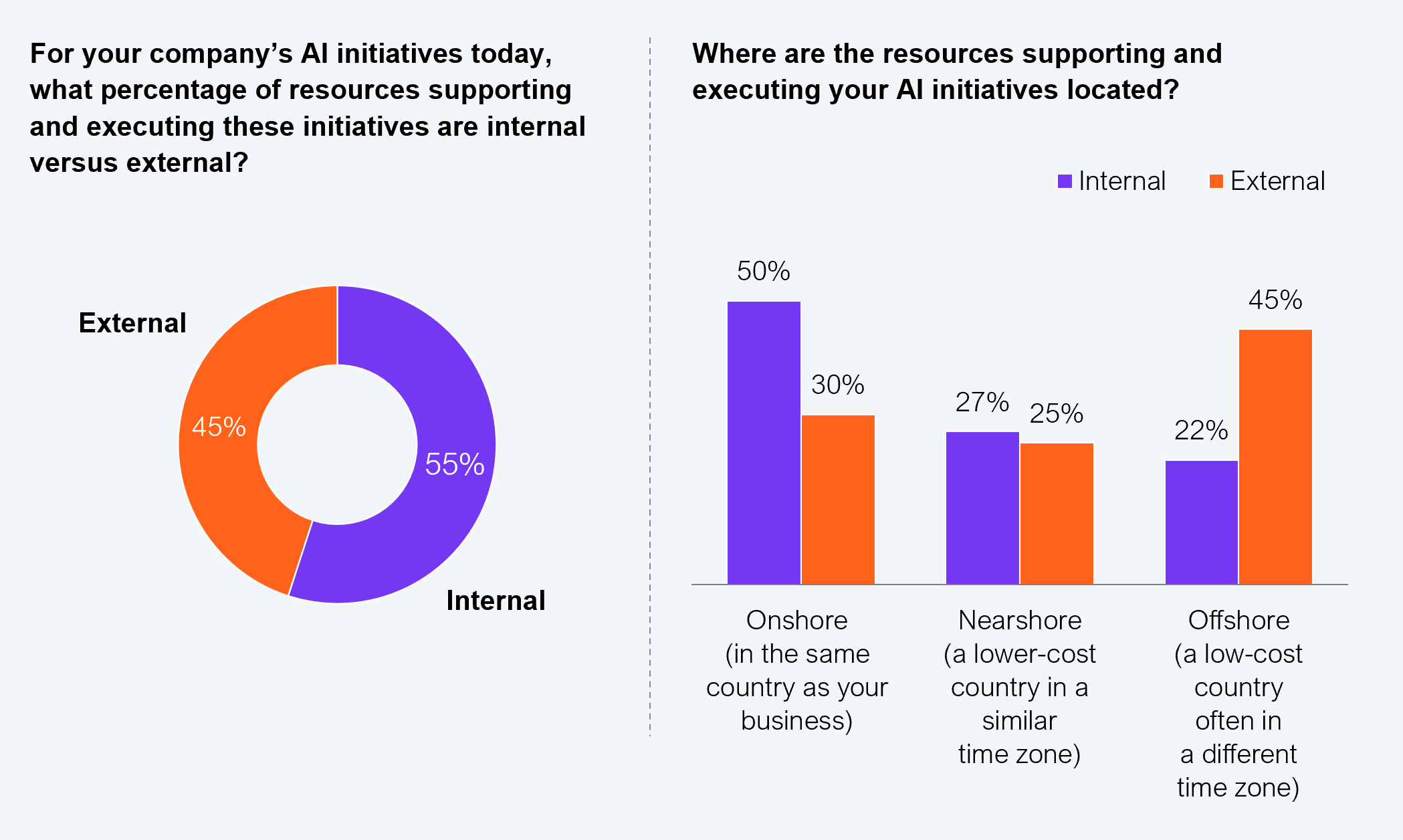
One of the key approaches BFS firms are taking to address their AI talent challenges is the use of third-party partners. Exhibit 11 shows that a whopping 45% of the AI resources supporting current AI initiatives are external resources—those employed by another company, such as a staffing agency or third-party professional services firm. We additionally queried respondents about where these resources are located. Internal resources are largely located onshore (50%), with the other 50% in captive operations in nearshore or offshore locations. External AI resources are the opposite, with the majority (70%) of these resources based in nearshore or offshore locations—offering cost-effective capabilities.
Sample: 505 global banking and financial services leaders
Source: HFS Research in partnership with Infosys, 2025
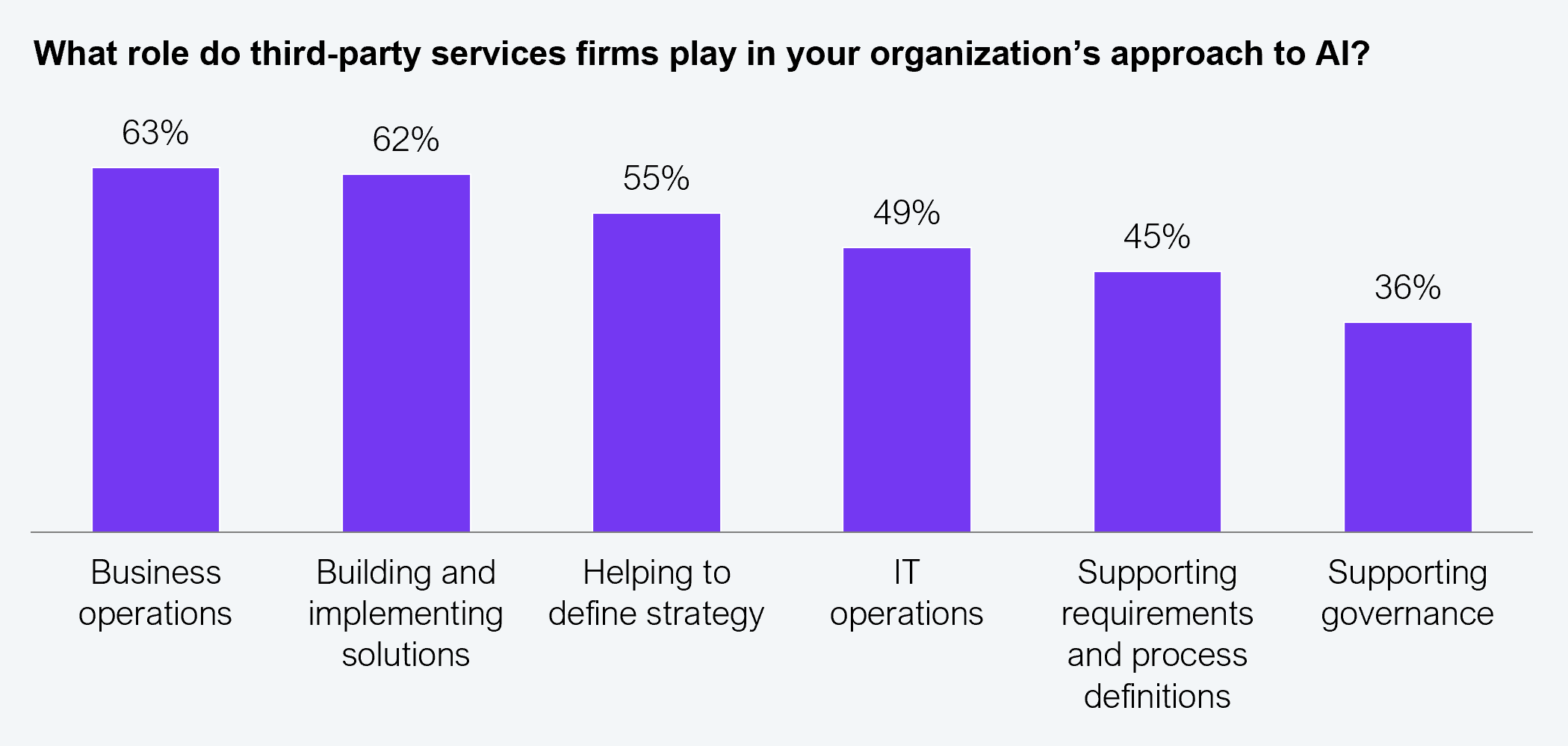
As for the scope of work delivered by these external resources, BFS firms indicated in Exhibit 12 that the top use cases are business operations (63%), building and implementing solutions (62%) and strategy (55%). The strong use of business operations services is a reminder that AI has been baked into many BFS processes for years especially in analytics-driven functions. Notably, supporting governance is dead last with just a bit more than a third of respondents leveraging external support for this critical function. This is likely due to BFS firms leading governance with internal resources combined with the lack of mature AI governance and risk processes outlined in Exhibit 10.
Sample: 505 global banking and financial services leaders
Source: HFS Research in partnership with Infosys, 2025
While third-party services firms have a critical role in enabling the AI journeys of BFS enterprises globally, BFS firms should think in the longer term about how they ensure they have the right resources internally. These service partners can increasingly play a role in educating and upskilling internal resources and cultivating a culture of AI-First through the democratization of AI—which is just a fancy way of saying AI pervades and increasingly leads how work is executed. Humans are not going away, so ensure your approach to AI clearly contemplates how to bring them on the journey.
The “So What” recommendation for the C-Suite
Remove roadblocks to AI value with effective AI governance and talent strategies. The path to being AI-First is paved with various challenges. Many foundational needs are being addressed in the current funding and investment cycle. However, BFS leaders must also consider and solve for AI governance and AI talent to enable true scale. AI governance should be defined as part of enterprise-wide AI strategy and supported across its myriad functions. The particulars will naturally vary based on region, country, or LOB requirements, but the fundamentals must be defined holistically. Similarly, the mission for AI talent is to make all talent AI talent. This is the future of work.
Thank you GenAI for kicking the door open to help BFS enterprises bring AI out of back-office oblivion. GenAI served as the catalyst to get AI back in the boardroom, and not a moment too soon, as the advance of AI technologies such as agentic AI are far exceeding the ability of established BFS firms to meaningfully assess, adopt, and apply AI in strategically meaningful ways. And by “strategically meaningful,” we mean doing more than hitting the low-hanging fruit lever of productivity with a side of potential cost-savings. There is a massive opportunity for BFS enterprises to become AI-First—leading with AI and automation to gain efficiencies, create new value, and drive competitive advantage rather than continuing to lead with people and manual processes.
The study reveals that BFS enterprises are all in on a formalized and funded embrace of AI. However, they risk failure if they don’t drive global, enterprise-wide AI strategies that contemplate more than people-centric bottom-line gains. To unlock the AI-First opportunity, BFS firms must recognize that their AI strategy IS their business strategy, with C-Suite leadership driving clarity of purpose to the rest of the company. This yields AI strategy that is top-down and AI execution that is bottoms-up.
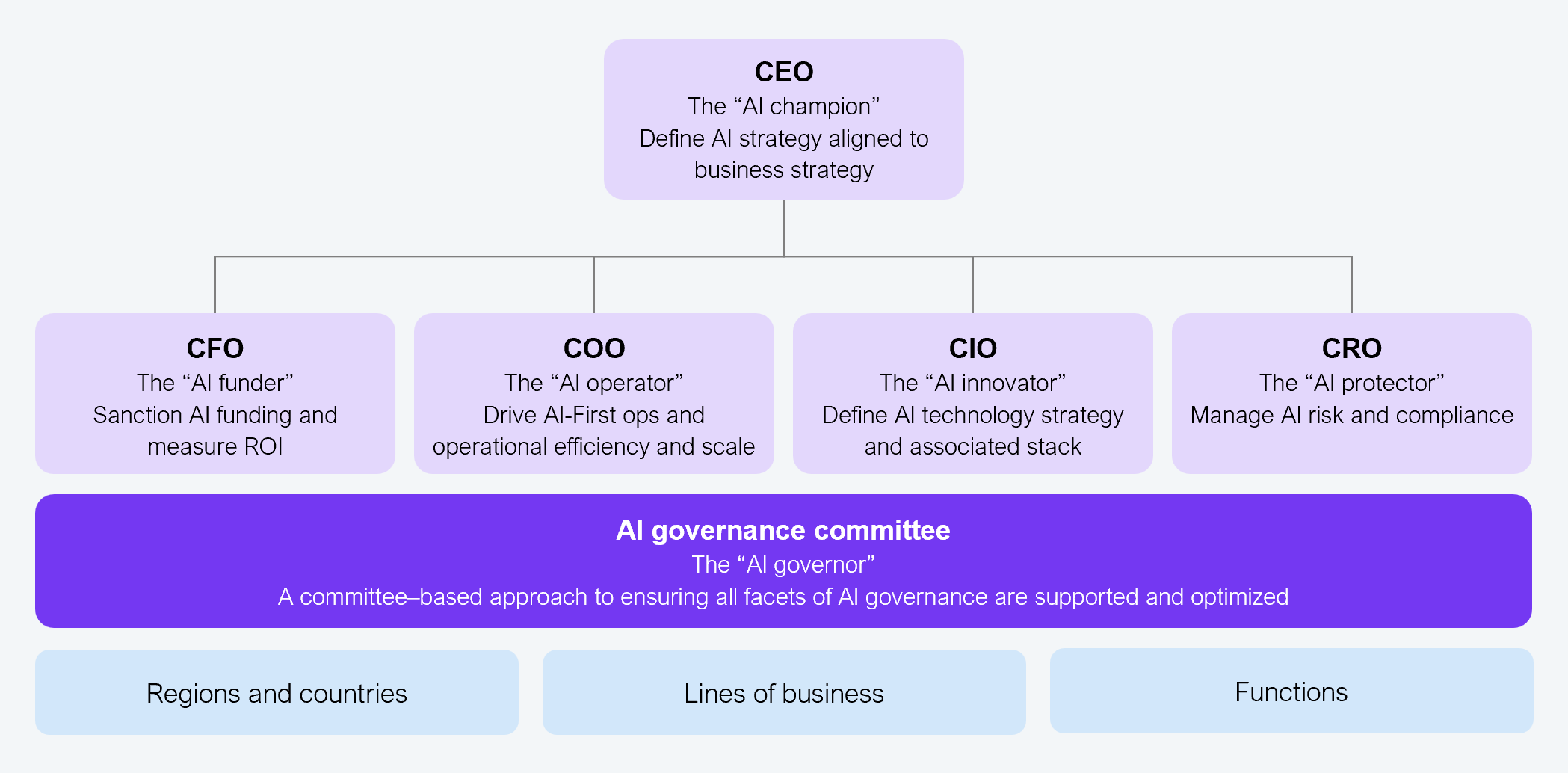
BFS C-Suite leadership must work together to define, oversee, and ensure success of their AI strategies. Exhibit 13 outlines the recommended roles for the BFS C-Suite in AI-First enterprises.
The CEO needs to be “AI champion”—defining how AI strategy aligns with business strategy and ensuring the team delivers on the mission. The CFO is the “AI funder”—determining what can and should get funding and overseeing ROI analyses to best understand impact. The COO is the “AI operator”—leading the AI-First charge by embedding AI into operations at scale. The CIO is the “AI innovator”—defining and implementing the AI tech stack and driving ongoing innovation. The CRO is the “AI protector”—helping to understand and manage risk and compliance so AI can safely flourish. Note the elevation of governance as a committee supported across key C-Suite functions. Depending on how your firm is structured, other roles may join this essential team, such as the chief data officer or chief human resources officer.
Exhibit 13: AI strategy and execution is a team sport in AI-First BFS firms
Sample: 505 global banking and financial services leaders
Source: HFS Research in partnership with Infosys, 2025



Register now for immediate access of HFS' research, data and forward looking trends.
Get StartedIf you don't have an account, Register here |
With the exception of our Horizons reports, most of our research is available for free on our website. Sign up for a free account and start realizing the power of insights now.
Our premium subscription gives enterprise clients access to our complete library of proprietary research, direct access to our industry analysts, and other benefits.
Contact us at [email protected] for more information on premium access.