
This Highlight report outlines KPMG’s approach, thoughts, capabilities, and vision for low code/no-code (LCNC) development services.
As we outlined here, LCNC is transforming traditional application development methods, and its speed and agility are gaining momentum among service providers and enterprises alike. LCNC services are rapid visual application development services that enable developers to easily and quickly create new applications that meet business needs. Because of its advantages, it can even support broader scenarios such as digital transformation, legacy system modernization, and process automation. Moreover, LCNC development is a rare gem seeing growth in the current COVID environment.
While tech-savvy business users can access drag-and-drop component functionality to create applications relatively easily, successful LCNC development requires IT support and additional expertise that IT services providers can offer. Not surprisingly, many services providers are assessing the services opportunities to support LCNC development for clients. Here we outline KPMG’s take on the opportunities and the services and solutions the service provider has developed to meet increasing customer demand. While KPMG is using LCNC in various areas, we will focus specifically on its application development services here.
LCNC: facilitating digital transformation initiatives
KPMG sees wide potential in LCNC, particularly in accelerating digital transformation. This includes the development of new applications, modernization of legacy systems applications, integration across technologies and systems, and intelligent automation.
KPMG’s customers are increasingly demanding modern, mobile- and web-enabled applications that solve business problems. To achieve this, speed and agility are key, both of which LCNC development can deliver. KPMG believes that LCNC platforms can also facilitate industry-specific application development as well as applications that support rapidly evolving requirements.
KPMG LCNC Platform Partners
Several LCNC platform providers have sprung up in recent years to persuade clients to be bolder in their development efforts. KPMG has large practices supporting LCNC services, with more than 1,700 professionals certified across Appian, Outsystems, Pegasystems, Microsoft PowerApps, ServiceNow App Engine, and Unqork among others.
KPMG also continues to explore emerging platforms, such as Google AppSheet, and Amazon Honeycode. This profile excludes KPMG’s RPA business, but it’s worth noting that it also partners with UiPath, Blue Prism, and Automation Anywhere as well as several smaller RPA platform providers.
Strong growth and continued investment in skills
KPMG is experiencing rapid growth in LCNC development services, across geographies, including the Americas, EMEA, and APAC including Australia. It expects enterprises to increasingly adopt an integrated technology approach, bringing together LCNC platforms, RPA and AI. Many of KPMG’s LCNC solutions deliver integrated RPA, AI, process mining, and UX capabilities.
To meet the skills requirements, KPMG is investing in recruitment as well as training staff in broad digital services and LCNC development. Skillsets that KPMG continues to strengthen include solution and enterprise architects, data architects, engineers, developers, and experts in UX/CX, integration, digital change management, and security. KPMG believes that successful LCNC development still requires IT expertise in several areas, including design, integration, security, resiliency, and data integrity. Additionally, it believes that solution architects, engineers, user experience (UX) experts, and change experts will all remain critical to successfully rolling out and supporting enterprise-grade LCNC applications.
Joint research between KPMG and HFS highlights that LCNC platforms are increasingly important automation investments for customers (Exhibit 1).
Exhibit 1: Most important automation investments before COVID and today
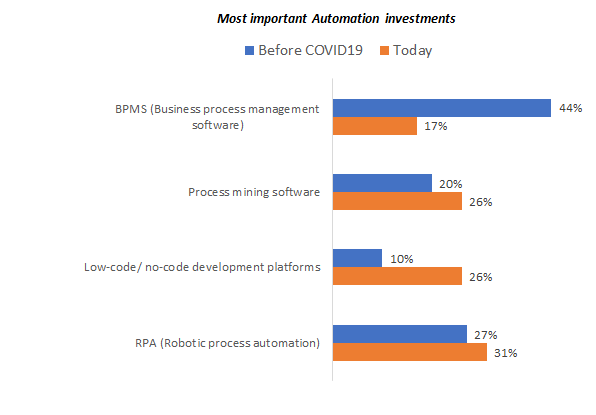
Sample: 300 executives across Global 2000 enterprises surveyed in May-Jun 2020
Source: HFS Research in conjunction with KPMG
Exhibit 1 highlights that COVID has accelerated investment in LCNC due to its agility and speed to develop applications, as well as the ability to update and change applications as needs change. Examples of current KPMG focus include complying with privacy requirements, patient care, and managing the return to work efforts (a prime example of fluctuating rules and required workflows). KPMG expects the trend to continue as enterprises realize the need to be agile, have short development timelines, and become more user-focused. Also, with companies looking to accelerate automation, cloud transformation, and application modernization, KPMG expects to see LCNC uptake to increase.
Holistic approach and proprietary tool investments
KPMG adopts a business-first approach to solving client challenges. It uses agile methodologies for LCNC development and implementation as well as supporting methodologies for strategy, transformation, target operating models, and behavioral change management.
Through its “Connected, Powered, Trusted framework”, KPMG delivers industry, functional, and technology expertise to transformation engagements. KPMG has developed proprietary methodologies and solutions to support each of these areas. For example, KPMG has pre-defined solutions across industries in the KPMG Connected Enterprise blueprints. KPMG’s Powered Enterprise suite has packaged solutions and accelerators to support functional transformation and it also has pre-developed automation scripts available to teams. KPMG also has dedicated CX/UX and change management teams to support LCNC and broader transformation projects.
KPMG has used LCNC to develop net new applications, as well as for application modernization initiatives. The service provider believes that increased awareness of the latter will fuel growth in this space. KPMG has developed an application modernization strategy to help enterprises to achieve successful deployments. This includes establishing LCNC development standards, focusing on the importance of the reusability of core components, embracing agile, and focusing on UX.
Industry sector strength and focus
KPMG has experience in delivering LCNC services across industry sectors, although the types of use cases vary. As the evolving LCNC services market matures, KPMG believes that the ability to deliver industry sector-specific services and solutions will be a critical differentiator for service providers.
Solution examples
KPMG has experience of using LCNC services across functions and industry sectors. We outline a few example solutions below.
Industry sector examples:
Other general examples:
In all of these cases, the client achieved a demonstrable business benefit, and using LCNC development delivered this quickly and effectively.
Consulting-led, industry-focused and global capability
HFS views KPMG’s strengths in this space as:
In the next 12 months, KPMG will continue to invest in skills, and solution development, both cross-sector and industry-specific. It will also strengthen its services capabilities across LCNC platforms, across digital capabilities.
The Bottom Line: KPMG has used LCNC to develop a variety of solutions for clients across industry sectors and geographies. The service provider continues to strengthen this fast growth area by investing in talent and proprietary tool development. KPMG has opportunities to increase market awareness of the business value it can deliver to prospective clients. It could also position as a key thought leader in this space as enterprises try to understand the advantages that LCNC development can bring to their business.
Register now for immediate access of HFS' research, data and forward looking trends.
Get StartedIf you don't have an account, Register here |
With the exception of our Horizons reports, most of our research is available for free on our website. Sign up for a free account and start realizing the power of insights now.
Our premium subscription gives enterprise clients access to our complete library of proprietary research, direct access to our industry analysts, and other benefits.
Contact us at [email protected] for more information on premium access.

