
The market dynamic in the evolving ServiceNow ecosystem is nothing short of astounding. A compelling example of these changes in the market adoption for us is a UK bank deploying ServiceNow Financial Services Operation. ServiceNow is integrating with the core banking processes, like payments, where banks are notoriously shy from moving away from legacy or even leverage cloud-based solutions. This underlines that ServiceNow is enabling cross-functional workflows and is no longer confined to its heritage around ITSM requirements. As such it has the potential to enable and accelerate the journey toward the OneOffice to connect the front, middle, and back offices to create a frictionless digital experience for customers, employees, and partners. The skills for supporting this journey are scarce and might help to explain the fierce battle for talent. This provides the background for Cognizant’s acquisition of Linium, a US-based ServiceNow pure play.
Linium is one of the early proponents of what ServiceNow calls Enterprise Service Management (ESM), the expansion of the platform towards cross-functional areas including customer management and HR. Hot on the heels of this acquisition, followed the consolidation of another kind as private equity firm Sunstone Partners acquired three businesses Evergreen Systems, Cerna Solutions, and Novo/Scale to create what it claims to be the largest ServiceNow pure play. We had the opportunity to discuss these developments with Cognizant’s ServiceNow leadership.
ServiceNow operationalizes the journey toward the OneOffice
To put the acquisition into context let’s take stock as to where we currently see the ServiceNow ecosystem. A glance at which segments are driving new contract wins paints a clear picture. In Q4 2020 IT Workflows (i.e. ITSM requirements) represented 62%, Customer & Employee Workflows (in ServiceNow jargon ESM) 23%, and Now Platform App Engine & Others (a broad bucket encompassing the Now development platform, the App Store, and other services) 15%. IT requirements are decreasing steadily in relative importance while the platform and Apps Store but also new vertical offerings are increasing. Against this background we see three main clusters of activity:
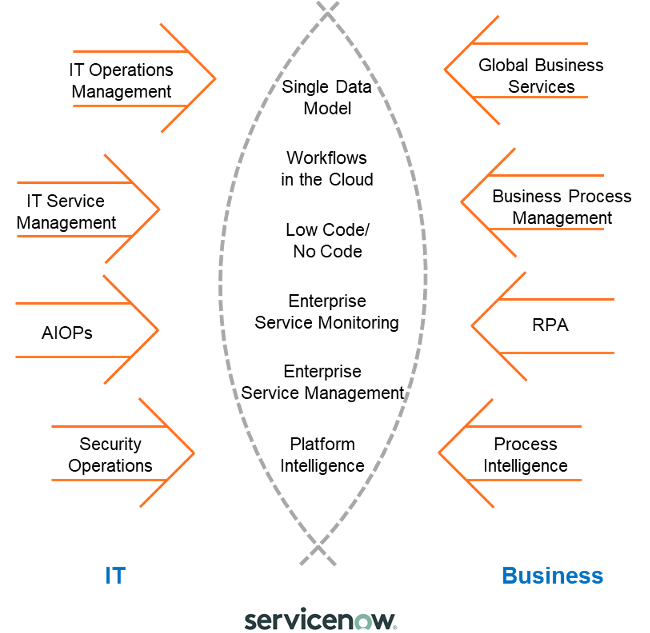
What clients call out as the key value proposition, namely providing a cloud-based platform for a single data model and process workflow, puts ServiceNow at the center of the OneOffice mindset. At the same time, the company is expanding toward the notion of Low Code/No Code and offers clients an opportunity to build their solutions on their Now platform. Therefore, as Exhibit 1 outlines, we see a significant opportunity for ServiceNow to progress toward Enterprise Service Monitoring and Enterprise (-wide) Service Management. Most of the tools and technologies in those areas are point solutions that are confined to organization silos. Thus, it could be providing much of the glue for the OneOffice. White-labelling or partnering on RPA would be the next logical step to expand the workflows on the business process side, in particular in the areas of customer services and financial management. Over time we expect ServiceNow to offer the full value chain of operational management. With process intelligence downstream linking to ServiceNow dynamic workflows while aiming to execute process steps around the notions of self-remediation and self-healing upstream. Suffice it to say this is somewhat oversimplifying the evolution that ServiceNow has undergone. Talking of simplifying, ServiceNow CEO Bill McDermott summarized the evolution of the company to be the provider of the platform of platforms. Translated into the HFS universe, it could become the cornerstone for operationalizing the OneOffice.
Exhibit 1: ServiceNow provides the capabilities for finally accelerating IT-Business alignment
Source: HFS Research 2021
Linium has been a poster child for driving ServiceNow beyond ITSM with glowing customer testimonials
Linium was one of the leading ServiceNow pure plays that got acquired by Ness Digital Engineering, a portfolio company of The Rohatyn Group (TRG) back in 2018. In the spring of 2020, Linium got fully integrated into and rebranded as Ness Digital Engineering. To the outside world, it appeared like solid progress. Thus, the news of the carveout through this acquisition was somewhat surprising and appears to point to the fact that the synergies between both organizations must rather have been on the moderate side of things. Ness’ focus areas were around cloud, analytics, and DevOps which could have been complementary to Linium’s ESM capabilities, yet culturally both organizations didn’t appear to gel. And Cognizant added color to that by pointing to the enthusiasm that the Linium team had shown in the initial calls.
Linium has glowing customer testimonials which resulted in it taking the number 1 slot for the voice of the customer in HFS 2019 ServiceNow Top 10 ranking research. What clients love most about Linium is that they are not a global service provider. their deep domain knowledge and the willingness to challenge clients on their strategy rather than focusing on the opportunities for billable work. This is best summed up in this client quote: “it just felt like they really cared about our success, and they weren’t as much worried about the money that they were gonna make from the interaction with us.” Furthermore, clients were complimentary about Linium’s guidance on the interdependency of applications and processes. Thus, avoiding lengthy and costly interruptions on the ServiceNow rollout. From the client’s perspective, Linium demonstrated its value far beyond just implementing modules on-demand as an implementation partner.
Where does Linium fit into Cognizant’s universe?
So how does Linium align with Cognizant’s broader strategic thinking beyond the narrow confines of its ServiceNow core capabilities? Cognizant’s executives were pointing to Linium’s proven strategy of expanding the ServiceNow platform beyond traditional implementations and their proven ability to assess, inquiry, collaborate, innovate, build and sustain opportunities keeping the clients’ main goals top of mind directly aligns with Cognizant’s focus on ensuring their clients’ businesses stay relevant. With Linium joining the Cognizant team they will continue to collaborate with ServiceNow on co-creating industry solutions and continue to be their customers’ trusted partner in driving digital transformation across the enterprise.
An example of strengthening Cognizant’s ServiceNow offering with Linium is leveraging their digital transformation analytics to fuel Cognizant’s digital acceleration workflow suite (DAWS). In addition, Linium’s dashboards provide an enhanced customer experience by offering a broad set of metrics, allowing customers to monitor the progress of their rollouts, as well as providing governance tools. With the same token, both teams can collaborate around the themes on business process modernization, optimized cloud workflows, and Low Code/No Code capabilities.
The culture and the enthusiasm around this acquisition are perhaps best summed by the statement, “We needed a catalyst like that here at Cognizant, to energize the team and to have different views.” The enhanced ServiceNow team will work together with Cognizant’s enterprise architect teams to integrate the various applications and platforms, which align to the HFS OneOffice mindset as well as the ambition of Bill McDermott to offer the platform of platforms connecting employees, the business, and the customer to drive business outcomes.
Bottom line: We will see more consolidation of service providers as ServiceNow provides much of the glue for operationalizing the OneOffice
Much of the ultimate success of the acquisition will hinge on the integration and on how much the culture of Linium can be preserved. The negative example to avoid is how DXC did obliterate the culture of Fruition Partners who were comparable to Linium back in those days. But we will see more consolidation in the ServiceNow space not only because of the scarcity of available talent but because ServiceNow is disrupting traditional enterprise architectures. Thus, stay tuned for HFS’s deep dive around the 2021 ServiceNow Services Top10 that we have just launched and where will expand on all those issues.
Register now for immediate access of HFS' research, data and forward looking trends.
Get Started
If you don't have an account, Register here |
With the exception of our Horizons reports, most of our research is available for free on our website. Sign up for a free account and start realizing the power of insights now.
Our premium subscription gives enterprise clients access to our complete library of proprietary research, direct access to our industry analysts, and other benefits.
Contact us at [email protected] for more information on premium access.

