This Market Vision Paper is for GBS and GCC leaders evaluating how to move from fragmented, human-led delivery models to AI-first, platform-based orchestration.
Global business services (GBS) is undergoing a structural redefinition. GBS leaders cannot stick to traditional models optimized for scale, standardization, and labor arbitrage and expect to keep pace with quickly changing enterprise demands and technology disruption. Shared services need to hustle beyond manual routing and rule-based tools.
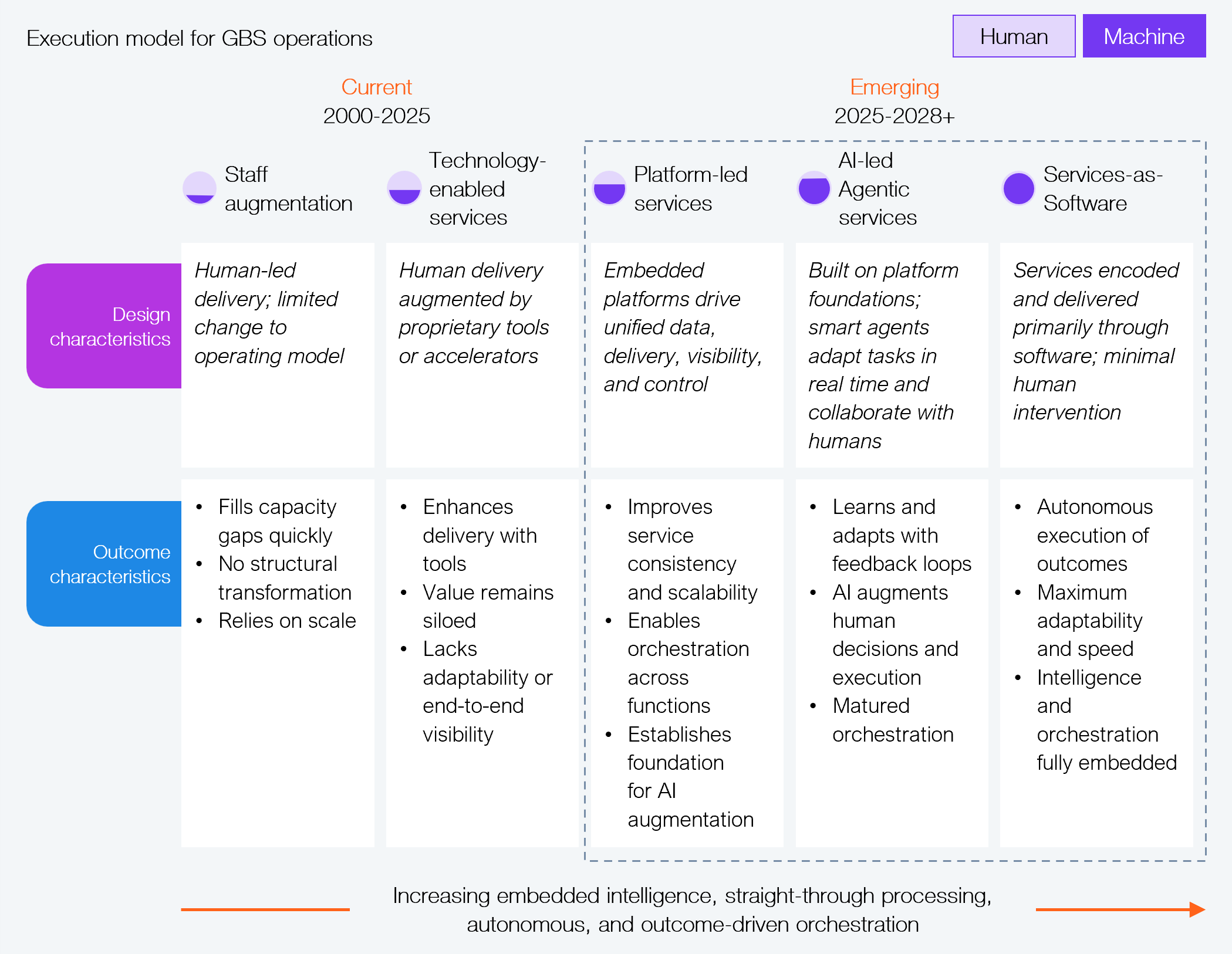
HFS has identified the next frontier as generative business services. With AI (artificial intelligence), GBS leaders can stitch together today’s fragmented workflows so operations teams can spot real-time risks, adapt to shifting business needs, and move beyond stopgap automations.
This evolution, shown in Exhibit 1, is already in motion. Leading enterprises are moving from people-heavy task execution to models powered by smart agents, self-learning workflows, and services-as-software foundations.
Source: HFS Research, 2025
GBS leaders have traditionally followed enterprise automation strategies that progress from rules to RPA (robotic process automation) and finally to machine learning. This linear approach often struggles to encode the “tribal knowledge” experienced professionals apply when managing exceptions, variations, and ambiguity. Capturing that nuance requires a different design paradigm where agents learn from contextual signals, adapt to evolving workflows, and move beyond rigid task logic.
EdgeVerve’s vision for GBS aligns with this directional shift. It articulates AI-first GBS as strategically integrating human expertise and machine intelligence to deliver continuously adaptive services across enterprise functions.
EdgeVerve brings the concept to life with its “AI Next for GBS” platform that consolidates all GBS work, including tickets and service requests, into a single layer where tasks are intelligently discovered, classified, and routed to the most suitable resolver, whether automation bot, AI agent, or human expert. The platform dynamically matches tasks with the right resources and equips them with contextual insights and guided process flows to drive accurate, efficient execution.
AI-first GBS is not a tech upgrade. It’s a strategic redesign of how organizations create value.
— Shashidhar N, VP & Global Platform Head, EdgeVerve
Modern GBS operations span complex, cross-functional domains such as finance, logistics, compliance, and customer support. These areas can no longer stay anchored to rule-based execution. Rapidly changing business dynamics demand adaptability across distributed teams, diverse data sets, and varying regulatory landscapes. Relying solely on human expertise limits scalability, and legacy systems lack the intelligence to respond dynamically to change.
AI is becoming the foundational lever for this transition. By embedding intelligence into workflows, decision-support systems, and service interactions, GCCs can move from task execution to outcome orchestration. Smart agents can learn from enterprise context, manage exceptions, and integrate fragmented activities into a responsive operations fabric.
HFS Research finds that over 70% of enterprise and global capability center (GCC) leaders agree: GBS must now be reimagined with AI-native foundations to drive growth, innovation, and enterprise alignment.
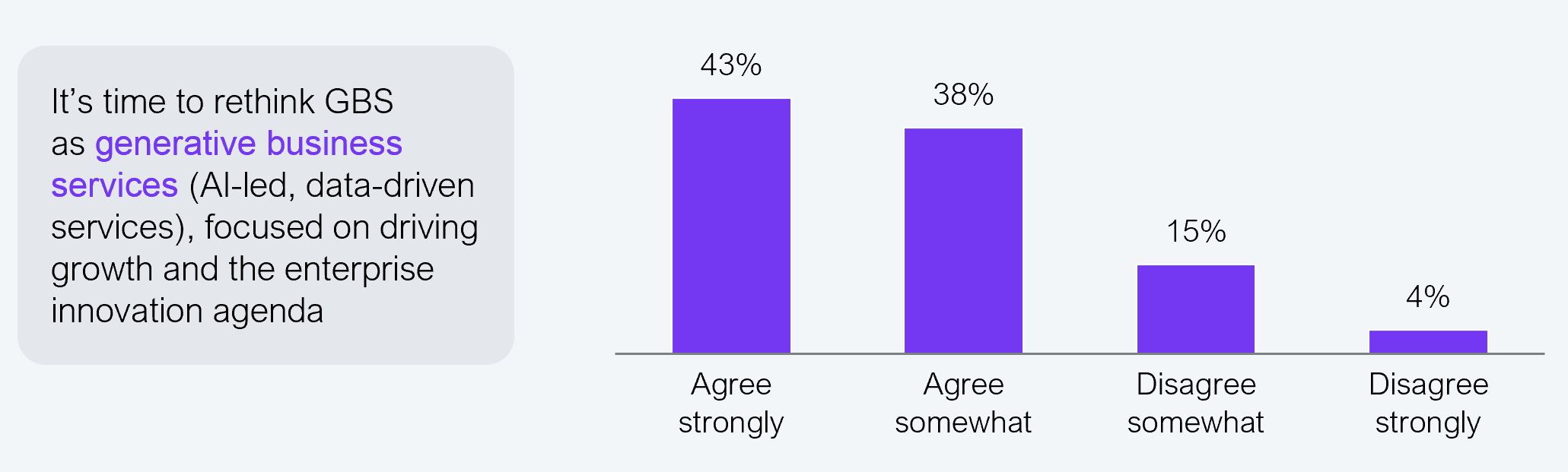
Sample: 510 enterprise and GCC leaders
Source: HFS Research, 2025
EdgeVerve shares this urgency. Its leadership calls for a structural overhaul of GBS delivery, from managing service tickets and SLAs (service level agreements) to enabling intelligent, adaptive operations that scale with business complexity.
As GCCs undergo AI-first transformation, the real value is unlocked only when applied AI is adopted at scale. Agentic AI introduces a fundamental shift, from viewing AI as a tool we actively manage to recognizing it as an autonomous agent working on our behalf. This autonomy significantly expands the possibilities for value creation but also introduces greater complexity in value delivery. That’s why a platform-based approach becomes critical to succeed in this transformation.
— Shashidhar N, VP & Global Platform Head, EdgeVerve
Most enterprises still operate with disconnected tools and siloed workflows, often leading to integration debt and limited contextual value creation.
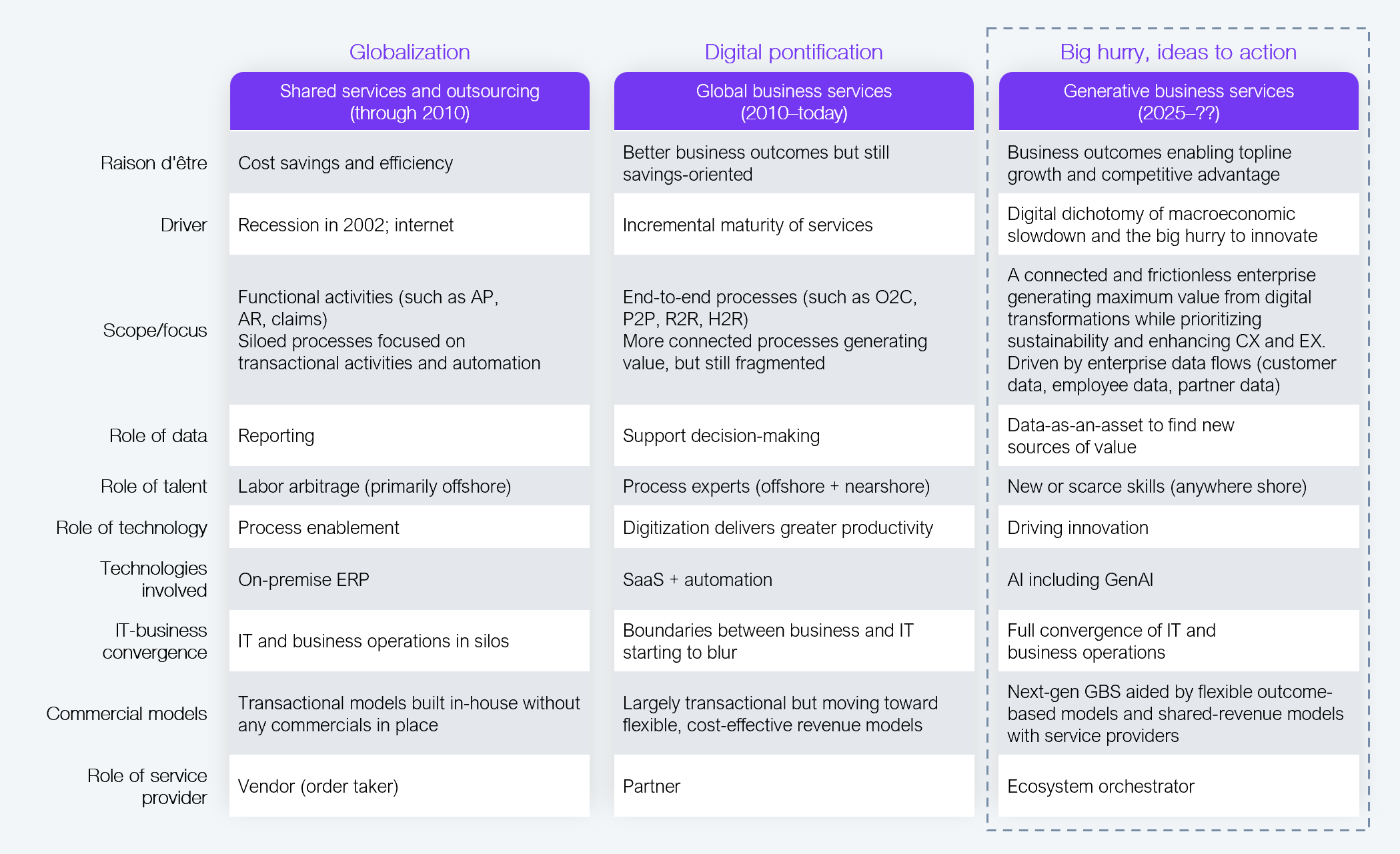
In our conversations with enterprise stakeholders, the following themes consistently surface as critical design requirements for the future of GBS, further described in Exhibit 3:
Source: HFS Research, 2025
We’ve seen enterprises automate workflows, but the needle won’t move until those workflows learn and evolve on their own.
— Sathish Kumar E V, AVP-Senior Director Product Management, EdgeVerve
This environment calls for a unified platform architecture that suppresses shadow IT, breaks down operational silos, and embeds intelligence where it’s most contextually relevant. For this redesign to stick, enterprise leaders must address the fundamentals of operating model change in parallel. Changes must include reshaping budgeting and funding models toward platform-level investment, tightening risk governance to keep pace with autonomous decision-making, and redefining workforce strategy for a human+machine delivery fabric.
Consider a multinational life sciences enterprise’s GCC operations. Traditionally, shared services models support functions like regulatory affairs, procurement, and pharmacovigilance via siloed workflows and disconnected point tools, each optimized for compliance and documentation but lacking adaptability or cross-functional insight. Though efficient for compliance, this setup lacks the flexibility to adapt in real-time. It cannot accommodate variations and judgment required for region-specific regulations, supplier-specific sourcing criteria, or case-by-case exceptions.
In such environments, team handoffs often lead to delayed submissions, fragmented reporting, and rising compliance costs. Decision-making relies on manual checks, and exceptions snowballed due to limited traceability across tools.
Now, let us imagine this GCC embracing the principles of AI-first GBS design. By unifying process flows across regulatory submissions, vendor onboarding, and case triage into a single orchestration layer, the GCC begins operating not as a cost center but as a decision-intelligent hub. Smart agents monitor documentation cycles, escalate anomalies, and support real-time regulatory updates, thereby reducing cycle time and improving right-first-time metrics.
EdgeVerve advocates for a transformative architecture that integrates the GBS workforce, AI agents, and automations into a collaborative fabric designed to solve end-to-end customer problems by orchestrating processes, leveraging enterprise data, and embedding decision intelligence at its core.
EdgeVerve’s AI Next OSM platform Built on EdgeVerve AI Next, a unified AI platform, Operations & Service Management (OSM) acts as a unifying layer across GBS. It intelligently matches requests with the best-suited execution path. For human agents, OSM dynamically identifies the optimal resource based on workload, availability, and skillset, ensuring efficient and accurate resolution. Each resolver has the correct data, contextual insights, and guided process flows to drive error-free execution.
By integrating technology, systems, processes, and people into a cohesive platform, OSM functions as a central operating system—akin to an ERP system (enterprise resource planning system)—that overcomes fragmentation and enables scalability, adaptability, and resilience. With embedded agentic AI, persona-driven orchestration, and enterprise-grade controls for security and compliance, OSM shifts the focus from tool deployment to sustained enterprise outcomes.
The platform is not just a digital layer. It’s a service ops fabric.
— Sathish Kumar E V, AVP-Senior Director Product Management, EdgeVerve
Through this unified platform-led approach, EdgeVerve reports the following outcomes across enterprise clients:
GBS can’t just be a labor shop anymore. It has to become a part of the enterprise that thinks and responds in real-time. But it won’t be easy. The shift requires abandoning fragmented constructs and committing to platform-led transformation.
EdgeVerve shares this vision for GBS transformation, treating AI-first operations as a foundational business architecture, not merely a layer of tooling. This perspective reflects key priorities HFS consistently hears from enterprise and GCC leaders.
AI is remaking GBS. It’s time to unify, automate, and get humans back in the driver’s seat.
An integrated approach enables clients to unlock scalable efficiency while maintaining control and agility in a rapidly evolving business landscape.
— Shashidhar N, VP & Global Platform Head, EdgeVerve
Register now for immediate access of HFS' research, data and forward looking trends.
Get StartedIf you don't have an account, Register here |
With the exception of our Horizons reports, most of our research is available for free on our website. Sign up for a free account and start realizing the power of insights now.
Our premium subscription gives enterprise clients access to our complete library of proprietary research, direct access to our industry analysts, and other benefits.
Contact us at [email protected] for more information on premium access.