This Market Vision Paper is for CIOs, CTOs, and enterprise architecture leaders evaluating how to escape code-heavy operating models that inflate tech debt and stall AI-driven transformation.
New research serves as a wake-up call for CIOs and CTOs bleeding budget on implementation.
Enterprise transformation isn’t short on software; it’s weighed down by code sprawl and the ecosystem built to maintain it. Each new bespoke line of code adds a maintenance tail that inflates services spend and tech debt, pulling budgets into integration and upkeep while innovation waits. That strain on IT increases reliance on systems integrators and crowds out software-led change. Artificial intelligence (AI) will compound the problem if it simply generates more code on legacy stacks; however, used within guardrails to refactor, standardize, and assemble governed components, it can reduce tech debt. The current operating model must evolve.
HFS Research, in partnership with Unqork, surveyed 123 large enterprises to understand IT budgets, services-to-software ratios, systems integrator (SI) relationships, AI adoption, and governance patterns. The survey uncovered:




The Bottom Line: As enterprises generate more “AI-assisted” code, they find themselves in an operating model with unintended consequences, such as runaway maintenance costs and increasing tech debt. IT is overwhelmed maintaining the systems they currently run while business leaders demand more, faster from them. Simultaneously, the C-suite is applying mounting pressure for AI implementation—not just pilots, but production with real return on investment.
The way through is a shift in models and architectures. IT needs to flip the services ratio and move from projectized services to productized outcomes in architectures that minimize customer code creation, maximize reuse, and embed governance so that AI reduces, rather than creates more tech debt.
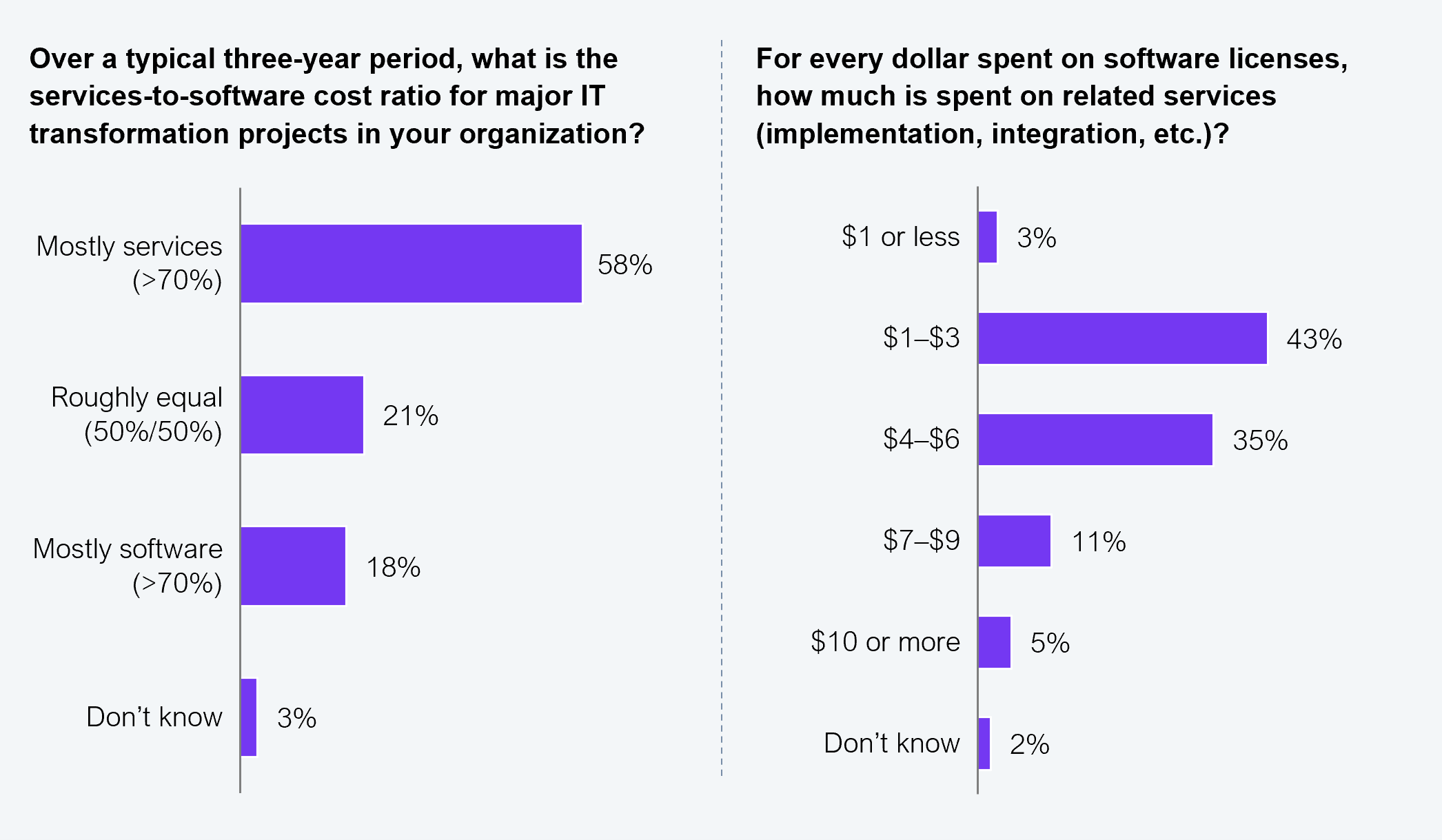
Only 18% of large enterprises’ transformation spending is allocated to software, while 58% of organizations dedicate over 70% of their three-year transformation budgets to services. Most spend 2–7x on services for every $1 of software; a $1 million software license can become a $2 million to $7 million total commitment after services and maintenance (see Exhibit 1). This erodes ROI, crowds out innovation, and compounds a “keep-the-lights-on” doom loop.
Sample: 123 decision makers across Global 2000 organizations
Source: HFS Research, 2025
Enterprises should avoid software that demands a standing army of engineers to keep it running. Reorient internal IT and systems integrators toward innovation, not perpetual upkeep, by standardizing on architectures where costs decline with scale through reusable components and pre-built integrations. The era of labor arbitrage has run its course; squeezing rates didn’t reduce code and architecture complexity, and now enterprises are constrained by the architecture and ecosystem built to maintain it.
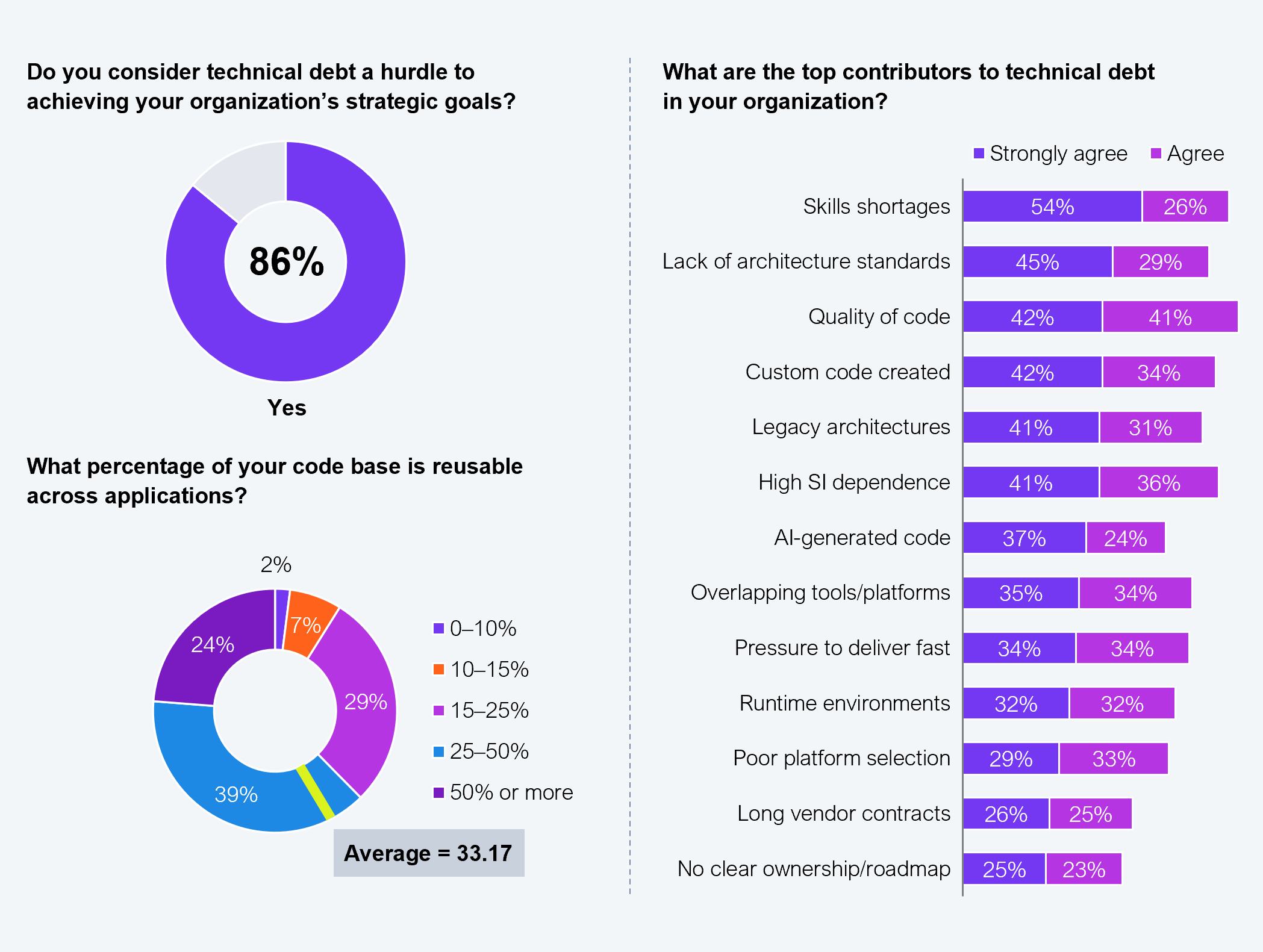
Technical debt, or tech debt, is the cumulative cost, risk, and effort required to operate, secure, and evolve what’s already been built. While verifiable data to quantify tech debt is scarce, some estimate that global tech debt exceeds $1 trillion. Leaders surveyed cite both human and structural drivers of tech debt: poor code quality (83%), skills gaps (80%), over-reliance on systems integrators (77%), custom code proliferation (76%), and missing standards (74%). Most, 86%, of respondents say technical debt blocks strategic goals. Only about a third of code is reused, while two-thirds is rebuilt. In short, code is a liability class, as every new line of code created adds a maintenance and risk tail (see Exhibit 2).
Sample: 123 decision makers across Global 2000 organizations
Source: HFS Research, 2025
It’s a tremendous amount of effort, these things cut out all the time…I consider it, in my view, sort of friction. That friction costs teams, and it’s a lot of effort to upgrade, patch, and run maintenance.
— CIO, federal wholesale bank
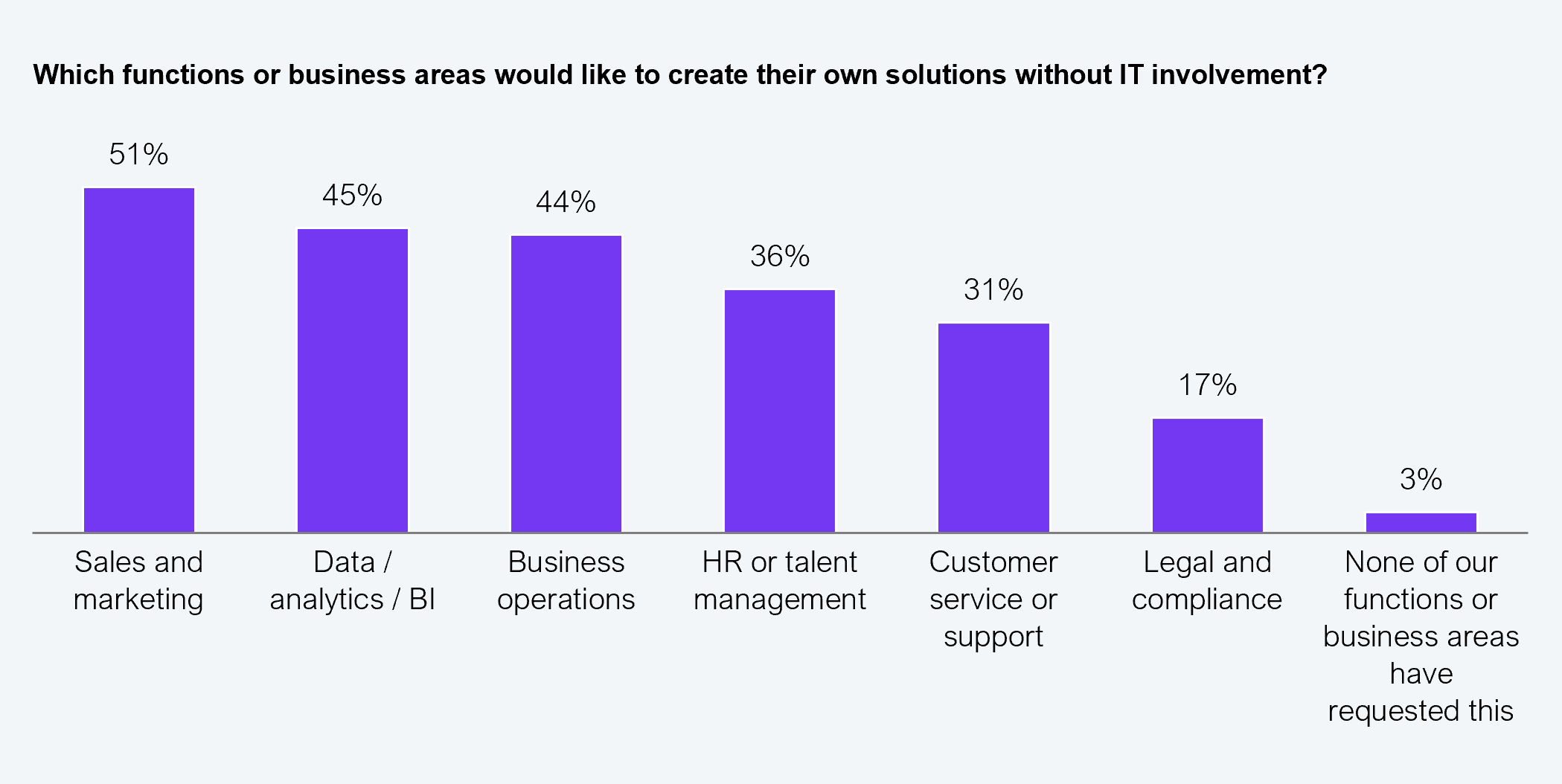
Simultaneously, businesses are demanding more from IT, and for some, with the right platforms and tools, citizen development is now a strategy. Nearly all (97%) business units want to build in parallel with IT. Sales and marketing (51%), data and analytics (45%), and business operations (44%) show the highest desire for this empowerment, reflecting that traditional IT delivery speeds are not fast enough. This creates the risk that business units will attempt to do it themselves or create shadow IT (see Exhibit 3).
Sample: 123 decision makers across Global 2000 organizations
Source: HFS Research, 2025
The widespread desire for business to build apps in parallel with IT indicates that traditional governance structures no longer meet business needs for speed and flexibility. It’s not a tooling problem. It’s a model mismatch where current approaches cannot reconcile speed with scale. This compounds the possibility of shadow IT and creates a governance gap if proper guardrails are not implemented to harness this trend.
We need to be agile as a business, so it’s really looking for digital enablers that can help cross the silos of our teams to really speed up how our business responds to work.
— Head of Strategy & Operations, global banking major
The only scalable answer is sanctioned, governed self-service through platforms, with policy-as-code, cataloged components, and deep observability. Enterprise buyers must implement a control tower that governs architecture, data, security, and reuse; define a standard taxonomy for components; and demand reference patterns for integration from vendors. Success must be measured by faster business delivery and declining tech debt indicators, such as a services-to-software ratio trending downward, a reuse percentage trending upward, fewer one-off integrations, higher test coverage via platform tools, and a reduction in maintenance costs.
Drowning in tech debt, with more requests than ever, enterprise IT has traditionally turned to systems integrators for lower costs and support to maintain their code-heavy models. In addition to expertise, systems integrators brought an opportunity for labor arbitrage through offshoring. They are often pulled into maintaining the status quo because incentives and architectures favor maintenance over reuse. In a maintenance-weighted model, many relationships feel transactional and maintenance-oriented, rather than transformational—a real Catch-22 for systems integrators.
Sample: 123 decision makers across Global 2000 organizations
Source: HFS Research, 2025
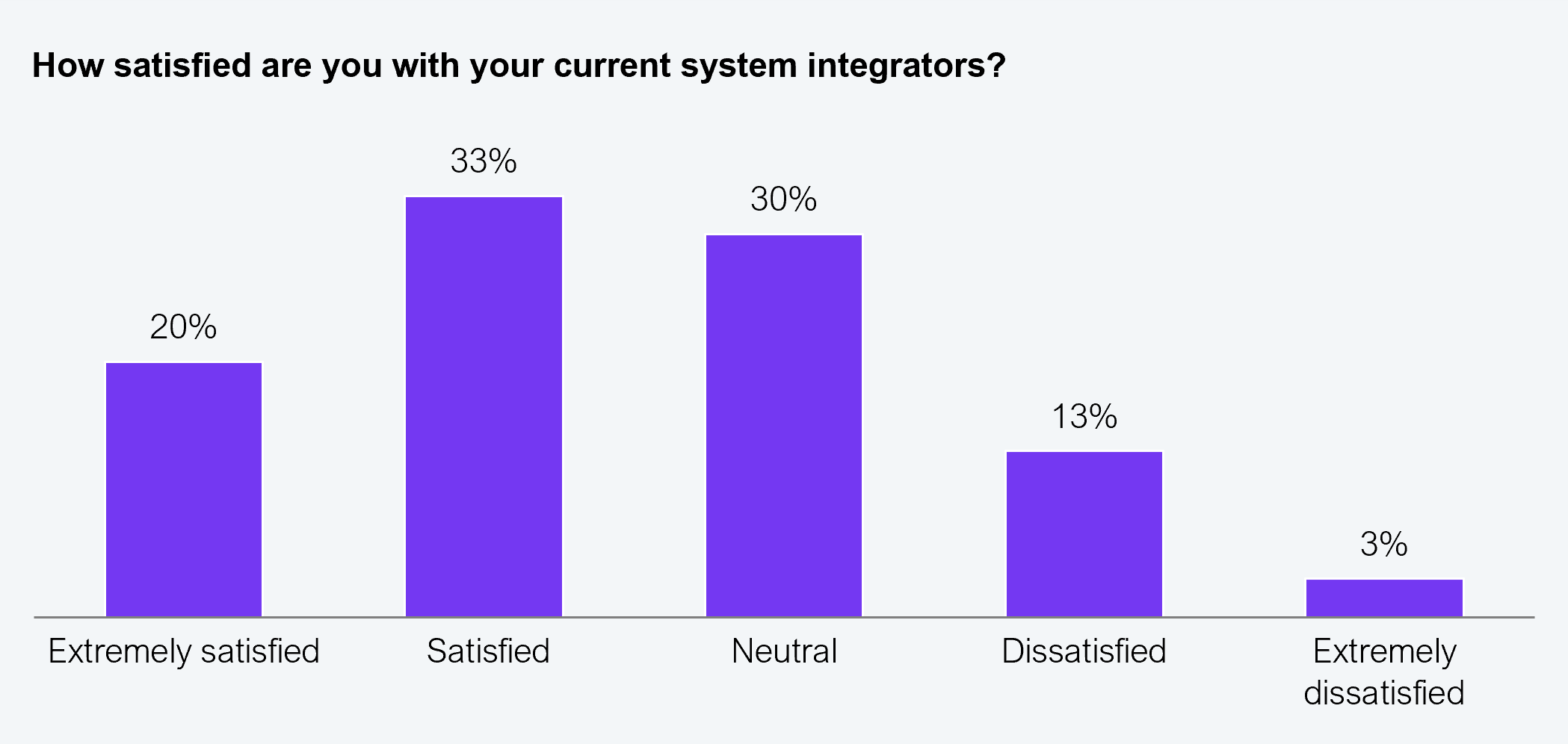
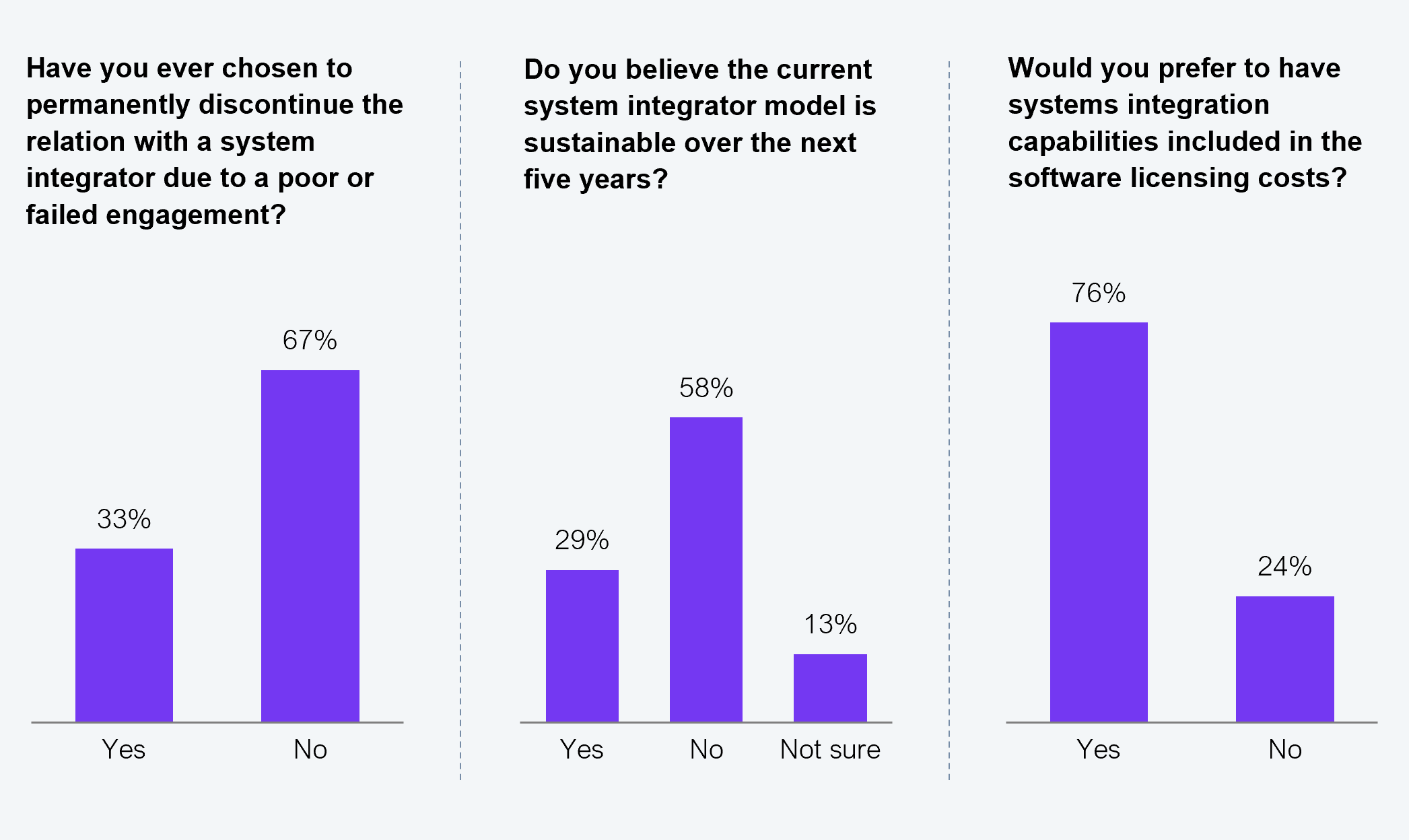
The survey data reflects that satisfaction with SIs is tepid (only 20% of decision makers are “extremely satisfied”). Roughly a third of engagements end without a satisfied outcome, often prompting partner changes (see Exhibit 4). Meanwhile, 58% say the traditional SI model will be unsustainable within five years, and 76% want integration bundled with software, indicating a preference for integration and governance to be bundled into the product, rather than the traditional two-step model of “buy software, then hire an SI” (see Exhibit 5).
Sample: 123 decision makers across Global 2000 organizations
Source: HFS Research, 2025
Systems integrators remain essential, but the value is shifting upstream to design standards, reusable patterns, and platform enablement with less bespoke delivery and more productized outcomes. The market is moving from project delivery to packaged outcomes. As enterprises look to vendors that help reduce the bespoke code they generate, maintenance requirements will decrease, and the integrator’s role in the enterprise IT ecosystem will evolve accordingly.
The AI tech debt paradox
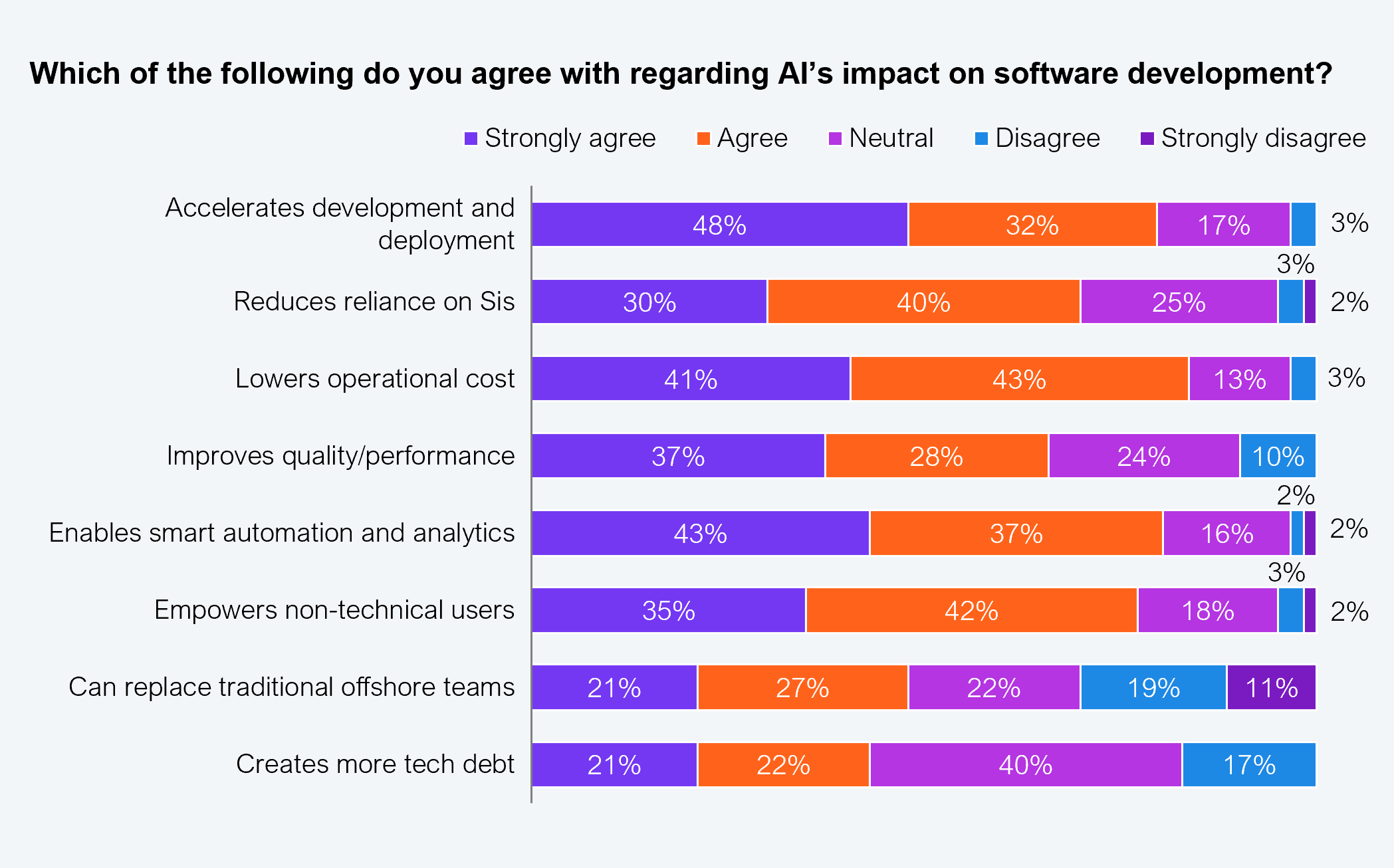
If AI is primarily used to generate more bespoke code on legacy stacks, it amplifies maintenance and accelerates the creation of tech debt. Deployed inside guardrails, AI can refactor, standardize, and assemble governed components, lowering run costs and debt while improving speed. If not implemented strategically, AI presents a paradox of promise and peril for software development. Organizations show the highest confidence in AI’s ability to reduce costs (84% agreement) and automate processes (80% agreement). Yet, 43% acknowledge that AI may create more tech debt, which ultimately increases costs.
Less than half of organizations (48%) believe AI will replace offshore teams, suggesting that organizations recognize AI will augment rather than replace human expertise. This recognition, combined with 77% of respondents believing AI empowers non-technical users, indicates that AI could be creating new dependencies rather than eliminating old ones (see Exhibit 6).
Sample: 123 decision makers across Global 2000 organizations
Source: HFS Research, 2025
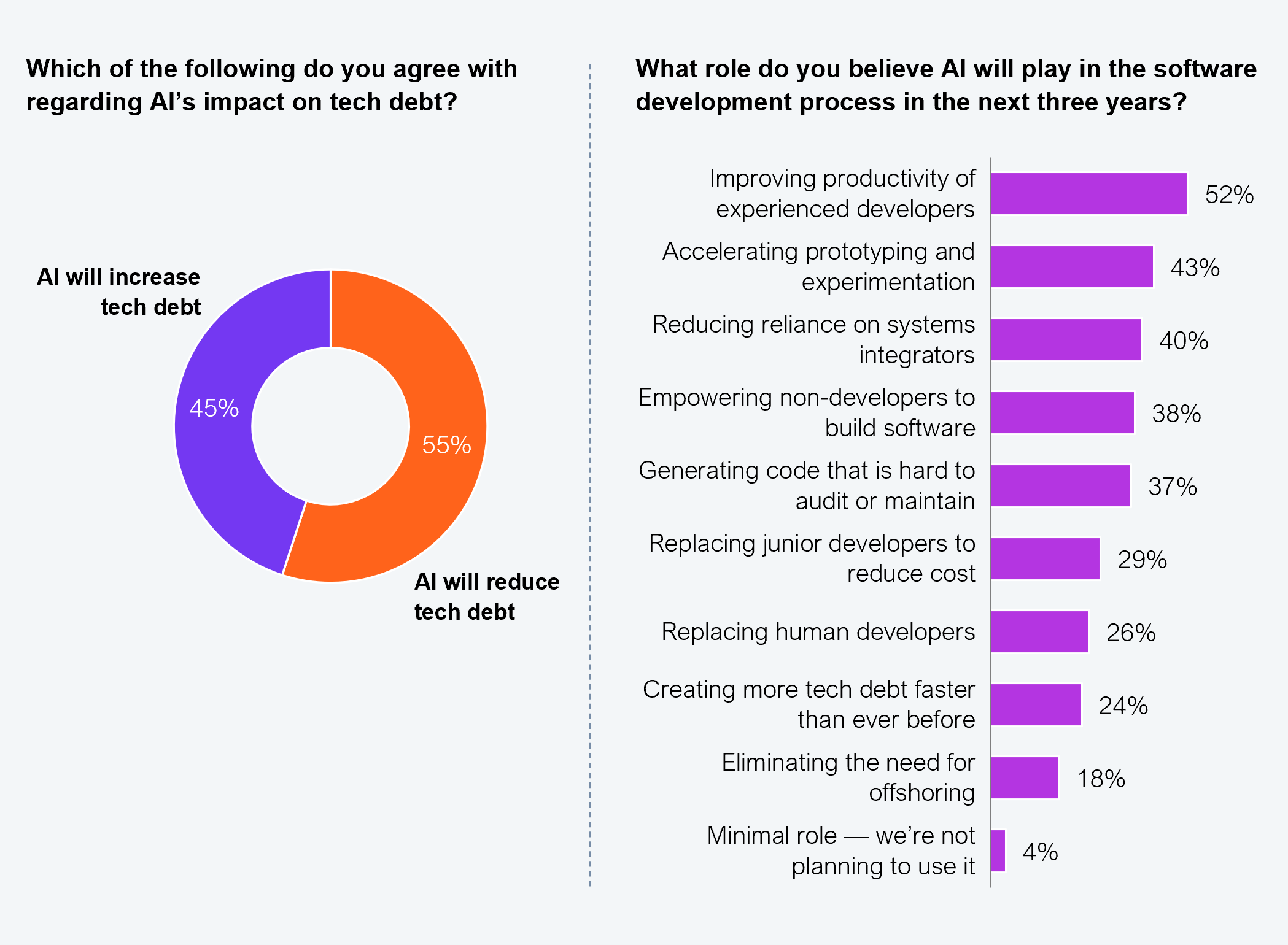
The risks are equally clear: 43% anticipate AI creating new debt, 37% expect hard-to-maintain code, and the top concerns are security (59%), legacy integration (50%), and loss of visibility (42%). In the long term, sentiment splits, with 55% of respondents believing AI will reduce tech debt, while 45% anticipate an increase (see Exhibit 7).
Sample: 123 decision makers across Global 2000 organizations
Source: HFS Research, 2025
The traceability of AI-authored changes and platform-generated tests, as default artifacts, must be a table stake in evaluating vendor offerings, and compliance controls must be embedded. Enterprises must use AI to assemble, refactor, and test governed components, rather than generating bespoke code. Platform-level policy checks and automated documentation must be built in—not bolted on.
Remember, without proper governance, quality controls, and architectural discipline, AI risks becoming the next generation’s technical debt crisis, where today’s shortcuts become tomorrow’s expensive remediation projects.
Enterprises are ready to offload legacy under the right conditions. With an outdated approach to transformation and more budget and resources tied to an ecosystem geared toward never-ending maintenance, the market stands ready for a fundamental shift in how legacy systems are managed.
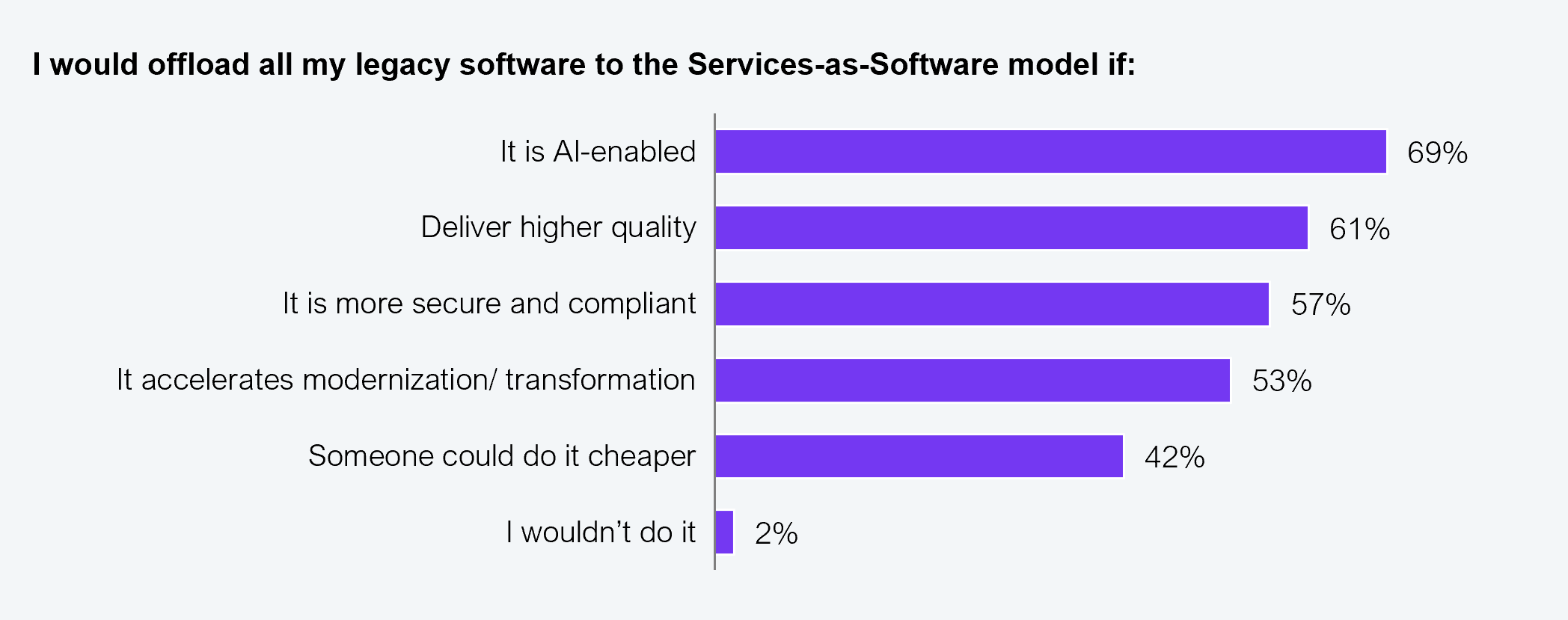
Nearly all (98%) of decision makers surveyed are ready to offload legacy to a Services‑as‑Software model (buying outcomes where integration, operations and governance are features of the product, not separate projects) under the right terms: prioritizing AI‑enabled management (69%), quality (61%), and security (57%) ahead of pure cost reduction (42%).
This preference suggests organizations want to overcome legacy burdens by enhancing capabilities rather than solely pursuing cost arbitrage. That’s a mandate to buy outcomes with integration, governance, and reuse built in—precisely the lever that could help flip the services ratio and contain tech debt (see Exhibit 8).
Sample: 123 decision makers across Global 2000 organizations
Source: HFS Research, 2025
Evolving the operating model
The research is unambiguous: Current models consume budgets, slow delivery, and harden tech debt, just as AI raises the stakes. The escape is a new operating model—Services-as-Software—a governed architecture that minimizes custom code and maximizes reuse, and AI applied within those guardrails to accelerate safely.
To make this shift, enterprises must:
Partner with vendors that bundle integration, enforce governance through architectures that minimize or eliminate code sprawl, and use AI to standardize, refactor, and test to reduce the services multiplier, compress run spend, and avoid the next wave of technical debt.
Transformation is stymied by the status quo: an ecosystem built to manage the maintenance burden of infinite code creation, not innovation. What’s needed is a new model that rewrites the economics of transformation to unlock innovation, embrace AI responsibly, and accelerate development without compounding cost and adding complexity.
Enterprises must pivot now to upend the status quo and help evolve an ecosystem that prioritizes code maintenance:
Flip the spending, shrink the surface area, and demand outcomes instead of buying obligations. This is how transformation becomes sustainable.
Register now for immediate access of HFS' research, data and forward looking trends.
Get StartedIf you don't have an account, Register here |
With the exception of our Horizons reports, most of our research is available for free on our website. Sign up for a free account and start realizing the power of insights now.
Our premium subscription gives enterprise clients access to our complete library of proprietary research, direct access to our industry analysts, and other benefits.
Contact us at [email protected] for more information on premium access.