This Market Vision Paper is for CIOs, chief transformation officers, and enterprise technology leaders ready to move beyond AI pilots and deploy AI employees that own business outcomes across customer service, sales, and HR operations.
Enterprise AI has reached an inflection point. What began as simple automation is becoming far more consequential: a rethinking of how work gets done. It’s not about deploying smarter tools but about redesigning how businesses function when software can act, decide and own outcomes.
To help organizations navigate this shift, HFS Research partnered with Ema, a pioneer in deploying agentic AI employees across enterprise functions, to define a new category: Agentic Business Transformation (ABT). ABT is the reinvention of enterprise operations that begins when AI employees—intelligent systems built to take responsibility for business results—move from isolated deployments to coordinated, enterprise-wide roles. These systems don’t just support work; they perform it.
This guide, grounded in Ema’s real-world deployments across Fortune 500 enterprises, introduces the foundational concepts of ABT, clarifies how agentic AI differs from previous automation waves, and illustrates how AI employees are transforming enterprise execution at scale.
In this guide, you’ll learn:
This guide is for CIOs, transformation leaders, and executives ready to move beyond pilot programs to operational AI that delivers a competitive advantage. It’s time to shift the question from “what can this tool do?” to “what can this agent own?”

While enterprise automation has delivered steady gains, it has also revealed its limits. Despite years of investing in RPA, chatbots, and workflow tools, many operational gaps remain unresolved. Support processes lag, sales cycles are bogged down by manual coordination, and internal services often frustrate the employees they aim to support. The promise of intelligent, real-time, always-on operations remains unmet.
The problem isn’t the lack of intelligence. These systems just weren’t built for autonomy. Most automation is still fundamentally assistive, moving only when triggered and depending on human oversight to resolve exceptions, coordinate across systems, and close gaps. While these tools reduce manual effort, they rarely change how work is structured or how outcomes are delivered.
The constraint was never processing power or data access. It’s the absence of systems that can pursue goals, reason through complexity, and take accountability for results. As business environments grow more dynamic and interconnected, enterprises need more than smart tools. They need systems that act with agency.
Agentic AI introduces that agency. It drives the shift from scripted tools to autonomous systems that can interpret intent, make decisions, take action across environments, and improve through experience. These systems are not configured to follow rules but built to achieve outcomes.
This evolution is anchored in three foundational capabilities:
Unlike copilots that rely on human direction or traditional bots confined to narrow paths, agentic systems can operate independently. They manage exceptions, adjust to changing conditions, and coordinate toward defined goals. This isn’t an incremental improvement but a shift in what enterprise systems are designed to do.
Despite rapid market adoption, most so-called agentic platforms aren’t truly autonomous. They offer advanced interfaces, faster responses, and more integrations but still depend on humans to define logic, manage edge cases, and guide execution. They mimic intelligence but stop short of owning outcomes.
This gap between brand and reality is becoming harder to ignore. Many enterprises expect transformation and end up with superficial gains. Without a shared framework to evaluate maturity, it’s difficult to distinguish between systems that assist and those that fundamentally change how work gets done.
Enterprises need clarity to move forward. HFS’ Agentic Maturity Model provides a structure for understanding where current deployments stand and where transformation begins (see Exhibit 1).
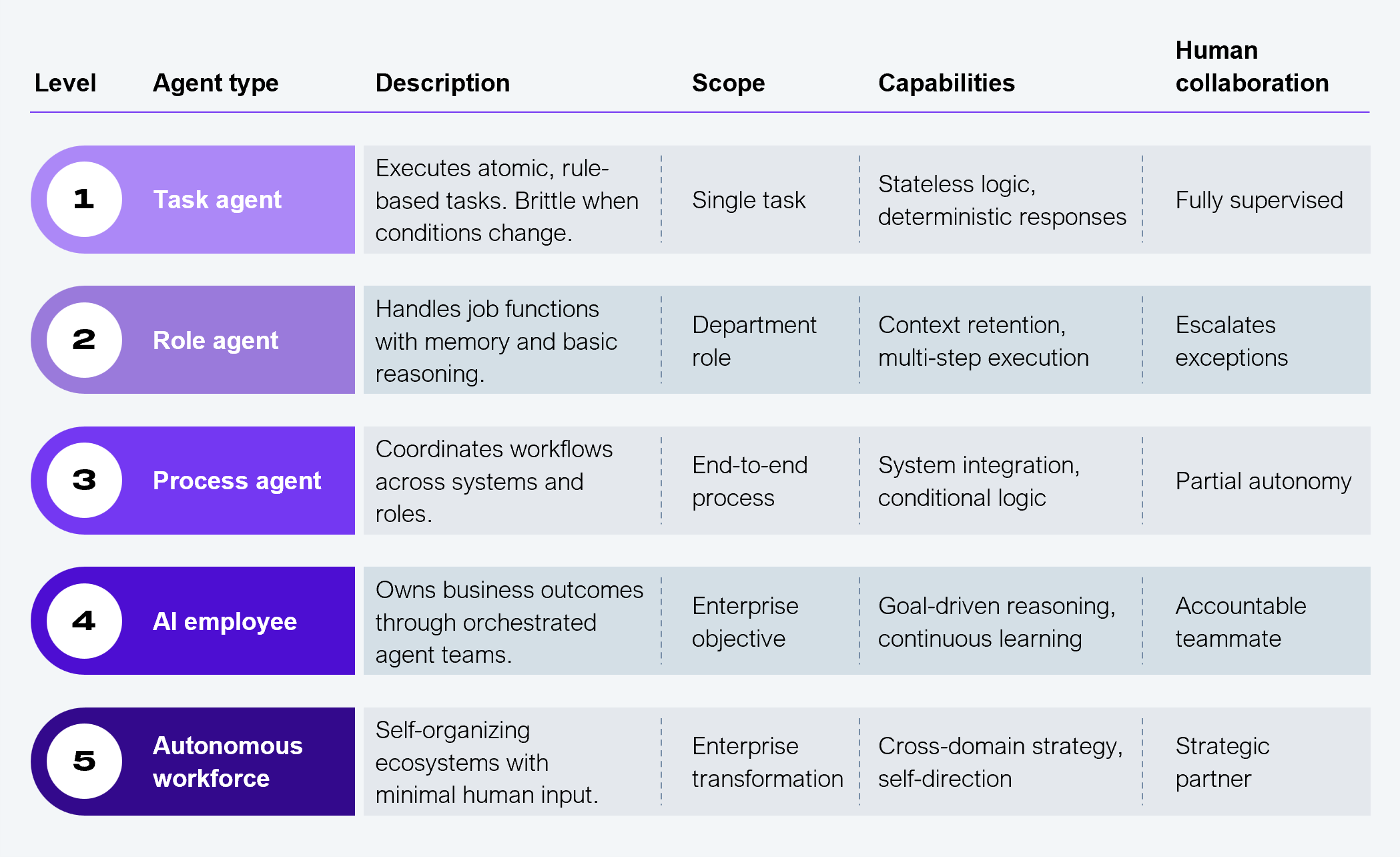
Source: HFS Research, 2025
Most current deployments operate at Levels 1 through 3. They deliver efficiency but still rely on predefined logic and human decision-making. The real shift occurs at Level 4, where systems stop waiting for instruction and start taking responsibility for results.
As Swati Trehan, Head of Strategy and Operations at Ema, put it, “The shift isn’t from humans to machines. It’s from tools that assist to systems that own outcomes.”
Level 4 is where AI employees emerge and where everything changes.
AI employees aren’t just agentic systems; they’re agentic AI specifically architected for enterprise accountability. While agentic AI provides the foundational capabilities, AI employees add enterprise-grade orchestration, outcome ownership, and business integration that make them genuine team members.
AI employees are already delivering measurable results across customer service, sales, and HR operations—resolving tickets autonomously, generating complex proposals, and streamlining employee requests. These aren’t just faster processes; they’re fundamentally different ways of working.
As Ema CEO Surojit Chatterjee explained, “AI employees aren’t monolithic agents. They’re collections of agents. Some will have 10, 20, and even 30 distinct agents working together and orchestrated through our proprietary mesh model.”
This mesh architecture is what enables true accountability. Different agents handle information retrieval, policy enforcement, exception management, and quality control. Together, they deliver outcomes with the reliability and responsibility you’d expect from your best human employees.
Individual AI employees deliver impressive results: faster customer resolution, automated proposals, streamlined HR processes. But these remain isolated wins. Customer service improves while sales processes stay slow. HR gets more efficient, while finance remains bottlenecked. You get better performance in silos, not transformation across the enterprise.
The early deployment of AI employees naturally starts with single functions, proving the technology works and delivers measurable value. However, the real transformation opportunity lies in moving beyond isolated successes to coordinated deployment across the enterprise.
Real transformation happens when AI employees coordinate across functions to drive outcomes—like a customer service AI employee handing an upsell opportunity to a sales AI employee, or an HR AI employee working with finance to automate onboarding budgets.
This transformed state is ABT—when AI employees are deployed at an enterprise-wide scale to transform how work is structured, how functions interact, and how success is measured across the organization.
ABT isn’t a methodology or framework; it’s the outcome. It’s the new operating model that emerges when individual AI employee successes connect and amplify across the enterprise. Instead of siloed improvements, you get integrated transformation that reshapes how the entire business operates. The path to ABT starts with understanding where AI employees deliver the strongest results today and how those successes create the foundation for enterprise-wide coordination.

The practical question is: where do AI employees deliver the strongest results, and how do you build from individual deployments toward enterprise transformation? The answer lies in understanding where early adopters are succeeding and why.
Across Ema’s deployments, three domains consistently emerge as high-impact entry points: customer experience, sales automation, and employee services. Each offers clear business value, manageable complexity, and a foundation for scaling toward ABT.
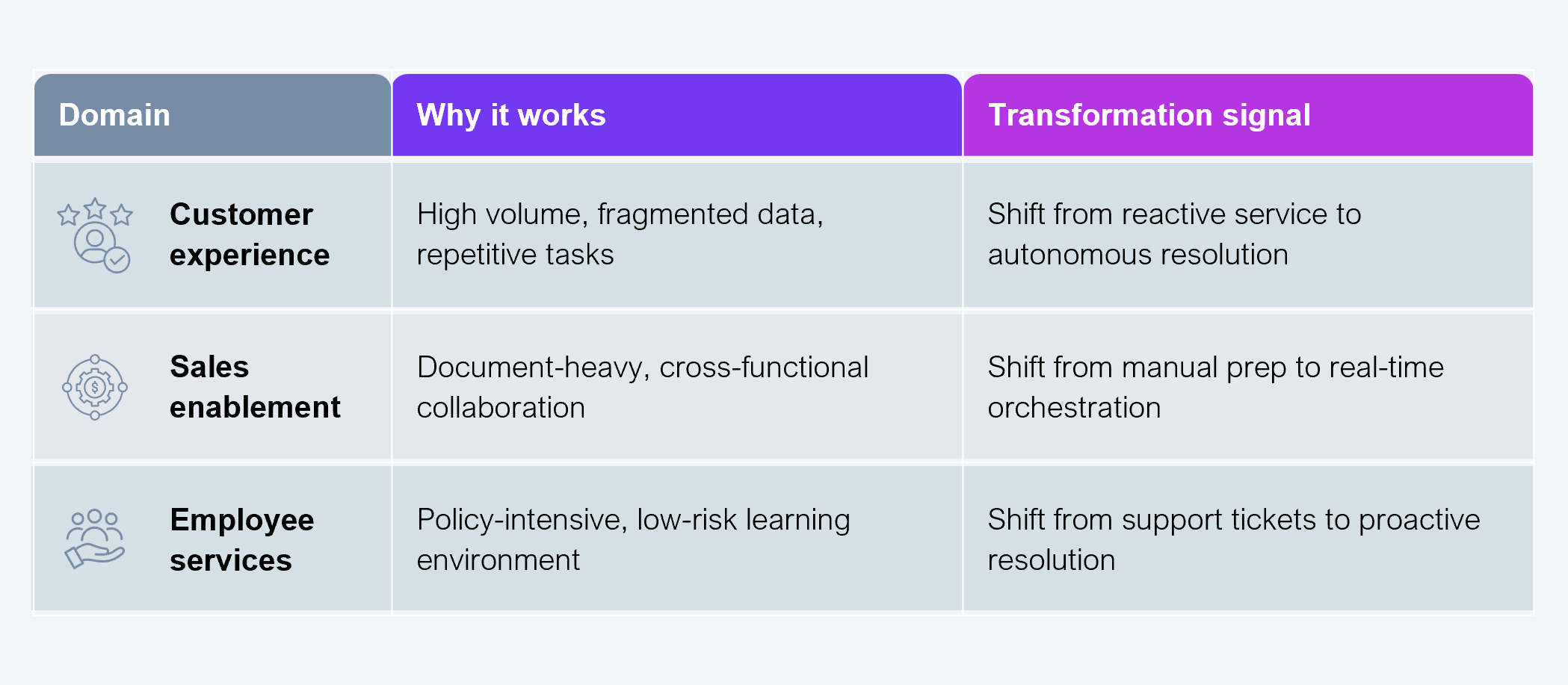
Source: HFS Research, 2025
Customer experience: From reactive service to autonomous resolution
Customer support became the proving ground for AI employees because the business case was obvious: improve satisfaction, reduce costs, and do it at scale. But this isn’t about chatbots with friendlier scripts. These are systems that reason through complex issues and resolve them across a fragmented infrastructure.
A major B2C lending platform with 50 million users was drowning in 2 million annual support tickets with customer satisfaction hovering around 40–50%. Ema’s AI employee autonomously resolved 80% of tickets while driving satisfaction scores to 75%. The transformation wasn’t just speed; it was capability. The AI employee can access loan systems, payment platforms, and external databases simultaneously, providing complete answers that human agents couldn’t match without switching between multiple applications. When customers submit complex queries about loan status or payment issues, the AI employee pulls data from all relevant systems to deliver comprehensive solutions in real time.
Sales automation: From bottlenecks to growth leverage
Sales has become a high-impact entry point for AI employees, offering clear value in a function often held back by slow, manual coordination. Proposal development, in particular, is time-consuming and requires input from multiple teams across the organization. AI employees reduce that complexity by generating complete outputs, coordinating across roles, and freeing up sales teams to focus on closing deals.
A global professional services firm was losing deals due to a slow proposal process that took weeks, requiring more than 20 specialists across legal, technical, and commercial teams to collaborate on 300–500 page RFP responses. Ema’s AI employee addressed this by generating complete proposals in minutes, with specialized agents handling research, writing, chart generation, and compliance checking, while a meta-agent ensures consistency across all sections. The result: 70% faster response times with higher quality than human-generated proposals. With this, the firm can pursue more opportunities, consistently outpace competitors, and enable its sales team to focus on relationship building rather than document assembly.
Employee experience: The unexpected unlock
HR emerged as the surprise success story for AI employees, driven not by cost reduction but by employee wellbeing. CHROs discovered that eliminating administrative friction dramatically improves workplace satisfaction while freeing HR teams for strategic work. Unlike customer-facing applications where AI mistakes affect external relationships, internal deployments offer safer learning environments with more tolerant users willing to provide feedback for continuous improvement.
A multinational technology services company with 250,000 employees across 52 countries deployed Ema’s AI employee as its universal HR interface. Workers interact through chat and company intranets to get policy answers, submit requests, and take action across multiple HR systems. The AI employee handles everything from vacation approvals to complex policy interpretations, enabling seamless escalation to human HR when sensitive issues arise. The transformation eliminated days-long delays for simple questions while freeing HR teams to focus on strategic business partnerships rather than ticket processing.
Enterprises that saw results didn’t just pick the right use case. They chose the right conditions. Across all three domains, four characteristics showed up consistently:
Knowing where AI employees deliver value is only half the equation. The harder part is figuring out how to start—with the right opportunities, a thoughtful approach, and realistic expectations.

Most enterprises approach agentic AI like any other software initiative. They begin with demos, narrow pilots, and minimal expectations. They measure success by whether something works, not whether it transforms. But deploying an AI employee is not a technology rollout. It’s a workforce decision.
The difference matters. Software supports people. AI employees take on roles. They own outcomes. And just like a new hire, their success depends on clarity of purpose, structured onboarding, and the ability to integrate with the team. Getting started requires a shift in sequence: define the outcome first, select the right delivery approach, and prepare the organization to collaborate with a system that doesn’t just assist but acts.
The difference between AI employee success and failure often comes down to opportunity selection. While the technology is proven, not every business process is ready for autonomous systems. Some workflows have the right combination of complexity, data access, and stakeholder readiness. Others will frustrate both the AI employee and the team.
The key is systematic evaluation. Rather than picking processes based on intuition or immediate pain points, start with a rigorous assessment of where AI employees can deliver the strongest impact with the lowest risk to ensure successful deployments. Before implementing any AI employee, assess opportunities using clear criteria that separate high-impact deployments from expensive experiments (see Exhibit 3). Choosing the wrong starting point can undermine confidence in the entire approach and delay the path to transformation.
How to use this assessment:
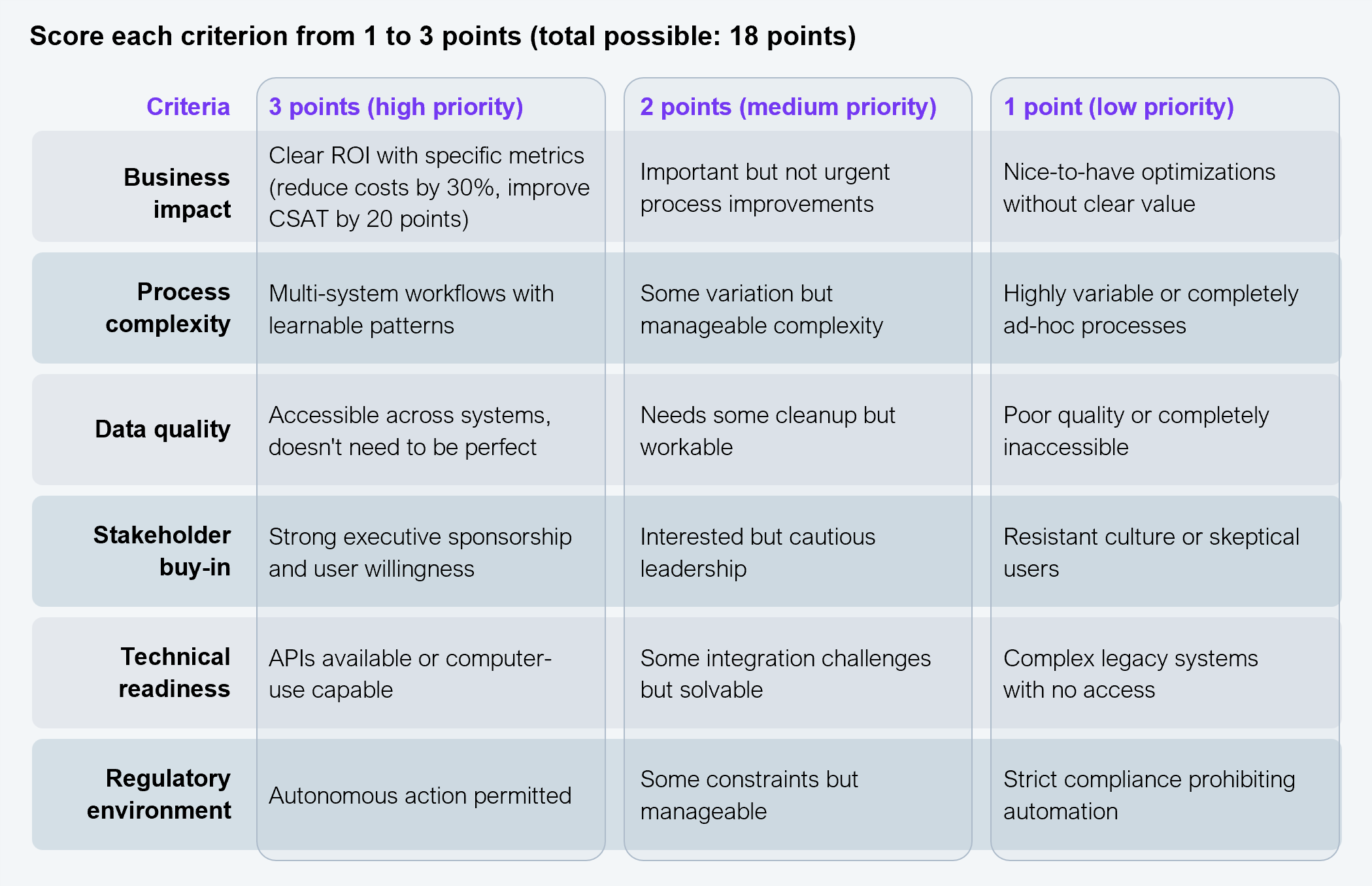
Source: HFS Research, 2025
Implementation priority guide:
Once you’ve identified high-scoring opportunities, the next critical choice determines your entire implementation strategy: building capabilities internally or partnering with a specialized platform.
This one decision will shape your ability to scale more than any other: whether to develop AI employees internally or partner with a specialized platform.
Many enterprises assume they need to build from scratch to stay differentiated. But the reality is that most internal efforts stall due to orchestration complexity, limited AI talent, and delayed returns. For non-core processes, it’s not about whether you can build but if it makes sense to do so.
The cheat sheet below clarifies the path based on business value, complexity, and internal readiness (see Exhibit 4).
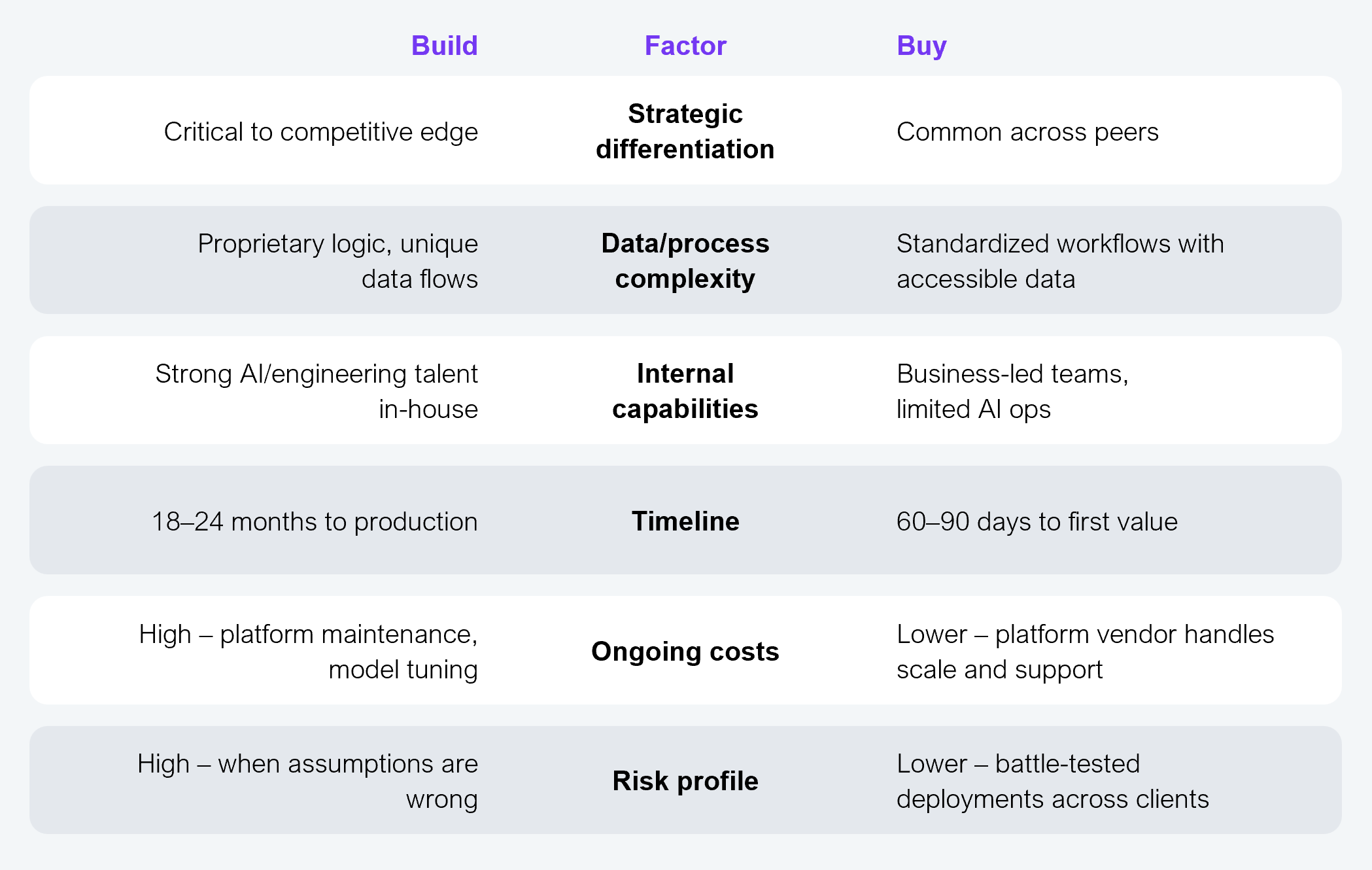
Source: HFS Research, 2025
Build when the process is truly unique: Internal development makes sense if the process is a source of competitive advantage—something industry-specific that no vendor can replicate. Think of a pharmaceutical firm’s R&D workflow or a financial institution’s risk models. But building requires orchestration expertise, infrastructure, and specialized skills that most enterprises lack. Add 18–24 months of development time and the opportunity cost of delayed value. Build for agency.
Buy for repeatable business functions: Customer support, HR operations, sales enablement, and finance workflows don’t need to be reinvented. Strong platforms already exist in these areas, offering proven integrations, continuous updates, and faster time to value. The best vendors offer just enough customization to meet your needs without losing the scale benefits of shared development. Buy for commodity.
If you’re going to buy, choose carefully. Check if a platform is built for real agentic execution or just dressed-up scripts with a better interface.
If the answer to these sounds like “that’s on you,” then you’re not buying an AI employee; you’re buying a framework that still needs staffing.
You wouldn’t hire a new employee and immediately give them full access to every system with zero oversight. The same principle applies to AI employees, but the onboarding process looks fundamentally different.
Traditional software deployments focus on configuration, testing, and training users. AI employee deployments require an entirely different approach: establishing trust, defining accountability, and teaching your organization how to work with a teammate that never sleeps, never forgets, and can access every system simultaneously.
The shift from managing tools to managing AI teammates creates new challenges:
Successful deployments follow a structured 90-day progression, moving from observation to collaboration to full autonomy (see Exhibit 5).
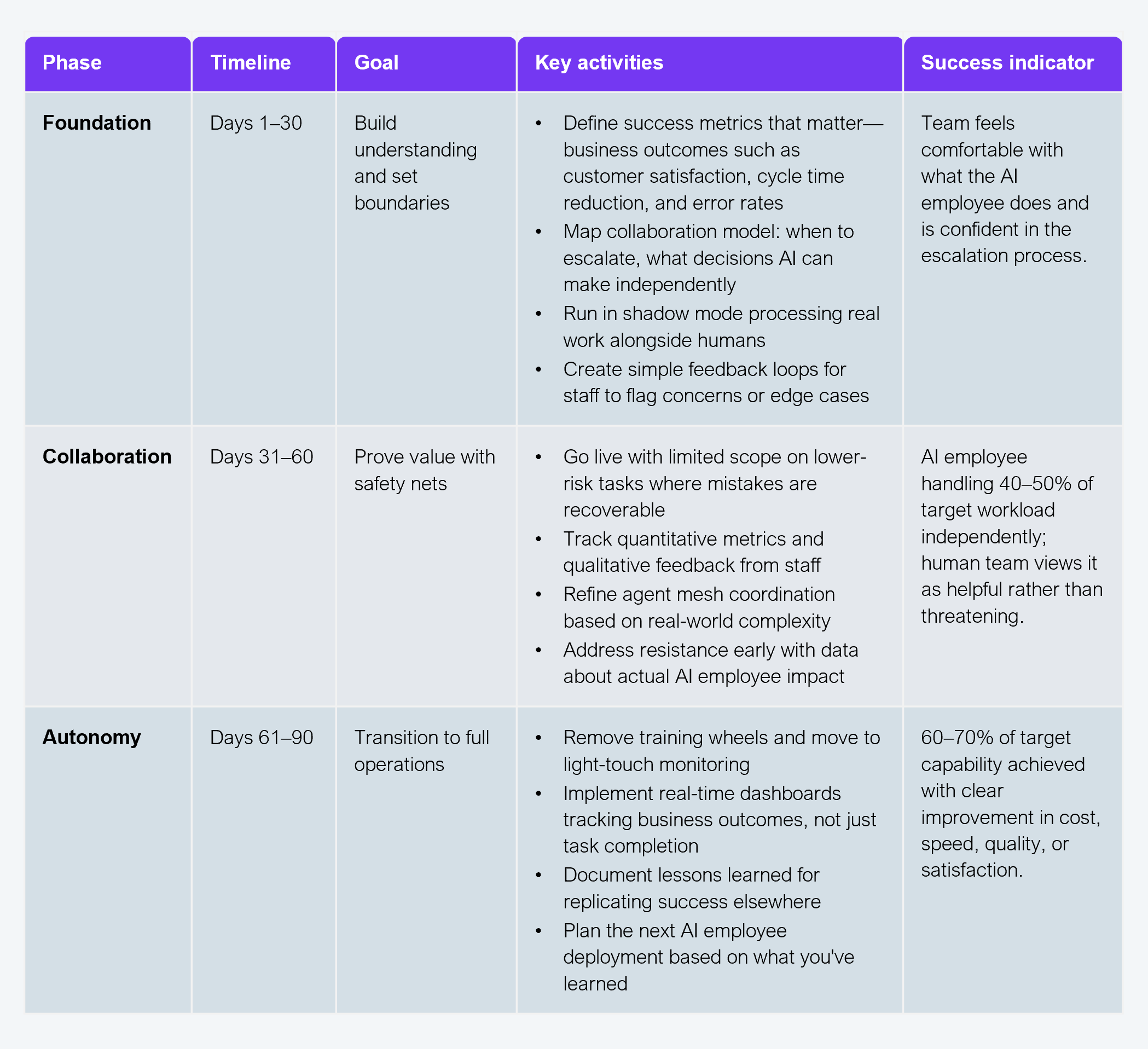
Source: HFS Research, 2025
This path mirrors how you’d onboard any new team member but adapts to the unique challenges of working with systems that learn and evolve over time.
With real-world evidence from pioneers such as Ema, the case for agentic AI has started to move beyond theory. The foundation for this transformation already exists. AI employees deliver measurable results across customer service, sales, and HR operations. The architecture is proven, the patterns are clear, and the path from individual deployments to enterprise transformation is well-defined.
What matters now is execution. Organizations that move systematically—identifying high-impact opportunities, deploying with discipline, and building toward coordinated AI workforces—will establish operational advantages that compound over time.
The question is no longer whether agentic AI will reshape how enterprises operate but how systematically organizations can progress from automation to true business transformation.
Register now for immediate access of HFS' research, data and forward looking trends.
Get StartedIf you don't have an account, Register here |
With the exception of our Horizons reports, most of our research is available for free on our website. Sign up for a free account and start realizing the power of insights now.
Our premium subscription gives enterprise clients access to our complete library of proprietary research, direct access to our industry analysts, and other benefits.
Contact us at [email protected] for more information on premium access.