Our recent “Sourcing and Procurement (S2P) Services, 2025” Horizons report highlights that the future of autonomous procurement is not far off considering the accelerating pace of innovation. However, enterprises are not yet ready to realize its full potential due to the lack of structured data, siloed platforms and workflows, and limited knowledge of stakeholders. For meaningful outcomes, CPOs must work with people, processes, and platforms to enable AI-driven orchestration.
We evaluated 14 S2P service providers across three Horizons (see Exhibit 1) on how they help enterprises move beyond transactional procurement to AI-driven orchestration in generating higher-order value.
The S2P landscape leaders are already demonstrating what full-scale transformation looks like, while the innovators and disruptors are quickly maturing their capabilities to close the gap between ecosystem orchestration, collaboration, and the creation of new sources of value, along with opportunities to scale efficiency and provide cost takeout.
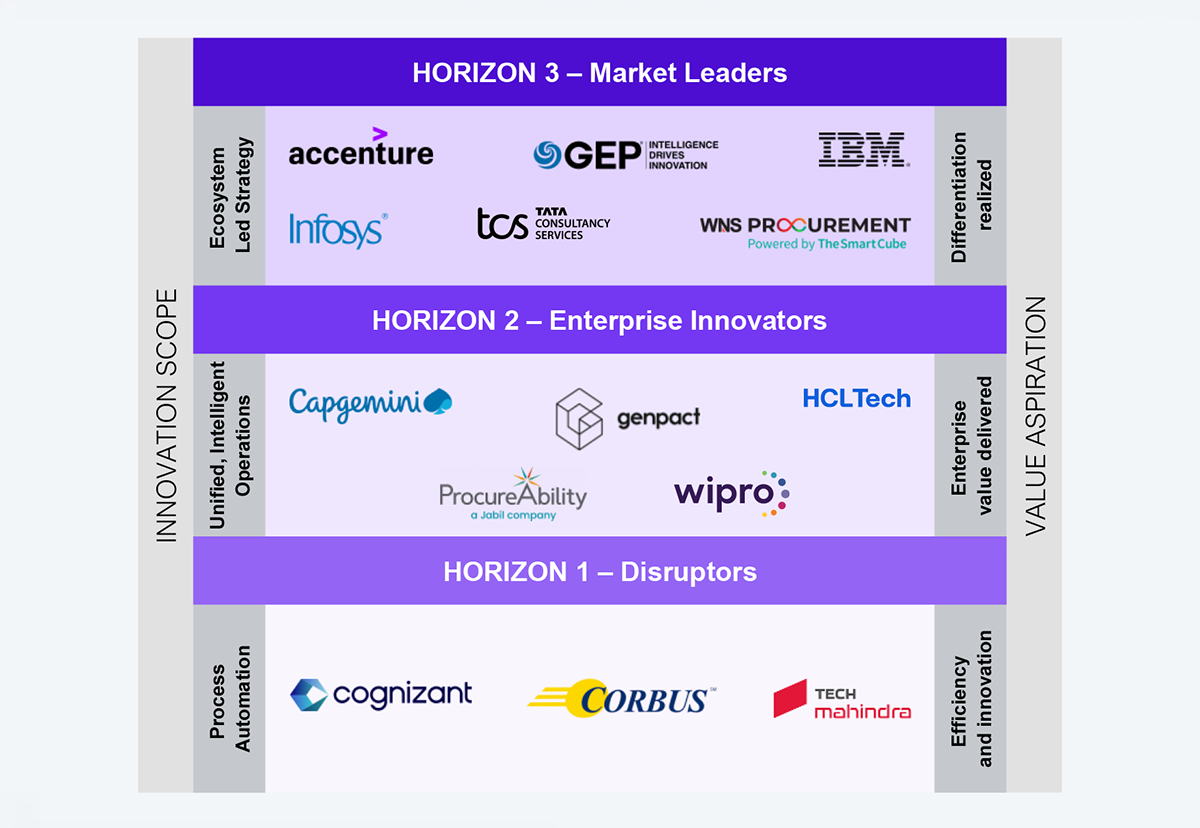
Note: All service providers within a Horizon are listed alphabetically
Source: HFS Research, 2026
Our analysis showed that enterprises are delivering measurable impacts: 3%–10% in cost savings, 90% compliance, increased spend under management, and real-time spend visibility through end-to-end S2P automation.
At the same time, organizations are struggling with fragmented data, limited budget, technology debt, operational firefighting across functions, compliance gaps, and talent shortages, hindering their automation progress. The challenges are rooted primarily in structural and capability gaps (see Exhibit 2). Budget constraints limit investment in technology and skills, while poor data quality, fragmented systems, and legacy tech debt reduce visibility and slow decision making. As a result, teams are stuck in operational firefighting, with limited capacity for strategic work.
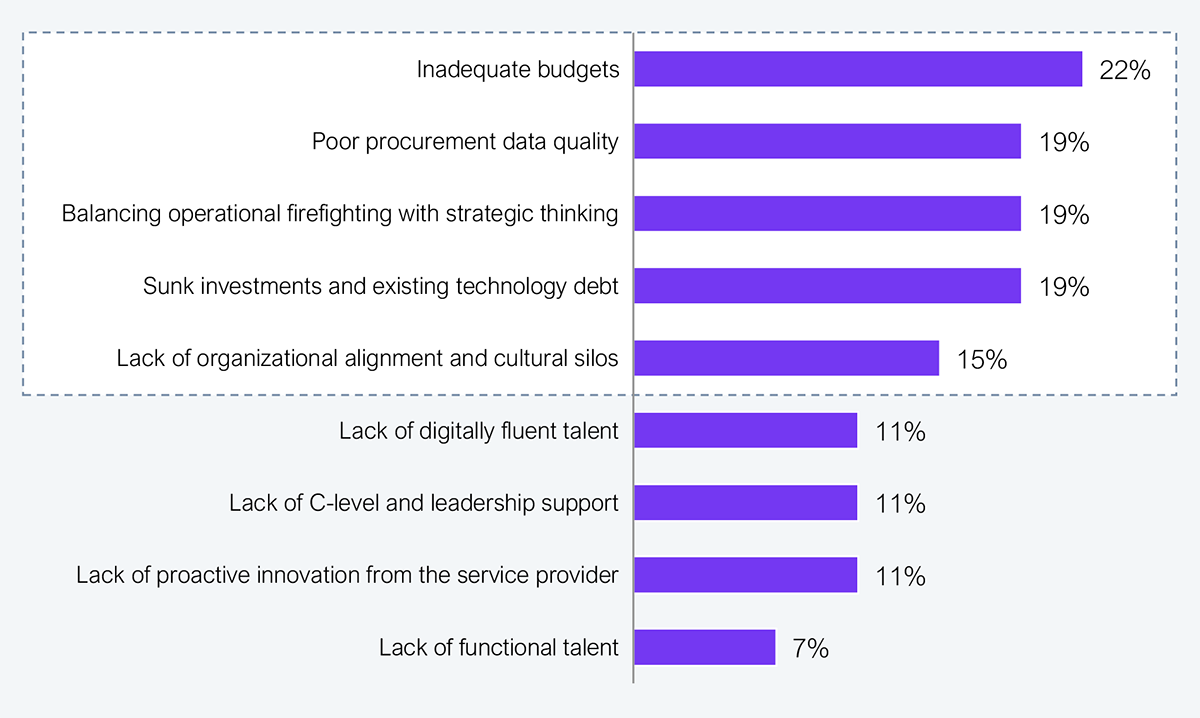
Sample: 27 procurement leaders in the S2P references survey
Source: HFS Research, 2026
In response, procurement objectives are extending beyond cost reduction to delivering broader business value. To achieve the future state of procurement orchestration, enterprises need a more well-rounded action plan that strengthens collaboration across functions and aligns technology strategies to optimize outcomes from existing processes. As the data being recorded is key to orchestration, procurement leaders should focus on collecting accurate intake data, invoicing, and payments until they are closed. It allows leaders to unify data for structured workflows and ease orchestration.
S2P tasks and workflows are being codified and platformized with the advent of large language models (LLMs). With LLMs as key catalysts, S2P providers are aggressively mapping transactional work to their existing IP-driven platforms or partnering with platforms to solve enterprise challenges.
Moreover, the Horizon 3 market leaders are leaving no stone unturned in creating an agent-driven, human-in-the-loop procurement orchestration, starting from intake to accounts payable across the S2P value chain. Here are some key examples:
AI-driven orchestration is no longer a future ambition for procurement. It is becoming the organizing principle for how S2P delivers value at scale. As data, workflows, and intelligence are unified across the S2P lifecycle, procurement leaders must move decisively beyond transactional execution toward orchestrated, insight-driven decision-making.
Register now for immediate access of HFS' research, data and forward looking trends.
Get StartedIf you don't have an account, Register here |
With the exception of our Horizons reports, most of our research is available for free on our website. Sign up for a free account and start realizing the power of insights now.
Our premium subscription gives enterprise clients access to our complete library of proprietary research, direct access to our industry analysts, and other benefits.
Contact us at [email protected] for more information on premium access.