We are already so invested in AI that there is no turning back. The positive impact on our personal lives and our ability to learn, think, and execute is no longer up for debate.
HFS analysts attending Davos didn’t gain confidence from the technology demos or the scale of investment announcements. Instead, they gained confidence from the sheer focus, intensity, and obsession smart CEOs now have with the future of AI and the opportunities it is creating. And shame on those leaders using AI as an excuse to cut jobs; that is just corporate cowardice, and we all know it.
Smart, ambitious leaders are not asking whether AI will matter. They are asking how quickly they can rewire their organizations around it and how to ensure their people are ready for what comes next. That mindset shift matters more than any model release.
No serious business today could function without the internet, cloud, or data platforms, and similarly, AI is becoming embedded infrastructure. It is not optional. It is foundational.
Every job in history that could be replaced by a machine eventually was. That is not a failure of society. It is how progress works. When technology catches up with a form of labor, humans do not disappear. We move on to new work that creates more value, greater growth, and often better outcomes for people.
It fits squarely into the long historical pattern of general-purpose technologies that raise productivity and reset how value is created. Economies are hollowed out when productivity gains are not reinvested, when growth stalls, or when institutions fail to adapt. AI, by contrast, is being adopted precisely because leaders are searching for new growth engines, not just lower cost structures.
When productivity rises, capacity expands. When capacity expands, organizations can do more, serve more customers, and pursue opportunities that were previously uneconomic. That expansion pulls demand forward, not backward. New products, new services, and new markets follow. This is the mechanism through which past technologies, from electricity to computing to the internet, reshaped economies without erasing them.
We are already seeing this dynamic play out. AI is creating demand for roles that blend human judgment with machine capability, including AI product owners who define outcomes, workflow designers who orchestrate human-agent collaboration, model trainers and data stewards who ensure quality and relevance, and risk, governance, and ethics leaders who oversee decision integrity at scale. Domain experts are becoming more valuable, not less, because intelligent systems need context, nuance, and accountability to perform well.
These are not replacement jobs. They are additive roles that only exist because AI now handles the mechanical parts of work. Far from hollowing out economies, AI is shifting human effort toward higher-value activities, enabling more innovation, faster growth, and broader participation in value creation. The real challenge is not job destruction, but ensuring people can move quickly into these new forms of work as the economy evolves.
Smaller teams can now build, test, and launch products in weeks rather than years because AI handles large portions of design, coding, analysis, and operational execution. For example, we are seeing mid-sized enterprises launch AI-driven advisory and decision-support services with teams a fraction of the size previously required, combining a handful of domain experts, AI product owners, and engineers with agentic systems that execute research, modeling, and customer interaction at scale. What once demanded large development and support organizations can now be delivered by lean, high-impact teams.
As a result, new services can be launched with fewer fixed costs and far less risk, encouraging experimentation and expansion rather than consolidation. Entirely new categories of work are emerging around personalization, customer experience orchestration, and intelligent decision support, roles focused on defining intent, context, and outcomes rather than repetitive execution. This is how growth happens. AI shifts the economics of innovation in favor of building more, trying more, and creating more value, which in turn creates new work for people, not less.
HFS analysis in Exhibit 1, based on 979 actual GenAI and agentic AI use cases, shows a clear and encouraging pattern in how enterprise value from AI actually unfolds.
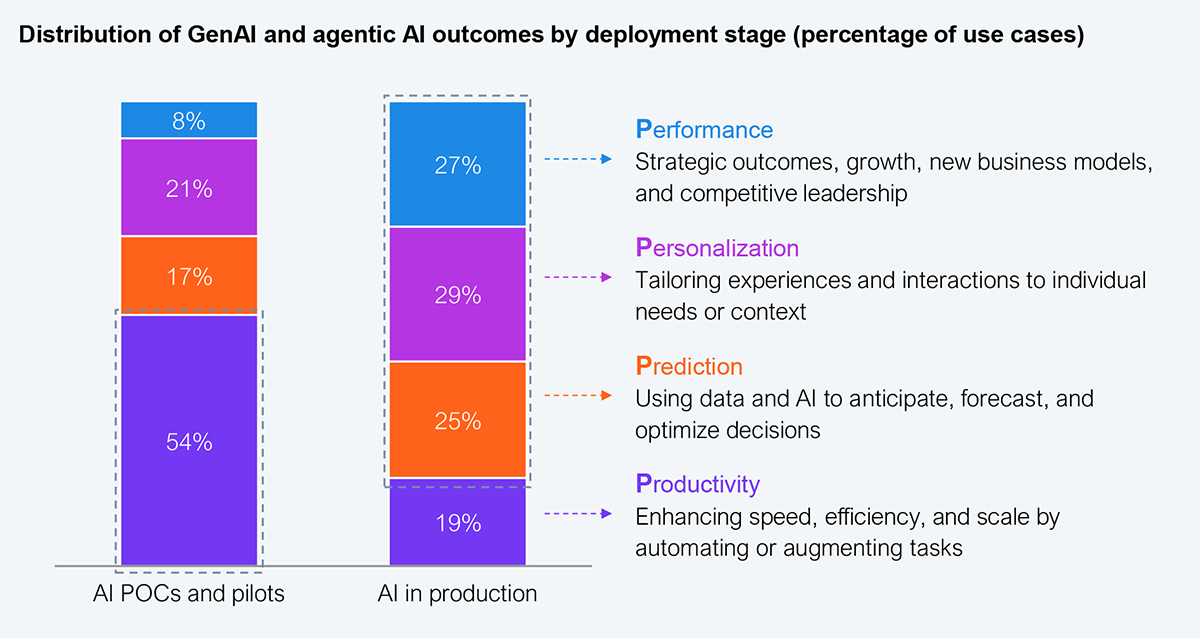
Sample: 979 GenAI and Agentic AI use cases collected by HFS over the last 12 months
Source: HFS Research, 2026
In the proof-of-concept (POC) and pilot stages, the focus is overwhelmingly on productivity, with 54% of use cases aimed at speed, efficiency, and task automation. That is the natural starting point, because productivity gains are easiest to prove and quickest to justify. But once AI moves into production, the value mix shifts decisively. Productivity drops to just 19% while higher-order outcomes surge. Personalization, prediction, and performance together account for more than 80% of production deployments, with personalization alone rising to 29% and performance more than tripling to 27%.
As enterprises scale AI, they create new roles to design, govern, and operationalize human-agent workflows, such as AI product owners who define outcomes, domain specialists who embed context into models, and risk and governance leaders who oversee decision integrity. In customer-facing functions, AI-driven personalization has fueled demand for experience designers and journey owners who orchestrate differentiated interactions at scale. In operations, predictive AI has expanded roles focused on scenario planning, exception management, and continuous optimization, work that did not exist when humans were trapped in manual execution.
The data reinforces a critical lesson for leaders. Productivity gets AI approved, but real enterprise value and real job creation only emerge once organizations push past pilots and redesign workflows, decision rights, and operating models around AI at scale. This is where growth happens and where new work for humans is created, not eliminated.
History shows that technology does not eliminate human purpose. It changes where human value sits. I hold out real hope that AI is not a game-ender for people in the workplace. If we focus on growth, reinvention, and human capability rather than fear, it will prove to be one of the most powerful job creators we have ever seen.
Register now for immediate access of HFS' research, data and forward looking trends.
Get StartedIf you don't have an account, Register here |
With the exception of our Horizons reports, most of our research is available for free on our website. Sign up for a free account and start realizing the power of insights now.
Our premium subscription gives enterprise clients access to our complete library of proprietary research, direct access to our industry analysts, and other benefits.
Contact us at [email protected] for more information on premium access.