Most people claiming to be involved with “agentic” initiatives today are actually referring to generative AI (GenAI). GenAI creates. Agentic AI acts. Generative systems respond to prompts, while agentic systems pursue goals. The problem is that most people just jump on the agentic buzzword without understanding what it really means. We lay it all out in Exhibit 1.

Source: HFS Research, 2026
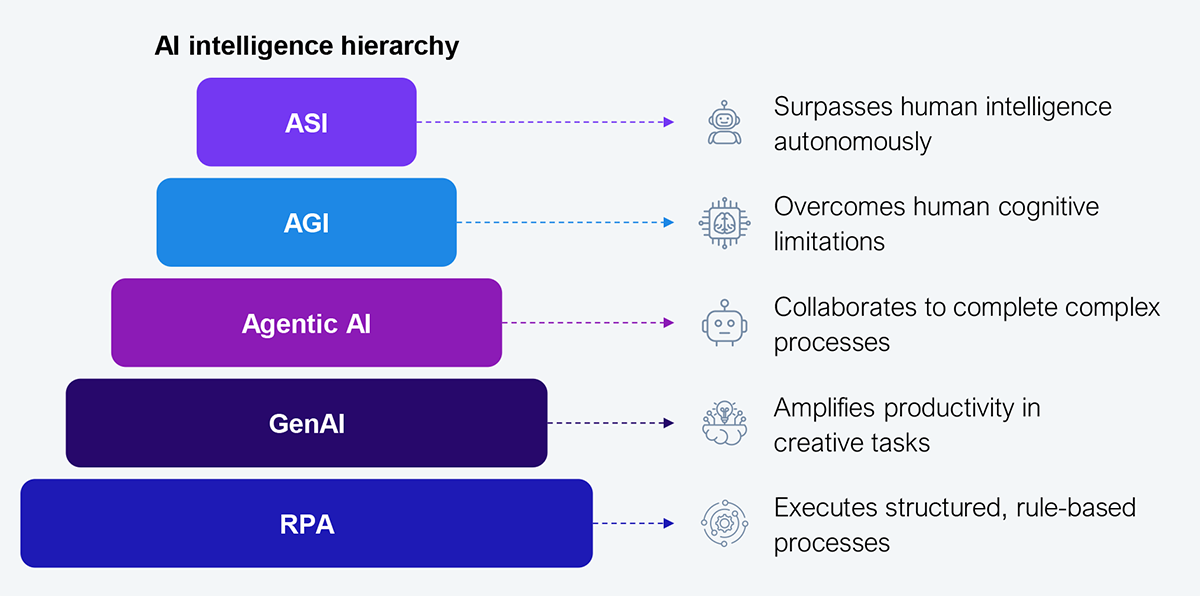
To understand the differences clearly, we need to view AI evolution as a continuum in Exhibit 1 and a hierarchy in Exhibit 2, from rule-based automation to true self-directed intelligence.
Source: HFS Research, 2026
Banks, telecoms, and healthcare organizations still use RPA (rule-based task automation) to eliminate repetitive work. A major bank uses UiPath bots to reconcile accounts by copying data between ledgers, and a telecom provider uses Automation Anywhere for service-order entry. Many healthcare payers depend on SS&C Blue Prism bots to extract and validate claim details from PDFs and legacy systems.
These automations remove manual effort but follow rules precisely, lacking awareness or adaptability. RPA is not like more advanced agentic tools; it cannot sense tone, urgency, or context. It does what it is told and nothing more.
Generative AI is a productivity amplifier; it has quickly become the enterprise creativity engine. Law firms use Microsoft Copilot to draft contract clauses, consulting teams rely on ChatGPT Enterprise to summarize research and build first-cut slides, and retailers deploy Salesforce Einstein GPT to generate marketing copy at scale. Startups like Mistral AI and Lyzr are taking this further, enabling enterprises to embed generative reasoning and contextual understanding into workflows. GenAI accelerates human creativity and insight but still needs oversight to ensure it aligns with brand, culture, and tone.
Vibe coding begins here. It leverages natural language prompts, allowing systems to embed organizational language and emotional context, ensuring outcomes reflect enterprise identity rather than generic output.
Agentic AI is a collaborative actor that represents the next evolution of enterprise automation. Supply chain systems can use agentic orchestration to reroute logistics when shipments are delayed, automatically adjusting inventory and notifying customers. Financial services firms can deploy AI agents to coordinate KYC checks, document analysis, and compliance reviews end-to-end. Technology providers can use agentic copilots that plan, code, test, and deploy small software fixes without human sequencing.
Startups like Lovable and Replit are pioneering this frontier, blending agentic orchestration with vibe coding to create environments that read human sentiment and intent. Lovable builds software agents that understand developer emotions and design preferences, while Replit uses agentic intelligence to foster human–machine flow in collaborative coding. Rhino.ai is experimenting with agentic systems that manage data onboarding and risk workflows automatically, using vibe-coded signals from user interactions to refine accuracy and decision confidence.
Agentic AI is where vibe coding becomes operational; it reads inputs from people and processes to make decisions that feel human. This is where enterprises shift from automation to orchestration and from efficiency to empathy.
Emerging research prototypes already hint at the coming of self-directed intelligence, or artificial general intelligence (AGI). We anticipate AGI being used in systems capable of cross-domain reasoning, combining engineering, finance, and operations knowledge to optimize entire factory ecosystems. Virtual assistants could learn and adapt to any role in an enterprise through self-training and transfer learning.
AGI represents the expansion of vibe coding from enterprise context to universal cognition. It’s AI that understands the nuances of human values, tone, and ethics across domains.
Artificial superintelligence (ASI) marks a theoretical endpoint where autonomous AI outperforms humans in reasoning, innovation, and governance, forming its own goals and continuously improving itself. Consider this “exponential intelligence.” At this stage, the input from vibe coding becomes the ultimate safeguard, ensuring that superintelligent systems remain grounded in human purpose and organizational ethics.
Enterprises today sit largely between the GenAI and early agentic AI stages. They use GenAI for content and insight, and they are beginning to orchestrate agentic systems for decisions and coordination. The next competitive frontier is not about who uses GenAI better, but who operationalizes agentic AI faster and who codes their enterprise with the right vibe.
Generative AI produces content. Agentic AI produces outcomes. Vibe coding inputs ensure those outcomes reflect human values, intent, and trust.
The leaders of 2026 will be those who design enterprises where people, processes, data, and AI operate as OneOffice… intelligent, unified, vibe-coded, and continuously learning.
Register now for immediate access of HFS' research, data and forward looking trends.
Get StartedIf you don't have an account, Register here |
With the exception of our Horizons reports, most of our research is available for free on our website. Sign up for a free account and start realizing the power of insights now.
Our premium subscription gives enterprise clients access to our complete library of proprietary research, direct access to our industry analysts, and other benefits.
Contact us at [email protected] for more information on premium access.