Most CHROs are being handed two mandates at once right now: cut costs and show AI progress. The response in most organizations is to reach for technology in the shape of a better portal, a new chatbot, or a refreshed shared services model. These moves can improve the surface, but they rarely touch what is underneath it. And when agentic AI lands on top of a fragmented operating model, it does not simplify the system. It scales the disorder.
The CHROs pulling ahead are approaching this differently. They are rebuilding how HR works before they automate it. IBM’s internal transformation is a clear example of what that looks like in practice and what it delivers when the sequence is right.
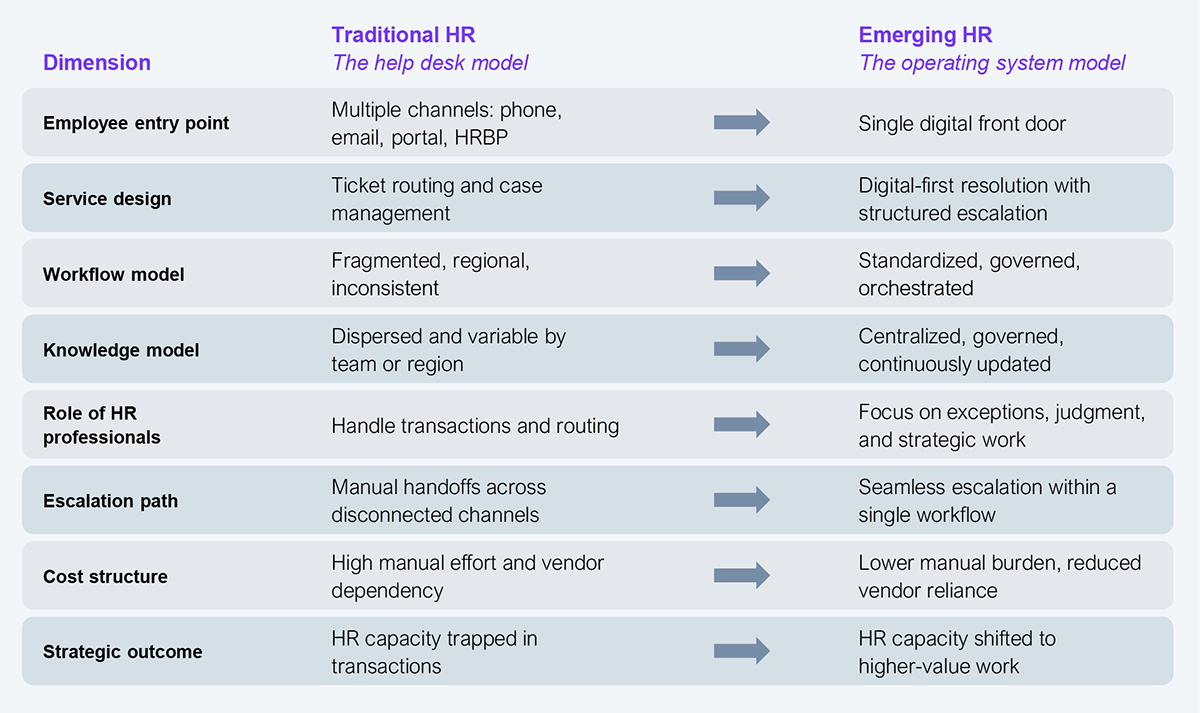
Most HR organizations still run on call center logic, even when they have layered digital tools on top. Employees come in through regional phone lines, shared inboxes, HR business partner relationships, and self-service portals that sit beside the human channels rather than replacing them. Each pathway develops its own routing logic, policy interpretation, and workarounds. Over time, the system becomes less of a designed service model and more of an accumulation.
When AI arrives in that environment, the outcome is predictable. Bots surface inconsistent answers because the knowledge beneath them is inconsistent. Employees route around the digital interface the moment it fails them. HR professionals remain tied up in the same coordination work they were already doing, now simply supported by more technology. The enterprise spends on AI, but little changes meaningfully.
The explanation often offered is that the technology needs more time; the models need more data, more tuning, or more maturity. But that interpretation mistakes the symptom for the cause. The models are not the primary constraint. The operating model underneath them is.
Automation applied before standardization does not improve a fragmented system. It accelerates it. The gap between how most HR functions operate today and what an AI-ready operating system actually requires runs deeper than most organizations have acknowledged (see Exhibit 1).
Source: HFS Research, 2026
IBM’s transformation is built on a simple premise of rebuilding the delivery model AI will run on before deploying it at scale.
The company consolidated HR support behind AskHR, a single digital entry point for employee and manager needs. Once work was entering the system through one path, IBM could standardize workflows and govern knowledge consistently. Only then did IBM layer AI on top. Three outcomes followed:
This structure also addressed a concern many CHROs raise: “What happens to entry-level development when transactional work disappears?” Entry-level employees rotate across the domain pods rather than entering a single administrative track, allowing them to build expertise across domains while still developing broad exposure to the function.
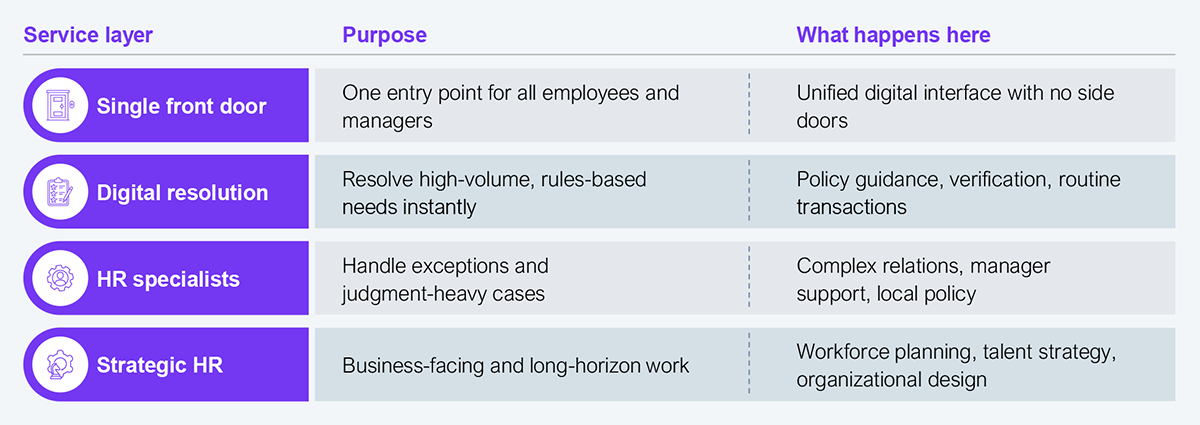
What made these outcomes possible was a deliberately tiered service architecture in which each layer handles a distinct class of needs (see Exhibit 2).
Source: HFS Research, 2026
Organizations trying to scale AI in HR often start in the wrong place. They introduce automation into processes that were never standardized to begin with. The result is not transformation; it is simply a faster version of the same fragmentation.
IBM’s experience illustrates this challenge clearly, but the lesson extends well beyond one organization. AI does not repair a fragmented operating model. It amplifies it. If entry points are inconsistent, workflows vary by region, and escalation depends on informal human coordination, AI will scale those weaknesses rather than resolve them.
For CHROs, the more practical question is not how quickly AI can be deployed, but whether the underlying service architecture is designed to support it. Three priorities consistently emerge in organizations that are building HR models that can scale AI effectively:
These operating model shifts reinforce one another, and organizations often progress across several at the same time.
HR is the only enterprise function that every employee engages with repeatedly throughout their working life: hiring, onboarding, performance management, compensation, and learning. When those interactions move to a digital-first model that works, employees develop new expectations. They begin measuring IT support, finance operations, and procurement against the experience standard HR has already set.
The CHRO who gets this right is not just running a more efficient HR function. They are conditioning the workforce for how the agentic enterprise will operate before other functions even begin the transition.
Claiming that position requires a genuine partnership with IT. CHROs own the operating model design, the workforce adoption strategy, and the business case. IT owns the infrastructure, integration capability, and technical governance. The enterprises making the most progress have both sides moving together. The ones stalling are waiting for the other to move first.
HR is the only function every employee must engage with repeatedly throughout their working life. When it becomes the first function to operate on a digital-first, agentic model, it quietly resets expectations for how every other enterprise function should work.
Those who move early will shape that model. Those who wait may find themselves implementing a version someone else has already designed.
Register now for immediate access of HFS' research, data and forward looking trends.
Get StartedIf you don't have an account, Register here |
With the exception of our Horizons reports, most of our research is available for free on our website. Sign up for a free account and start realizing the power of insights now.
Our premium subscription gives enterprise clients access to our complete library of proprietary research, direct access to our industry analysts, and other benefits.
Contact us at [email protected] for more information on premium access.