CoreStack’s acquisition of BetterCloud is not a simple acquisition for extending the product portfolio or gaining client access. It is about creating an agentic governance OS: a policy-aware, context-driven operating layer that does not just monitor the digital estate but actively governs it, enforcing intent across users, workloads, data, and AI agents in real time. This combination gives CxOs a serious shot at approaching governance as one operating problem instead of three disconnected ones and building a unified control plane for digital estates that simultaneously supports CIOs trying to simplify operations, CISOs trying to reduce risk, and CFOs trying to get a cleaner view of technology waste.
Enterprises are now trying to control three quickly colliding layers of complexity at once: cloud infrastructure, sprawling SaaS estates, and a new wave of AI tools and agents. Most enterprises still manage cloud resources in one stack, SaaS applications in another, and AI risk through a patchwork of policy, manual controls, and wishful thinking. That was tolerable when cloud, SaaS, and AI were bought and run separately, but as the human+AI model becomes prevalent, this approach becomes unfeasible. A study by HFS Research found that embedded governance is the biggest challenge that organizations currently face (see Exhibit 1).
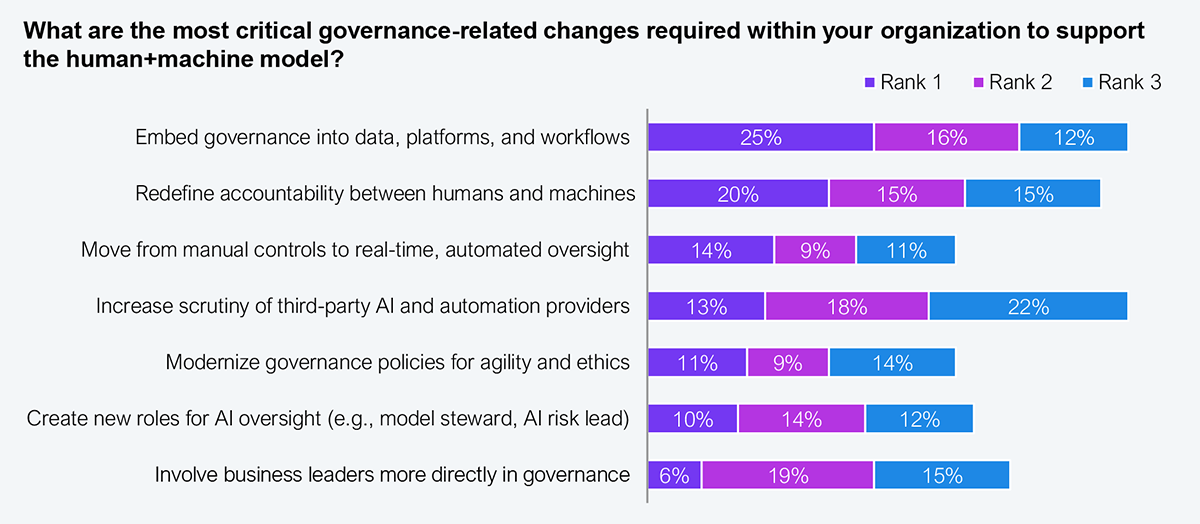
Sample: Leaders from 505 G2000 enterprises
Source: HFS Research, 2026
Buyers increasingly want a single platform as the governing layer rather than point solutions across CloudOps, SaaSOps, AIOps, and cloud-native application protection platforms (CNAPP). CoreStack already brings a multi-cloud governance spine with FinOps+, SecOps, CloudOps, CloudKM, and Graphion. BetterCloud adds SaaS lifecycle management, spend optimization, user automation, file governance, and an increasingly explicit AI-governance posture for the SaaS layer. For CxOs, the real strategic prize is a “single governance fabric” spanning infrastructure, apps, and data.
The average organization has hundreds of SaaS applications, trapping IT teams in an endless cycle of integration management and preventing them from focusing on higher-value priorities. Simultaneously, significant portions of provisioned licenses remain unused, adding costs while providing no ROI. Layer onto that a surge in shadow AI and unsanctioned tools, and the result is not simply waste. It is policy inconsistency, weak offboarding, duplicate controls, audit friction, and rising operational drag that cost millions, hamper innovation, and increase security risks.
The combined positioning centers around contextual understanding of assets, identities, dependencies, compliance, cost ownership, and risk signals. That is an important shift because automation without context just accelerates mistakes. Context-aware governance turns telemetry into decision-grade action, which is non-negotiable for the AI-accelerated enterprise.
Governance has traditionally been sold as a brake pedal, while its real job is to give the enterprise enough confidence to move faster. The most compelling enterprise use cases that give this deal the potential to matter beyond simple portfolio expansion include these scenarios:
CoreStack and BetterCloud still have to prove the integration and combine BetterCloud’s connectors and workflow engine with CoreStack’s FinOps and CloudOps modules. But the direction is right. The adaptable enterprise needs a governance layer that unifies technology, finance, and risk. This combination is one of the more credible attempts to build it.
The winning governance platforms will be the ones that can see across the full stack, reasoning about what matters, and acting autonomously on policy intent without waiting for human escalation or forcing the enterprise to choose between speed and control. CxOs should use the CoreStack–BetterCloud deal to re-evaluate governance platforms not on how many modules they have, but on how well it can govern the enterprise at the speed of AI.
Register now for immediate access of HFS' research, data and forward looking trends.
Get StartedIf you don't have an account, Register here |
With the exception of our Horizons reports, most of our research is available for free on our website. Sign up for a free account and start realizing the power of insights now.
Our premium subscription gives enterprise clients access to our complete library of proprietary research, direct access to our industry analysts, and other benefits.
Contact us at [email protected] for more information on premium access.