This Point of View is for chief engineers, VPs of engineering, and R&D leaders integrating advanced AI to redesign product development and its workflows.
The competitive advantage from shorter time-to-market for new products is pushing enterprises to compress their engineering cycles. AI is further accelerating this shift by automating design, simulation, verification, and code generation faster than most enterprises can reengineer their processes. The next phase requires engineering leaders to move beyond treating AI as a productivity layer to integrating agentic AI into engineering platforms for redesigning entire development workflows and producing best-in-class products.
At MATLAB Expo 2026 in Bangalore this month, MathWorks showed how the integration of agentic AI into engineering platforms and the addition of new features helped automate repeatable tasks and speed up more design iterations (see Exhibit 1). MATLAB’s USP is its pre-built toolboxes, integrated with Simulink, for technical computing in specialized domains.
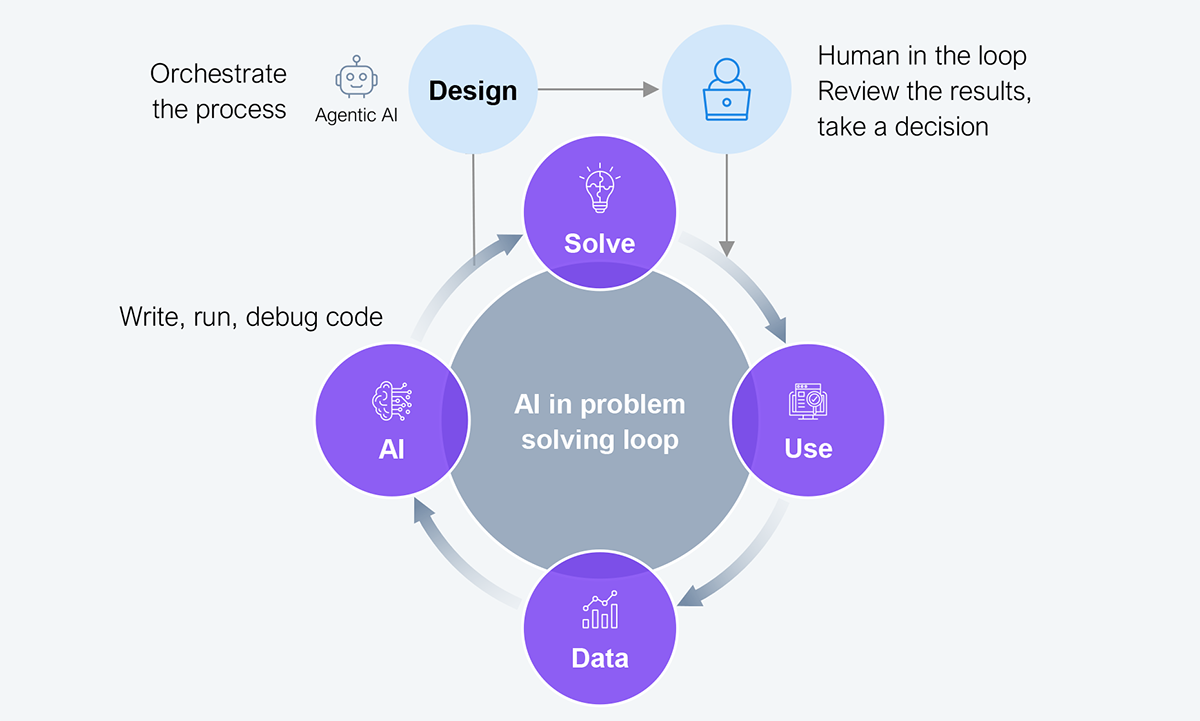
Source: MathWorks, HFS Research, 2026
MATLAB demonstrated two broad use cases where AI adoption is accelerating: component design and problem solving. While the principles of engineering design remain unchanged, the integration of GenAI and agentic AI has transformed practices around it. Large language models (LLMs) are used to create new designs and content, with a human in the loop to evaluate and make decisions. General Motors has applied that approach, showing how AI crunched their cycle time for new product development. Work that required multiple teams and several months to turn design sketches into high‑quality 3D animation now takes less than a day by a single designer.
However, engineering needs more than just faster creation. Design must be safe and certifiable across complex and multi-domain systems that interact with the physical world. When an LLM is used, the engineer loses direct touch with the code that is generated but still owns the consequences of every line of code, making verification and validation much more critical before any code is used. Before the burst of LLMs, every bug was human-written. Humans can’t just wish away accountability today by using AI for code generation.
Savyasachi Srinivas, VP, Engineering at Collins Aerospace explained why it’s not about the AI tools used but about integrating the entire engineering value chain. Digital engineering at scale matters today because of the growing complexity of products and the compressed time-to-market. It also addresses the need for traceability across a product’s lifecycle, with real-time decision making and cross-domain integration. AI acts as a force multiplier, transforming enterprise systems from a system of records into a system of intelligence and action.
Kaushik Raghunath, VP, Engineering R&D at Mercedes-Benz Research and Development, noted that the easy wins are tasks that are repetitive and voluminous. The reason for not being able to realize real value at scale from AI is because they have been optimizing parts or pockets of work instead of optimizing it in its entirety. By optimizing specific areas of work, we are only shifting the bottleneck. Not everyone in the organization is skilled at prompt engineering, even if they are good at coding.
Krishnakumar Badrinath, Executive Director and Chief Engineer at Boeing, discussed how AI is applied to enhance product features and improve productivity through code and report generation. He suggested that the safest first step for deploying agentic workflows is a less complex use case such as document generation, where work is voluminous and laborious.
Integrating agentic AI into engineering processes will not only ensure your new products reach the market quicker, but are also profitable, creative, compliant, and reliable.
Register now for immediate access of HFS' research, data and forward looking trends.
Get StartedIf you don't have an account, Register here |
With the exception of our Horizons reports, most of our research is available for free on our website. Sign up for a free account and start realizing the power of insights now.
Our premium subscription gives enterprise clients access to our complete library of proprietary research, direct access to our industry analysts, and other benefits.
Contact us at [email protected] for more information on premium access.