Many CIOs running agentic AI initiatives on Salesforce are unable to scale them beyond initial proofs of concept (POCs) to enterprise-wide systems. The problem is not platform capability, but the missing accountability layer that sees through these initiatives beyond initial deployments.
Salesforce is addressing this challenge by productizing forward-deployed engineering (FDE) the way it once packaged software into SaaS. Paired with a full overhaul of its consulting partner program, this makes Salesforce the first enterprise SaaS vendor to institutionalize FDE as a “with partner” capability and align partner incentives accordingly. CIOs get access to the Services-as-Software™ ecosystem, where GSIs are accountable for closing the scaling gaps that Agentforce alone did not.
But this model only works if enterprises move away from the old ways of working. Capturing the upside requires a contract and operating model reset that puts partners on the hook for business value.
Nearly 75% of enterprises building with agentic AI are stuck in the first two stages of maturity, and just 7% have enterprise-grade deployment tied to KPIs. Agents built on top of Agentforce don’t scale because many service partners lack the product engineering rigor and a systems thinking approach to institutionalize the governance and orchestration needed to make that happen (see Exhibit 1).
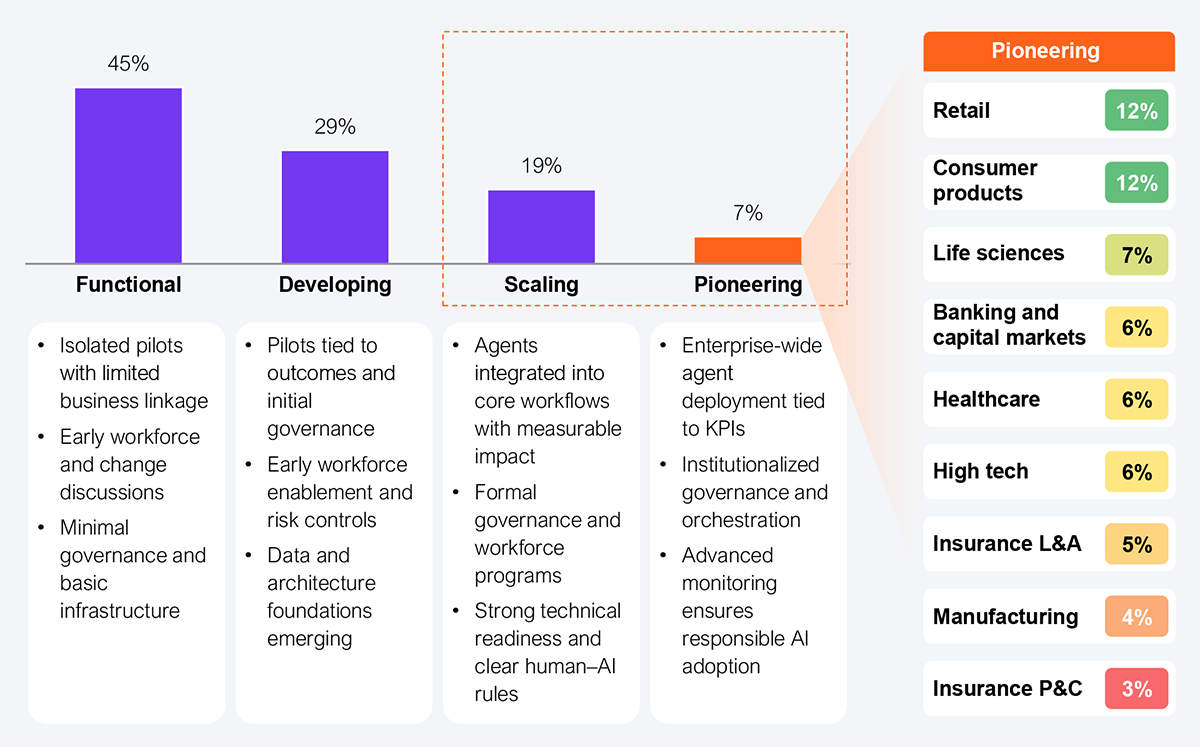
Sample: 545 major enterprise decision makers
Source: HFS Research, 2026
For CIOs scaling agentic AI across a Salesforce environment, the limiting factor isn’t budget or intent. It’s the gap between deployment and adoption as well as who owns that gap. Traditional global system integrator (GSI) engagements are handed off at go-live; the FDE model doesn’t. It structures your partner relationship around an embedded team that ensures end-to-end accountability, shifting the dynamic from project delivery to continuous capability building.
A significant benefit is access. FDE partners carry a direct line to Salesforce product teams. This means that when your agents hit a platform ceiling, that limitation is routed back to the roadmap for the next upgrade cycle rather than being stalled in a support queue. For CIOs evaluating where GSIs still earn their seat alongside an FDE partner, the answer is governance, change management, and enterprise integration complexity. But on the AI adoption curve itself, the FDE structure is designed to compress the timeline from deployment to measurable business value in a way that traditional delivery models structurally cannot.
However, the model only delivers if your operating model and contracts move with it. CIOs must adopt these five imperatives to move from “developing” to “scaling”:
Partner network designations are gates, not capabilities. The partners that Salesforce selected at the FDE network launch have the credentials, but the designation tells you nothing about whether a firm has the operating model to sustain FDE delivery across the full lifecycle of your engagement. Five diligence criteria separate partners that can deliver value from those that just showcase designation:
Salesforce is the first SaaS incumbent to institutionalize FDE through partners, but it will not be the last. For CIOs, it is less about making “single partner” decisions and more about whether their organization can operate under outcome-linked contracts, embedded FDE pods, and post-launch governance. Those running FDE engagements through traditional statements of work (SOWs) and operating models will end up paying a premium, showing that the old playbook still doesn’t work, and will face the same reset again.
Register now for immediate access of HFS' research, data and forward looking trends.
Get StartedIf you don't have an account, Register here |
With the exception of our Horizons reports, most of our research is available for free on our website. Sign up for a free account and start realizing the power of insights now.
Our premium subscription gives enterprise clients access to our complete library of proprietary research, direct access to our industry analysts, and other benefits.
Contact us at [email protected] for more information on premium access.