This HFS Point of View is for CFOs, CIOs, and enterprise transformation leaders rethinking how they buy, price, and scale agentic AI as it moves from cost cutting to outcome-based value.
The conversation dominating the world of AI-driven enterprise transformations is how to move away from this monolithic obsession with cost toward the dream of outcome-driven partnerships, where investments are driven by real business value and not simply removing more headcount. Forget “mess for less” and start thinking “a lot less mess for a lot more value.”
The cold, hard reality is that every AI transformation story starts the same way. A CFO demands ROI justification. A CIO frames the business case around headcount reduction and process automation. A project team builds a proof-of-concept to demonstrate the productivity math. For a while, that method works. More than half (54%) of AI use cases at the proof-of-concept (POC) or pilot stages are still rooted in productivity and cost, according to HFS Research data covering 979 GenAI and agentic AI use cases collected over the last 12 months.
When those POCs move into production and are tested under real enterprise conditions, a remarkable transformation occurs. Enterprises that survive the pilot phase and commit to scaling AI in production find that 81% of their outcomes are operating in the top three tiers of value creation: performance, personalization, and prediction. The cost-and-scale imperative that justified the investment gives way to something far more powerful: an intent-driven, outcome-first mindset that opens up entirely new business possibilities.
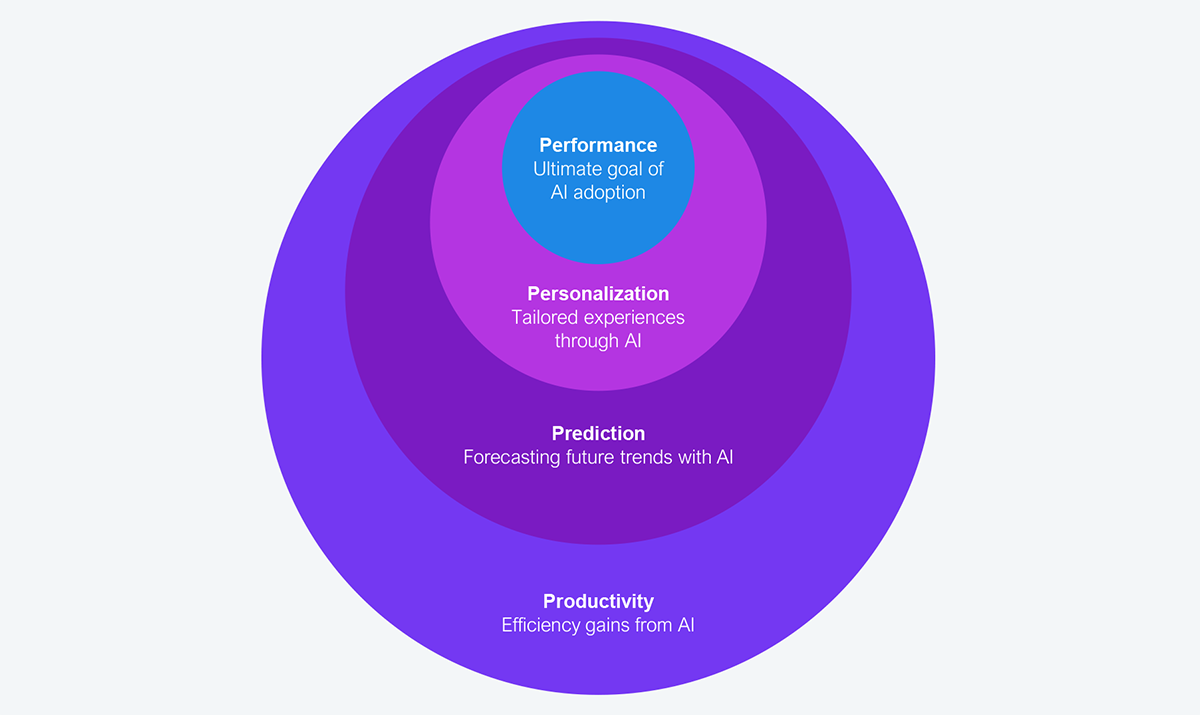
This shift is the story the 4Ps of agentic AI tell, and every enterprise leader needs to understand how the 4Ps impact how they buy, price, deploy, and think about intelligence at scale.
The agentic 4Ps are not aspirational categories. They are empirical outcomes observed across hundreds of live enterprise AI deployments. Here is what each one means:
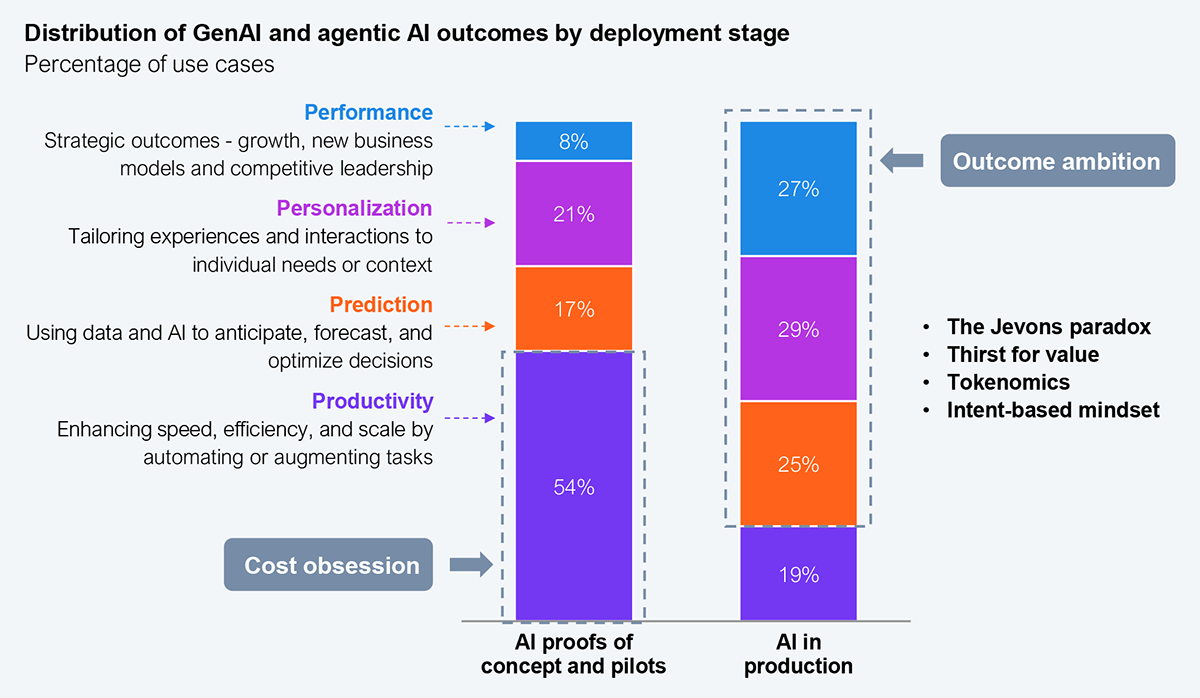
Sample: 979 GenAI and Agentic AI use cases collected by HFS over the last 12 months
Source: HFS Research, 2026
William Stanley Jevons observed in 1865 that improvements in the efficiency of coal use did not reduce coal consumption; it dramatically increased it. The paradox is counterintuitive but empirically consistent. When a resource becomes cheaper and more efficient to use, demand for it grows faster than the efficiency gains reduce it.
When AI can execute multi-step workflows autonomously and orchestrate processes across systems without human intervention, and when the cost of deploying intelligence drops toward near-zero marginal cost, the rational enterprise response is not to use less intelligence, but to apply intelligence to every decision, customer interaction, process, and growth opportunity that was previously uneconomical to address.
The CFO who authorized the initial AI investment to cut 30%–40% of operational costs may find that the same infrastructure, deployed with an outcome mindset, is now powering a new revenue line, a real-time personalization engine, and a predictive risk model that prevents losses that were previously invisible. The intelligence does not shrink to meet a cost target; it expands to fill the opportunity space.
This dynamic explains why the shift from productivity, which drops from 54% in POC to 19% in production while performance, personalization, and prediction increase, is not just a maturing of deployment. This shift is the Jevons paradox at work. Enterprises that scale agentic AI discover that the appetite for intelligence grows faster than the cost of delivering it. The constraint was the cost of deploying it at scale, not the technology. Remove that constraint, and the use cases multiply.
The Jevons paradox explains the consumption dynamic, but a parallel organizational psychology, equally important and less discussed, is at work. Once enterprises taste genuine AI-driven outcomes, their appetite for more does not plateau, but accelerates.
Call it the thirst for value. The thirst begins in the moment a leadership team stops asking “Did we get the ROI we promised the board?” and starts asking “What else can we do with this?” It is the behavioral shift that separates enterprises that treat AI as a cost project from those that treat it as a growth platform.
Source: HFS Research, 2026
The pattern is consistent across HFS Research’s production-stage cohort. Enterprises that achieve a meaningful outcome in one domain, a measurable reduction in customer churn, a demonstrable improvement in forecast accuracy, and a new revenue stream enabled by AI-driven personalization do not pull back and declare victory. They redeploy, expand, and push the boundary of what they were willing to attempt before because the evidence of what is possible has changed their sense of what is permissible.
This progression is fundamentally different from the organizational dynamic that governs cost-reduction programs. Cost programs have a finish line. You hit the target, close the project, and move on. Value creation programs do not have a finish line, because the definition of what counts as value keeps expanding as capability matures. The thirst for value is what drives enterprises up the 4Ps stack, from productivity through prediction and personalization toward performance, not as a planned roadmap but as an emergent consequence of what they discover along the way.
The leadership implication is significant. Organizations that design their AI programs around a fixed cost target will hit it and stop. Organizations that design around an open-ended value ambition will keep going. Once activated, the thirst for value is a strategic asset.
Traditional software and services pricing was built on headcount logic. You paid per user, FTE, license, or seat. The implicit assumption was that value scaled with the number of humans doing the work. AI shatters that assumption entirely.
When an agentic system can execute thousands of tasks simultaneously, the concept of a seat becomes meaningless. You are not replacing a person; you are replacing a workflow, and workflows do not have seats.
“Tokenomics” is the pricing architecture that reflects this reality. In the context of enterprise AI services, tokenomics means pricing consumption based on the units of AI activity: tokens processed, decisions made, tasks executed, or outputs generated. Instead of paying a fixed monthly cost per user, an enterprise pays for the intelligence it consumes, much like paying for compute or electricity.
The unit economics are transparent, usage-based, and directly tied to activity volume rather than headcount. Tokenomics is still a consumption model; however, it creates the perfect bridge to ambitious outcome-based commercial models, where pricing is tied directly to the business results AI generates.
Here is what that looks like in practice across the Services-as-Software™ landscape:
These models are not hypothetical. They are beginning to appear in enterprise contracts today, and they will become the standard commercial architecture of Services-as-Software as the market matures. The era of buying services and software by the seat is ending. The era of buying outcomes by the result has begun.
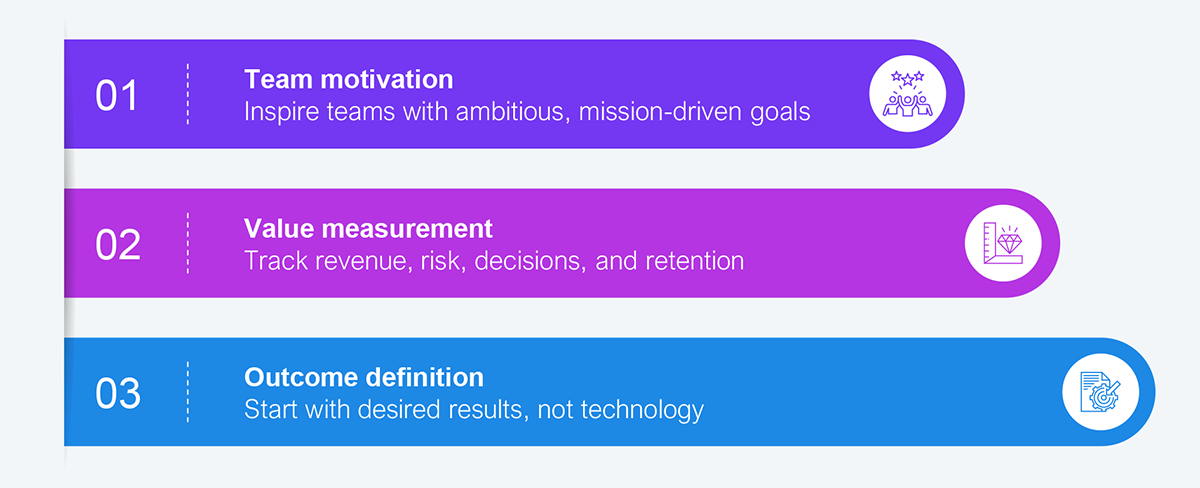
The shift from cost-based to outcome-based AI is primarily a leadership journey, not a technology journey.
Leaders who are wired for operational efficiency ask, “How do I do the same thing cheaper and faster?” Leaders who operate from an intent-driven mindset ask, “What becomes possible that was impossible before, and what new value can I create if I remove the constraints of cost and scale?”
These are fundamentally different questions. The first question keeps you inside the existing business model. The second question opens the door to entirely new ones.
Consider what happens when a retail enterprise stops asking, “How do I reduce contact center headcount?” and starts asking, “What if every customer interaction was personalized in real time to their context, history, and emotional state?” The first question leads to automation. The second leads to a competitive differentiator. The technology is the same, but the leadership mindset determines which outcome you pursue.
Source: HFS Research, 2026
The data supports this distinction. The enterprises in HFS Research’s production cohort that have reached the Performance tier of the 4Ps are not the ones that had the biggest AI budgets. They are the ones with leaders who asked harder questions earlier.
The pattern is consistent across industries. Here are the archetypes that characterize the move from cost-based to outcome-based AI deployment:
The move from GenAI pilots to agentic value at scale requires a specific technology and methodology stack. It is not enough to deploy a large language model and call it AI transformation.
Agentic orchestration layers are the backbone of the shift. These are systems capable of decomposing complex, multi-step tasks into executable subtasks, assigning them to the right AI agents or human workers, monitoring execution, and escalating exceptions. Without orchestration, AI remains a point solution. With it, AI becomes a process engine.
Retrieval-augmented generation (RAG) and enterprise knowledge graphs ensure that AI systems operate on accurate, current enterprise data rather than hallucinating from training data alone. Outcome-based models require accuracy. Accuracy requires grounding AI in verified enterprise context.
Workflow automation platforms (including robotic process automation, integration layers, and API meshes) connect agentic AI to the systems of record where enterprise processes actually live. Intelligence without execution capability is just analysis. The combination of agentic reasoning and workflow execution is what makes outcome delivery possible.
Human-in-the-loop governance frameworks define when AI acts autonomously and when it defers to human judgment. Clarifying roles and responsibilities is more than a safety mechanism; it is a commercial and operational design principle. Outcome-based contracts require clear accountability, and that accountability requires a governance model that specifies the boundaries of autonomous action.
Intent-based interfaces are the emerging front end of agentic systems. Rather than configuring workflows through process diagrams or code, business users express outcomes in natural language. “Reduce days sales outstanding by 20% this quarter.” “Identify the top 500 accounts most likely to churn in the next 90 days and initiate retention workflows.” The system interprets the intent and orchestrates the execution, closing the loop between leadership mindset and operational reality.
Measurement and attribution infrastructure underpins outcome-based commercial models. You cannot price on business results if you cannot attribute those results to specific AI actions. Investment in AI observability, causal attribution, and outcome tracking is a prerequisite for the commercial models that will define the next generation of enterprise AI contracts.
The 4Ps framework is not a static snapshot. It is a direction of travel, and the direction is clear. More enterprises will make the leap from cost-and-scale to outcomes, and those that do it faster will compound the advantage.
Services-as-Software will evolve along three dimensions in the near term:
The enterprises that will lead this transition are not waiting for the technology to mature. They are asking harder questions today: What outcomes do we actually want? What would we attempt if cost and scale were no longer constraints? How do we rewire our commercial models to reward the value we create rather than the activity we generate?
Those questions are the starting point for an intent-driven AI strategy. The data from 979 real-world use cases shows that the enterprises asking them are already moving up the 4Ps stack, from productivity to performance, from cost to outcomes, from pilot purgatory to production impact.
The only question is whether your organization is positioned to grow with it or get left managing a cost reduction that will soon be table stakes.
Register now for immediate access of HFS' research, data and forward looking trends.
Get StartedIf you don't have an account, Register here |
With the exception of our Horizons reports, most of our research is available for free on our website. Sign up for a free account and start realizing the power of insights now.
Our premium subscription gives enterprise clients access to our complete library of proprietary research, direct access to our industry analysts, and other benefits.
Contact us at [email protected] for more information on premium access.