This HFS Point of View is for CIOs, CFOs, and GCC leaders redesigning operating models and FTE economics to turn AI ambition into measurable productivity and innovation.
Enterprise CIOs and CFOs have given global capability centers (GCCs) a more ambitious mandate: deliver higher productivity, increase efficiency, and accelerate AI innovation. However, many GCCs still lack the authority, data access, and sponsorship to turn these ambitions into actual outcomes. GCCs are strategically positioned as a transformation engine, but often serve as an execution arm in day-to-day operations.
Closing this gap requires boards to give GCC leaders decision-making authority, change the operating model, create innovative partnerships, and adopt new approaches to drive AI initiatives. Without these structural changes, GCCs will remain operating centers rather than evolve into innovation hubs capable of delivering enterprise-wide impact.
According to HFS Pulse data, 55% of GCC leaders described their centers as strategic hubs for AI-led innovation, and about 49% are expecting to accelerate operational efficiency through AI and automation (see Exhibit 1). These findings indicate that conversations between GCCs and their partners are now moving beyond cost, productivity, and talent to AI-led innovation.
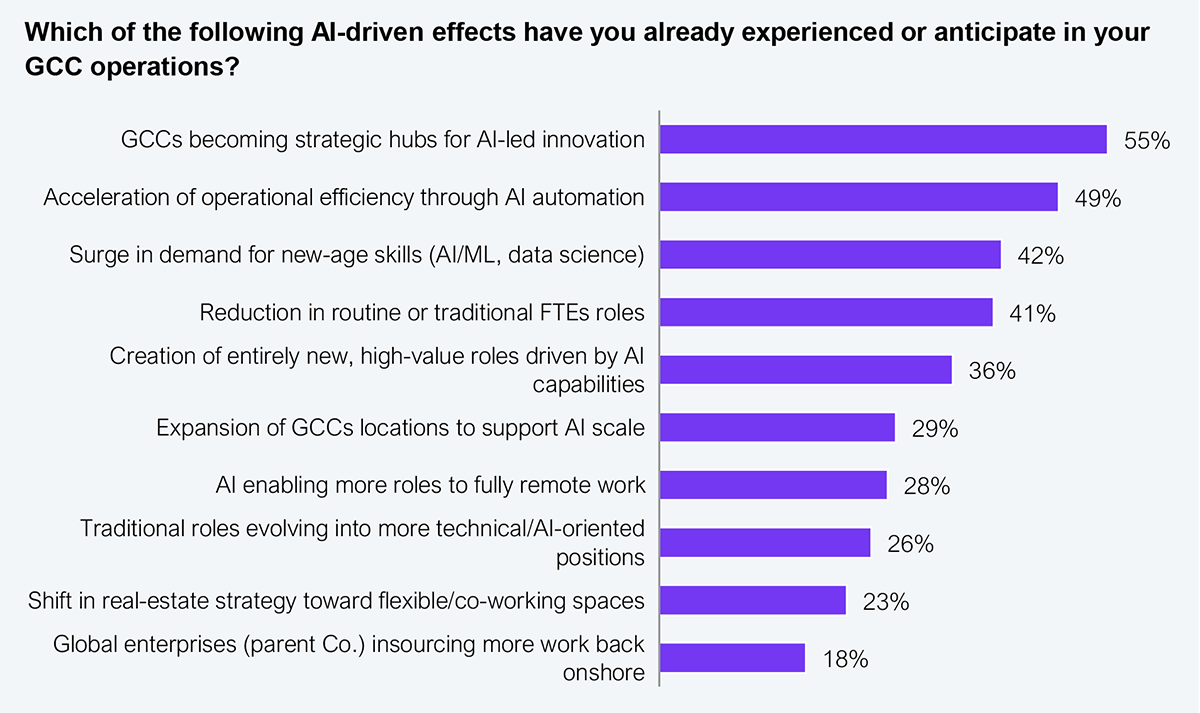
Sample: 204 major enterprise decision makers; total does not add to 100% due to multiple selection options
Source: HFS Research GCC Pulse, 2025
However, the situation on the ground is different. AI productivity remains limited due to enterprise-level challenges and ineffective partnerships. Our Global Capability Centers (GCC) Services, 2026 report found that while more than 70% of GCC leaders achieved measurable outcomes on cost, quality, reliability, and access to niche talent through partnerships, only 32% achieved AI-driven productivity and just 16% saw innovation yields (see Exhibit 2). Realizing true value requires CIOs and CFOs to unify data across the enterprise and share the AI-led innovation agenda with headquarters, partners, and GCCs.
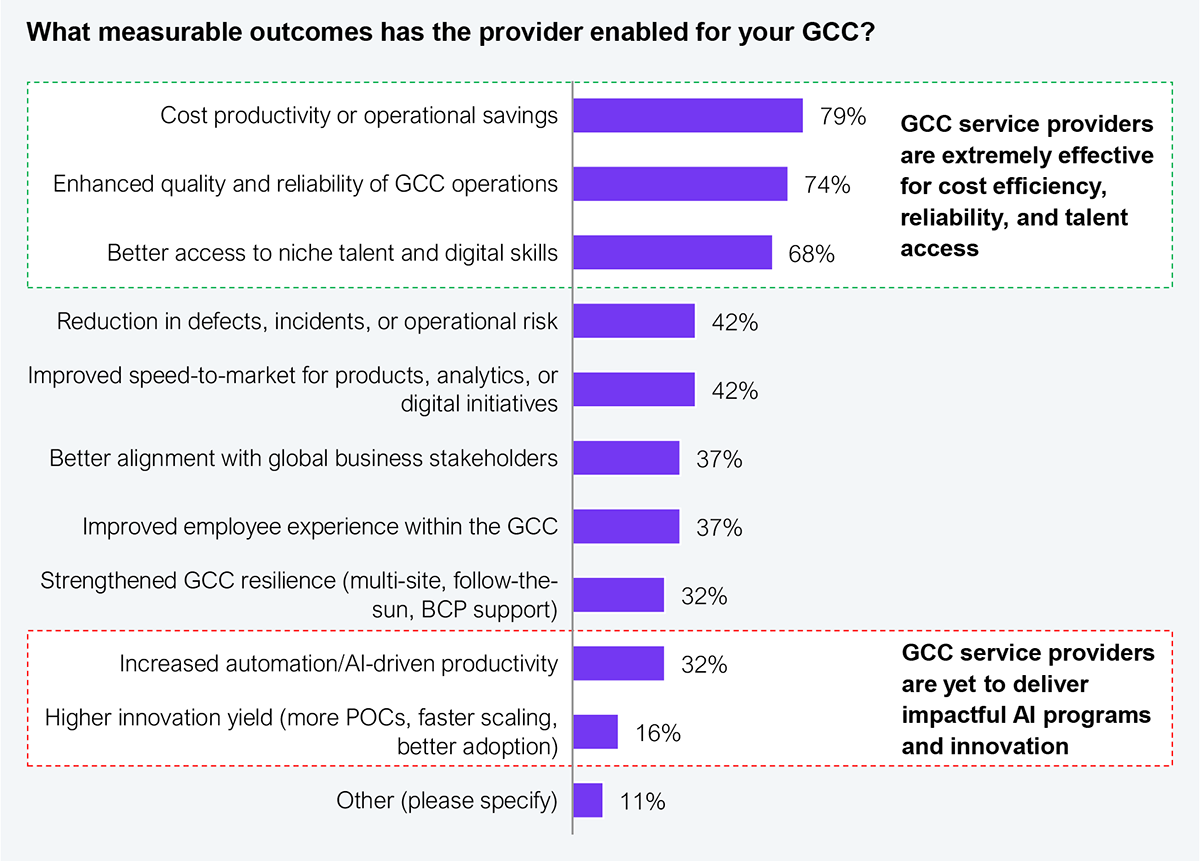
Sample: 19 enterprise GCC leaders participated in the survey and interviews
Source: HFS Research, April 2026
Most GCCs operate under an economic model based on capacity. Headcount is the unit of value. Utilization is the proxy for performance. Billing, budgets, planning, leadership KPIs, and headquarters chargebacks all rest on the same FTE foundation. That model worked when the GCC’s job was predictable, repeatable execution at lower cost. It now punishes AI productivity.
The moment an AI agent or copilot removes the need for a junior engineer, the GCC’s scorecard goes the wrong way. Utilization dips, chargebacks shrink, and headcount growth stalls. The cost-per-FTE metric that headquarters use to justify the GCC costs starts looking worse. The model rewards keeping people busy rather than eliminating work. Procurement reinforces it from the headquarters side, benchmarking the GCC on rate cards and the pyramid mix rather than on cycle-time reductions or decisions automated. Until GCCs rewire their economics around throughput and business outcomes, AI productivity has nowhere to land.
Some enterprises are breaking this pattern by enabling AI alignment across headquarters, GCCs, and partners. The proliferation of new GCCs being set up in India, in partnership with providers, is driving AI-led productivity with new economics and innovative approaches. For example, a global logistics provider rewired its economics around AI productivity rather than capacity growth, aligning the entire ecosystem to a single end-to-end value stream, i.e., ship to collect, with shared accountability for outcomes, not just inputs.
The current operating model is unsustainable. GCCs can no longer be viewed as delivery centers if they’re expected to deliver greater productivity and innovation. Realizing true value requires CIOs and CFOs to make clear decisions on GCC authority, redesign the operating model, sponsor AI innovation, and work alongside ecosystem partners with outcome-based expectations. Here are some approaches to enable this:
To transform your GCC from a cost-savings center into an AI-driven innovation hub, adopt capacity-utilization economics to drive AI productivity, make structural changes to the operating model, and, more importantly, shift the leadership’s mindset.
Register now for immediate access of HFS' research, data and forward looking trends.
Get StartedIf you don't have an account, Register here |
With the exception of our Horizons reports, most of our research is available for free on our website. Sign up for a free account and start realizing the power of insights now.
Our premium subscription gives enterprise clients access to our complete library of proprietary research, direct access to our industry analysts, and other benefits.
Contact us at [email protected] for more information on premium access.